In June 2025, a Chinese research team published results from an experiment designed to simulate a whale fall in the South China Sea. The team, led by Han Tian of Sun Yat-sen University and the Southern Marine Science and Engineering Guangdong Laboratory, lowered a cow carcass to a depth of 1,629 meters on the continental slope near Hainan Island. Their goal was to observe the stages of decomposition that normally follow when a large marine animal sinks to the ocean floor.
Whale falls were first documented by accident in 1987, when oceanographer Craig Smith’s graduate students found a gray whale skeleton at 1,200 meters off the coast of California. Since then, researchers have located only about two dozen natural whale falls. Because the events are rare and unpredictable, some teams have begun placing carcasses deliberately. The Monterey Bay Aquarium Research Institute has sunk five whale carcasses over the past 15 years. A cow carcass offers a cheaper and more accessible substitute for teams that cannot obtain a whale.
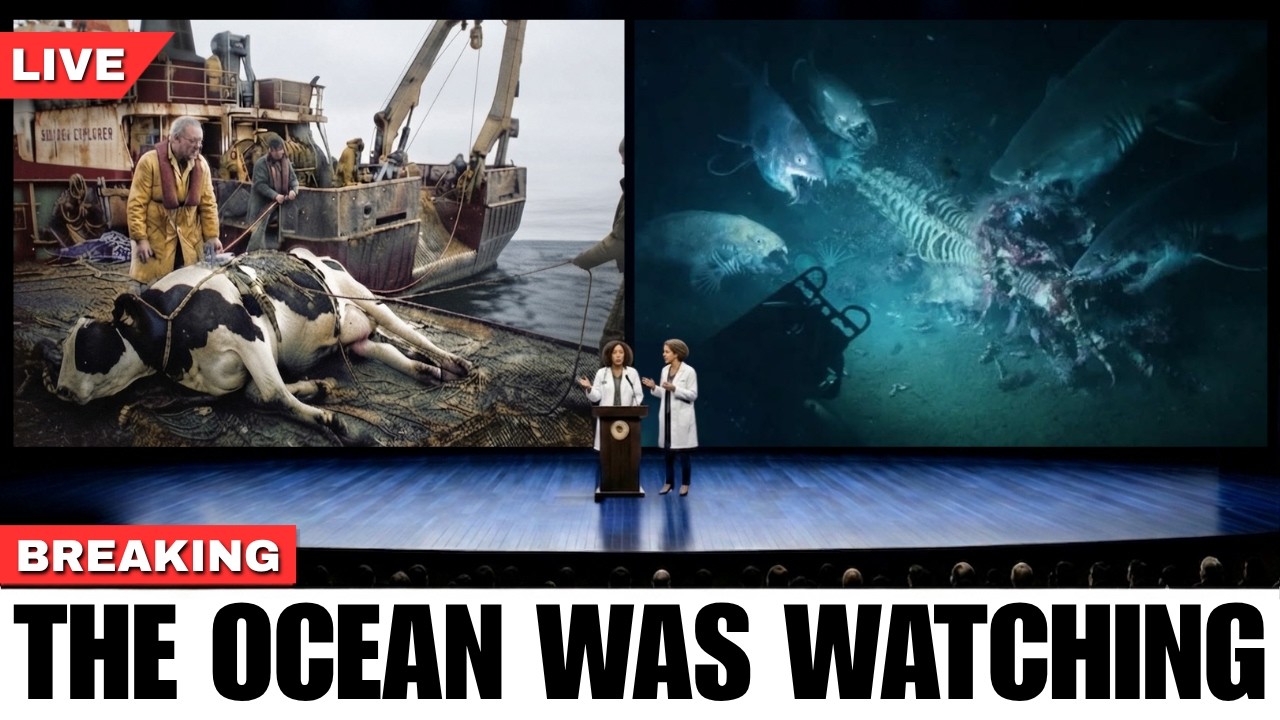
On a natural whale fall, scientists have documented three stages of decomposition. First, mobile scavengers such as sleeper sharks, hagfish, and rattail fish consume the soft tissue. This stage can remove 40 to 60 kilograms of tissue per day, reducing a five-ton carcass to bone in roughly four months. Next, enrichment opportunists including worms, snails, and crabs feed on the remaining organic material in the sediment and bone. This stage can last up to two years. Finally, the sulfophilic stage begins when hydrogen sulfide released from the bones fuels chemosynthetic bacteria. These bacterial mats and the specialized animals that feed on them can persist for decades. One notable species in this final stage is the Osedax worm, which has no mouth or digestive system and absorbs nutrients through root-like structures that grow into the bone.
The Chinese team expected a similar sequence when they deployed their cow carcass. Instead, the footage captured eight Pacific sleeper sharks approaching the site. This was the first confirmed sighting of that species in the South China Sea. Pacific sleeper sharks are typically found in colder northern waters across the North Pacific. They are slow-moving, deep-dwelling predators, and their presence in this region was unexpected.
The footage also showed behavior not previously documented in the species. The sharks approached the carcass one at a time rather than feeding simultaneously, with some individuals yielding to others. Han Tian described this as an apparent queuing pattern, suggesting that feeding priority is determined by each shark’s competitive intensity. The orderly turn-taking among animals usually regarded as solitary was an unexpected finding.
The study did not achieve its original objective. The sharks consumed the carcass too quickly for researchers to observe the slower stages of decomposition they had planned to study. The team noted, however, that the experiment still produced a valuable result: a previously unrecorded observation of Pacific sleeper shark behavior in a new region.
The researchers also raised the possibility that climate change contributed to the sharks’ presence in the South China Sea. Warmer ocean temperatures can push cold-water species toward deeper water or new latitudes in search of suitable conditions. The finding may be an early indicator of broader changes in deep-water ecosystems, which are rarely monitored directly.
A separate study off the coast of British Columbia points to similar concerns. A ten-year project led by Fabio De Leo of Ocean Networks Canada and Craig Smith placed humpback whale bones on the seafloor and monitored them with underwater cameras connected to a permanent observatory. Over the full decade, the cameras never recorded Osedax colonization. A wood-boring bivalve called Xylophaga also colonized samples more slowly than expected. Smith connected both observations to the expansion of low-oxygen zones driven by ocean warming. He warned that the loss of whale fall and wood fall habitats could eventually disrupt the ability of Osedax populations to spread and interbreed across large distances.
The two studies, taken together, suggest that deep-sea ecosystems built around whale falls may be sensitive to gradual shifts in water temperature and oxygen levels. These systems have been documented in the fossil record for tens of millions of years, and they have rarely been observed in detail until recently. What the recent research shows is not a dramatic event but a quieter one: species appearing where they were not previously recorded, and other species failing to appear where they normally would. Both observations may reflect the same underlying changes in ocean conditions, even if the effects are only beginning to be measured.