Asian carp, a fast-growing invasive species in lakes and rivers across the Mississippi River basin, became a major problem in the Midwest. For 40 years, nothing in the Illinois River could eliminate them. Not electricity, not toxins, not one and a half billion dollars in concrete construction. They grow and spread quickly because they lay thousands of eggs at a time, several times a year. Then their numbers began to decline on their own, and no one could figure out why.
The first real evidence appeared in a tank at the University of Illinois, where small silver carp taken from the upper river simply stopped moving. Nothing had been added to that tank. Nothing had attacked them. Whatever stopped those fish was already in that water, and it had been working in the river all along.

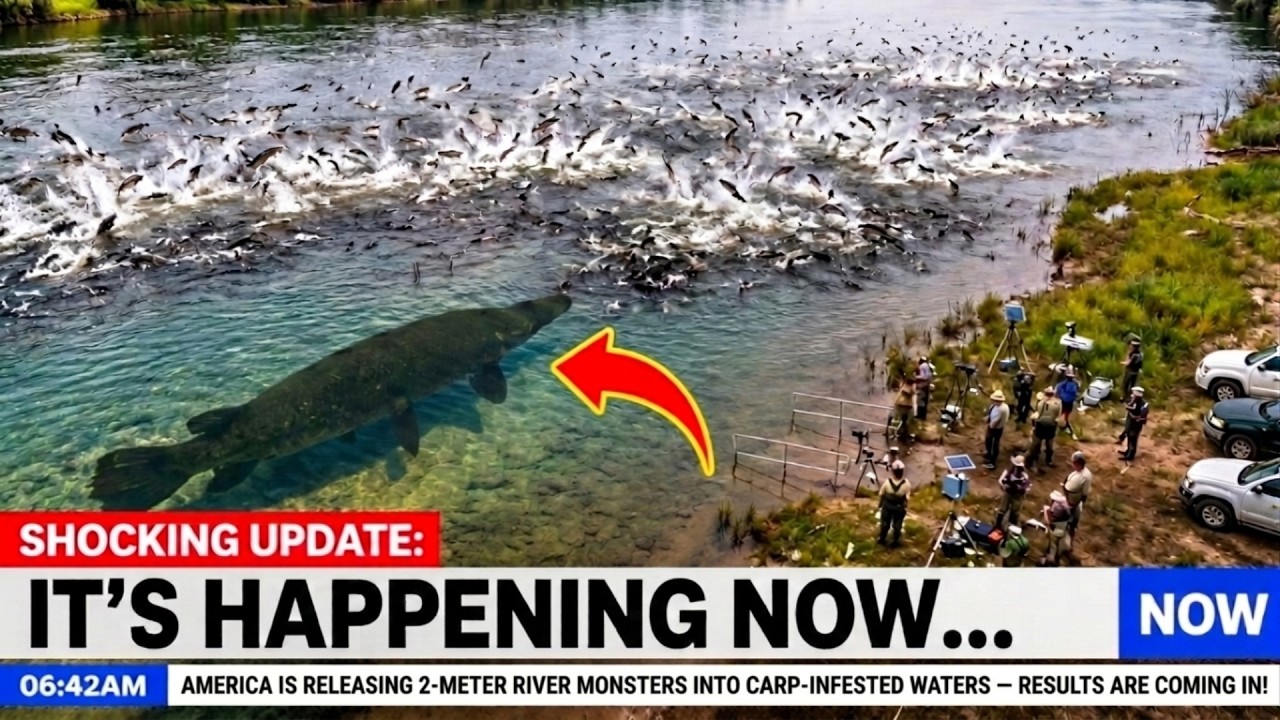
The jumping river. You are going 30 miles an hour on the Illinois River when a ten-pound fish comes straight out of the water and hits your chest. Then another, then dozens of fish launching around the boat like cannonballs. Each one is the size of a bowling ball, and none of them intends to stop. This is what silver carp do when a motor passes over them. The sound reaches them, and they shoot upward. For more than 40 years, these fish dominated the Illinois River.
In some stretches, they were estimated to represent about 70 percent of all living things in the water by weight. Lift a net, you find carp. Lift another net, you find carp. So the government responded with everything it had. It ran electricity through a canal to force them back. It poured a fish-killing chemical into six miles of the Chicago Sanitary and Ship Canal, thousands of gallons, and called it another front in the war to keep these voracious fish away from Lake Michigan. None of that broke the carp.
Then numbers near Starved Rock began to drop. It was not a collapse, but a slow decline season after season in a waterway where these fish had never lost ground to anything before. No one ordered it. No one planned it. The most expensive battle against invasive species in the country was still theoretically being lost. But the enemy had quietly begun to shrink on its own.
Everyone assumed they already knew the reason. There was a monster back in that river. Eight feet long, armored, older than anything else swimming in North America, and it had just been released into the very waters the carp had taken over. The story wrote itself. But it was also wrong. And the people who knew it was wrong could not get anyone to listen.
To understand why the carp are losing ground now, you have to understand why nothing could stop them before. In the early 1970s, fish farmers in the American South had a tedious problem. Their ponds were constantly clogging with algae. Instead of pouring chemicals every season, they brought in fish from China that ate algae and plankton all day. Drop a few into the pond and the water cleans itself. No chemicals. No maintenance. It worked exactly as advertised until the water rose.
Floods tore through the region’s pond barriers. The carp went wherever the water went. Researchers could never pin the escape to a single event. But the result is undisputed. The fish reached tributaries. The tributaries fed the Mississippi basin. And the Mississippi basin is the largest connected river system in North America. From there, they moved into the Illinois River and began swimming north. Within about a decade, a fish imported to clean farm ponds had spread across the heart of the continent. No one chased it. No one had to. It simply followed the water into a system running from Louisiana to the edge of Chicago.
But getting out was the easy part. What this fish did once it arrived is the reason a river could be 70 percent carp and still look completely normal from a boat. A single female silver carp can release hundreds of thousands of eggs in one spawning season. Under the right conditions, one fish exceeds a million. She does not do it alone. Every adult female in that river empties her eggs into the same water at the same time. Every spring, the Illinois River turns into a production line running at full capacity.
Breeding is not even the most dangerous part. The most dangerous part is the mouth. Silver carp swim with their mouths open, filtering plankton directly from the water column. Things too small to see. That seems harmless until you remember what plankton is. It is the first meal for nearly every native fish in that river. And for many of them, it stays on the menu for life. The carp does not hunt anything. It does not attack anything. It gets to the table first, eats faster, and eats more. Watch what that does.
Gizzard shad numbers fell. Bigmouth buffalo declined sharply behind them. Bass and catfish lost the food they depended on. Nothing was bitten. Nothing was chased. The food simply stopped existing. And every fish above them in the food chain became smaller, fewer, and hungrier. It is a bad decade for the Illinois River. It is a disaster for what lies upstream. Because this river does not end in Illinois. It ends at a door someone opened more than a century ago and never closed.
Chicago is where the continent leaks. More than a hundred years ago, engineers reversed the Chicago River and dug a canal that permanently connected the Mississippi basin to the Great Lakes. Two water systems that nature kept separate now share one passage, and that passage opens into Lake Michigan. Lake Michigan is the drinking water source for tens of millions of people. The fishery behind it is worth billions of dollars a year. If a reproducing population of carp establishes itself in that basin, there is no way to remove them.
So the money moved. In 2002, the Army Corps of Engineers installed an electric barrier in the canal about 37 miles from Lake Michigan. A current in the water meant to discourage fish from crossing. More arrays followed. Then came the Brandon Road project, bubble curtains, underwater sounds, and stacked electric fields in a narrow lock at a cost exceeding one and a half billion dollars. Billions were spent, and the carp kept breeding in numbers beyond what any fishing crew could catch. Then Starved Rock began to decline, and there was one question that mattered more than every budget line in this fight. What is killing them?
At the bottom of the Illinois River lives a fish most Americans do not know exists. The alligator gar. It reaches eight feet in length, can exceed 200 pounds, has a long flat snout, two rows of teeth, and a body covered in diamond-shaped scales so hard that an ordinary knife struggles to cut them. Its family line goes back more than a hundred million years, and its design has barely changed because it never had to. Then humans erased it from the northern end of its range. They called it a trash fish. They shot it because it looked like a monster. They built dams that cut it off from the shallow flooded flats where it spawns. Without those flats, it simply stops reproducing. By the mid-1990s, Illinois considered the alligator gar gone from the state.
Then the state began bringing it back. Around 2010, Illinois natural resource crews started carrying buckets of hatchery-raised juveniles onto boats and releasing them into the same river where their ancestors had been wiped out. These were the fisheries staff who had raised those fish from eggs in hatchery tanks. They knew exactly what they were releasing and why. The rest of the country did not. And within weeks, the country decided on their behalf. The largest predator in the river had just been dropped into waters occupied by the most destructive invader in the river. An ancient monster meets a modern invasion. It was too tempting to resist. It was also a calculation no one bothered to make.
The story spread nationally fast. Headlines, reports, politicians happy to stand beside a picture of an eight-foot fish. People want a magic solution for every invasive species, and here was one with teeth. The only people who did not believe it were the ones who put the gar in the water. Fisheries staff at Illinois DNR sat in agency rooms and conference sessions repeating the same three things over and over. The restoration program was never designed to deal with Asian carp. Its goal was to bring back a native species humans had driven from the state and give anglers a giant native fish to chase. And the gar would have little effect on the carp.
They said it in their reports. They said it to reporters. You can hear the exhaustion in how flatly they repeated it. Here is why they were so sure. In the early years, Illinois released about 6,000 alligator gar. Juvenile fish die at terrible rates in the wild, and only a fraction survive to become real predators. Now compare that to carp, which are not counted in individual fish but estimated in tons per mile of river. A handful of scattered gar across hundreds of miles of water is a bucket of water thrown at a burning building. But the numbers are not the fatal flaw. The mouth is.
An alligator gar can only open its jaws so far. It can catch juvenile carp while they are still small enough to swallow. After that, the carp outgrows the threat entirely. Adult silver carp reach more than a foot long, with a wide heavy body. It swims past a prehistoric predator without fear. So the apex predator the country was counting on could, at best, trim the numbers of juvenile fish for one season in a river where every female releases eggs in the hundreds of thousands. No one noticed because the boring answer never beats a good monster. That left the decline continuing, real and measured, with no explanation attached.
The first part of the real answer is a February morning, an hour before sunrise, on water cold enough to hurt. Commercial fishing crews are on the Illinois River because the state started paying them to be there. It is dark. The boat deck is slick. Gloves have been wet for an hour. Every piece of metal on the boat is cold enough to take skin off a bare hand. No one is pretending this is romantic work. Illinois provided the equipment, guaranteed the buyers, and put a bounty on top of the market price, estimated at a few cents a pound.
A few cents sounds like nothing. It is nothing until the net comes up. When a single haul brings thousands of pounds of fish over the bar, silver bodies packed so tightly the whole mass moves like one animal, a few cents a pound turns into a paycheck. Once real money is attached to every fish in the water, no one has to motivate anyone. The crews chase them on their own. They are not there for the ecosystem. They are there because the fish are worth something. And that turns out to be the strongest protective force anyone has in this conflict.
Add it together and you get one of the least publicized numbers in American conservation. Over about 15 years, removal crews pulled tens of millions of pounds of carp out of the Illinois River alone. Count every waterway in the state, and the total comes to about 80 million pounds. Eighty million pounds removed by hand, by boat, by net, by people who get up in the dark in February because the fish are worth a few cents each. No monsters, no machines, no press conferences.
But you do not pull that much weight out of a river just by casting nets and hoping. The crews had to learn how to move schools of fish that outnumbered them by orders of magnitude. The trick they ended up using did not come from America at all. China has managed these fish for centuries. While America fought them for four decades, scientists went and borrowed old knowledge and turned it into what is called the Modified Unified Method. Here is how it works.
Nets are set across the water to build a wall underwater. Then the crews make noise. Banging on vessels, pushing sound through the water column, pressure moving in one direction. The carp panic. Panicked carp move as one mass away from the noise, straight into the direction where the second net is already waiting. The crews gather them like cattle into a water pocket that shrinks until the fish are pressed against each other. Then the wall rises at once. Thousands of fish rush over the edge together, hit the surface, still leaping and fighting, and the crew works through the noise until there is no room left to put more. Individual coordinated operations have pulled hundreds of thousands of pounds of carp out of the water in a single haul.
But the cleverest tactic is not using nets at all. A crew catches a few live carp, attaches radio transmitters to them, and releases them. Carp are social fish. Under pressure, they seek their group. So the tagged fish swims straight back to the school, and the signal leads the crews to the river bend where the whole mass is gathered. Nets are set, and the school comes out. They are using carp to catch carp.
Removal operations are not distributed evenly across the state. The crew works at the leading edge, where the adult fish are farthest upstream, near Chicago. Remove the reproducing fish at the front, and you eliminate the next wave of eggs before they exist. Then Illinois tried something even stranger. It tried to get you to eat the problem.
Asian carp is genuinely good fish. White meat, mild flavor, low mercury, high protein. The problem is one word: carp. In this country, that word means a bottom-feeding, muddy-tasting, unwanted fish. No one orders it. And when no one orders it, no market forms. And when no market forms, there is no money to take fish out of the river. So in 2022, Illinois spent several hundred thousand dollars to solve one problem only: the name. It renamed the fish “copi,” short for copious, because there is so much of it that needs removing.
Chefs joined. Processors joined. Copi started appearing on menus and in grocery cases. The logic behind the marketing is simple and direct, and it works. Restaurants want copi. Distributors buy copi. Crews catch more carp because someone is paying for it. The state expected millions of pounds removed in the first year, and early numbers came in above projections. Every dish sold means a few more pounds of fish that will never reproduce. It is the strangest weapon in this entire fight, and it works because appetite expands in a way no agency budget can.
This is the first force: nets, bounties, transmitters, and a menu item. But fishing only explains part of the decline. Because there is a line in the upper Illinois River that carp will not cross, and no crew put it there. For more than a decade, scientists tracking carp movement kept hitting the same wall they could not see. Schools of fish kept creeping north, north, north, then stopped. About 50 miles from Lake Michigan, they did not advance further. The electric barrier, which sits closer to the lake, was not the reason. Neither were the nets. There was no visible obstacle in the water at all. The fish reached a certain line on the map and turned back year after year, as if something was repelling them.
So a research team from the University of Illinois went to that part of the river and filled containers with its water. Back in the lab, they placed juvenile silver carp in it under controlled conditions and watched. Nothing was added. No chemicals, no currents, no barriers, just river water brought in from the exact place where the fish stop. It did not take long. These are fish that jump six feet in the air at the sound of an outboard motor. In that water, they became sluggish. Their sustained activity dropped measurably in a tank containing nothing but river water and a fish that should have been lively. Same species, same age class, different water, different animal.
Think about what the researchers realized in that room. Every dollar in this fight was being spent on things you could point at with your hand. Electricity, concrete, sound, bubble curtains, nets. Meanwhile, the thing actually holding the line 50 miles away was in the water for free. And it had been doing it all along. It was not on any map. It was never in budget requests. There was no way to film it, no ribbon to cut in front of it, no agency that could claim credit for building it. The explanation is that the closer you get to Chicago, the worse the water quality gets. Generations of industrial and municipal discharge, low oxygen, elevated pollutants, and warm water. Any organism swimming through that stretch burns energy just to stay alive. Breathing costs more. Swimming further costs more than that. Spawning, the most taxing thing a fish does, costs more than all of it. For carp, pushing into that water is like climbing to high altitude. It can be survived, but it is not worth it. So the fish makes the simplest decision available and stops.
It is not only chemistry. Closer to the city, the banks turn more to vertical concrete. No shallows, no submerged vegetation. No place for eggs and larvae to live. Silver carp also need long continuous stretches of flowing water to keep their eggs suspended while they develop. Locks and dams break that corridor into short disconnected pieces. Eggs that sink die. So even carp that cross the poor water arrive somewhere they cannot successfully reproduce. Poor water, bare walls, a broken passage. Three things accumulated one after another, designed by no one. Meanwhile, the barrier at Brandon Road, which cost more than one and a half billion dollars, is still unfinished.
So how well does this accidental version work? There is a record, and it is narrower than anyone expects. During all the years of monitoring above the barrier, only a very small number of bighead or silver carp were ever found. Not schools, not spawning groups, just individual fish found one at a time, years apart. Each time, the response was the same. Crews flooded the area. They used nets. They sampled. They ran environmental DNA surveys across every connected water body they could reach. Each time, the result came back the same way. No stable populations. No reproduction. A single stray fish and nothing behind it. A handful of fish in more than a decade against a river carrying carp in tons per mile. The wall holds. It is just not the wall everyone budgeted for.
Which means what stands between Asian carp and the Great Lakes right now is a few cents a pound and the condition of Chicago’s water. Both could disappear faster than anyone wants to admit. It is a fragile peace. The harvest side depends entirely on money. Cut the funding and the whole thing stops within one season. Boats go do something else. Nets stay on the trailer. No one pulls 10 million pounds of anything out of a river out of civic pride. This is not hypothetical. Federal and state governments spent years arguing over cost shares for Brandon Road. Agreements were signed, contracts awarded, then funding slowed again. Sometimes even the funding that pays fishermen to remove carp stalled. And carp do not need a second invitation.
In the lower Illinois River, they still dominate completely. They have not disappeared from the system. They are only being scaled back. Every spring, females release the same huge quantities of eggs into the same water. The production line never stopped. Its output is only reduced by nets at one end and poor water at the other. Remove either pressure, and the population could rebound in one strong spawning year. This is why Brandon Road matters. Once completed, it becomes the only part that works without annual appropriations, without a market for fish tacos, without anyone having to remember to sign a check. While unfinished, it is just an expensive hole in the ground. Meanwhile, the thing actually doing the work depends on a line item in a budget and a pollution problem. Neither is guaranteed to survive the next round of arguments.
That leaves one last thing to address. The monster is still down there. And it is still on its way back. Illinois never stopped releasing alligator gar. Every year, more juveniles go into the water. That fish never saved the Illinois River from carp. It could not have. The people who raised it said so from the beginning in rooms that had already made up their minds. But it comes back anyway. Not in headlines. At the end of a fishing line on a quiet afternoon, when something huge pulls and the water opens, and an angler stares at an animal whose ancestors were erased from this map by humans. It is here because this is where it is supposed to be. And because someone standing over a hatchery tank decided that was reason enough. The country wanted that fish to be a weapon. It was only a fish coming home.
In the meantime, the carp still launch out of the surface every time a motor passes. Dozens of them flash in the light, then crash back down. But now, ahead of them, there are nets, bounties, menus, tagged fish leading crews to their schools, concrete banks, and polluted water. And perhaps somewhere in the future, a barrier costing more than one and a half billion dollars that no one can promise will be built. Tens of millions of people drink from the Great Lakes. What stands now between that water and these fish is a combination of human labor and pollution. That raises an uncomfortable question. If someone cleaned up the Illinois River, removed the waste, restored the natural banks, and made it healthy again as common sense would dictate, they would be stripping away the last shield. Cleaning the river might be the most dangerous thing anyone could do to it.