Dr. Sarah Mitchell had spent fifteen years cataloging forgotten histories, but nothing prepared her for the moment she held a faded 1907 photograph under the archive’s golden October light. The Thornton family posed proudly in front of their Nebraska farmhouse, but behind them, a scarecrow stood in the cornfield—and it had human eyes.
Sarah’s breath caught as she adjusted her magnifying glass. “That’s not possible,” she whispered, her hands trembling. The scarecrow’s gaze seemed to pierce through the decades, alert and aware, staring directly at the camera. She called her colleague, Dr. James Rodriguez, who confirmed her worst fear: the facial features were too defined, too human. “Those look like human eyes,” he said, “but that’s impossible.”
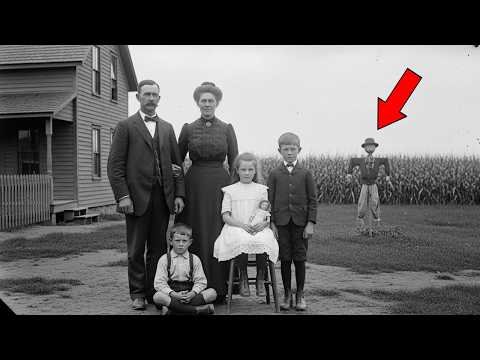
The photograph, donated from the estate of Eleanor Thornton—the last surviving family member—had been sitting in the archive for weeks, dismissed as routine. But now, Sarah noticed the scarecrow’s posture, too straight, too deliberate. Its clothes were real work clothes, not burlap and straw. And there was something else: a rope around the neck area, barely visible but unmistakable.
Sarah’s research led her to county records: a hired hand named Thomas Briggs had worked the Thornton farm in 1907. He disappeared that October, owed three months’ wages. The family claimed he left for California, but witness accounts didn’t match. A letter from Thomas to his sister, found in a wooden box passed down through generations, revealed his fear: “If you don’t hear from me by month’s end, something terrible has happened.”
With forensic anthropologist Dr. Patricia Yoshida, Sarah scanned the abandoned field. Ground-penetrating radar revealed a rectangular depression exactly where the scarecrow had stood—a grave. Soil analysis confirmed human bone fragments and fabric consistent with 1907 work clothing.
That evening, Sarah and James pieced together the timeline. Thomas demanded his wages on October 16th. The family photograph was taken October 18th—likely after he was already dead, his body dressed in his own work clothes and propped up as a scarecrow. “They killed him for asking for money they owed him,” Sarah said. The Thornton family sold the farm six months later and vanished to Oregon, never speaking to anyone in town again.
As Sarah stared at the photograph one last time, she saw it clearly now: the unnatural tilt of the head, the human proportions, the eyes that stared because they were the eyes of a dead man. “The scarecrow had eyes because it was Thomas,” she said softly. The family’s attempt to hide their crime in plain sight had inadvertently preserved the truth for over a century—waiting for someone to look closely enough.
The exhibit opening had drawn more attention than Sarah ever anticipated. Local newspapers ran the story, and a regional television crew filmed the ceremony from the back of the room. But it was the quiet moments afterward that stayed with her—Linda Walsh pressing her palm against the glass case that held Thomas’s letter, Martha Henderson telling her grandchildren about the prairie that remembers everything.
Two weeks later, a letter arrived at the Historical Society addressed to Sarah personally. The return address was a law firm in Portland, Oregon. She opened it at her desk, the afternoon light falling across the embossed letterhead, and read it twice before the words fully registered.
“We represent the surviving descendants of the Thornton family,” the letter began. “Our clients have recently become aware of the exhibit and the allegations contained therein.” Sarah’s stomach tightened. The letter went on to state that the family “strenuously disputed” the conclusions drawn about their ancestors and requested a meeting to discuss “the removal of defamatory materials.”
She called James immediately. He read the letter over her shoulder, his jaw tightening. “They want to bury him again,” he said flatly. “A hundred and seventeen years later, and they’re still trying to make him disappear.”
The meeting was set for a Thursday morning in the Historical Society’s conference room. Three people arrived: a lawyer named Gerald Hayes, and a brother and sister in their sixties—Charles and Diane Thornton, direct descendants of the family in the photograph. Charles was tall and silver-haired, carrying himself with the careful dignity of someone accustomed to being listened to. Diane was quieter, her eyes moving around the room as though cataloging everything.
Sarah had laid out the evidence on the long table: the photograph, the letter, the radar scans, the soil analysis. She had promised herself she would stay calm.
“We’re not here to defend murder,” Charles said before anyone had even sat down. “We’re here because we don’t believe our great-grandparents were capable of it.” He placed a leather-bound journal on the table. “This belonged to my great-grandmother. It’s been in our family for over a century. None of us had ever read it—it was considered private. But after we heard about your exhibit, my sister and I decided we needed to know.”
Diane spoke for the first time, her voice soft but steady. “There are entries about Thomas Briggs. And they don’t say what you think they say.”
Sarah exchanged a glance with James, who had slipped into the room and now stood against the wall, arms crossed. She reached for the journal, her fingers hesitant on the worn cover. “May I?”
Charles nodded. “Page forty-three. That’s where it starts.”
Sarah opened the journal carefully, the brittle pages crackling under her fingertips. The handwriting was elegant and cramped, the ink faded to a sepia brown. She found page forty-three and began to read aloud.
“October sixteenth. Thomas demanded his wages again today, and I fear my husband’s temper. I told Thomas to leave before something terrible happened. I gave him what money I had hidden away and begged him to go.” Sarah paused, her eyes scanning ahead. “She’s saying she tried to help him.”
Diane leaned forward. “Keep reading. The next entry is the one that matters.”
Sarah turned the page. The handwriting here was shakier, the strokes pressed hard into the paper.
“October nineteenth. My husband came in from the field at dusk, his hands shaking, his eyes wild. He said Thomas attacked him, that it was self-defense. I did not believe him, but what could I do? He made the older boy help him. They dressed the body and set it in the field until we could bury it after dark. I have not slept since. God forgive us all.”
Silence settled over the conference room. James shifted against the wall, his arms still crossed. “So she’s claiming she was a witness, not a participant.”
Charles shook his head slowly. “My great-grandmother was many things, Dr. Mitchell, but she was not a liar. If she wrote it, she believed it.” He tapped the journal. “There’s more. The last pages. She writes about leaving Nebraska, about the nightmares, about the hired man who visited her in dreams for the rest of her life.”
Sarah read on. The final entry, dated 1912, four years after the family fled to Oregon, was barely legible.
“I see him standing in the field every night before I sleep. He does not accuse me. He only stares, the way he did in the photograph. I have told my husband that if we do not confess, I will do it myself. He says I am mad. Perhaps I am.”
Sarah set the journal down. “This changes the story, but it doesn’t change what happened to Thomas. Your great-grandfather killed him. Your great-grandmother knew and stayed silent for the rest of her life.”
Diane’s eyes glistened. “We’re not asking you to say otherwise. We’re asking you to tell the whole truth. That she was afraid. That she tried to warn him.”
Gerald Hayes cleared his throat and slid a folder across the table. “My clients are proposing a joint statement. A correction to the exhibit that acknowledges the journal’s account. In exchange, they will publicly support the memorial and make a donation to the Historical Society.”
James stepped away from the wall. “You want to soften a murder into a family tragedy.”
Charles met his gaze without flinching. “No, Dr. Rodriguez. We want to stop pretending that evil is simple. My great-grandfather was a murderer. My great-grandmother was a coward. Both things are true. The question is whether you can tell that story without flinching from the parts that make you uncomfortable.”
Sarah looked down at the journal, at the trembling handwriting of a woman who had carried a terrible secret across a continent and into her grave. She thought of Eleanor Thornton, the last of the line, spending her final months talking about setting things right.
“I’ll need to consult with our board,” Sarah said finally. “But I think there’s room in the exhibit for the journal. For the whole story.”
Diane exhaled, and something in her posture loosened. “That’s all we ask.”
As the Thorntons gathered their things to leave, Charles paused at the door. “Dr. Mitchell. There’s one more thing. My sister and I have decided to pay for a proper funeral for Thomas Briggs. A real one, with a headstone and a service. A hundred and seventeen years late, but better than never.”
Sarah nodded, unable to speak. The prairie, she thought, remembered everything. And now, finally, so would everyone else.
The funeral was held on a clear November morning, the kind of day that made the Nebraska sky look infinite. Sarah stood with James, Linda, and Martha as the small crowd gathered around Thomas’s grave. Charles and Diane Thornton stood apart, their heads bowed, and when the minister finished the service, Charles stepped forward and placed a single white rose on the headstone.
“We’re sorry,” he said, his voice carrying across the silent cemetery. “For all of it.”
Linda wept openly, and Martha held her hand. Sarah looked at the photograph in her pocket—a copy of the original, the scarecrow now circled in red—and felt the weight of a century finally lift. The truth had been buried, but it had never died.
Back at the Historical Society, the revised exhibit opened a week later. The journal now sat beside Thomas’s letter, and a new panel told the full story: the murder, the silence, the fear, and the long road to justice. Sarah watched visitors pause before the display, their faces shifting from curiosity to horror to something like understanding.
“History isn’t simple,” she told a reporter who asked about the controversy. “It’s messy and painful, and sometimes the people we judge are more complicated than we want them to be. But that’s why we have to tell it all.”
That evening, Sarah stood alone in the archive room, the golden October light a memory. She thought of all the photographs waiting in dusty boxes, all the secrets still hidden in plain sight. The prairie remembered everything, Martha had said. And now, so would they.
But as she turned off the lights, one question lingered: how many other scarecrows stood in the backgrounds of forgotten photographs, their eyes staring out at a world that had never learned to look closely?
Report this article
Select a reason for reporting:






