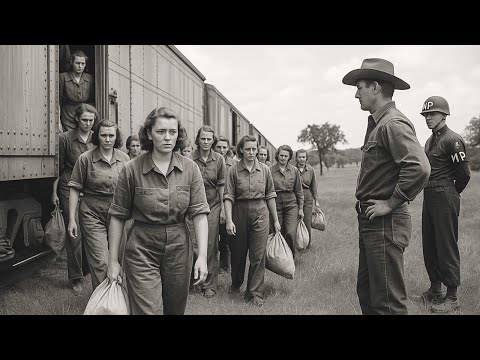
Texas, spring 1945. The sun climbed over endless flatlands, painting shadows across barbed wire and wooden watchtowers at Camp Hearn. Fourteen German women stood in a loose line near the corral fence, hands clasped, eyes adjusting to light so bright it felt physical. They had been told Americans were brutal. They had rehearsed defiance, prepared for humiliation. Instead, a ranch hand named Tom walked toward them carrying saddles, rope coiled over his shoulder, dust on his boots.
“What are those for?” one whispered in German. No one answered. None of them could have imagined.
The war in Europe was collapsing. Berlin smoldered. Hamburg lay in ruins. And in the chaos of surrender, among the millions streaming across devastated landscapes, came a group most Americans never expected to see. German women in Wehrmacht auxiliary uniforms, captured by Allied forces, and designated as prisoners of war. They were Helferinnen—military auxiliaries, communication specialists, clerks, translators, medical assistants. Young women who had served in uniform, who wore the eagle and swastika, who followed orders in a regime that told them they were building a thousand-year empire. Now they stood on foreign soil, defeated, uncertain, waiting.
The train carrying them southwest rattled through Kansas in late April. Through the windows, the landscape transformed. Gone were the bombed cities, the skeletal factories, the hunger-etched faces of occupied Europe. Here stretched endless plains dotted with cattle, farmhouses painted white, grain silos catching afternoon light. Children waved from dusty roads. Women hung laundry in backyards. The normalcy felt surreal.
Ingrid Hoffman pressed her forehead against the glass. Twenty-three years old from Hamburg, daughter of a shipyard worker. She had spent two years as a radio operator for the Luftwaffe communications division in France. The last thing she remembered before capture was running through a burning airfield outside Lyon. Smoke so thick she couldn’t see her own hands. Now she watched American farmland scroll past like scenes from a propaganda film she would have dismissed as impossible.
The other women sat silent, swaying with the train’s rhythm. Some dozed, others stared at their hands. They wore the gray-green wool uniforms issued months ago, now stained, torn at the elbows, missing buttons. Their faces carried the hollow look of people who had stopped expecting good news.
Beside Ingrid sat Margarete Schneider, thirty-one, a nurse from Munich who had worked field hospitals on the Eastern Front. Her hands moved constantly, restless, as if searching for bandages to change or wounds to dress. Across from them, Elsa Werner, nineteen, from a village outside Dresden, a clerk who typed orders she never questioned until the day Soviet artillery began falling, and questioning became irrelevant.
The train slowed. Through the windows, Texas appeared. Not the Texas of their imagination—if they had imagined it at all—but something stranger, more vast. Sky pressed down like blue glass. Mesquite trees twisted low against red earth. Cattle moved slow as clouds. The horizon swallowed fear and replaced it with vertigo.
They disembarked at a small station south of San Antonio. Heat hit like a physical force. The air tasted of dust and something sweet—hay or wildflowers, Ingrid couldn’t tell. American soldiers stood nearby, rifles loose in their hands, talking quietly among themselves. They looked young. Farm boys in olive drab. One chewed gum. Another squinted at a newspaper.
An officer approached. Captain James Morrison, forty-six, from East Texas, son of ranchers. A man whose face showed sun damage and something else—weariness maybe, or resignation. He spoke in accented German, words slow and careful. “You will be taken to Camp Hearn. You will work. You will follow regulations. You will not be harmed.”
The women exchanged glances. Not be harmed. The phrase hung strange in the heat. What did that mean? What did Americans consider harm?
From there, they were placed on trucks. Canvas flapped overhead as they drove north through ranch country. Ingrid watched Texas unfold, trying to reconcile propaganda with reality. She had been told Americans were soft, decadent, incapable of sacrifice. Yet here stretched land that looked hard-won, maintained by labor. She could see it in every fence post, every irrigation line, every carefully tended field.
They passed through small towns where people stopped to stare. An old woman on a porch, hand shading her eyes. A boy on a bicycle, mouth open. A shopkeeper sweeping his step, broom going still. No one shouted, no one threw stones. They simply watched, faces unreadable as the trucks carried German prisoners deeper into Texas.
Camp Hearn sat thirty miles from the nearest town, surrounded by rangeland that rolled gentle toward distant mesas. Established in 1943 to hold Italian and German POWs, it consisted of barracks arranged in neat rows, a mess hall, guard towers at each corner, and beyond the wire, corrals where horses moved like ink brush strokes against evening light.
The women’s barracks occupied the south section, separate from the male POW compounds. Inside, rows of cots with thin mattresses, foot lockers, a single window facing west. The walls were unpainted pine that smelled of resin in the heat. Someone had left folded blankets on each bed. Someone had swept the floor clean.
That first night, they lay awake listening. Crickets. Wind through mesquite. Distant cattle lowing—sounds that belonged to peace, not war. Ingrid stared at shadows on the ceiling and thought about her mother, her younger brother, the apartment in Hamburg that might not exist anymore. Her throat tightened. She turned toward the wall.
Morning came sudden and bright. A guard knocked on the barracks door at dawn. Voice gruff but not cruel. “Breakfast in twenty minutes. Then work assignments.”
They dressed quickly, fingers clumsy with fatigue. Outside, the sky showed pink and orange—colors Ingrid associated with childhood. With mornings before the war, when her father still lived and Hamburg still stood intact. The air smelled different here, dry and clean, without the overlay of rubble, dust, and smoke that had become Europe’s perfume.
The mess hall surprised them first. Long tables covered with checked cloth, metal trays stacked beside serving stations—and the food. Scrambled eggs, bacon, toast, coffee so strong the smell made Ingrid’s stomach clench with sudden hunger. Fresh milk in pitchers. Butter—real butter, yellow and soft.
Margarete stopped walking, her eyes filled. “Is this real?”
An American guard, young, maybe twenty, grinned. “Plenty more where that came from. Y’all ain’t starving on my watch.”
They sat together, uncertain, picking up forks with hands that trembled. The first bite of bacon tasted like revelation. Salt and fat and smoke—textures they had almost forgotten. Ingrid ate slowly, afraid she might cry, afraid this might be theater designed to soften them before harsher treatment began. But the guard just poured more coffee, whistling something tuneless, and wandered back to the kitchen.
After breakfast, work assignments. The camp commander, Colonel William Hayes, stood before them in the morning light. Fifties, silver hair, face that suggested he had spent more time on horseback than behind desks. He spoke in English with an interpreter translating.
“You folks will be helping with ranch operations. Feeding livestock, cleaning stables, mending fences, wrangling when necessary. We’re short-handed. The boys are overseas. You’ll work six days, rest on Sunday. Treat the animals right. Treat each other right. We’ll have no problems.”
Wrangling? Elsa whispered to Ingrid. We’re prisoners.
The interpreter, a thin man named Garcia who spoke German with a Spanish accent, heard her. “Horses don’t care about politics, señorita. They just need feeding.”
The first day in the corral felt like stepping into someone else’s dream. The women were divided into groups and led to different sections of the ranch operation. Ingrid found herself assigned to the main stable—a long building that smelled of hay and leather and something mineral. Horse sweat maybe, or the dust that rose from their coats.
Tom Brennan ran the stables. Fifty-eight, born on the ranch his grandfather homesteaded in 1872. A man whose hands showed decades of rope work and whose eyes held the patient skepticism of someone who trusted horses more than humans. He sized up the German women with a long look, then nodded.
“Can any of you ride?”
Silence. Then Margarete raised her hand tentatively. “I rode as a child. Before the war.”
Tom handed her a curry brush. “Start with grooming. The mare in the third stall—gentle as Sunday. Talk to her while you work.”
Margarete approached the stall. The mare, a bay with white socks, turned her head and exhaled through velvet nostrils. For the first time since capture, Margarete smiled. She lifted the brush and began working it through the mare’s coat in long, steady strokes, murmuring in German—nonsense words, the kind of soft sounds that cross language barriers. The mare leaned into the touch.
Tom watched from the doorway, arms crossed. After a moment, he called to another prisoner. “You there—Elsa, right? Come help me with the feed.”
The work was physical, exhausting, honest. They hauled hay bales, filled water troughs, mucked stalls, mended tack. Sweat soaked through their uniforms. Their backs ached. Blisters formed on hands unused to this labor. But something shifted. The simplicity of caring for animals. The rhythm of routine. The absence of sirens and explosions and constant fear. It created space for something they had lost. Presence.
By midday, the heat shimmered like glass over the corral. The women took breaks in the shade of the barn, drinking water from tin cups, too tired to talk. Tom brought sandwiches—thick slices of beef between fresh bread—and handed them out without comment. Ingrid bit into hers and tasted something beyond food. Generosity maybe, or the kind of practical compassion that exists in places where survival depends on everyone doing their part.
That evening, after the day’s work ended, they returned to the barracks, exhausted. Ingrid’s hands throbbed. Her shoulders felt like stone. She lay on her cot and stared at the ceiling, trying to process what felt like cognitive dissonance. In Germany, she had been told Americans were the enemy—weak, materialistic, lacking discipline and moral fiber. Yet here, in this place, she had encountered something different. Routine. Structure. Fairness. Food. And strangers who treated her not as subhuman, but as someone capable of work and deserving of rest afterward.
Margarete sat on the edge of her cot, unlacing her boots. “That mare,” she said quietly. “She reminded me of my childhood. Before everything.”
Ingrid closed her eyes. Before everything. Before the war, the bombing, the propaganda, the collapse. Before the moment when the world they knew disintegrated and left them here in Texas, grooming horses for people they were supposed to hate.
Weeks passed. Spring gave way to early summer. The work continued—day after day in heat that rose from the earth itself. The women grew stronger, skin darkening from sun. They learned the rhythms of the ranch: when to feed, when to water, which horses preferred gentle handling. Tom began teaching them to ride properly. Margarete proved a natural, moving with the mare as if they shared thoughts.
“You’ve got the gift,” Tom said. “Not everyone does.” She ducked her head, embarrassed by praise—but something in her posture straightened.
The guards proved different from expectations. Young men deemed unfit for combat. Farm boys with flat feet or poor eyesight. One, Private Danny Foster, twenty, from Oklahoma, struck up tentative conversations during water breaks. “You miss home?” he asked Ingrid one afternoon. She nodded. “Always.” “Me, too.” The absurdity of the moment—enemies sharing homesickness—went unspoken but felt.
By midsummer, small kindnesses accumulated. Tom brought extra apples and let the women feed the horses from their palms. The cook, Rosa, saved fresh tortillas, teaching them to fold warm rounds around eggs and beans. Father McKenzie offered to mail letters home.
Then came the moment that broke something fundamental. A Saturday in July, a mare in distress—a breech foal. Margarette stripped to her shirtsleeves. “I’ve delivered foals before. I became a nurse.” She and Tom worked together in rising wind and rain, two people united by urgency, nationality irrelevant. The fo came in a rush of fluid and membrane. Margarette cleared its nose. It gasped, shuddered, opened dark eyes.
“Good work,” Tom said, gripping her shoulder. “Damn good work.” Something passed between them—recognition, respect, the dissolution of propaganda.
That night Margarette wrote in her diary: Today I delivered a foal on American soil with an American rancher who called me by my name and trusted my knowledge. I do not know what this means for everything I believed. I only know the foal lived, and I felt useful for something other than destruction.
News from Europe arrived in fragments. The camps. The photographs. The evidence too vast to dismiss. “We didn’t know,” Elsa whispered, weeping. But they had known something. They had participated in a system that required their blindness. Guilt settled like physical mass.
Father McKenzie found Ingrid alone in the stable one evening. “You cannot change what was done. You can only decide who you will be going forward.” How do we live with this? “One day at a time. With work, with honesty, with attempts at goodness—even knowing we’ll fail often.”
Work became refuge. The horses asked nothing about the past. They only required presence, gentle hands, steady voices. In that simplicity, the women found survival.
Summer deepened. Danny brought his guitar to the corral. “Sing it,” he said of a German song about leaving home. She did—voice cracking, then finding strength. German lyrics merged with American guitar, and for a few minutes the war felt distant. Enemy soldiers united in the universal longing for home.
Tom organized a small celebration for the Fourth of July. Watermelon chilled in the springhouse, ice cream churned by hand, fireworks blooming in the dark sky. Margarette sat beside Tom. “Thank you for treating us like people.” He looked at her, face shadowed. “Can’t see the point in anything else.”
By August, mail service to Europe was partially restored. Ingrid received a letter from her aunt in October. Her mother had survived the bombing but died of pneumonia that winter. Her brother was missing, probably captured by Soviets. The apartment had burned. Everything was gone. She read it three times, sitting on her cot while shadows stretched across the floor. Grief arrived not as collapse but as hollow recognition.
That evening she walked to the corral alone. The horses grazed in the last light. She leaned against the fence and let herself cry for everything lost. Tom found her there. He didn’t speak—just stood nearby, giving her space and presence in equal measure. After a long while, he offered a handkerchief, clean and pressed.
“My wife died two years ago. Cancer. Some losses you carry forever, but carrying gets easier.” They stood together, watching darkness settle. Two people united by grief, by the strange intimacy of shared silence.
Fall arrived. Temperatures cooled. The women had been at Camp Hearn six months—time enough to reshape understanding. Then came the announcement. Repatriation would begin in the new year. German POWs returned to Europe, to occupied zones, to whatever remained of their homeland.
Return. The word should have sparked joy. Instead, it felt complicated. Return to what? To rubble and famine and collective guilt. Here they had food, work, purpose. Here they had been treated with unexpected decency. Leaving meant stepping back into uncertainty.
Margaret sat on her cot that night, staring at her hands—hands that had treated wounds, delivered a foal, braided a horse’s mane. “I don’t know if I can go back,” she told Ingrid. “I don’t know what’s there for me.” Ingrid understood. The Germany of her childhood no longer existed. Who returned? What version of herself would step off the ship?
Tom noticed their subdued mood. One afternoon while they cleaned tack, he asked directly. “You afraid to go home?” Margaret paused, leather cleaner in hand. “Home doesn’t exist anymore. We’re going back to a place that has the same name, but nothing else familiar.” He nodded slowly. “War does that. Takes the world you knew and replaces it. My father fought in the first war. Said it took years before he felt like he belonged anywhere.” Did it get better? “Eventually he learned to build something new rather than mourn what was gone.”
Winter brought frost on fence posts, breath visible in morning light. Christmas approached. Father McKenzie organized a simple service. The carols were familiar—Silent Night written in Austria, melodies crossing borders. Ingrid sang in German while American soldiers sang in English, the same words, the same longing for peace.
Afterward, Rosa served hot chocolate. Margaret sat with Tom, warming their hands on ceramic mugs, talking about horses and weather and nothing consequential. The ordinariness of it felt like grace. “You’ll do well when you go back,” Tom said quietly. “You’ve got strength. You’ll rebuild.” She smiled, sad and grateful. “Because of here. Because of what I learned here about who I could be.”
In January, the first departure dates arrived. The women packed their few belongings—a smooth stone from the creek, dried wildflowers pressed between pages, photographs Tom had taken of them with the horses. On the final morning, they gathered at the stable to say goodbye. Margaret spent a long time with the bay mare, forehead pressed to the animal’s neck, whispering thanks in German.
Tom shook each woman’s hand, grip firm, eyes direct. “You take care now. Remember what you learned here—about the work, about people, about moving forward.” Ingrid nodded, throat tight. “Thank you. For everything.” He tipped his hat. “You earned your keep. The horses will miss you.”
They loaded onto trucks in pale winter light. As Camp Hearn receded, Ingrid looked back one final time—the corral, the stable, the barracks that had been home for eight months, the landscape that had witnessed transformation. She was still trying to understand.
The ship departed New York in late January. Twelve days through winter seas. The women stood at the rail, watching America disappear into gray distance, each carrying private thoughts about what Texas had meant, who they had become.
They arrived in Bremen to find a city that existed more in memory than reality. Ninety percent destroyed. Rubble mountains where neighborhoods had stood. Survivors moving through ruins like ghosts. Ingrid made her way to Hamburg by freight car, packed with refugees and displaced persons, all searching for something lost to war.
She found her aunt living in the basement of a bombed-out building, surviving on rations and work clearing rubble. The reunion was quiet. They had nothing left but each other. But Ingrid carried something from Texas. The memory of being treated with decency. The knowledge that enemies could become complicated. That humanity persisted in unexpected places. That small acts of kindness undermined propaganda more effectively than any counterargument.
She found work helping to rebuild—physical labor not unlike ranch work, hauling debris, mixing concrete. Her hands, calloused from the Texas corral, adapted quickly. At night she remembered horses moving across endless sky, watermelon on the Fourth of July, a rancher who chose kindness over convenience.
Margaret settled in Munich. She found work at a veterinary clinic, her experience overcoming questions about her war service. Eventually she married a farmer, moved to a small village, raised children who grew up hearing stories about horses in Texas, about Americans who treated enemy prisoners like human beings, about a war that taught hard lessons about propaganda and truth.
Elsa returned to Dresden—or what remained. She worked as a translator for American occupation forces, her English learned at Camp Hearn proving useful in the new order. She never married. She spent her life teaching children languages, believing communication across borders was the antidote to the ideology that had destroyed her generation.
In the decades that followed, historians would puzzle over the phenomenon of German POWs in America. More than four hundred thousand prisoners held far from combat, treated according to Geneva Convention standards that often exceeded conditions for American citizens. Fed well, paid for labor, allowed recreation and education. Some prisoners reported their years in American camps were the best of their lives—a statement that revealed as much about the brutality of the Eastern Front as about American treatment.
The women prisoners remained largely invisible in official histories—too few to warrant detailed study, too complicated to fit neat narratives about gender and war. But they existed. These women who wore Wehrmacht gray and worked American ranches, who learned that enemies were more complex than propaganda allowed, who carried home memories of unexpected kindness that shaped their understanding of humanity forever.
And somewhere in Texas, long after the war, an old rancher still kept a photograph tacked inside his stable door—fourteen German women in borrowed work clothes, standing beside horses, squinting into the sun, almost smiling.
What do you think—can ordinary kindness truly undo the damage of ideology, or does it only soften the memory of what we failed to stop?
Report this article
Select a reason for reporting:






