In August 1932, Bonnie Parker and Clyde Barrow were the most hunted outlaws in America. Just days earlier, they had gunned down a deputy and wounded a sheriff at a country dance in Stringtown, Oklahoma. The law was closing in from every direction. Desperate for shelter, they fled to Carlsbad, New Mexico, to a remote farm owned by Clyde’s aunt, Nellie Stamps. It seemed like the perfect hideout—isolated, surrounded by family, and far from the heat of Texas and Oklahoma.
But trouble followed them even there. Their stolen Ford V8 was too conspicuous, and Nellie, terrified of the men her niece had brought into her home, secretly alerted the authorities. On the morning of August 14, 1932, Deputy Sheriff Joe Johns drove out to the Stamps farm to investigate a suspicious vehicle. He had no idea he was about to walk straight into the lion’s den.
Johns spotted the Ford and peered through the window. The back seat was a rolling arsenal—rifles and shotguns stacked like firewood. He knocked on the door, and Bonnie answered with a calm smile. She told him the car belonged to two young men who were getting dressed and would be right out. Then she called back into the house, a signal that the law was at the door.
Inside, Clyde and his accomplice Raymond Hamilton were caught off guard. Their weapons were locked in the trunk, out of reach. But Clyde wasn’t about to surrender. He found a shotgun in a closet, and he and Hamilton slipped around the side of the house. Before Johns could react, they had him at gunpoint. Clyde fired a warning shot that clipped the deputy’s hat right off his head. Hamilton disarmed him, and within seconds, the lawman was their prisoner.
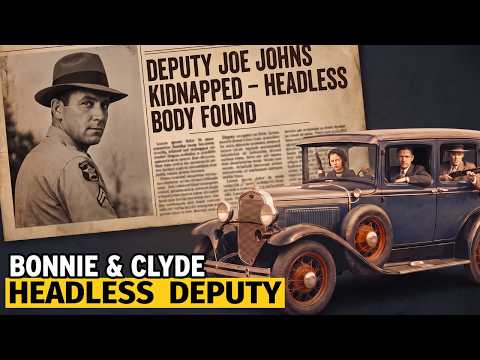
They worked fast. They disabled Johns’s car, cut the phone lines, and shoved him into the back seat of the Ford. Then they sped off toward Texas, beginning a terrifying twenty-hour journey. Johns later described being wedged between Clyde and Hamilton, with Bonnie perched on Hamilton’s lap, a pistol pressed against his ribs the entire time. “They would have shot me if I moved,” he recalled. The car was littered with guns, though he noticed they didn’t have any machine guns—yet.
The trip was far from smooth. They blew out seven tires along the way, slowing their escape to a crawl. At one point, they tried to steal another car but failed. And there was a moment when Clyde and Hamilton, furious at Nellie’s betrayal, talked about turning back to kill her. Johns, fearing for his life and hers, argued passionately against it—and miraculously, they listened.
But while Johns was enduring the ride of his life, something else was happening behind him—something that would turn the entire manhunt upside down. Two truck drivers had discovered a body on the side of the road, about ninety miles from El Paso. The body was headless. Word spread like wildfire, and the conclusion seemed obvious: the kidnapped deputy had been murdered by Bonnie and Clyde, his body dumped along their escape route. The authorities connected the dots and declared Joe Johns dead—his head severed by the Barrow gang.
A massive manhunt erupted for the killers of a deputy who was, at that very moment, sitting in the back seat of a car with the outlaws, completely unaware that the world had already buried him. It would take more investigation to untangle the truth. The headless body was not Johns at all. It was a transient, in the wrong place at the wrong time. But for a while, the official story was that Joe Johns had lost his head—literally.
Near San Antonio, the gang finally stopped. They threatened to kill Johns several times during the journey, but according to his account, Bonnie persuaded them to let him go. Before they parted, they asked if he had enough money to get back to Carlsbad. When he said no, they handed him some cash and left him on the side of the road. Johns walked to the nearest house, then to the sheriff’s office in Pecos County. He was alive. The dead man had returned.
Joe Johns outlived them all. He went on to become mayor of Eddy County, chief of police in Carlsbad, and a county treasurer. He died in the 1970s at the age of 84—from injuries sustained in a car accident, not a bullet. His obituary still mentioned that day in 1932 when he was held captive by Bonnie and Clyde. But the story doesn’t end there. The headless body, the failed car theft, the near-miss with Nellie—each detail would come back to haunt them. And the manhunt was far from over.
The news of Johns’s release hit the wire services within hours, and the humiliation stung every lawman from New Mexico to Oklahoma. A deputy had been kidnapped, paraded across two states, and then handed pocket money by the very outlaws the entire Southwest was hunting. J. Edgar Hoover, still building his Bureau’s reputation, reportedly flew into a rage when he read the morning papers. The Barrow gang had made fools of them all, and someone was going to pay for it.
But Clyde wasn’t done making headlines. He knew the clock was ticking now. Johns had seen their faces, their car, their route. The farm in Carlsbad was burned as a hideout, and Nellie Stamps was probably already talking to every reporter who would buy her a cup of coffee. They needed distance, and they needed it fast.
What they didn’t know was that the headless body near El Paso had already been identified—not as Johns, but as a drifter named Alvin Houser, a man with no connection to the gang whatsoever. The mistake had cost the authorities precious days. While posses had been combing the desert for a corpse, the real outlaws had slipped through their fingers. By the time the correction made the papers, the Ford V8 was already a hundred miles gone.
Bonnie, for her part, was growing restless. The kidnapping had been a lucky break, not a plan, and she knew luck ran out. She had started keeping a journal in those weeks—poems, mostly, scribbled on the backs of envelopes and motel stationery. One of them, a piece she called “The Trail’s End,” would later become famous for all the wrong reasons. It spoke of death and reckoning, of two lovers who would never see old age. Clyde read it and told her to burn it. She didn’t.
Instead, they pressed on toward the Texas panhandle, where the roads were flat and empty and a stolen car could disappear into the dust. Raymond Hamilton, who had grown tired of sleeping in the back seat and eating canned beans, began to grumble. He wanted his cut, he wanted a real bed, and he wanted out. Clyde, never a patient man, told him to shut up or walk. The partnership that had survived a shootout and a kidnapping was starting to crack.
They stopped at a filling station outside Abilene, where a young attendant named Royce filled the tank and noticed the bullet holes in the fender. He didn’t say a word—not then. But as the Ford pulled away, he wrote down the plate number on the back of a receipt. It would be three days before anyone thought to ask him what he’d seen. Three days, as it turned out, was all the Barrow gang needed.
By the time the plate number reached the Texas Rangers, the Ford V8 was sitting behind a barn in Atoka County, Oklahoma, covered in a horse blanket and a layer of fresh mud. Clyde had swapped the stolen car for a battered Hudson sedan, paying the farmer twenty dollars and a shotgun to look the other way. It wasn’t a fair trade, but fairness wasn’t high on Clyde’s list of priorities that week.
Raymond Hamilton, meanwhile, had made good on his threat. He’d walked out two nights earlier, taking a rifle and a hundred dollars from Clyde’s coat pocket. “He’ll talk,” Bonnie warned. “They always talk.” Clyde stared at the empty spot where Hamilton had slept and said nothing. He knew she was right, but there was nothing to be done about it now.
They drifted south, avoiding the main highways, sleeping in the car and eating cold biscuits from a paper sack. The summer heat was brutal, and the Hudson’s radiator boiled twice a day. Bonnie’s journal filled up with cramped, angry handwriting—lists of towns, lists of names, a running tally of every road they’d burned. She started calling it “the ledger,” and she kept it hidden in the lining of her coat.
It was in a diner outside Wichita Falls that they heard the news. A man at the counter was reading a newspaper aloud to his companion, laughing about the deputy who’d been kidnapped and then given cab fare. “Can you believe it? They let old Joe Johns go with pocket money. What kind of outlaws are these?” Bonnie stirred her coffee and didn’t look up. Clyde’s jaw tightened, but he kept his eyes on his plate.
What neither of them knew was that the diner’s owner had recognized them from a photograph in that same newspaper. He didn’t call the police—not yet. He was a cautious man, and he’d seen what happened to people who got too close to the Barrow gang. Instead, he sent his teenage son out the back door with a note for the sheriff’s office two blocks away.
The sheriff, a heavy man named Dobbs who had spent thirty years chasing cattle thieves and moonshiners, read the note and sighed. He’d been expecting something like this for weeks. He rounded up four deputies, handed out shotguns, and told them to wait until the outlaws were in the car and moving. No sense in a gunfight in a crowded diner. Not if it could be helped.
But Bonnie had noticed the boy slip out the back. She’d been watching the door all morning, the way she always did. She reached under the table and pressed her foot against Clyde’s boot—their signal. He didn’t react, didn’t even blink. He just finished his eggs, paid the bill, and walked out with his hand resting casually on the butt of the pistol in his waistband.
The deputies were waiting behind a row of parked cars. What they hadn’t counted on was that Clyde had parked the Hudson facing the alley, not the street. He and Bonnie walked out the front door, turned the corner as if heading for the car, then broke into a run. The first shotgun blast took out a window above their heads. The second kicked up dust at their heels. Clyde fired twice over his shoulder without looking, and one of the deputies dropped behind a fender, clutching his arm.
They were in the Hudson and gone before Dobbs could organize a proper pursuit. The whole thing had lasted less than ninety seconds. Bonnie was breathing hard, her hands shaking as she reloaded the pistol in her lap. Clyde was grinning—that reckless, boyish grin that she loved and feared in equal measure. “Told you we’d make it,” he said.
She didn’t answer. She was thinking about the ledger in her coat, about the poem she’d written the night before, about the way the deputy had fallen. Luck, she thought, was a finite thing. And they were spending it fast.
They drove east through the night, headlights off, until the Hudson’s engine began to knock. By dawn they were limping into a crossroads called Wellington, Texas, where a mechanic named Boss Simmons agreed to look at the car for five dollars cash. He didn’t ask about the bullet holes, and they didn’t offer to explain them.
While Simmons worked, Bonnie sat on a bench outside the garage and opened the ledger one last time. She wrote a single line, then closed it and tucked it back into her coat. Clyde came out with two bottles of Coca-Cola and sat beside her without a word. For a moment, they were just a young couple on a summer morning, waiting for a car.
Then a radio inside the garage crackled to life. A newscaster was reading the description of a Hudson sedan, last seen near Wichita Falls. Simmons’s wrench went still. Clyde set down his bottle, took Bonnie’s hand, and whispered, “Walk. Don’t run.”
They walked. Behind them, the mechanic reached for the telephone. Ahead, the road stretched west into the heat shimmer, empty and endless. They had outrun the law again—but for how long, and at what cost? What would you have done in Bonnie’s shoes, knowing every mile forward was one mile closer to the end?
Report this article
Select a reason for reporting:






