The cardboard box arrived on a rainy March morning, and Sarah Mitchell almost set it aside. She had a backlog of restorations, a studio full of light boxes and chemical baths, and fifteen years of experience telling her that most “urgent” projects could wait. But something about the handwriting on the intake form—“Old family portrait, badly damaged, not sure it can be saved”—made her open it first.
What she lifted out was larger than expected: an 11-by-14 photograph mounted on crumbling cardboard, its surface scarred by brown water blooms and flaking emulsion. Through the damage, seven figures emerged—three adults, four children, all African American, dressed in their finest clothes. Their postures were rigid, their expressions solemn, the unmistakable signature of an 1880s studio portrait. Sarah had restored hundreds of such images. She had never seen one that made her pulse quicken before she even began.
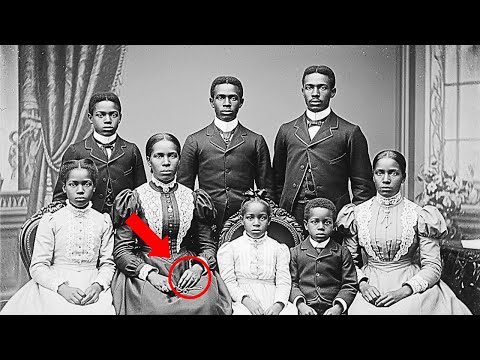
She photographed the portrait in its current state, documenting every crack and stain, then slid it into her high-resolution scanner. Infrared and ultraviolet light could pierce layers of damage, revealing details invisible to the naked eye. The machine hummed and clicked for hours while Sarah worked on other projects, but her attention kept drifting back to the box. Something about the woman seated on the left—the one whose face was half-obscured by water damage—wouldn’t let her go.
By late afternoon, the scans were ready. Sarah opened them on her large monitor and zoomed in section by section. The digital images revealed what the physical photograph had hidden: the pattern on the curtains, the titles of books on a shelf, the shy half-smile of a boy trying not to fidget. And then she reached the woman’s hand.
The ring was unmistakable now, rendered in crisp detail by the infrared scan. It wasn’t a simple wedding band. The design was elaborate—a broken chain intertwined with a five-pointed star, each link individually crafted, the break precisely detailed. Sarah leaned back in her chair, her mind racing. In 1886, just twenty-one years after the Civil War, such a symbol would have carried profound meaning. A broken chain: freedom from bondage. But the craftsmanship was too specific, too deliberate. This wasn’t personal jewelry. It looked like an emblem of membership.
She pulled up her research databases, searching for similar rings used by abolition societies and post-war African American organizations. Nothing matched exactly. The broken chain appeared in various contexts, but never intertwined with a star in this particular configuration. “Significant water damage, emulsion loss approximately 30%, possible jewelry detail to investigate during restoration,” she had written on her intake form. Now that note felt laughably inadequate.
Sarah reached for her phone and called the one person she knew would understand. Marcus Washington, a professor of African American studies at Harvard, answered on the second ring. “Marcus, I need your expertise. I’m restoring an 1886 family portrait and I’ve found something unusual.”
An hour later, she was sitting in his cluttered office, watching him study the enlarged image of the ring. The afternoon sun slanted through the window, illuminating dust motes and stacks of manuscripts. Marcus adjusted his reading glasses and was silent for a long moment.
“The broken chain is clear enough,” he finally said. “Standard abolitionist symbolism. But this star configuration…” He pulled a reference book from his shelf. “The timing troubles me. By 1886, the official abolitionist movement had largely disbanded. The war was over. The major societies had declared victory and moved on.”
“But?” Sarah prompted, recognizing the tone of a scholar who’d found an anomaly.
“But we know that freedom on paper didn’t mean freedom in practice,” Marcus continued. “There were documented cases of people still being held in slavery—illegally, secretly—well into the 1880s. Isolated plantations, remote areas where federal authority didn’t reach. And there were rumors of underground networks that helped people escape, similar to the old Underground Railroad but operating after the war.”
Sarah felt a chill. “You’re saying this ring might have belonged to someone still fighting slavery after the war ended?”
Marcus nodded slowly, then looked at the full portrait again. “Look at how they’re positioned. The woman with the ring is central, commanding. This isn’t just a family portrait. This is a statement of some kind.” He paused. “Sarah, I think you may have found something significant here—something that changes what we know about post-war resistance.”
What followed was a two-week sprint that swallowed every spare hour Sarah had. She worked the physical restoration by day—swabbing away a century of grime, stabilizing the flaking emulsion, coaxing Ruth Johnson’s face back into focus—and spent her evenings on video calls with Marcus and his network of historians. The portrait was slowly coming back to life under her hands, but it was the research that kept her awake at night.
Marcus contacted Dr. Evelyn Chen, a genealogist in Atlanta who had spent decades compiling records of post-Civil War Black families. “Record-keeping for Black families in this period was spotty at best,” Dr. Chen explained on their first call, her voice carrying the weariness of someone who had fought this battle many times. “Census records often listed people by first name only. Property records were tangled by discriminatory laws. But this family clearly had status. That dress alone would have cost significant money.”
She zoomed in on the ornate chair behind the family. “That carved pattern was popular among studio photographers in the mid-1880s. If I had to guess, this was taken in Atlanta or Savannah.”
Days later, Dr. Chen called back with barely suppressed excitement. “I think I found them. The Johnson family of Atlanta. Ruth Johnson, her husband Samuel, and their four children.” A pause. “Sarah, there’s something else. In the 1886 city directory, there’s a notation by Ruth’s name I’ve never seen before. Benevolent work. That might mean nothing. Or it might mean everything.”
The Atlanta History Center’s archives smelled of old paper and climate control. Sarah and Marcus had driven down from Boston, and Dr. Chen met them there on a humid April morning with several boxes already waiting. Ruth Johnson’s story emerged in fragments—property deeds, church records, newspaper clippings—and each fragment made her more extraordinary.
Born Ruth Freeman in 1847 in North Carolina, she had been born into slavery and freed during the war as a teenager. By 1870 she had reached Atlanta and married Samuel Johnson, a carpenter who had also been enslaved. By 1880 she owned three buildings in the Sweet Auburn area and employed a dozen people. For a Black woman in the postwar South, that level of success was both remarkable and dangerous.
“Look at this,” Dr. Chen said, pointing to a deed from 1882. “She didn’t just buy property—she bought adjacent properties, creating a kind of compound.” She pulled out another document. “And here she’s listed as a founding member of the Friendship Baptist Church and the Atlanta Colored Women’s Relief Society.”
Marcus photographed each page. “The Relief Society. These organizations did charitable work on the surface—widows, orphans, the sick. But they could also move money, hide people, share information.”
Then Dr. Chen lifted a letter from the box, and her hands trembled slightly. “Listen to this. 1884, addressed to Ruth from someone named Elizabeth in Macon. ‘Dear Sister Ruth, the three we discussed have arrived safely in your care. I trust they will find the new beginning they seek. The work continues, though it grows more dangerous. Remember our sign.’”
The room fell silent. “Remember our sign,” Sarah whispered. “The ring.”
Marcus was already reaching for his tablet, pulling up a map of 1880s Georgia. “Atlanta was a railroad hub, easily reached from rural areas across the state. If people were fleeing debt bondage, convict leasing, illegal enslavement—Atlanta would have been a logical destination. The official histories say the Underground Railroad ended with the war.” He looked up. “What if they’re wrong? What if it simply changed form?”
Sarah looked at the restored portrait glowing on her laptop, at Ruth’s quiet, determined face, at the ring catching the light on her finger. This was no longer just a photograph. It was evidence.
The break came from a retired professor in South Carolina, who wrote to Marcus after seeing his query on a scholarly forum. “You should talk to the descendants of the Gullah communities on the Sea Islands. My grandmother told me stories about the continuers—people who kept running the freedom roads after the war ended. Nobody believed her because the official history said it was over. But she insisted.”
That thread led them to Saint Helena Island, and to three elderly residents whose great-grandparents had belonged to what they called the extension—a network that ran from the late 1860s well into the 1900s. Meanwhile, a jewelry historian confirmed the ring was custom work, and microscopic examination of the scan revealed tiny markings on the inner band: EV1882AG.
Dr. Chen recognized the pattern instantly. “A metalworker’s mark and a date. Atlanta, Georgia, 1882.” They traced the initials to Elijah Vance, a formerly enslaved man who had opened his own shop after the war. His surviving ledger contained a single, fateful entry from July 1882: Special commission RJ, five rings with agreed design. One.
Five rings. Not one. Marcus sat back slowly. “These weren’t personal jewelry. They were emblems for a group. Five leaders, each given a ring to identify their authority and authenticate their communications.”
Within a week they had found three more photographs in scattered archives—Savannah, 1887; Charleston, 1889; Birmingham, 1891—each showing a woman of prominence wearing an identical ring, each woman documented as doing vague “charitable work” or “assistance to newcomers.”
Dr. Chen laid it all out on the table. “A network spanning at least four major Southern cities, operating from 1882 into the 1890s, led by women who wore these rings as identification. Its purpose: helping people escape illegal bondage and exploitation that persisted long after the war.”
“Why so little direct evidence?” Sarah asked.
“Because it was dangerous,” Marcus said. “Helping people flee debt bondage or convict leasing could still get you killed. These women operated in secret, used coded language, left minimal paper trails. The rings were hidden in plain sight—meaningless to outsiders, instantly recognizable to those who knew.”
Finding Ruth’s living descendants proved easier than expected. Dr. Chen traced the line forward through marriage records and census entries to Angela Morrison, a civil rights attorney in Atlanta. Sarah called her on a warm May afternoon and explained, carefully, what they had found. The silence on the other end stretched so long she thought the call had dropped.
“My grandmother used to tell me stories,” Angela finally said, her voice thick. “She said her grandmother—Ruth—had helped people. She called them the lost ones, people who’d been left behind by freedom. We thought she was being metaphorical. We had no idea she meant it literally.”
They arranged to meet the following week. Angela gathered her mother, her aunt, two cousins, and her teenage son in her living room, and Sarah set the restored portrait on the coffee table. Ruth’s face was clear and vibrant now, and for a long moment no one spoke.
Angela’s mother, Dorothy, touched the frame gently. “She looks strong,” she whispered. “Look at her eyes. She’s not afraid.”
Then Angela rose and crossed to a cabinet, returning with a small wooden box. “This has been in our family for generations. My mother gave it to me. Her mother gave it to her.” She opened it, peeling back aged velvet. Inside lay a ring—the broken chain intertwined with the star, identical to the one in the photograph.
The room went absolutely still. “Ruth’s ring,” Sarah breathed. “You’ve had it all this time.”
Dorothy nodded, tears sliding down her cheeks. “Mama told me to keep it safe, that it meant something important. But she never told me what. She said the story had been lost.”
“Not anymore,” Marcus said quietly. “Not anymore.”
Devin Clark’s front-page feature ran in the Atlanta Journal-Constitution that July: “The Ring of Freedom: How Black Women Fought Slavery After Slavery Ended.” Within hours the story had been shared hundreds of thousands of times. Museums called. Historians who had spent entire careers on Reconstruction wrote in, equal parts thrilled and chastened.
Nine months later, the Smithsonian unveiled Continuation: The Hidden Network That Fought Slavery After Emancipation, with Ruth’s restored portrait enlarged to wall size, her ring gleaming under the lights. “She was hiding it in plain sight,” Angela said, “waiting for someone to look closely enough to see.”
A year after that, they dedicated a new headstone outside Atlanta: Ruth Johnson, 1847–1903. Freedom fighter. Leader of the Continuation Network. She helped hundreds find liberty. Ruth’s ring sat in a place of honor at the family table that afternoon, and Angela’s ten-year-old daughter traced the broken chain with one finger.
Driving back to Boston, Sarah thought of all the photographs still waiting in attics and estate sales, all the stories hidden in plain sight. Ruth had fought, saved lives, and mattered—and now she would never be forgotten again.
So here’s my question for you: what forgotten story might be hiding in your own family’s photographs?
Report this article
Select a reason for reporting:






