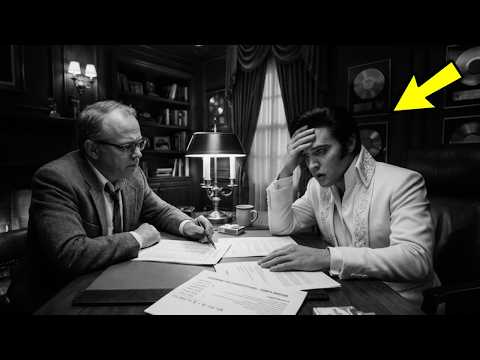
January 15th, 1973, Graceland. The office was quiet—the kind of quiet that only exists in the early hours before the house wakes, before the phones start ringing, before the world remembers Elvis Presley lives here and wants something from him. Elvis sat behind his desk, a cup of coffee going cold beside him, staring at a single page of numbers. He had been staring at it for a long time.
The man across from him—the new accountant, hired three weeks ago specifically because he had no prior connection to Colonel Tom Parker—had stopped talking several minutes ago. He had learned quickly that when Elvis went this still, this silent, you waited. You didn’t fill the silence. You let it do its work. The number at the bottom of the page was not a mistake. The accountant had checked it four times. It was not a rounding error, not a misunderstanding of contract language, not a gray area open to interpretation. Colonel Tom Parker had taken more than $20 million that belonged to Elvis Presley. Not over the course of their entire 18-year partnership—just in the last five years.
Elvis set the paper down carefully, almost gently. The accountant resumed talking—percentages, contract clauses, deal structures, the specific mechanisms through which the money had moved from Elvis’s earnings into Parker’s various companies and accounts. His voice was professional, precise, unhurried. But Elvis had already stopped listening. He was doing his own math—a different kind of math, not figures on a spreadsheet, but memories. Every time Parker had told him money was tight. Every tour he had been discouraged from taking because the costs were too high. Every film project he had wanted to pursue but been told they couldn’t fund. Every time he had trusted Parker’s assessment of what was financially possible and what wasn’t. And all the while Parker had been taking 50%, 60%, sometimes 70%. The agreed arrangement had been 25. The industry standard was 15.
Elvis picked up the phone. He dialed a number he knew by heart. “Tom, be at Graceland tomorrow, 9:00 a.m. Come alone.” He hung up before Parker could respond.
Colonel Tom Parker arrived at 8:45 the following morning—15 minutes early. In 18 years of working together, Parker had never once been early to anything. It was one of his control mechanisms: always precisely on time, never a moment before, making everyone else wait, establishing from the first second who held the power. His punctuality was a performance, carefully calculated, never accidental. Today he was early and nervous, and the two facts were connected.
Elvis kept him waiting anyway. Parker sat in the entrance hall of Graceland for 20 minutes. Vernon Presley, Elvis’s father, walked past him twice, both times without acknowledgement—not a nod, not a word, not even eye contact. After 18 years of being treated as a trusted partner of the family, Vernon walked past him like he was furniture. Parker understood the message. Whatever shelter he had enjoyed under the Presley family’s roof was gone.
At 9:20, Elvis appeared at the top of the staircase. He didn’t come down immediately. He simply stood there, looking down at Parker, letting the silence expand until it had weight. Parker looked up. Elvis looked down. Neither man spoke. The entrance hall felt enormous and very cold. Then Elvis walked down the stairs slowly, without hurrying. He crossed the hall and gestured toward his office with one hand, saying nothing. Parker followed.
Inside the office, Vernon, the new accountant, and Elvis’s attorney. Three men. Three chairs arranged in a deliberate arc. Documents stacked neatly on the desk. The room had been prepared. This was not a conversation. It was a proceeding. Parker’s swagger—the particular physical confidence he had carried for decades, the way he moved through rooms as if he owned them—evaporated the moment he saw the setup.
Elvis closed the door behind them both. He sat down. He folded his hands on the desk. He looked at Parker the way a man looks at something he is seeing clearly for the first time. “Tom,” he said. His voice was quiet, controlled, frightening in its steadiness. “I want you to tell me, in your own words, what percentage you take of my earnings.”
Parker shifted in his chair. “Elvis, you know the arrangement. We’ve had the same deal for years. 25% for management services, which is industry standard.” The attorney slid a document across the desk. “Is 15%. Top managers rarely exceed 20. You are taking 50% of most deals, sometimes more.” Parker’s face flushed. “Now, wait just a minute. These deals are complicated. The Vegas contracts, the touring revenue—”
“The Vegas contracts,” Elvis said, “where you negotiated a separate fee for yourself on top of your management percentage. The touring revenue where you took 50% off the top before expenses were calculated. The merchandising deals where you licensed my name and image through your own company and kept 85 cents of every dollar.” He was not raising his voice. That was the thing. He was stating facts, reading from documents, moving through the information methodically. And the absence of anger made it more devastating than any outburst could have been.
Parker opened his mouth. Elvis raised one hand. “I’m not finished.”
The accountant took over. For the next 40 minutes, he walked through 18 years of contracts, deal structures, payment schedules, side arrangements. Each document told the same story from a different angle. Parker had structured every deal to maximize his own take while minimizing Elvis’s. He had negotiated separate fees for himself on top of his management percentage. He had created shell companies that collected licensing revenue from Elvis’s name and image, keeping the majority. He had made deals that were financially optimal for Colonel Tom Parker and financially limiting for Elvis Aaron Presley.
The 1956 film deal with Hal Wallis that locked Elvis into years of low-quality pictures—Parker had received a $50,000 finder’s fee that Elvis had never known about. The merchandising arrangements of the early ’60s that flooded the market with Elvis products—Parker’s companies collected 85% while Elvis received 15. The celebrated 1969 Vegas contract, the one Parker had presented as a triumph—Parker had pushed his own percentage up to 50 and secured himself a separate consulting fee of $50,000 per engagement on top of everything else.
Vernon Presley, who had been Elvis’s business manager in name but had deferred almost entirely to Parker’s expertise for nearly two decades, sat in his chair looking like a man who had aged ten years in an hour. “Tom,” Vernon said, his voice unsteady, “you told me we couldn’t afford to buy Elvis out of those movie contracts. You said the penalties would bankrupt us.” Parker said nothing. “But you were making money from those contracts. You had separate deals with the studios. You wanted Elvis making those films because you were getting paid regardless of whether they were good or not.”
The silence that followed was absolute. Elvis stood up and walked to the window. His back was to the room. Outside, the grounds of Graceland spread in every direction—the home he had bought with money that could have been double if he’d had honest representation. He looked at it for a long moment without speaking.
When he turned back around, his eyes were calm, cold, completely clear. “How much, Tom, total, over 18 years? How much did you take beyond the agreed 25%?”
Parker said nothing. The accountant answered, “Based on the contracts we’ve been able to review, conservatively, $35 to $40 million.”
Elvis did not react visibly—did not raise his voice, did not move, did not look away from Parker. “That’s not just money,” he said quietly. “That’s every opportunity I passed on because you told me we couldn’t afford it. Every tour I didn’t take. Every project I couldn’t fund. Every decision I made based on financial information that was a lie. That’s not just theft, Tom. That’s 18 years of my career that you shaped to benefit yourself.” He paused. “You didn’t just steal my money. You stole my choices.”
Parker tried everything over the next hour. He reminded Elvis of what he had built for him—from a truck driver in Memphis to the biggest name in entertainment history. He argued that every contract had been signed willingly, every arrangement agreed to. He suggested that the complexity of the deals justified his fees. He appealed to their 18 years together, to the personal history between them, to loyalty.
Elvis let him talk, let him make every argument, exhaust every excuse, reach for every justification. And then he laid out exactly what was going to happen next.
“Forensic accountants are going to review every deal, every contract, every payment for the last 18 years. You will cooperate fully. No delays, no missing documents, no excuses.” Parker started to speak. “When they’re finished,” Elvis continued, “we renegotiate. Your percentage drops to 20. No side deals, no separate fees, no companies that license my name without my written approval. Every deal goes through my attorney before it goes through you. Every payment comes with full documentation reviewed by my accountant.”
“Elvis, that’s not—”
“What would be reasonable,” Elvis said, the temperature in his voice dropping another degree, “is terminating this contract, suing you for fraud, and letting you explain to the world how you spent 18 years stealing from the artist who made you relevant. What I’m offering you is something you have not earned. Take it or don’t. You have 24 hours. After that, the offer is gone, and we go to court.”
The room was completely silent. Parker looked at Elvis for a long moment, then at Vernon, then at the documents on the desk, then at the attorney. The equation was simple, and he understood it perfectly. Accept reduced terms that stripped away his control and his hidden income, or face a public legal battle that would end his reputation, his career, and very likely his freedom.
“I’ll need time to review the new terms with my attorney,” Parker said carefully.
“24 hours,” Elvis repeated. “Starting now.”
Parker left Graceland looking like a man who had walked in holding something he no longer had.
Word moved quickly through Elvis’s inner circle. The Colonel had been caught. Elvis was taking back control. What surprised everyone, what no one had fully anticipated, was what Elvis chose to do next.
He did not go to the press, did not leak the story, did not pursue criminal charges despite clear evidence of fraud. Jerry Schilling later recalled Elvis’s reasoning. “If I destroy Tom publicly, I destroy 18 years of my own story along with him. Everyone will ask why I trusted him for so long. I become either a fool or a victim, and that’s not who I am.”
The new contract was signed three weeks later. Parker fought every clause, but the leverage had shifted completely. His percentage dropped from 50 to 20. All deals required prior approval from Elvis’s attorney. The side companies were shut down. For the first time in 18 years, Elvis Presley had the final word on every decision in his own career.
The change was immediate. James Burton watched it up close. “He came into those rooms knowing the numbers, understanding the structure of deals, asking questions that made people uncomfortable. He had always been the talent. Now he was also the authority.”
The industry noticed. Other artists began asking harder questions of their own managers. Tom Petty later said, “We heard about what Elvis had done, how he handled it without setting everything on fire. That showed us standing up to the industry didn’t have to mean destroying your own career.”
Elvis died on August 16th, 1977. He was 42. Investigators later confirmed that the 1973 renegotiation had saved him millions in his final years. Because he had acted, there was enough to secure his daughter’s future—enough to grow into what Graceland became, a legacy that still generates more revenue today than Elvis earned in his entire lifetime.
Lamar Fike remembered something Elvis said during those difficult months. “I can’t change what happened. I can only control what happens next.”
Elvis’s greatest performance was never on a stage. It was in a room where no cameras were rolling, no crowd was watching, and the only thing left to perform was the hardest version of himself—the one who chose power over spectacle, integrity over destruction, the future over the wound.
Has there been a moment in your life when you had every right to burn something down, and chose not to? What did that cost you—and what did it give you in return? Share your story in the comments.
Report this article
Select a reason for reporting:






