She arrived in America with a diamond and ruby crown wrapped in a nightgown and barely three hundred dollars to her name. The woman carrying it was no ordinary refugee. She was a princess of royal blood, the great-granddaughter of Queen Victoria, and the daughter of a beloved queen. Yet here she was, a single mother with four children, stepping off a train into the unknown suburbs of Boston. How does a princess become a penniless exile? And what happens when the fairy tale ends not with a rescue, but with a choice to save herself?
This is the story of Princess Ileana of Romania—a woman who lost a kingdom, a marriage, and a child, yet found a strength that no crown could ever give her.
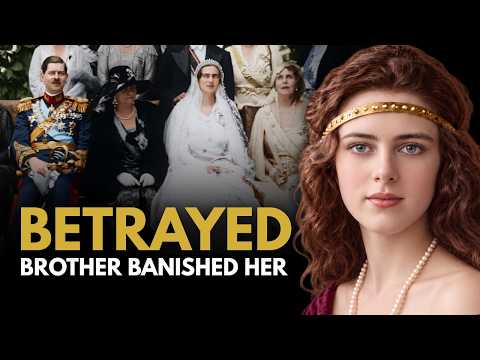
Born on January 5, 1909, in Bucharest’s Cotroceni Palace, Ileana was the youngest daughter of Crown Prince Ferdinand and Crown Princess Marie. Her birth was announced by twenty-one cannon shots, and her name was chosen from Romanian folklore—the name of the most beautiful princess in ancient tales. From the start, she was a child of destiny, but not the kind that leads to a throne.
Her mother, Princess Marie, was a British princess by birth, a granddaughter of Queen Victoria. She had come to Romania at seventeen as a bride, and she would become one of the most beloved queens in Romanian history. Ileana was her favorite. “We understood each other, always and in everything,” Marie would later write. The little princess was described as having large blue eyes, mature beyond her years, with a lively and athletic spirit. She seemed to know right from wrong from the moment she was born.
But the golden age of old Europe was ending. When Ileana was five, the shots at Sarajevo tore the continent apart. In 1914, her father became king, and in 1916, Romania entered World War I on the side of the Allies. As the enemy surrounded Bucharest, the royal family fled east to Iași, a crowded, freezing city. There, amid typhus, hunger, and endless trains of wounded soldiers, Ileana’s carefree childhood ended.
Her mother put on a Red Cross nurse’s uniform and moved between the wards. The little princess often accompanied her. She sat beside wounded soldiers, befriended officers in their beds, and prayed with them. According to her mother, she saved bread from her own table to give to hungry soldiers. In those hard months, something was born in her that would shape her entire life: the conviction that royal status is not a privilege of luxury, but a lifelong covenant of service.
When the war ended, Romania emerged doubled in size, finally united as Greater Romania. In 1922, Ferdinand and Marie were crowned king and queen. The country flourished, and so did its youngest princess. Ileana was not the type to fit the mold of a palace princess. She had a sharp mind, incredible endurance, and a spirit hungry for exploration. Her greatest passion was the sea. At a time when women of her class did not touch a ship’s helm, she studied navigation and seamanship seriously. Her mother wrote that she insisted on passing her naval exams like any man, without asking for royal favor. She earned her credentials as a navigator and for years sailed her own boat, Speranza.
Watching those white sails, Queen Marie admitted a hidden fear that they might one day take her daughter far away. But the sea was only part of Ileana’s immense energy. At fifteen, she sang and played with factory girls in reserve troupes, learning, as she put it, her way into social work. She went on to organize and lead Romania’s Girl Guides, founded Red Cross girls’ units, and helped establish the country’s first school of social service. Her mother watched her transform into a natural leader and a gifted speaker, comparing her to a little Joan of Arc, very modern. If Queen Marie was treated as a distant goddess, Ileana was loved as a daughter of the nation. As a later Romanian tribute described her, she became the beloved of the Romanian people. And that very love would signal the beginning of her personal tragedy.
In July 1927, King Ferdinand I died. The throne passed to his five-year-old grandson, Michael, under a regency. But in June 1930, Carol, Ileana’s older brother, returned to Bucharest. He had renounced his rights to the throne in 1925. Now he pushed his son aside and proclaimed himself King Carol II. The new king did not want to share the people’s affection. He removed his mother, Queen Marie, from public life and sought to diminish her popularity. His sister—young, unmarried, and beloved—was the next problem.
The solution was a marriage abroad. The candidate was Archduke Anton of Austria, Prince of Tuscany, born in Vienna in 1901, a member of the exiled House of Habsburg and a passionate pilot. Carol introduced them and encouraged the match. On July 26, 1931, at Peleș Castle in Sinaia, the fairy-tale palace in the Carpathian forests, the wedding was held, filmed by news cameras as a glamorous royal event. But behind the splendor was a royal warning. Carol declared that the Romanian people would never tolerate a Habsburg on Romanian soil and refused to grant the couple permission to live in Romania. Hannah Pakula, biographer of Queen Marie, believes this was his plan from the start. In effect, the princess had been sent into exile.
Queen Marie later wrote that when her daughter left, she turned her face to the wall and wept. Ileana and Anton settled in Austria, making their home at Sonnberg, a castle near Vienna. Between 1932 and 1942, she gave birth to six children. The children were raised in their father’s Catholic faith, while she remained Orthodox. Her son Stefan later recalled that she placed a little Romanian soil under the bed of each newborn child.
On July 18, 1938, Queen Marie died in Sinaia. She left her favorite daughter Bran Castle, the medieval fortress perched on a rock in a Transylvanian mountain pass. As she wished, her heart was buried apart from her body in a chapel at her palace in Balchik on the Black Sea. With the outbreak of World War II, the fragile peace around Ileana collapsed. Archduke Anton was called to fly for the German Luftwaffe, serving as a pilot until late in the war. Sonnberg was initially used to house German troops. Then Ileana turned it into a Red Cross hospital for wounded Romanian soldiers, and she worked there herself.
In Romania, too, the world was crumbling. In 1940, the country was forced to cede vast territories, and Balchik passed to Bulgaria. At Ileana’s request, her mother’s heart was transferred to Bran and placed in a small chapel carved into the rock opposite the castle. The following year, little Mircea was reburied beside it. In September of that year, King Carol abdicated and left the country permanently. The door that had been closed to Ileana was opened again.
In early 1944, she gathered her children and returned home to Bran. In the village below the castle—later surrounded by Dracula legends—she established a military hospital and named it after the heart in the rock above: Queen’s Heart Hospital. Wounded men streamed from the front. The princess worked there as a nurse and ran the hospital as its director, later devoting an entire book to her daily life there.
On August 23, 1944, King Michael led a coup that pulled Romania out of its alliance with Germany, and the Red Army swept into the country. Anton, who had joined the family at Bran, was placed under house arrest. Yet the hospital did not close its doors. It evolved from a military hospital into one that treated villagers, the sick, and anyone who knocked. The end of the war did not bring freedom to Romania. Under Soviet occupation, the Communists steadily seized power. On December 30, 1947, King Michael was forced to abdicate, and Romania was declared a people’s republic. Within days, an order was issued for Ileana and her family to leave the country. Bran, the hospital, and the tombs carved in the rock were left behind.
She described that departure in the final chapter of her memoir, I Live Again. It was January 7, 1948. The servants wept in the narrow hallway of the house. At the gate, a local innkeeper, a Communist she had been warned about repeatedly, pushed the guard aside and embraced her. At the bridge, crowds of peasants and students gathered. According to her account, they offered her fir branches—evergreen symbols of love and faith—and knelt in the road to ask for her blessing. The road was blocked by snowdrifts, so the small convoy tried to cross the fields near the industrial village of Tohani, and the cars sank into the melting mud. Ileana walked to the workers who had finished their shift and asked for help. They pulled the cars out in silence and refused the money she offered. As she remembered, their spokesman told her that the land itself hated her departure and asked her to kneel with them and pray for the king, the country, and her return. She knelt in that muddy field as the sun set behind the Carpathian Mountains. The chapter ends with a single line: The sun was setting, but it would rise again.
Forty-two years would pass before she saw Romania again.
The train carried the family to Vienna, then came years of wandering and uncertainty. They lived for a time in Switzerland, then moved to Argentina. In 1950, Ileana was granted a visa to the United States. In 1951, after separating from Anton, she brought her four younger children to Newton, Massachusetts, a suburb of Boston. According to her obituary in The New York Times, she arrived carrying a diamond and ruby crown wrapped in a nightgown. Her son Stefan later recalled that she came with about three hundred dollars, and the crown was sold to buy a house for the family.
Alone with her children in a foreign land, the princess earned her living by lecturing. She traveled across America—according to her son, up to sixty thousand miles a year—speaking in churches, clubs, and halls about her life, the tragedy of her captive homeland, and the dangers of communism. She worked with the Romanian Orthodox Church in America and wrote two books: I Live Again and Hospital of the Queen’s Heart.
Her marriage to Archduke Anton, worn down by war and exile, formally ended in May 1954. He returned to Austria, where he lived until 1987. A month later, Ileana married Dr. Stefan Issarescu in Newton. That second marriage, too, ended in divorce. And fate was preparing the cruelest blow of all. On January 11, 1959, a Lufthansa passenger plane crashed in rain while approaching Rio de Janeiro. Among the dead were Ileana’s eldest daughter, Minola, just twenty-five, and her husband, Count Jaroslav Kotulinski. Minola was expecting her second child. She left behind a baby girl.
Two years later, her son Stefan fell gravely ill, and she helped nurse him until he recovered. After a difficult surgery, her daughter’s death, and her son’s illness, she felt, as Stefan later put it, the need to dedicate her life entirely to prayer and the Church. In 1961, with the blessing of Metropolitan Anthony Bloom, she entered the small Orthodox convent of the Protection of the Mother of God in the French village of Bussy-en-Othe. There she spent six years testing her vocation in a daily routine of prayer and work. Each summer she returned to America, where she taught about Orthodoxy and monastic life.
In 1967, in that quiet French convent, she was tonsured a nun. The great-granddaughter of Queen Victoria received a new name. In the language of monastic life, Princess Ileana of Romania had died to the world. And Mother Alexandra was born.
She did not remain in France. During the summers she spent in America, she became convinced the country needed something it did not yet have: a monastery where American women of any background could live Orthodox monastic life in English. In 1964, land was purchased in Ellwood City, among the wooded hills of western Pennsylvania. In 1967, she returned there to stay and founded the Orthodox Monastery of the Transfiguration. According to her son, much of its cost was paid from her own money. A small community of nuns gathered around her, and she became its first abbess, leading it until the early 1980s.
Within these walls, the former princess revealed herself as a spiritual writer. She wrote about the Lord’s Prayer, the Creed, the Jesus Prayer, and the holy angels. She traveled widely to speak about her faith. When Stefan visited her at the monastery, he found his mother at greater peace than he had seen her in a long time. The princess who had lost two homes had built a third out of nothing but faith and determination.
Decades passed. The Communist regime in Romania seemed as though it would last forever, and the hope of seeing her homeland had faded. Then, in December 1989, revolution overthrew the dictatorship of Nicolae Ceaușescu. Romania was free. In September 1990, after forty-two years of exile, Mother Alexandra made the last great journey of her life. She returned to Romania, accompanied by her daughter Alexandra, to visit her parents’ graves. She did not come as a claimant to palaces, but as a pilgrim. Her strength was fading.
On the evening of January 4, 1991, on the eve of her eighty-second birthday, she fell at the monastery and fractured her hip. In a hospital in Youngstown, Ohio, she suffered a severe heart attack. On January 21, 1991, Mother Alexandra died at the age of eighty-two. She was the last surviving child of King Ferdinand and Queen Marie. She was buried in the quiet monastery cemetery in Ellwood City. According to her son, a small box of Romanian soil, which she had kept through all her years of exile, was buried with her in her grave. On her gravestone, at her request, were carved the words of Saint Paul: “Whether we live or die, we are the Lord’s.”
She was born at the height of Europe’s royal glory. She sailed her own boat, built hospitals, and spoke before crowds on two continents. She suffered the betrayal of those closest to her, the ravages of two world wars, the poverty of exile, and the loss of a beloved child. Yet none of these blows extinguished her kindness. Where others broke, or cursed their fate, or demanded revenge, she answered with work, compassion, and prayer.
Today, the Monastery of the Transfiguration in Pennsylvania still welcomes nuns and pilgrims. In 2006, Bran Castle was returned to her son Dominic. And the memory of Princess Ileana endures as a reminder that true greatness does not depend on the shifting tides of politics, and can shine brighter than any royal crown.
So tell me—when the fairy tale ends and no hero comes, what kind of story do you choose to write for yourself?
Report this article
Select a reason for reporting:






