Sarah Mitchell had spent three years cataloging forgotten lives, but nothing prepared her for the cardboard box labeled simply Family Photos 1900s. Inside, wrapped in crumbling tissue paper, lay a formal studio portrait from 1903—a well-dressed family frozen in time, their faces solemn, their secrets intact. But it was what Sarah noticed in the background that made her heart race: an open book, deliberately placed on an ornate table, its pages just barely visible.
She leaned closer under her desk lamp, magnifying glass in hand. The book was open to two pages, with faint markings that could have been text or illustrations. But the photograph’s age and the limits of 1903 technology made it impossible to read. Still, Sarah’s instincts screamed that this was no ordinary prop. Every element in a studio portrait was intentional—especially for a family that had paid good money to be immortalized.
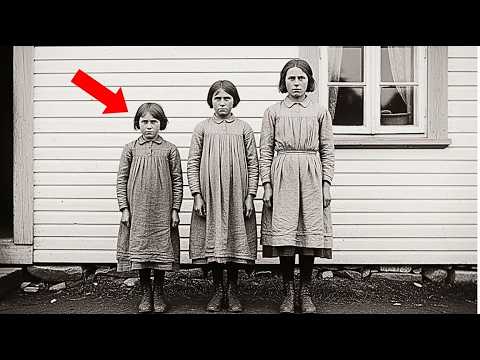
She flipped the photo over. In faded pencil, elegant cursive read: “The family, Murphy Studio, Boston, March 1903.” No names, no occasion—just a tantalizing hint of a story waiting to be uncovered. Sarah photographed the portrait with her high-resolution camera and uploaded it to her computer, zooming in on the book. Even with digital enhancement, the details remained frustratingly unclear. She saved the file and made a note to bring it to her supervisor’s attention. Something about this photograph felt significant, though she couldn’t yet articulate why.
Three days later, Dr. James Harrison, the society’s senior curator, stood behind her desk, studying the screen. “You think there’s something worth pursuing here?” he asked, squinting at the magnified section. Sarah pointed at the book. “Look at the positioning. Everything in studio photographs from this period was carefully arranged. Why include an open book unless it meant something specific?” James nodded slowly. “Fair point. What do you propose?” Sarah didn’t hesitate. “Send it to the digital forensics lab at the university. They have new imaging software that can extract details from historical photographs that weren’t visible even a few years ago.”
Two weeks passed before an email arrived from Dr. Chen at the imaging laboratory. The subject line read simply: “You need to see this.” Attached were three enhanced images, each showing a different section of the book’s pages, now rendered in startling clarity. Sarah opened the first attachment with trembling fingers, her coffee growing cold on her desk as she stared at the screen. The left page showed a geometric symbol she recognized immediately—a compass overlaying a square, the unmistakable emblem of Freemasonry. But it wasn’t just a simple drawing. Surrounding the central symbol were intricate diagrams, lines connecting various points in complex geometric patterns, annotations in careful handwriting, and what appeared to be degrees or measurements marked at specific intervals.
The second image showed the right page covered in dense handwritten text arranged in neat columns. Several phrases were perfectly legible: “third-degree ceremony,” “master mason,” “obligation of silence,” and most striking of all, a list of names with dates beside them, formatted like a registry or membership roll. The third image provided a wider view, showing both pages together along with a portion of the book’s leather cover, where gold embossed letters spelled out partial words that Dr. Chen’s software had reconstructed as “Ancient and Accepted Scottish Rite.”
Sarah picked up her phone with hands that were actually shaking now and called James. “You need to come down here right now,” she said, her voice barely steady. “I know what we’re looking at, and if I’m right, this family was hiding something that could have destroyed them completely.” Within an hour, James was back in her office, and they were both staring at the enhanced images in stunned silence. Sarah had pulled up several reference books on Freemasonry and laid them open on her desk, comparing the symbols in the photograph to illustrations in the texts.
“My God,” James whispered, running his hand through his graying hair. “That’s not just any Masonic book. That’s a ritual manual, a working book that would have contained the actual ceremonies and secrets of the lodge. These weren’t sold publicly. They were handmade or specially printed for high-ranking members only.” “And it’s in a Catholic family’s portrait,” Sarah added quietly. “In 1903 Boston, that combination would have been absolutely explosive.” James looked at her sharply. “How do you know they were Catholic?” Sarah pulled up another document on her computer. “I’ve been researching. The Murphy Studio was located in the North End, which was predominantly Italian and Irish immigrant territory. The family’s clothing and the modest studio suggest they weren’t Protestant elite. And look at the children. Those are Catholic school uniforms, I’m almost certain.”
They sat in silence for a moment, contemplating the implications of what they had discovered. Sarah spent the next two days barely leaving her desk, except to use the restroom and grab increasingly cold coffee from the breakroom. She needed to understand exactly what they had found and why it mattered so profoundly. The more she read about Freemasonry in early 20th-century Boston, the more the weight of the photograph settled on her shoulders—and the more the mystery deepened.
In 1903, Boston was a deeply Catholic city. Its population had been swelled by massive waves of Irish and Italian immigration that transformed the city’s character over the previous fifty years. These immigrants brought their Catholic faith with them as a cornerstone of identity, community, and survival in a new world that was often hostile to their presence. The Catholic Church had formally condemned Freemasonry multiple times throughout the 19th century, declaring it fundamentally incompatible with Catholic faith and teaching. Pope Leo XIII had issued a particularly strong papal encyclical in 1884, specifically denouncing Masonic organizations as enemies of Christian civilization, calling them dangerous secret societies that promoted religious indifferentism and moral relativism.
For a Catholic family in Boston to be involved with Freemasonry wasn’t just socially awkward or theologically questionable. It was spiritual treason of the highest order. Discovered members faced immediate excommunication, which in those tightly knit immigrant communities meant complete social death. Catholic-owned businesses would be boycotted into bankruptcy. Children would be ostracized and bullied at parish schools. And families could be driven from their neighborhoods entirely by the combined pressure of clerical condemnation and community shunning.
Yet, paradoxically, Freemasonry was simultaneously flourishing among Boston’s Protestant establishment—the lawyers, judges, businessmen, politicians, and civic leaders who controlled the city’s economic and political machinery. The Masonic lodges offered powerful networking opportunities, pathways to social advancement, and a sense of brotherhood and mutual obligation that transcended normal business relationships. For an ambitious man, especially an immigrant trying desperately to climb the social ladder in a society structured to keep him at the bottom, Masonic membership could open doors that would otherwise remain firmly and permanently closed.
Sarah found census records from 1900 and 1910, searching systematically for families who might match the photograph’s composition. She was looking for a family with the right number of children, the right age distribution, living in Boston’s North End during that crucial period. The search was tedious and often frustrating, involving cross-referencing multiple databases and dealing with handwriting that was sometimes nearly illegible, even in scanned form. Finally, after hours of searching, she found a promising lead that made her pulse quicken. The 1900 census listed a family at an address on Hanover Street in the North End. Father aged 39, mother aged 35, four children ranging from 4 to 14 years old. The father’s occupation was listed simply as merchant.
Sarah cross-referenced the Hanover Street address with church records at the Boston Archdiocese, which had digitized many of their historical parish registries in recent years. Her hands were actually shaking as she opened the digitized records for St. Leonard’s Church, one of the primary Italian parishes in the North End. There it was, exactly as she had hoped and feared. The family had been registered members, with baptismal records for all four children, marriage records for the parents, and regular notations of Easter duty compliance indicating they were practicing Catholics in good standing. The father’s name was Thomas Murphy—an Irish name in a predominantly Italian parish, suggesting he was part of the earlier wave of Irish immigration that had preceded the Italian influx. The mother was Mary, maiden name unrecorded in these particular documents. The children were Michael, Catherine, Margaret, and Elizabeth, their ages matching the apparent ages in the photograph.
Sarah found more records in the city directory for 1903, published just months after the photograph would have been taken. Thomas Murphy, merchant, maintained a dry goods store at the same Hanover Street address where the family lived. These combined business-residential properties were common among immigrant merchants who couldn’t afford separate commercial and domestic spaces. Business records from the Massachusetts Secretary of State’s office revealed more. Thomas had incorporated his business in 1895, listing himself as sole proprietor. Property records showed he had purchased the building outright in 1898—a remarkable achievement for an Irish Catholic immigrant in an era when property ownership was often difficult for immigrants to secure due to both economic barriers and occasional outright discrimination.
But the most significant discovery came from an unexpected source. Sarah found Thomas Murphy’s name in the membership records of the Ancient and Accepted Scottish Rite, housed in the archives of the Massachusetts Grand Lodge. He had been initiated into Freemasonry in 1887, just nine years after arriving in America. By 1901, he had risen to the 32nd degree. And in 1902—just one year before the photograph—he had been elevated to the 33rd degree, the highest honor in Scottish Rite Freemasonry. The 33rd degree was not simply advanced membership. It was reserved for Masons who had demonstrated exceptional dedication, service, and leadership within the organization. Thomas Murphy’s lodge brothers, listed in the same records, included judges, bank presidents, city councilmen, and prominent Protestant businessmen—exactly the kind of powerful connections that could transform an Irish immigrant’s struggling dry goods store into a prosperous family business.
Thomas Murphy had achieved what many ambitious immigrants attempted but very few accomplished. He had penetrated the Protestant establishment by joining their secret brotherhood. The connections he made through the lodge had clearly given him access to credit, business opportunities, legal protection, and social networks that would have been utterly impossible for an Irish Catholic through normal channels. Sarah sat back in her chair, staring at the photograph on her screen with new understanding. Thomas Murphy’s expression no longer seemed simply stern. It now appeared defiant, almost challenging anyone who might judge him for his choices. Mary’s tense posture and tightly clasped hands took on new meaning as well. She must have known. She must have lived every day with the knowledge that her husband was committing what the church considered a mortal sin—that their family’s prosperity was built on a foundation of spiritual treachery.
The cost of Thomas’s success must have been enormous. If his Catholic neighbors on Hanover Street discovered his Masonic membership, they would have destroyed him economically and socially. If the parish priest found out, excommunication was absolutely certain—and the shame would have extended to his entire family. His children would have been pariahs, unmarriageable within the Catholic community.
Yet if he abandoned the Masons, he would lose the business connections that allowed him to compete with established Protestant merchants, and his family would likely sink back into poverty. He was trapped, Sarah realized, walking a razor’s edge between two incompatible worlds every single day of his adult life.
She found more records documenting the Murphy family’s trajectory. The eldest son, Michael, had attended Boston Latin School starting in 1904—highly unusual for an Irish Catholic boy, and almost certainly made possible through Masonic connections. The daughters had attended private academies rather than parish schools, another marker of the family’s rising status and another decision that must have raised eyebrows in their Catholic neighborhood.
Then Sarah found something that made the hair on the back of her neck stand up. In the parish death records for St. Leonard’s Church, she found Thomas Murphy’s name. He had died in January 1911 at age 50, and his funeral mass had been held at the church with full Catholic rites. Father Joseph Morelli had presided, and Thomas had been buried in the Catholic section of Holy Cross Cemetery. Somehow, incredibly, his secret had remained hidden until his death.
Or had it? Sarah wondered if Father Morelli had known or suspected—and had chosen mercy over rigid enforcement of church law. It was possible, even likely. Priests dealt with human weakness and impossible situations every day. Perhaps the priest had understood that Thomas Murphy, for all his theological transgressions, had been a good father, a faithful husband, and a man who attended mass every Sunday and never missed his Easter duty.
The photograph took on even deeper meaning now. It was taken in March 1903, when Thomas was at the height of his success and his secret was still secure. Within eight years, he would be dead. But the book in the background—that deliberate, defiant inclusion—was his quiet testament, a message to anyone who might one day look closely enough to see the truth.
Sarah sat back, the weight of the discovery settling over her. Thomas Murphy had not been a villain or a hypocrite. He had been a man caught between two worlds, doing what he could to survive and provide for the people he loved. And now, more than a century later, his secret was finally out—not as a scandal, but as a story of impossible choices and quiet courage.
What would you have done in Thomas Murphy’s place—betray your faith or watch your family starve?
Report this article
Select a reason for reporting:






