December 19, 1944. A cold stone barracks outside Verdun. Sixteen officers sit in uneasy silence as General Dwight Eisenhower asks the question that will decide the fate of thousands: Who can rescue the surrounded Americans at Bastogne?
Three days earlier, over 200,000 German troops had stormed out of the Ardennes forest, backed by nearly a thousand tanks and 1,900 artillery pieces. Allied intelligence had missed it almost entirely. Now, the 101st Airborne was trapped in a Belgian crossroads town, and the clock was ticking.
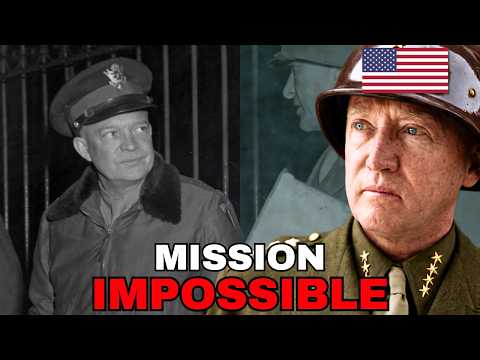
Most of the men in that room commanded troops facing the wrong direction, mid-attack somewhere else, a hundred miles or more from the fighting. When it was his turn, Lieutenant General George S. Patton said his Third Army could attack north with three divisions inside 48 hours. The room laughed, not politely, either.
To understand why they laughed, you have to understand what Patton was actually offering. His Third Army numbered over 250,000 men, spread across a front facing east, mid-attack toward Germany’s Saar region. Turning that force 90 degrees, pulling three corps out of one offensive and pointing them at another across secondary roads in weather multiple accounts call the worst Europe had seen in 50 years—that was not the kind of thing an army did on 48 hours’ notice.
Eisenhower had asked for six divisions. Patton reminded him he only had three to give. What the room didn’t know was that Patton had already spent the past week preparing for exactly this moment. There’s a name behind that preparation, the record almost lost. And this story is going to come back to it. Hold on to that.
When Eisenhower pushed on timing, Patton first offered December 21st. Eisenhower, unconvinced he could move that fast without leaving his own flanks exposed, called the offer fatuous. Patton adjusted. December 22nd with three divisions: the Fourth Armored, the 26th Infantry, the 80th Infantry. If a promise like that gets your attention, wait until you see what it actually cost to keep.
What followed wasn’t one dramatic gesture. It was six days of an army dragged sideways through ice. Major General John Millikin’s Third Corps started moving before the meeting at Verdun had even finished. Major General Manton Eddy’s 12th Corps, fighting in the south, had to swing around and absorb Third Army’s abandoned eastern front. Meanwhile, Lieutenant General Alexander Patch stretched his own Seventh Army sideways to cover the gap left behind.
All of it moved on secondary roads never built for this kind of traffic, in cold that grounded Allied aircraft and buried convoys in drifts. Patton left Verdun and never went back to his own headquarters in Nancy. He moved straight to Luxembourg City and spent the next six days more often on the road than in any command post, pushing the movement forward by phone and by presence.
On December 22nd, exactly as promised, Third Army attacked north with three divisions. It took four more days to reach the men it was attacking to save. But who, exactly, were they racing to save? Four days earlier, when German officers had walked up under a white flag and demanded Bastogne’s surrender, the acting commander of the 101st Airborne had answered with a single word: “Nuts.”
The men Patton’s tanks were racing toward had already told the Germans exactly what they thought of being rescued through surrender. What they needed now was a road, not permission. By December 23rd, the spearhead already had a face. Captain Charles Trover, commanding C Company of the 37th Tank Battalion, was killed by a sniper while standing in his tank’s turret. His replacement was a 32-year-old lieutenant from Vermilion County, Illinois, named Charles Boggess.
Three days later, Patton’s whole promise would come down to him. On the afternoon of December 26th, C Company was down to nine tanks staged on high ground near a village called Closimont, five miles from Bastogne. Lieutenant Colonel Creighton Abrams—the officer the army would one day name its main battle tank after—briefed Boggess over a worn map and ended with four words: “Get to those men.”
At 4:15 that afternoon, Boggess’s tank, a Sherman nicknamed Cobra King, led the column out. They hit a fortified pillbox on the way in. Gunner Corporal Milton Dickerman worked the 75 mm main gun, in his own words, like it was a machine gun—21 rounds in a few minutes while the loader kept feeding shells. The column lost four Shermans pushing through the village of Assenois. Behind the survivors, the Germans detonated mines, knocking out a half-track and sealing the edges of the gap the column had just cut open.
The single lane they’d opened was now the only route in or out of Bastogne. Infantry spent the rest of that night clearing German stragglers from the woods on either side, and the village of Assenois itself wasn’t declared secure until 8:00. Near an old Belgian army pillbox on the far side of the village, Dickerman silenced a German position with three rounds.
In the fading light, Boggess spotted movement near the tree line and called out twice, “Come on out. This is the Fourth Armored.” A soldier broke from a foxhole. He introduced himself as Lieutenant Webster of the 326th Airborne Engineers and said he was glad to see them. The time was somewhere around 4:45 in the afternoon.
Twenty-five minutes later, at 5:10, Lieutenant Colonel Abrams shook hands with Brigadier General Anthony McAuliffe, the man commanding Bastogne’s defense. The siege that had trapped the 101st Airborne for six days was over. For the Fourth Armored Division alone, the cost of getting there ran close to 1,000 men killed and wounded. Five dead, 22 wounded, and five missing from the 37th Tank Battalion. 30 dead and 180 wounded from the 53rd Armored Infantry.
That’s how 48 hours became a promise kept on the 22nd and a corridor cut open on the 26th—for a price paid out in exact names on a casualty list. But the story doesn’t end there. Ten days before Verdun, on December 9th, Patton’s intelligence chief, a colonel named Oscar Koch, walked into Third Army headquarters with a briefing nobody else on the Western Front had given…
Koch laid out enemy strength the way his job required and told Patton plainly that if the Germans hit the thin line to the north, the odds in that scenario favored them. Patton’s response wasn’t alarm. It was, “We’ll be in a position to meet whatever happens.”
Three days later, he told his staff to start drawing up plans for turning the army north if the breakthrough came. On the morning of the 16th, before headquarters had confirmation the attack had even started, Koch told Patton he believed the Germans were moving, probably toward Luxembourg. By nightfall, he was right.
Third Army already had three complete plans ready, each needing nothing but a single code word over the telephone. Patton’s preferred version was called Sent. The trigger word, when the moment came, was two words: “Play ball.”
That’s the real shape of the 48-hour promise—not bravado in a briefing room, but homework finished a week early by a staff Patton trusted enough to listen to before he needed to. You’ve probably seen this shape before, somewhere far from a war room. The boldest person in the meeting gets remembered. The person whose evidence made the boldness safe does not.
And what makes this story unusual isn’t that Patton pulled off the fastest pivot an American army had ever attempted. It’s that the man who actually saw it coming a week before anyone else spent the rest of his career as a name historians have to go looking for. Oscar Koch got a line in Patton’s own diary calling him the best intelligence officer in any American command. Patton got the legend.
Charles Boggess went home, came back to Bastogne once in 1984, and told a reporter something worth remembering. “I believe it is appointed to each man to have a few minutes of glory in his life. Mine lasted four miles and 25 minutes.” He died the following year.
Creighton Abrams went on to command American forces in Vietnam and later became Army Chief of Staff, dying of cancer in 1974—six years before the Army named its next main battle tank after him. It would take until January 16th for the bulge to close completely. But the corridor Boggess opened on the 26th is the day military history marks as the moment Bastogne stopped being a siege and became a salient the Germans could no longer afford to keep surrounding.
Was Patton’s promise genius? Or was it a general cashing in on a colonel’s homework? Even the German commanders who tried to break them had something to say about it once the fighting was done—and their assessment cuts straight to the heart of why the American line held when it should have shattered.
Their verdict, recorded in the years after the war, was blunt: the Americans had won not because they were stronger, but because they were faster than anyone believed possible. A German corps commander reportedly admitted that the speed of the Third Army’s turn north broke the timetable the offensive depended on. The bulge was never meant to be a siege; it was meant to be a race—and the race was lost in a corridor four miles long.
So the question lingers, sharp as a December wind. Was it Patton’s genius that saved Bastogne, or was it Oscar Koch’s homework, finished quietly a week early while the rest of the front slept? The legend has an answer. History has a name. And the men who walked out of those foxholes had a road.
Maybe that is the truest shape of leadership—not the loudest promise in the room, but the quiet evidence that makes the promise safe to keep. Boggess had his four miles and twenty-five minutes. Koch never got his.
So tell me—when the history books close, who really deserves the legend: the one who made the bold claim, or the one who made it possible?
Report this article
Select a reason for reporting:






