Jennifer Hayes had restored hundreds of photographs, but the moment she lifted the Patterson family portrait from its battered frame, something felt wrong. The image was dated March 1930—a family of five posed stiffly against a painted studio backdrop. The mother held a small girl on her lap, but as Jennifer scanned the photo at high resolution, she noticed the child’s posture was off. The girl wasn’t sitting; she was being held up.
Jennifer had seen that look before—the unnatural stillness, the faint blue tinge around the lips. In fifteen years of restoration work, she’d uncovered secrets hidden under decades of grime, but this was different. This wasn’t a mistake to erase; it was a truth someone had tried to soften.
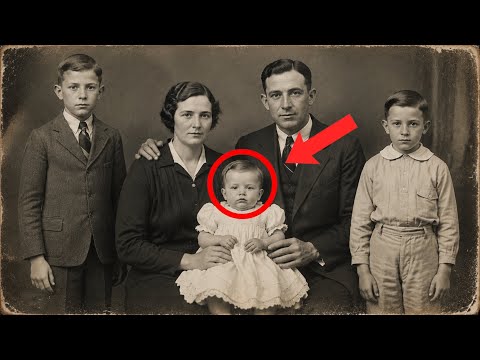
She zoomed in on the child’s hands. The fingernails were tinged with blue. The ankles looked swollen. Jennifer’s stomach tightened. She knew those signs from medical textbooks—cyanosis, edema. This little girl was dying.
She pulled the donation records. The photograph had come from the estate of David Patterson, along with boxes of family papers. Jennifer called the historical society’s archivist, Marcus Chen. “I think this little girl was seriously ill when this photograph was taken,” she said. “The signs are barely visible in the damaged image, but they’re unmistakable once restored.”
At the historical society, Marcus slid a folder across the table. A clipping from the Chicago Tribune, April 1930: Helen Rose Patterson, beloved daughter of Robert and Catherine Patterson, died April 12th, 1930, aged 3 years and 8 months. Jennifer’s throat tightened. The photograph was dated March 1930—one month before Helen died. The family had known.
She worked through bundles of letters tied with faded ribbon. A letter from January 1928 held the diagnosis: “Her heart is malformed… there’s no treatment. She might live a few months, maybe a year or two if we’re fortunate.” Another letter, February 1930, explained the portrait: “We want something tangible to hold on to once she’s gone… One photograph while Helen is still with us.”
Jennifer sat back, the weight of the story pressing down on her. This wasn’t just a photograph. It was a farewell.
Jennifer finished reading the letter from Thomas Patterson, the older boy in the photograph, now 95 years old. His words echoed in her mind: “Helen was more than a sick child. She was funny and sweet. She loved being read to.” She carefully placed the letter back in its protective sleeve, her fingers trembling slightly. The exhibition was already a success, but this—this personal testimony—added a layer she hadn’t anticipated.
She called Michael Patterson, Thomas’s son, who had brought the letter. “Thank you for sharing this,” she said. “It changes everything. It makes Helen real in a way the photograph alone couldn’t.” Michael’s voice was warm on the other end. “My father wanted her story told. He said the photograph kept her alive for him, and now it can do the same for others.”
Jennifer spent the next week integrating Thomas’s letter into the exhibition. She placed it beside Catherine’s diary entries, letting the voices of the family speak for themselves. Visitors lingered longer, reading every word. Some wept openly. Others stood in silence, hands clasped.
One afternoon, a young couple approached Jennifer. The woman was pregnant, her belly round beneath a loose sweater. “We saw the article about your restoration,” she said. “Our unborn baby was just diagnosed with a heart defect. They said it’s treatable, but we’re scared.” She glanced at the photograph of Helen. “Seeing this… knowing what families went through before… it gives us hope.”
Jennifer felt a lump in her throat. “Helen’s story is a reminder of how far we’ve come,” she said gently. “But it’s also a reminder of the love that carries families through.” The couple nodded, their eyes glistening. They stayed for another hour, reading every letter, every diary entry.
That evening, Jennifer received an email from Dr. Rachel Morrison, the pediatric cardiologist who had spoken at the opening. “I’d like to use the Patterson materials in our medical training,” she wrote. “Not just for the clinical signs, but for the human context. Our students need to understand that behind every diagnosis is a family facing the unimaginable.”
Jennifer agreed immediately. She began working with Dr. Morrison to create a case study that paired the restored photograph with Catherine’s letters and Thomas’s testimony. It would be taught alongside modern cases of congenital heart disease, showing how far medicine had come—and how much had stayed the same.
As she prepared the materials, Jennifer found herself thinking about Helen’s short life. Three years and eight months. “For however long you were given,” she whispered, echoing the words she’d written in her journal. The photograph had survived ninety years, and now it would teach future doctors, move visitors to tears, and keep Helen’s memory alive.
But there was one more thing she needed to do. She opened her email and began drafting a message to Michael Patterson. “I’d like to create a digital archive of the Patterson family materials,” she wrote. “Something that can be accessed by anyone, anywhere. So Helen’s story never gets lost again.”
She hit send and leaned back in her chair, exhausted but fulfilled. The exhibition had been running for three months, and the response had been overwhelming. Schools had requested field trips. Genealogists had reached out. Even a documentary filmmaker had expressed interest.
Jennifer looked at the restored photograph on her screen. Helen’s face, once hidden under decades of damage, now looked back at her with quiet dignity. The blue lips, the swollen hands—they were still there, but they no longer defined her. Instead, they were part of a larger story: a story of love, loss, and the enduring power of a family’s choice to remember.
She thought about the question Dr. Williams had posed at the board meeting: When do we reveal what a family worked so hard to conceal? The answer, Jennifer realized, was when the truth serves a greater purpose. The Pattersons had softened the signs of Helen’s illness, but they had also preserved her memory. By restoring the image, Jennifer had uncovered both the illness and the love—and in doing so, she had honored the family’s intention.
Her phone buzzed. A text from Marcus: “The historical society wants to extend the exhibition for another six months. They’re calling it the most impactful exhibit they’ve ever hosted.” Jennifer smiled. She typed back: “Tell them I’m honored. And tell them Helen’s story is just beginning.”
She stood up and walked to the window. Chicago stretched out below her, a city that had been home to the Pattersons nearly a century ago. Somewhere in those streets, Catherine had walked with Helen, Robert had worked overtime, and two young boys had learned to be gentle with their fragile sister.
Jennifer turned back to her desk. There was more work to do. The digital archive, the case study, the documentary—all of it would take time. But she was ready. After all, she had spent fifteen years restoring photographs. Now she was restoring stories.
And Helen Patterson’s story deserved to be told.
The digital archive took shape over the following weeks, and Jennifer found herself working late into the evenings, scanning letters and cross-referencing dates. It was during one of those late sessions that she noticed something she’d overlooked. Tucked inside Catherine’s diary, pressed flat between two pages, was a small square of paper covered in a child’s careful pencil strokes. A drawing of five stick figures holding hands, with the smallest one labeled in wobbly letters: “HELEN.”
Jennifer turned the paper over. On the back, in Catherine’s hand: Thomas drew this for Helen, February 1930. She kept it under her pillow. The drawing had survived ninety years, folded small enough to fit in a dying child’s hand.
She scanned it at high resolution and added it to the archive, but something about it nagged at her. The stick figures were arranged in a line, all the same height—except the smallest one, drawn slightly apart, with a circle around her. As if Thomas had already begun to place Helen somewhere separate, somewhere protected.
The documentary filmmaker, a woman named Priya Desai, visited the studio a week later. She spent an hour with the restored portrait before speaking. “I’ve made films about grief before,” she said finally. “But this is different. This family didn’t just lose a child. They documented the losing. That’s rare.”
Jennifer showed her the drawing. Priya went very still. “Can I film this?” she asked. “Not the object itself—the moment someone sees it for the first time.”
They arranged a small filming session with Michael Patterson and his grandchildren. Jennifer watched as the youngest, a girl of about seven, studied the stick figures. “That’s Aunt Helen?” she asked, pointing to the circled figure. “Why is she all by herself?”
Michael knelt beside her. “Because she was too sick to run around with the others,” he said. “But see how they’re all holding hands anyway? That means they were always connected, even when she couldn’t keep up.” The girl nodded slowly, then asked if she could draw her own picture of Helen to add to the archive.
Jennifer found her a sheet of paper. The girl drew a stick figure with a crown and a wide smile. “Because she’s a princess now,” she explained. “And princesses don’t have tired hearts.”
Priya caught the exchange on camera, and Jennifer saw her wipe her eyes behind the lens. Later, over coffee, Priya said, “That’s the film. Right there. A child who never met Helen understanding her through a drawing and a photograph. That’s how stories survive.”
But not everyone was comfortable with the attention. A week later, Marcus called Jennifer with a concern. “We’ve had a letter,” he said. “From a woman claiming to be a Patterson descendant. She says the family never consented to having Helen’s medical condition displayed so publicly. She’s threatening to contact the press.”
Jennifer’s stomach dropped. “Who is she?”
“A granddaughter of David Patterson—the younger boy. She says her grandfather never spoke about Helen and would have been horrified by the exhibition.”
Jennifer thought of David, the boy who had read aloud to Helen, sounding out the harder words. The boy who, according to Catherine’s letters, had asked when his sister was coming back. “Did she say why?” Jennifer asked.
“She says it was private family pain. She doesn’t think strangers should be picking through it.”
Jennifer sat with the accusation for a long moment. It was a fair question, she realized—one she’d wrestled with herself. “Can we arrange a meeting?” she asked. “I’d like to hear her out.”
The woman’s name was Susan Patterson-Keane, and she agreed to meet at the historical society the following Tuesday. Jennifer spent the weekend rereading every letter, searching for any sign of what David might have wanted. There was nothing explicit—just Catherine’s note that David had asked when Helen was coming back, and Robert’s letter saying the boy couldn’t sleep.
On Tuesday morning, Jennifer arrived early and set the restored photograph on the table between two chairs. Susan walked in precisely at ten—a sharp-eyed woman in her sixties, carrying a leather satchel. She didn’t sit.
“I’ll be direct,” Susan said. “My grandfather David was a private man. He never talked about Helen, not once in my whole childhood. When I asked about the little girl in the photograph on his wall, he changed the subject.” She paused. “You’ve put her illness on display for thousands of strangers. That’s not honoring him. That’s exploiting him.”
Jennifer nodded slowly. “I understand why it feels that way. But I’d like to show you something.” She slid Thomas’s letter across the table. “This is from your great-uncle. He wrote it before he died.”
Susan hesitated, then picked it up. She read in silence, her expression shifting as she moved through the pages. When she reached the line about Helen loving to be read to, her jaw tightened. “David did the reading,” she murmured. “He told me that once, when he was very old. Just once.”
“He told you about her?” Jennifer asked gently.
Susan set the letter down. “He said he used to read her his schoolbooks because she couldn’t go outside. He said she was the only person who ever listened to him without interrupting.” Her voice cracked. “Then he told me never to ask about her again.”
Jennifer let the silence settle. “Maybe he couldn’t talk about her because it hurt too much. But he kept her photograph on his wall his entire life. That’s not forgetting. That’s carrying.”
Susan looked at the restored portrait for a long moment. “He kept it up,” she said quietly. “Even when my grandmother wanted it moved to a back room.” She sat down at last, her satchel still clutched in her lap. “I don’t like the idea of strangers knowing her medical details. But I suppose… I suppose if David carried her for ninety years, someone should know why.”
They talked for another hour. Susan admitted she had her own copy of the photograph, inherited from David, tucked in a drawer she rarely opened. “I never understood why he kept it,” she said. “Now I think I do.”
Before she left, Susan made a request. “If you’re going to tell this story, tell the whole thing. Not just the sad parts. Tell people that David read to her. That Thomas carried her. That my great-grandmother sold her mother’s silver to buy medicine. Don’t let her be just a sick child in a photograph.”
Jennifer promised she would. She walked Susan to the door, and they shook hands—a tentative truce, but a truce nonetheless.
That afternoon, Jennifer added a new panel to the exhibition design. It would feature David’s story alongside Thomas’s, the two brothers who had loved their sister in different ways—one who spoke of her always, and one who never spoke of her at all. Both forms of grief, she wrote in her notes, were acts of love.
She was still at her desk when her phone rang. Priya, the filmmaker. “I heard about the descendant,” she said. “How did it go?”
“Better than I expected,” Jennifer said. “I think we just got the final piece of the story.”
“What’s that?”
Jennifer looked at the photograph of Helen, then at the child’s drawing beside it. “That silence isn’t the same as forgetting. Sometimes it’s just love that’s too heavy to speak.”
Susan’s words reshaped the exhibition’s final room. Jennifer added a quiet alcove where visitors could sit with the family’s grief—Thomas’s letter on one wall, David’s silence on another. “Both brothers carried her,” the panel read. “One in stories, one in stillness.”
On the exhibition’s last weekend, Michael brought his granddaughter to see the new alcove. The girl studied the drawing of stick figures, then looked up. “So Aunt Helen was never really alone?” she asked. Michael shook his head. “Never.”
Jennifer sealed the digital archive that evening, Helen’s face glowing on the screen. Ninety years of silence, finally answered. For however long you were given—and for however long love remembers.
What would you have done—reveal the truth, or let the family’s softness stand?
Report this article
Select a reason for reporting:






