The tracers come first. Red lines in the night sky curving down from 3,000 feet. So many of them they don’t look like individual bullets anymore. They look like a glowing rope, a dragon’s tail.
The sound follows a second later. Not the crack of gunfire, not the thump of a .50 caliber. This is different. This is a buzzsaw tearing through sheet metal. A sustained roar that doesn’t stop. 6,000 rounds per minute, 100 bullets every second. When the M134 minigun opened up over the Vietnamese jungle, it didn’t suppress the enemy—it erased them. The Viet Cong had a name for it: The Dragon.
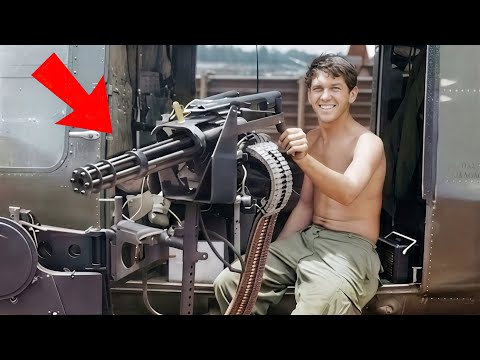
Helicopters changed everything in Vietnam. The jungle was too thick for tanks. Roads were kill zones. But helicopters could drop troops anywhere—on ridgelines, in clearings, behind enemy lines. The Bell UH-1 Iroquois, the Huey, became the symbol of American air mobility. Fast insertion, fast extraction.
But helicopters are fragile. Thin aluminum skin, exposed fuel tanks, slow approach speeds. And there’s a window—the critical 11 minutes of landing and takeoff—where the bird is low, slow, and completely vulnerable. The Viet Cong figured this out fast.
Their tactic was brutally simple. Let the Americans call in the helicopters, wait until the Huey is 50 feet off the ground and slowing for landing, then light it up with everything. AK-47s, RPDs, heavy machine guns, concentrated fire from three sides of a landing zone. A helicopter that takes fire during approach has two choices: abort or push through. Abort means the mission fails and the troops on the ground stay pinned. Push through means you might lose the bird and everyone on it.
The door gunners had M60 machine guns. Good weapons, reliable, 550 rounds per minute. But an M60 can’t suppress an entire tree line. Can’t make the enemy stop firing just by the sound of it spinning up. A door gunner with an M60 could engage targets he could see. He couldn’t make the jungle go silent.
The .50 cal was better, harder hitting, longer range, but only slightly faster rate of fire, and way too heavy for most helicopter mounts. And both weapons had the same fundamental limitation. They were gas operated. If a round didn’t fire, the gun stopped, jammed. And clearing a jam while taking fire at 100 feet altitude is a good way to die.
The army needed something different. Not a better machine gun—a fire hose.
The answer came from the Civil War. 1862: Dr. Richard Jordan Gatling patents a hand-cranked gun with multiple rotating barrels. The logic was elegant—spread the heat across six barrels instead of one, sustained fire without melting the gun. The Gatling gun worked, but by 1911, newer automatic weapons made it obsolete. The army declared it dead and sent the last ones to museums.
Then jets happened. World War II is over. Dogfights now last seconds instead of minutes. Standard machine guns can’t cycle fast enough. The Air Force needs overwhelming volume of fire. General Electric goes to museums, pulls out old Gatling guns, and bolts electric motors to them. Without the drag of a hand crank, with consistent electric power, the old design hits 4,000 rounds per minute. The M61 Vulcan, a 20mm six-barreled cannon, becomes standard on American fighters.
But 20mm is too big for helicopters—too much recoil, too heavy. So they scale it down. 7.62 NATO, six barrels, electric motor. They call it the minigun, designation M134.
What made it revolutionary wasn’t the rate of fire. It was the power source. A gas-operated gun needs each round to fire to cycle the action. Dud round, gun stops. The M134 doesn’t care. The electric motor spins the barrels regardless. Dud round? The rotation extracts it and ejects it. The gun keeps running. Variable rate of fire, 2,000 to 6,000 rounds per minute. At max rate, that’s 100 bullets per second. A 3-second burst delivers 900 rounds—more ammunition than most entire firefights used in total.
They mounted it everywhere—on Hueys, on the new AH-1 Cobra gunships, on O-6 Cayuse scouts. But the platform that made it legendary was a World War II transport plane nobody wanted anymore. The Douglas C-47 Skytrain. Slow, unarmored, obsolete. They cut gun ports in the left side and mounted three miniguns. Called it the AC-47. The crews called it Spooky. Or Puff, the Magic Dragon.
December 23rd, 1964. First combat mission. A remote outpost in the Mekong Delta is being overrun. No artillery can reach it in time. Spooky arrives overhead just after midnight. This is the part people get wrong. They think it was a strafing run. It wasn’t. The pilot banks left 30 degrees, then he holds it. The AC-47 circles—not strafing, orbiting. This is the pylon turn. The pilot coordinates bank angle and air speed so the left side of the aircraft stays pointed at one spot on the ground. The guns fire continuously as the plane circles. It’s not a gun anymore. It’s a cone of bullets. Everything inside the cone dies.
The sound isn’t like other weapons. It’s not thump-thump-thump. It’s a sustained roar. Like ripping fabric, like a chainsaw. Veterans describe it differently—buzz, roar, scream. But everyone agrees: once you’ve heard it, you never forget it.
And at night, you can see it. Every fifth round is a tracer. At 6,000 RPM, that’s 20 tracers per second. They don’t look like bullets. They look like a solid red line from sky to ground. A dragon’s breath.
The Viet Cong at Trung Hung broke contact immediately. They stopped fighting and ran. The AC-47 stayed overhead for two hours. By dawn, the VC were gone. The outpost held.
By the end of 1964, these prototype gunships had flown 16 missions. They’d fired nearly 180,000 rounds, and they hadn’t lost a single base. Word spread—in Vietnamese and in English. The Americans called it Puff because of the red tracers. The enemy called it the dragon. Some called it the monster.
Intelligence reports found written orders in captured documents: Do not fire at the dragon. Do not reveal your position. When you hear the sound, stop shooting and hide.
This is the detail no one talks about. The fear wasn’t rational. NVA soldiers were disciplined, experienced fighters. They’d faced B-52 strikes and napalm. But the minigun was different. A North Vietnamese veteran in a post-war interview said the worst part wasn’t being shot at. It was waiting. Hearing the aircraft circle overhead, waiting to hear whether the sound would start again, not knowing if you were inside the cone.
One statistic floated through Air Force channels and became legend: No base defended by Spooky was ever overrun while the aircraft was on station. Records are unclear whether that’s literally true, but everyone believed it. The infantry believed it. The enemy believed it.
By 1965, the Air Force was rushing more AC-47s into production. The army was retrofitting Hueys. Then came the AC-130 Spectre—four miniguns, four 20mm Vulcans, and later 40mm cannons and a 105mm howitzer. The 16th Special Operations Squadron started hunting trucks on the Ho Chi Minh Trail. Official records credit AC-130s with destroying over 10,000 trucks.
But the mission that showed what the weapon could really do happened in 1969. Fung Hip, a small South Vietnamese outpost. The NVA decided to take it. Regiment-sized force, human wave attacks throughout the night. Captain Winn Van Tong, a South Vietnamese Air Force pilot, flew an AC-47 over the base. He stayed on station all night. When his ammunition ran low, he flew back to base, reloaded, and returned. Then did it again. By dawn, his aircraft had fired 63,000 rounds in one night. One aircraft. The outpost held.
63,000 rounds is difficult to visualize. If you laid them end to end, they’d stretch over three miles. The logistics alone—loading that much ammunition, managing the feed systems, coordinating with ground forces to avoid fratricide—required extraordinary crew coordination. But it worked. The NVA withdrew, and the story spread through both armies.
The psychological warfare guys understood what they had. They started pairing minigun gunships with wandering soul Buddhist funeral music and wailing voices played from loudspeakers, telling VC soldiers their ancestors wanted them to go home. Pure psychological horror. The tape would play. The VC, spooked or enraged, would fire at the sound. The moment muzzle flashes appeared, Spooky would open up. Spiritual terror plus kinetic annihilation.
The NVA adapted. They started hugging American positions, moving so close that gunships couldn’t fire without hitting friendlies. They dug deeper bunkers with overhead cover that could stop 7.62. They mastered light discipline at night. And they kept fighting. But they never stopped fearing the dragon.
February 24th, 1969. An AC-47 called Spooky 71 is hit by a mortar shell. Shrapnel tears through the cargo bay. The crew is wounded, and a Mark 24 magnesium flare—armed and ready to drop—gets knocked loose. It’s rolling around the floor. Ammo cans, minigun belts, hydraulic fluid everywhere. The flare burns at 4,000 degrees. If it ignites, everyone dies.
Airman First Class John Levitow has 40 shrapnel wounds, bleeding, half conscious. He sees the flare. He throws himself on it, grabs it, and drags it to the open cargo door. The flare is burning his hands. He doesn’t let go. He hurls it out into the night. Seconds later, it ignites. Levitow saved the aircraft and the crew. He received the Medal of Honor—one of the few enlisted airmen to ever receive it.
June 18th, 1968. Captain Larry Taylor is flying an AH-1 Cobra when he gets a call. A four-man LRRP team is surrounded. No extraction bird available. Taylor empties his rockets, empties his minigun. The enemy is still coming. He lands his two-seat attack helicopter in the middle of a firefight and tells four men to climb onto the rocket pods and skids. They cling to the outside while Taylor flies them out under fire. The minigun suppression he’d laid down gave them the seconds they needed. Taylor received the Medal of Honor in 2023—55 years late.
These stories aren’t outliers. They’re what the weapon enabled. The minigun changed what was possible in the air. But inside those shaking helicopters, it changed the men who used it.
Being a door gunner with a minigun wasn’t like the movies. The weapon weighs 85 pounds with the full system—battery pack, feeder, ammo can. Mounting it on a Huey meant you lost troop capacity. Some crews did it anyway for night missions where volume of fire mattered more than precision. The physical sensation isn’t recoil, it’s torque. The barrels spinning create a gyroscopic effect. The gun wants to twist in your hands. You’re not aiming at individuals. You’re hosing a grid square. Veterans describe it like using a pressure washer. Pointed at the jungle, erase the jungle.
The noise, even through a flight helmet, is brutal. Most door gunners came home with permanent hearing damage. And the ammunition consumption is terrifying. A trigger-happy gunner could empty the entire supply in under 60 seconds, leaving the helicopter defenseless. Training emphasized fire discipline—short bursts, walk the tracers onto target, conserve ammo. For the AC-47 and AC-130 pilots, the challenge was flying the gun sight. Maintain a perfect pylon turn, exact bank angle, exact air speed to keep the guns on target. Too steep and the rounds fall short. Too shallow and they go long. The biggest fear wasn’t enemy fire. It was friendly fire. A navigation error, a misidentified position—and that volume of fire goes on to American troops.
The minigun had maintenance issues. Vietnam’s humidity corroded electrical contacts. Dust fouled the feeder mechanisms. The ammo belt, if slightly twisted or if the links were corroded, would jam the feeder. But it kept working. And it kept killing.
Now, let’s talk about what it couldn’t do. 1987, Predator comes out. Jesse Ventura carries an M134 and fires it from the shoulder. Terminator 2 does the same. The myth is born: man-portable minigun. Physically impossible. The recoil force at 6,000 RPM is over 150 pounds. The weapon requires a car-sized battery to spin the motor. The movie prop was powered by a cable running down Ventura’s pant leg to an offscreen battery, firing blanks at reduced rate. The ammunition—1,000 rounds of 7.62—weighs 60 to 70 pounds. A 10-second burst empties a backpack most men couldn’t lift. The minigun works because it’s vehicle-mounted. Period.
Why didn’t the Soviets build one? The NVA relied on Soviet weapons—AKs, RPDs, DShK heavy machine guns—but no rotary gun, no Spooky equivalent. Soviet doctrine emphasized artillery and simplicity. They wanted weapons a conscript could maintain in a frozen trench. A minigun is complex, power-hungry, logistically expensive. But there’s a simpler answer: the NVA couldn’t support the logistics. No generators, no massive ammo stockpiles, no heavy-lift helicopters. The minigun was an American solution to an American problem: how do you make a fragile helicopter survivable in a jungle full of people trying to kill it? The answer: give it a weapon so overwhelming that the enemy stops shooting.
The M134 is still in service. The modern variant, the M134D, uses titanium housing and improved feeders. It’s mounted on Blackhawks, on special operations vehicles, on Navy patrol boats. The core design hasn’t changed. 70 years after Gatling patented it, 60 years after Vietnam, some designs just work.
But the veterans who used it don’t talk about the specs. They don’t talk about rate of fire or barrel life or feed mechanisms. They talk about the sound—that sustained roar that echoed over the jungle canopy at 3 a.m. when a base was under attack and everyone was waiting to see if they’d survive until dawn. And they talk about what it felt like when Spooky arrived overhead. When the tracers started falling, when the dragon opened its mouth and breathed fire, the enemy would stop shooting. Not because they were all dead—because they were too scared to fight back.
When the minigun finally stopped firing, there was a moment—just a few seconds—where the jungle didn’t erupt again. It went quiet. And in Vietnam, that silence was never good. It meant the enemy wasn’t there anymore. Or it meant they were waiting, breath held, praying the sound wouldn’t start again.
So what do you think? Does the dragon’s roar still echo in the memories of those who heard it—and should we remember the minigun as a weapon of terror or a lifesaver? Share your thoughts in the comments.
Report this article
Select a reason for reporting:






