Dr. Rachel Morrison had seen thousands of 19th-century photographs in her career as a museum conservator, but the moment she lifted the framed portrait from its shipping container, something cold coiled in her chest. The image showed a Victorian family in a garden—a stern father, two solemn children, and a mother cradling an infant. Everyone in the picture looked perfectly still, perfectly composed. But the baby’s eyes were closed, its tiny hands folded across its chest, and its skin had an unnatural, waxy pallor that made Rachel’s breath catch.
She zoomed in on the infant’s face, adjusting the contrast on her monitor. What she saw made her blood run cold: the baby wasn’t sleeping. It was dead.
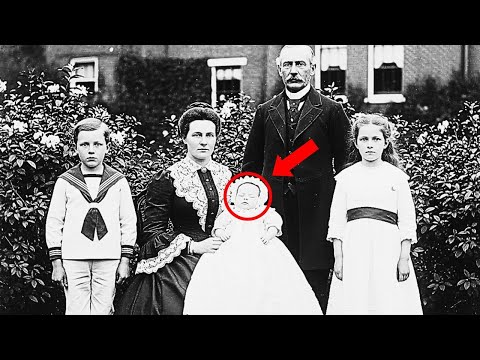
The photograph was a postmortem portrait—a common Victorian practice when infant mortality was staggering and photography was a rare luxury. But this one was different. The mother’s eyes, magnified on Rachel’s screen, held an agony so raw it seemed to leap across 142 years. She wasn’t cradling a sleeping child; she was holding her dead son for the last time.
Rachel’s hands trembled as she turned the frame over. A faded inscription read: “Our beloved Charles Edward, taken from us June 15th, 1882. Gone, but never forgotten.” The baby had been just three months old.
The museum’s archives led Rachel to a ledger from Whitman and Sons Photography. The entry for June 1882 was chilling: “Memorial portrait of infant deceased. Rush commission, completed same day. Payment, $25.” That sum was a month’s wages for a working-class family—a small fortune for a single photograph. But for the Ashfords, it was worth every penny.
Rachel tracked down Margaret Ashford’s letters to her sister, Clara. In one dated June 20th, 1882, Margaret wrote: “We dressed Charles in his christening gown and I held him one last time while Mr. Whitman took our portrait in the garden. Without this image, future generations will not know he existed.”
The words blurred as Rachel read on. Margaret described how her son Henry had wanted to touch his baby brother but was frightened by how cold and still he was. Elizabeth had cried throughout the session. And yet they posed, holding their dead child, because they refused to let his brief life be erased.
What Rachel discovered next would change everything—a handwritten note from Margaret, tucked into the family Bible, dated 1925. It read: “Keep this photograph always and remember that every life, no matter how short, has meaning and value.”
Rachel stared at the image again. The baby’s closed eyes, the mother’s hidden anguish, the father’s stiff-backed grief—all of it frozen in silver and glass. She thought of her own proposal for an exhibition, of the visitors who would stand before this portrait and feel the weight of a mother’s love reaching across centuries. But she had no idea, not yet, how deeply this photograph would touch the living—or what it would reveal about the secrets we keep and the memories we refuse to bury.
Rachel spent the following week assembling the exhibition’s supporting materials, but one detail nagged at her. The inscription on the frame named four family members—Margaret, William, Henry, and Elizabeth—yet the ledger described a rush commission completed in a single day. Something about that haste unsettled her. A family wealthy enough to afford a double-rate memorial portrait would not ordinarily have waited three days to summon the photographer.
She returned to the Ashford papers with a narrower question. Why June 18th? Charles Edward had died on the 15th. The burial, Margaret’s letter revealed, had taken place on the 20th. That left a three-day gap between death and portrait, an interval that seemed deliberate rather than accidental.
Among the business ledgers from William’s importing company, Rachel found a single sheet of personal correspondence misfiled between invoices—a letter from William Ashford to his brother-in-law, dated June 17th, 1882. The handwriting was cramped and hurried, the ink smudged in places.
“The doctor advises we bury the child quickly, before the heat worsens,” William had written. “But Margaret will not consent to the funeral until the photographer has come. She says she cannot put Charles in the ground without something to keep. I have sent word to Whitman and Sons, but they cannot come until Monday. Three days, my friend, three days we must keep our son in this house, and the weather is warm.”
Rachel set the letter down and pressed her fingers to her temples. The delay had not been a luxury of grief. It had been a necessity born of a mother’s refusal to bury her child without a likeness to hold. Three days in a warm June house, waiting for a photographer’s schedule to open.
She read on. William described the measures taken to preserve the body—ice packed in cloths, the nursery kept shuttered and cool, the windows sealed against the summer air. The undertaker had warned that the child’s features might change. Margaret had sat with the body through the nights, watching for any sign of deterioration, insisting that the portrait must show Charles as he had been.
The letter’s final lines were nearly illegible, the pen pressed hard enough to tear the paper. “I do not know what to do for her. She speaks to him as though he lives. She has not eaten since Thursday. If this photograph gives her peace, I will pay any sum and wait any number of days.”
Rachel sat back, the reading room silent around her. She had assumed the photograph captured a moment of composed grief. Now she understood it had captured something harder—a vigil. A family keeping watch over a small body in a shuttered room, counting the hours until a stranger with a camera could arrive to make the loss real and permanent.
She pulled up her exhibition notes and began to revise. The wall text she had drafted described the photograph as a “memorial portrait.” That was accurate, but it was incomplete. It had been a deadline, a race against decay and heat, a mother’s last act of defiance against a world that wanted her to bury her son and move on.
Rachel glanced at the clock. It was nearly six. The museum would close soon, and she still needed to speak with Dr. Wellington about the exhibition’s opening remarks. But first she wanted to examine one more thing—the negative, if any trace of it survived, or the studio’s proof book, which might show whether other exposures had been attempted before the final image was chosen.
She wrote a note to the Historical Society requesting access to the remainder of the Whitman and Sons records. There might be a proof print, a rejected frame, some evidence of the session’s difficulty. And there might be something else—a second photograph, taken perhaps of Charles Edward alone, that Margaret had not mentioned in her letters.
As she gathered her papers, Rachel felt the familiar pull of a story that refused to stay contained. The Ashfords had given her more than a photograph. They had given her a question she could not yet answer: what else had they preserved, and what had they chosen to leave in the dark?
The reply from the Historical Society arrived two days later, a brief email from Dr. Chun confirming that the Whitman and Sons proof books had been catalogued but never digitized. Rachel scheduled a visit for Thursday morning and spent the intervening hours finishing her condition report, though her mind kept drifting to the shuttered nursery and the ice-packed cloths.
On Thursday, Dr. Chun led her to a narrow storage room where the proof books sat in acid-free boxes, each volume bound in worn leather. The 1882 volume was the third in the series, its pages brittle and foxed. Rachel turned them carefully, past portraits of stiff-collared men and corseted women, until she reached the entries for June.
The Ashford commission occupied a full page. Six exposures had been made, not one. Five were marked with a small x in pencil—rejected. The sixth bore a single word in the photographer’s hand: “Chosen.”
Rachel’s pulse quickened. She examined the rejected frames, each a variant of the same composition. In two of them, the mother’s face had blurred—a movement during the long exposure, perhaps a sob she could not suppress. In another, the boy had turned his head, breaking the pose.
But it was the fifth exposure that stopped her. In this frame, the baby had been photographed alone, without the family. Charles Edward lay on a cushion of white lace, his bonnet adjusted, his small hands arranged at his sides. Beside the image, in Margaret’s distinctive sloping hand, someone had written: “For my own keeping. Not to be shown.”
Rachel stared at the proof. Margaret had commissioned a second portrait—a private one, never framed, never hung in the parlor. The family portrait was for the children, for the grandchildren, for the story the Ashfords would tell across generations. But this one, the solitary image of Charles Edward alone, had been meant for Margaret’s eyes only.
She turned the page and found a note in the studio’s records, dated June 19th, 1882: “Mrs. Ashford requests one additional print of the solitary pose, mounted on card, delivered privately. Payment enclosed.” The print had been made and delivered. Whether it survived was another question.
Rachel photographed the proof book page with her phone and returned the volume to its box. On the walk back to the museum, she found herself thinking about the difference between the two images. The family portrait was an act of remembrance—a declaration that Charles Edward had belonged to a household, a lineage, a story. But the solitary portrait was something rawer. A mother’s private grief, unshared even with her husband, kept in a drawer or a locked box where no visitor would ask questions.
She wondered if the print still existed somewhere—folded into a Bible, tucked behind a mirror, pressed between the pages of a diary. Or if it had been destroyed, burned or buried with Margaret when she died in 1926, a final secret returned to the earth.
At her desk, Rachel opened her exhibition file and added a new section to her notes. The wall text would need to address this—the distinction between public mourning and private memory, between the photograph a family displayed and the one a mother kept for herself. It was, she realized, a distinction that modern grief had largely lost. Today, every photograph is shared, posted, archived. The Victorians understood that some sorrows were meant to be held close, seen by no one.
She picked up her phone to call Dr. Wellington, then hesitated. There was one more thread to pull first—a name she had noticed in the studio ledger, written in the margin beside the Ashford entry. A witness, perhaps, or an assistant. She zoomed in on the photograph of the proof book page and read the faded pencil mark again.
“Miss L. Whitman, present.”
Jonathan Whitman’s daughter, perhaps. A young woman in the studio that day, watching a mother hold her dead child while the camera did its slow work. Rachel wondered what she had seen, what she had written in her own diaries, if any survived. The Whitman family papers might hold an answer—or they might hold nothing at all.
She saved the image to her research folder and reached for her coat. The museum’s lights were dimming for the evening, and the gallery where the Ashford photograph would hang was still empty, its walls waiting. Rachel thought of Margaret’s private portrait, hidden somewhere or lost forever, and felt the weight of an unfinished story pressing against her chest.
Rachel found the answer three weeks later in a box of Whitman family papers at the Historical Society. A diary, kept by Louisa Whitman, the photographer’s daughter. The entry for June 18th, 1882, was brief: “Mrs. Ashford asked me to hold her hand while Father worked. She said she could not bear it alone. I have never forgotten the weight of her fingers.”
Louisa had kept the private print. Tucked inside the diary was a small card, faded but intact: Charles Edward alone on his cushion of lace. On the back, in Louisa’s hand: “Returned to me after Mrs. Ashford’s death. She asked that I keep him, as I had been there.”
Rachel displayed the private portrait beside the family image, two griefs side by side. One public, one held close. “Some sorrows are meant to be seen,” she wrote in the wall text. “And some are meant only to be kept.”
On opening day, a visitor whispered to her companion, “Which one would you have kept?”
What would you have done with the private portrait—displayed it, or left it in the dark?
Report this article
Select a reason for reporting:






