The snow fell in thick, relentless sheets, blanketing the Sangre de Cristo mountains in a silence so deep it seemed to swallow the world. John C. Frémont’s fourth expedition was dying—not by Indian attack, not by accident, but by the slow, merciless grip of winter. And at the heart of it all stood an old, lanky trapper with faded red hair and eyes like gray ice: Bill Williams.
He had warned them. “This route ain’t fit for man nor beast in winter,” he’d croaked, his thin, cracked voice barely carrying over the howling wind. But Frémont, stubborn as a mule, pushed on. Now, mules froze standing up, men gnawed on tallow candles, and the snow piled higher than a man’s head. Bill Williams, the legend of the Rockies, the Lone Elk, found himself trapped in a nightmare of his own making—or so it seemed.
For days, the party huddled in snow pits, living on frozen mule meat and desperation. When the animals were gone, they boiled leather straps and boots. Bill, who had spent forty years in these mountains, had never seen such cold. “I’ve known the snow to be deep, but never like this,” he muttered, his breath a frozen cloud. The men were skeletal, their faces gaunt, their eyes hollow. And then came the decision: four men would trek 180 miles to Taos for help. Bill Williams volunteered, along with King, Breckenridge, and Croitzfeldt. On Christmas Day, they set out with a pound of sugar, a few pounds of frozen mule meat, and a handful of macaroni.
Within three days, the food was gone. They ate a hawk, a frozen otter, then the leather of their shoes. Eight days they chewed on parched boot leather, their stomachs cramping with hunger. King collapsed first, too weak to move. “Go on,” he whispered, “I’ll follow after a rest.” They left him, but Bill Williams knew. “I saw a raven circlin’ low,” he said, his voice flat. “That’s a sign of death. I’ve never known it to fail.” He was right. When Croitzfeldt went back, King was dead, frozen stiff on the icy ground.
Then, one morning, Breckenridge killed a deer. He tore out its liver and devoured it raw, then brought meat back to the others. Bill seized it with his long, claw-like fingers, tearing into the raw flesh with a wild joy. Hope flickered. But as they prepared to move on, four horsemen appeared on the horizon. Indians. They took cover, ready to fight. “Well, boys,” Bill rasped, “when the fight’s over, the Indians will have more hair or we’ll have more blankets.” But then he stood up, waved his gun, and shouted: “Look at that—that’s Frémont himself!”
Relief had come, but not without a cost. Ten days of torture with frozen feet brought them to a settlement. Bill Williams survived, but his spirit was scarred. He had led men into the jaws of death, and the Ute Indians, his former kin, had not forgotten his betrayal. Years ago, he had led soldiers to attack them, and they wanted his hair. Now, as he recovered, whispers followed him. He would not escape their justice.
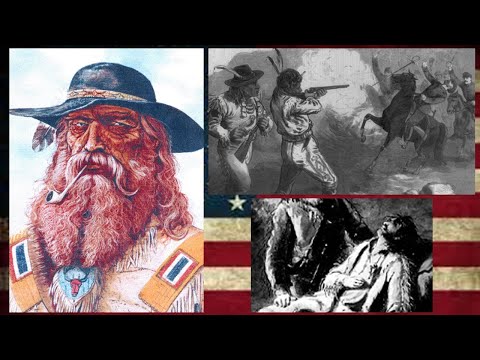
The spring of 1849 brought a grim discovery. A band of hunters, sent to recover supplies left by Frémont’s party, found a camp in a dismal canyon. There sat Bill Williams, legs crossed, leaning against a pine trunk, his head bowed, snow covering his frozen body. A jagged rent in his elk-skin shirt and dark stains told of a wound. The Utes had finally gotten even.
But the hunters who found him were not so certain. One of them, a grizzled old trapper named Jake Simmons who had known Bill in the Taos days, knelt beside the frozen corpse and studied the wound with narrowed eyes. “This ain’t no arrow hole,” he said, tracing the jagged tear in the elk-skin with a trembling finger. “Nor a knife cut neither. Looks more like he fell on his own traps—see there, the spring’s still half-cocked.” The others gathered round, and sure enough, the rusted jaws of a beaver trap lay just beneath the old man’s thigh, its teeth dark with something that was not rust.
Yet the mystery only deepened. Bill Williams’s powder horn was still full, his bullet pouch untouched. No Indian, Ute or otherwise, would have left such prizes behind. His rifle leaned against the pine where he sat, loaded and primed, as if he had been waiting for something—or someone—when the end came. “He weren’t scalped,” Simmons muttered. “And he weren’t robbed. What kind of Injun does that?” The question hung in the frozen air like the smoke of a dead campfire.
The hunters buried him there in the canyon, piling stones over the body to keep the wolves off. Simmons carved a rough cross into the trunk of the pine, and Breckenridge, who had come along on the recovery expedition, stood hat in hand and said a few words. “He was the best damn guide I ever knew,” he said quietly, “and the orneriest. Both things was true at once, and I reckon they always will be.” They rode out at first light, leaving the Lone Elk to the mountains that had made him and, in the end, unmade him.
Word of his death drifted back to Taos by summer, and the stories began to grow like weeds. Some said the Utes had caught him napping and taken their revenge at last. Others swore he had simply lain down and died of cold and old age, too stubborn to admit he could not outlast the winter as he once had. A few—the ones who had known him longest—whispered something else entirely: that Bill Williams had seen the raven circling over his own camp the night before he died, and that he had not moved from that pine trunk because he knew, with the terrible certainty of a man who read signs better than any Indian, that his time had come.
And so the name lived on where the man could not. Bill Williams Mountain still rises above the little town of Williams, Arizona, and Bill Williams Fork still runs cold and clear down to the Colorado. Travelers stop at the station platform and gaze up at the peak, asking who the man was, and the old-timers shake their heads and tell them what they have always told anyone who asks. “He was a hunter and a trapper, a preacher and a sinner, a white man who lived like an Indian and died alone in the snow. Beyond that, stranger, your guess is as good as mine.”
But there is one more tale, told only in whispers around certain campfires in the high country. They say that on bitter winter nights, when the wind screams down the canyons and the snow piles deep against the pines, a figure can sometimes be seen shuffling along the ridge—long and lank, with a greasy black hat and a rifle carried crosswise before him, walking with that curious double wobble, talking to himself in a thin, cracked voice that might be laughing or might be crying. The older trappers do not speak of it to strangers. They simply bank their fires a little higher and keep their rifles close, and if you ask them why, they will only say that some men are too ornery to stay dead, and that Bill Williams, wherever he is, is still rambling back and forth across the trail.
But the story did not end with the stones piled over his body, nor with the cross carved into the pine. In the summer of 1849, a young Army lieutenant named Elias Whittaker rode into Taos with a detachment of dragoons, carrying orders to map the routes Frémont had failed to chart. Whittaker was a methodical man, a West Point graduate with a passion for facts, and he found the legends of Bill Williams intolerable. “A man cannot simply vanish into a mountain and become a ghost,” he wrote in his journal. “There is a record to be found, and I intend to find it.”
He began with the survivors. Breckenridge, still recovering from his frozen feet, gave him a full account over three nights in a Taos cantina, and Whittaker wrote it all down in his neat, cramped hand. Croitzfeldt, half-mad from the ordeal, would only say that Bill Williams had saved his life and then refused to speak another word about it. But it was the old Mexican traders who gave Whittaker the piece he had not expected—a name, a place, and a date.
“There was a Ute woman,” an old trader named Ignacio told him, crossing himself as he spoke. “She came to the pueblo of San Gerónimo in the spring, after the snows. She carried a child. She said the father was the old trapper with the red hair gone gray, and that he had left her to go north with the soldiers and never returned.” Whittaker’s pen paused above the page. A child. A Ute woman. The myth of Bill Williams had just grown a root.
He found her in a small adobe on the edge of the pueblo, a woman of perhaps thirty with dark, steady eyes and a face that gave nothing away. Her name was White Shell Woman, and she spoke Spanish well enough for Whittaker to understand. She did not weep when he told her Bill was dead. She only nodded slowly, as if she had known for a long time, and then she said something that Whittaker would remember for the rest of his life.
“He told me he would die in the snow,” she said. “He said the raven had told him. But he said the snow would keep him, and that one day men would come looking for him, and they would find him sitting up like a chief, and they would know he had not run from it.” Whittaker asked her if she believed the old man had been killed by the Utes. She looked at him for a long moment, and then she laughed—a dry, humorless sound. “The Utes did not kill him,” she said. “He was one of them once. They would have taken his hair long ago if they wanted it. No—he died because he was old, and because the winter was cruel, and because he would not turn back. That is all.”
Whittaker wrote it down, but he was not satisfied. He pressed her about the wound, the jagged rent in the elk-skin shirt. White Shell Woman shook her head. “He fell,” she said simply. “On the ice. He was always falling, that man. His legs were never straight, you know. He wobbled when he walked.” And then she turned away and would say no more.
The lieutenant rode back to Santa Fe with a journal full of contradictions and a growing suspicion that the truth about Bill Williams would never be pinned down like a butterfly in a case. The man had been a preacher and a sinner, a guide and a betrayer, a husband to Ute women and a stranger to his own kind. He had lived in the wild for forty years and died in it alone. Perhaps, Whittaker thought, that was the only record Bill Williams had ever wanted—not words on a page, but a name on a mountain and a story that would not die.
He filed his report, and the Army filed it away, and the years went on. The railroad came through the mountains, and the town of Williams grew up at the foot of the peak, and the old-timers still sat on the station platform and told their tales to anyone who would listen. And somewhere in the high country, in a canyon that no map had ever named, the stones still lay piled over a frozen trapper, and the pine trunk still bore a rough cross, and the wind still screamed down the ridges on bitter winter nights, carrying a thin, cracked voice that might have been laughing or might have been crying.
Decades later, a young folklorist from Chicago tracked down White Shell Woman’s granddaughter in a dusty pueblo and asked the old question once more. The woman smiled and reached beneath her shawl, drawing out a small antelope-horn bottle, scraped thin and transparent. “He left this with my grandmother,” she said. “He told her the medicine inside would bring him back if ever the mountains called him home.” The bottle was empty.
The folklorist turned it over in her hands, and on the base, carved in a shaky, uneven hand, she found four words: I am still here.
She never learned who had carved them—or when. She only wrote in her notebook that night that some men leave no grave worth visiting, only a name that refuses to sit still. And on the platform at Williams, Arizona, the old-timers still nod toward the mountain and say the same thing they have said for a hundred years: “Ask the raven, stranger. He knows.”
So what do you think—did Bill Williams die in that lonely canyon, or is he still out there somewhere, wobbling along the ridge, laughing at us all?
Report this article
Select a reason for reporting:






