Dr. Rachel Foster’s breath caught as she adjusted the microscope over the 1913 wedding photograph. The image, a sepia-toned portrait of Edwardian elegance, showed a handsome groom standing proudly beside his bride. His left hand was deliberately positioned to display a wedding ring—but this was no ordinary band. It was a sixteenth-century Italian poison ring, its hinged frame designed to open and release powder.
“James, look at this,” she whispered, her voice trembling. Dr. Patel leaned in, then recoiled. “That design wasn’t replicated until the 1930s. This photo predates it by two decades.” Rachel flipped the photo over. In faded ink, a name: Jonathan and Catherine Clark, née Reynolds, June 14, 1913. A quick database search revealed a chilling detail—Catherine died just six months after the wedding, of “nervous fever.”
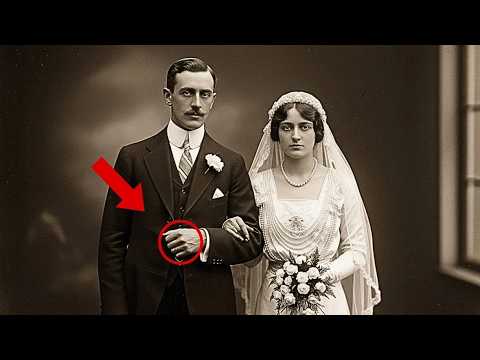
Rachel’s academic curiosity morphed into something darker. A pharmacist with access to arsenic, a bride dead within months, and a ring that could hide poison—the pieces didn’t just fit; they screamed. “I need to see Catherine’s medical records,” she told Patel, already reaching for her phone. He raised an eyebrow. “You’re expanding your scope?” She studied the groom’s confident smile, the eyes that didn’t quite match. “Something’s wrong here.”
What she couldn’t know was that the elegant ring had witnessed not one death, but five—every member of the Reynolds family who stood between Jonathan Clark and one of Boston’s largest fortunes. Nor could she anticipate how her research would link a century-old crime to one of America’s most powerful political dynasties.
The next morning, Rachel sat in the Massachusetts Historical Medical Society, poring over the records of Dr. William Hammond, the Reynolds family physician. Catherine’s file was extensive. Starting in July 1913, just weeks after her wedding, she suffered a cascade of symptoms: gastrointestinal distress, headaches, irritability, and progressive weakness. By November, she was bedridden with what Hammond called a “nervous breakdown with intestinal disturbances.”
His note from that month was damning: “Patient’s hair began falling out in patches. Skin shows unusual pigmentation around nails and neck. Symptoms suggest possible arsenic exposure.” The final entry, dated December 18, 1913: “Mrs. Catherine Clark succumbed at 3:17 AM. Husband present.” The death certificate listed nervous fever—but the described symptoms were textbook for chronic arsenic poisoning, a substance readily available to pharmacists in 1913.
Rachel’s pulse quickened as she cross-referenced the broader Reynolds family records. Catherine’s father, industrialist George Reynolds, died in March 1914—just three months after his daughter—with strikingly similar symptoms. His wife, Eleanor, followed in July. By September, Catherine’s only brother, Thomas, was dead. By December, the last obstacle to the family fortune, elderly aunt Margaret, was gone after a brief, mysterious illness.
In less than eighteen months, every direct member of the Reynolds family had died, leaving Jonathan Clark—who had married into the family just before the devastating series of losses—the sole heir to a fortune worth roughly $25 million in 1914 currency.
Rachel photographed the relevant records, her mind racing. The symptoms in all five cases were consistent with arsenic poisoning. The timing formed a clear pattern that led to Jonathan Clark’s control of the entire Reynolds fortune—and the ring in the wedding photo, designed to conceal and dispense powder, provided a potential method. A pharmacist would know exactly how to administer arsenic to mimic natural illness.
As she was leaving, Rachel received an email from the executor of the Reynolds estate. Additional family materials had been discovered in a sealed box in the attic—diaries, correspondence, and financial records covering 1910 to 1920. The estate was a grand Victorian mansion on Beacon Hill. The executor, Richard Blackwell, met Rachel in the dusty attic where generations of family records had been stored.
“These materials haven’t been examined in decades,” he explained, gesturing to a leather trunk. “Your interest in Catherine Clark’s materials comes at a very opportune time.” Among the official documents, Rachel discovered a locked diary inscribed with Eleanor Reynolds’s name. A small key, taped inside the trunk, opened it to reveal a mother’s private thoughts.
The early entries showed a proud mother rejoicing in her daughter’s engagement to the ambitious and charming Jonathan Clark. By August, the tone had shifted dramatically. August 12, 1913. Catherine visited today, looking pale and distressed. She confided that she hasn’t felt well since returning from her honeymoon. Jonathan insists it’s just adjustment to married life and prescribes various tonics from his pharmacy. I am concerned by her yellowed skin and the tremor in her hands.
By November, Eleanor’s entries revealed growing suspicion. November 18, 1913. I can no longer ignore my worst fears. Catherine’s condition matches the arsenic poisoning cases described in Dr. Hamilton’s medical text. I watched Jonathan administer her medicine himself. Today, I noticed he was wearing a strange ring with what appeared to be a hidden compartment. When I inquired, he quickly covered it and changed the subject.
The final entries were heartbreaking. December 19, 1913. My beloved Catherine was buried today. Jonathan played the grieving husband beautifully, yet I saw no real sorrow in his eyes. George now admits my fears have merit, but says we must proceed cautiously with any accusations.
January 10, 1914. George has fallen ill with symptoms disturbingly similar to Catherine’s initial decline. Jonathan has offered him medicines from his pharmacy, which George wisely refused. We have changed the household staff as a precaution, yet George continues to deteriorate.
Eleanor’s diary ended abruptly in February 1914, but the trunk contained another crucial document: an unsent letter from George Reynolds to his attorney. “If anything happens to me, you must record my serious concerns about my son-in-law. Eleanor and I have come to believe he may be responsible for Catherine’s death through deliberate administration of poison, most likely arsenic. We have observed his use of an unusual ring with a hidden compartment to add substances to food or drink.”
George died before the letter was sent, and his amended will was never executed—as evidenced by records showing Clark’s control of Reynolds assets throughout 1914. As Rachel prepared to leave, Blackwell mentioned, “The current owner of Clark Pharmaceuticals is coming tomorrow. Senator Harold Clark, great-great-grandson of Jonathan Clark, and a presidential candidate.”
Rachel’s investigation led to the Massachusetts College of Pharmacy, which held historical records from Boston-area pharmacies. The business ledgers of Clark’s Pharmacy for 1910-1920 were preserved in their collections. Dr. Martin Chen, the archivist, explained that Clark’s Pharmacy had been highly prominent. Jonathan Clark was known for compounding specialized medicines and importing European pharmaceutical innovations. His business expanded significantly after 1914, eventually growing into Clark Pharmaceuticals.
The purchase records revealed what Rachel had suspected. Between January 1913 and December 1914, the pharmacy ordered large quantities of arsenic compounds, ostensibly for creating various medicinal preparations common to the era. The prescription records were even more revealing. Starting in June 1913, Jonathan created custom tonics for each member of the Reynolds family. The ledger listed them by name: Digestive tonic for Mrs. Catherine Clark, vitality elixir for Mr. George Reynolds, and similar entries for Eleanor, Thomas, and Margaret Reynolds.
“These custom preparations were a common practice at the time,” Dr. Chen explained. “Were the specific ingredients typically documented?” Rachel asked. “Usually, yes. It was standard practice for inventory purposes.” But the entries for the Reynolds family preparations contained no ingredient lists—only notes that the formulations were prepared personally by J. Clark and kept in a private ledger. That ledger was not among the preserved records.
However, Rachel discovered something equally valuable: employment records showing a young assistant named Michael Sullivan who worked for Clark from 1912 to 1915, then abruptly moved to Chicago. This thread led Rachel to public records in Chicago, where she discovered that Sullivan had given a sworn statement to a private investigator in 1919, claiming knowledge of illegal pharmaceutical practices by his former employer.
Sullivan’s affidavit, preserved in the Chicago History Museum, was damning. “I observed Mr. Clark compounding unlabeled preparations using arsenic compounds. They were kept separately and administered personally to his wife’s family. Most concerning was the special ring Mr. Clark always wore, a replica of an antique design with a hidden compartment. I saw him use this ring to extract powder that he added to the Reynolds family’s preparations.”
The investigation stalled when Sullivan died unexpectedly in early 1920, officially of pneumonia. Without their key witness, any case against Jonathan Clark—who had become wealthy and influential—collapsed. As Rachel gathered her materials, her phone buzzed with a news alert: Senator Harold Clark leads presidential polls. The image showed a distinguished man with Jonathan Clark’s eyes and a smile that didn’t quite reach them.
The modern implications of Rachel’s historical research hit hard as she traced the Clark family’s trajectory using Reynolds textile money. Jonathan expanded from a single pharmacy to manufacturing, creating Clark Pharmaceuticals by 1920. Under his leadership, the company grew rapidly, securing government contracts during both World Wars. Jonathan lived until 1965, long enough to see his company become a major pharmaceutical player and his grandson William Clark elected to Congress. That political legacy continued through generations, culminating in Senator Harold Clark—Jonathan’s great-great-grandson and current CEO of Clark Pharmaceuticals before entering politics.
His presidential campaign focused on his business acumen and his family’s long tradition of medicine and public service—traditions built, in reality, on arsenic and murder. Rachel studied her next steps carefully. As a historian, she was bound to pursue the truth, but she was acutely aware of the explosive nature of her findings. Accusing a presidential candidate of benefiting from murders committed by his great-great-grandfather would invite intense scrutiny of both Senator Clark and herself.
She consulted her department chair, Dr. Elizabeth Morgan, sharing her research without initially revealing the Clark family connection. “This is exceptional work,” Dr. Morgan said after reviewing the evidence. “A clear case of serial poisoning using pharmaceutical knowledge and an innovative delivery method.” Rachel admitted, “There’s a modern complication. The killer’s descendant is a prominent public figure.” “How prominent?” “A presidential candidate.” Silence filled the office. “This raises significant ethical considerations. Historical truth matters, but so does its application. What exactly are you planning?”
Rachel said, “I’ve documented a historical crime. I’m not suggesting the descendant bears responsibility. However, a family fortune and political career built on murder seem relevant to the public interest.” Dr. Morgan advised, “Proceed with caution. Make sure your research is beyond reproach before taking any public position. And Rachel, powerful people protect themselves. Watch your step.”
That evening, Rachel created digital backups of her evidence, storing them in multiple secure locations. As she worked, a notification appeared—an email from Richard Blackwell. Senator Clark has expressed great interest in your research regarding his great-grandfather. He specifically asked about the wedding photograph and mentioned wanting to discuss your findings personally. Would you be available to meet with him tomorrow at the Reynolds estate?
Rachel stared at the screen. She had only told Blackwell she was researching early twentieth-century medical jewelry. She had said nothing about finding evidence of murder or Jonathan Clark’s poison ring. How did the senator know the precise focus of her research? Rachel’s suspicion about the need for caution was confirmed.
The next morning, she arrived at her office to find it had been searched overnight. Nothing was obviously missing, but the items on her desk were slightly rearranged, and her file cabinet drawers weren’t quite closed. Details her historian’s eye immediately caught. Campus security confirmed a routine maintenance check had been conducted in her building overnight, but no one should have entered individual offices. The surveillance cameras had experienced a technical malfunction during the exact hours in question.
Rachel explained the situation to Dr. Patel. “This isn’t coincidence. Someone wanted to see my research without leaving a trace.” “Do you think it’s connected to the Clark case?” “Well, what else could it be? I’ve documented evidence suggesting the Clark family fortune began with five murders. That’s not an origin story a presidential candidate wants circulating.”
Her phone buzzed with a text from an unknown number: Your research on historical pharmaceuticals sounds fascinating. Perhaps we can discuss it over coffee. I have information that might interest you. — Michael Clark, Research Division, Clark Pharmaceuticals. Another member of the Clark family was suddenly interested in her work. The coincidence was too convenient. Rachel showed the message to Dr. Patel, who frowned. “They’re circling the wagons. The question is whether they’re concerned about political embarrassment from historical facts, or if there’s something more dangerous at stake.” “Like what?” “Clark Pharmaceuticals is worth billions. Their company holds government contracts, international partnerships, and significant political influence. Even a historical scandal could affect stock prices and invite regulatory scrutiny.”
Rachel weighed her options. Refusing contact might escalate the situation, while agreeing to meet could reveal exactly what the Clark family knew about her research. She replied cautiously: I’d be happy to discuss historical pharmaceutical practices. Perhaps at the university café tomorrow at 10 AM? The response came immediately: Excellent. I have a particular interest in historical medicine dispensers, including jewelry. See you then. The specific mention of jewelry confirmed her suspicions. Somehow, the Clark family knew exactly what she had discovered.
Rachel spent the evening preparing a detailed timeline of her findings with supporting documents. She emailed it to her personal attorney with instructions to release it to specific journalists and academic colleagues if she didn’t check in every 24 hours. As she prepared for sleep, Rachel reflected on the wedding photo once more. Catherine Reynolds’s expression, initially seeming appropriately demure, now appeared tinged with uncertainty—as if the young bride had sensed on some level the danger posed by the man beside her and his seemingly innocent wedding ring.
“I’ll make them know what he did to you,” Rachel whispered to the long-dead woman. “But all of them.”
The university café buzzed with morning chatter as Rachel sat facing Michael Clark. “You’ve been investigating my family’s history,” he said, his smile tight. “The ring, the deaths—it’s a compelling narrative. But narratives can be dangerous.”
Rachel met his gaze. “I have medical records, a sworn affidavit, and a poison ring. This isn’t fiction.” Michael leaned forward. “My uncle is a presidential candidate. Whatever you publish will be buried under lawsuits and PR campaigns.”
She slid a folder across the table. “Then explain why your great-great-grandfather’s assistant described that exact ring. Or why Catherine’s preserved tonic contained lethal arsenic.” Michael’s face paled.
Weeks later, the paper went live. The scandal exploded—headlines screamed of murder, stocks plummeted, and Senator Clark’s campaign collapsed. Rachel stood before the Smithsonian exhibit, the wedding photo now behind glass.
What would you have done—publish the truth or protect the living from the sins of the dead?
Report this article
Select a reason for reporting:






