Dr. Elizabeth Carter had examined thousands of immigrant family portraits, but the moment she zoomed in on the father’s face in this 1901 studio photograph, a chill ran down her spine. The image seemed ordinary—a stern German immigrant, his wife, and three children posed in their Sunday best. Yet something in the father’s eyes, a guarded tension, hinted at a secret buried beneath the starched collar and formal demeanor.
When her colleague, Dr. Marcus Webb, ran the photo through an ultra-high-resolution scanner, the truth emerged. There, on the left side of the father’s neck, was a long, irregular scar—a knife wound, deliberately hidden by his collar and the studio lighting. The man had gone to great lengths to conceal it, tilting his head just so, ensuring the shadows fell perfectly. This was no accident; it was a calculated deception.
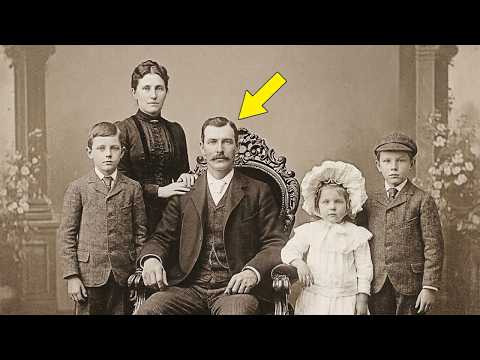
Elizabeth’s research revealed the family as the Wagners: Friedrich, Anna, and their children. But Friedrich’s past was a blank slate before 1896. No immigration records, no trace of his existence. His wife Anna’s history was fully documented, but Friedrich had simply appeared in Philadelphia, married quickly, and started a family. The scar, medical experts later confirmed, was from a life-threatening assault—two deep lacerations from a knife, inflicted years before the photo was taken.
Digging deeper, Elizabeth uncovered a police file from New York City. A wanted man named Heinrich Baumann, suspected of attempted murder in 1897, had fled after being wounded in the neck during a struggle. The timeline matched perfectly: Baumann disappeared, and Friedrich Wagner emerged. The scar was the key—a mark of violence that linked the two identities.
But the story took an even darker turn. Friedrich Wagner was murdered in 1902, stabbed to death in an alley. A neighbor reported hearing an argument days before: “I found you and you thought you could hide.” It seemed Baumann’s past had caught up with him. Elizabeth traced the likely killer to Josef Kreiger, Baumann’s victim from New York, who had moved to Philadelphia the same year and departed for Germany shortly after the murder. The symmetry was chilling: the hunter had become the hunted.
Yet the real tragedy lay with Anna and the children. Widowed and destitute, Anna sewed herself to death, dying of tuberculosis in 1908. The children were scattered—Otto to an orphanage, Margaret to domestic service, Wilhelm to a factory accident that killed him at 32. The photograph, once a symbol of respectability, now stood as a monument to a family destroyed by one man’s hidden past.
As Elizabeth prepared to publish her findings, she couldn’t shake the image of Anna’s hand resting on her husband’s shoulder, unaware of the darkness he carried. The scar had revealed not just a criminal, but the invisible wounds inflicted on innocent lives—a story that had waited over a century to be told.
Elizabeth closed the journal file and sat back, but the silence in the archives office felt different now—charged, unfinished. Marcus had said the same thing twice that afternoon: “We’ve answered who Friedrich Wagner was, but we haven’t answered what he was running from before New York.” It was the one question the article had left open, buried under the tidy conclusion of Kreiger’s revenge.
She pulled up the 1897 police file again and read the boarding house address in Lower Manhattan. Something about the phrasing of Josef Kreiger’s statement had nagged at her for weeks. He had described Baumann as quiet and hardworking at first, employed at a nearby brewery. But a man does not acquire a knife scar like that in a boarding house quarrel over three dollars. The violence in Baumann was older, deeper, trained.
Marcus appeared in her doorway with a folder he had not shown her before. He had been running the enhanced image of Friedrich’s hands through a pattern-recognition program, searching for calluses, ink stains, any occupational marker. The results had come back strange. “Look at his knuckles,” he said, laying the printout on her desk. “Old breaks, healed badly. And here—a tattoo fragment on the wrist, almost erased.” Elizabeth leaned in. Beneath the suit cuff, a faint blue smudge, geometric, deliberate.
She spent the next two days in the university’s German-language holdings, searching for any record of a Heinrich Baumann before 1895. The name was common, but the tattoo was not. A footnote in an 1894 Hamburg police gazette mentioned a sailor’s mark—a compass rose on the left wrist—borne by members of a dockworkers’ association implicated in a fatal brawl. The name attached to the description was not Baumann. It was Heinrich Vogt.
Elizabeth’s pulse hammered. She cross-referenced Vogt against emigration records and found a departure from Hamburg in early 1895, destination New York, listed under the name Heinrich Vogt. Then nothing—until Heinrich Baumann surfaced in a Manhattan boarding house two years later. Two false names, two escapes, one man. The pattern was not a single act of desperation. It was a habit.
She called Marcus, her voice tight. “He didn’t just change his name once. He did it before—in Germany. Whatever he was running from started there, and it followed him across an ocean.” Marcus was quiet for a moment. Then: “If he was already hiding in 1895, then the attack on Kreiger wasn’t his first violence. It was his second. Or his third.”
Elizabeth pulled up the passenger manifest for the ship that carried Heinrich Vogt to New York. Beside his name, in the column for nearest relative in the country of origin, someone had written a single word, then scratched it out so violently the ink had torn the paper. She requested a high-resolution scan of the original document from the Hamburg archive and waited three days for the file to arrive.
When it did, she opened it at full magnification and angled her screen to catch the light. The scratched-out word was still legible in the torn fibers of the paper. It was a name: Elsbeth.
Not a mother. Not a sister. The manifest column specified wife.
Elizabeth sat very still, staring at the name as though it might change if she looked away. A wife. Heinrich Vogt had left a wife behind in Germany—or perhaps not left her at all. Perhaps he had fled her, or fled what he had done to her. “If he had a wife in Hamburg,” she said slowly to Marcus over the phone, “then Anna wasn’t his first marriage. She was his second. And if the first wife was alive, then his marriage to Anna in 1896 was bigamy.”
Marcus let out a long breath. “Which means the man wasn’t just hiding from a crime. He was hiding from an entire life. A name, a marriage, possibly children.” He paused. “Elizabeth, if there were children in Germany, they’d be Anna’s children’s half-siblings. There could be people alive today who have no idea.”
She began searching Hamburg parish and civil records for a marriage between a Heinrich Vogt and an Elsbeth. It took four days, two archive requests, and one patient German archivist named Frau Reinhardt who answered her emails at midnight her time. The marriage was recorded in 1889 at a Lutheran church in the Altona district. Elsbeth Vogt, née Krüger, age 22. Heinrich Vogt, age 23, occupation: dockworker. Two children followed—a son in 1891, a daughter in 1893.
Then the records turned grim. In March 1894, Elsbeth Vogt was admitted to a Hamburg hospital with severe injuries: a fractured jaw, a broken wrist, burns along one forearm. The admitting note, written in a cramped clerk’s hand, used a phrase Elizabeth had seen before in old documents. “Häusliche Gewalt”—domestic violence. She was discharged after three weeks. There was no police report, no arrest. In that era, what happened inside a home stayed inside it.
Elizabeth requested the death registers for the Altona district covering 1894 and 1895. When the scan arrived, she found Elsbeth Vogt’s name in the autumn of 1894. Cause of death: “Folgen der Verletzungen”—complications of injuries. She had died at twenty-seven, five months after leaving the hospital, leaving two children, ages three and one.
And Heinrich Vogt had vanished from Hamburg within weeks. The departure record she had already found—early 1895, bound for New York—now read differently. He hadn’t fled a brawl. He had fled a dead wife and two orphaned children.
Marcus came to her office that evening, and they sat with the documents spread between them. “So the pattern is worse than we thought,” he said quietly. “He hurt his first wife so badly she died. He ran. He attacked Kreiger over three dollars. He married Anna under a false name and gave her three children, then got himself killed and left her to bury herself in poverty.” He shook his head. “Every person who got close to this man was damaged or destroyed.”
Elizabeth nodded, but her mind had moved to the two children in Hamburg—the son and daughter of Elsbeth Vogt, left behind in 1895. What had become of them? She wrote to Frau Reinhardt that night, asking whether the Altona records showed anything of the Vogt children after their mother’s death. The reply came two days later, brief and matter-of-fact. The children had been taken in by Elsbeth’s sister, a seamstress named Margarethe Krüger, who raised them in the same cramped Altona tenement. The son, Johann, had died in the First World War. The daughter, Lina, had married in 1921 and left Hamburg for Bremen. The trail, Frau Reinhardt wrote, could likely be followed further if Elizabeth wished.
She sat back and looked at the 1901 photograph still pinned above her desk. Friedrich Wagner, smiling stiffly in his starched collar, hiding one scar while carrying a dozen others no camera could capture. “He built a whole family on top of a grave,” she murmured. “And never once looked back.”
But even as she said it, she knew the story wasn’t finished. There was a daughter in Bremen. A line of descendants who had never heard the name Baumann, or Vogt, or the story of the woman who died in a Hamburg hospital in 1894. Elizabeth reached for her notebook and wrote a single line at the top of a fresh page: Lina Vogt, Bremen, 1921. Then she picked up the phone to call Frau Reinhardt back.
Frau Reinhardt’s second reply took longer, and when it came, it carried a weight Elizabeth hadn’t expected. Lina Vogt had married a Bremen dockworker named Konrad Dettmer in 1921, and the couple had raised three children through the lean years of the Weimar Republic. But the archive held one more document: a 1938 letter from Lina to the Altona parish, requesting her mother’s death certificate for a family record. In it, she wrote that she had never learned what became of her father—only that he had gone to America and vanished.
Elizabeth read the sentence twice. “She spent her whole life not knowing,” she said to Marcus. “Not knowing he was a killer. Not knowing he built a second family in Philadelphia. Not knowing he was murdered in an alley.” Marcus was silent, then said the thing they were both thinking: “Do we tell the descendants? Any of them?”
They traced Lina’s line through Bremen records and, with the help of a German genealogist, found a living great-granddaughter—a schoolteacher in her fifties named Ingrid Dettmer. Elizabeth wrote a careful letter, offering the research without demanding a response. Ingrid replied within a week: “My grandmother spoke of a father who went to America. We thought it was a sad story of abandonment. We never imagined this.”
In Philadelphia, Otto’s descendants agreed to meet Ingrid by video call. Elizabeth watched them on the screen—two branches of one shattered family, separated by an ocean and a century of silence, finally seeing each other. “We share a great-grandfather,” Ingrid said, her voice unsteady. “And a great-grandmother we never knew was hurt.”
When the call ended, Elizabeth turned back to the photograph one last time. The scar was still there, hidden in the shadows of a starched collar. But it no longer felt like the whole story. It was only the first wound in a long chain of them.
What would you have done—told the descendants everything, or let the past stay buried?
Report this article
Select a reason for reporting:






