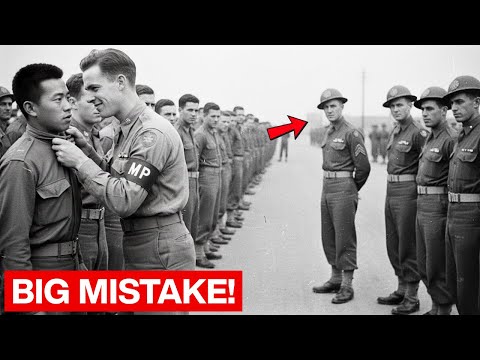
March 1942, Brisbane, Australia. The afternoon sun hammered Queen Street like a punishment, turning the pavement into a shimmering mirror of heat. Outside the American PX store, two young men in United States Army uniforms stood perfectly still. Their boots were polished to a high shine. Their uniforms were pressed and clean. Their faces were frozen in shock.
Three white American military police officers blocked the entrance, arms crossed, faces hard as stone. “Coloreds use the side entrance,” one MP said, his voice flat, like he had said these exact words a thousand times before. He pointed to a narrow alley between two buildings. The alley was dark and smelled of garbage. A small sign hung crooked on the wall: Nonwhite personnel only.
The two soldiers were Japanese American. Their names were on their uniforms. Their blood type was stamped on their dog tags. They had volunteered to join the army even though their mothers and fathers, their sisters and brothers, were locked up in prison camps back in California. The government called these camps internment centers, but everyone knew they were prisons surrounded by barbed wire and guard towers.
These young men had said yes anyway. They had raised their right hands and sworn to protect and defend the United States of America. They wore the same green uniform as every other American soldier. They carried the same M1 Garand rifle. They would face the same Japanese bullets and bombs. But right now, in this moment, they were not allowed to buy a candy bar in an American store.
A crowd began to form on the sidewalk. Australian soldiers stopped to watch. Civilian men and women paused on their way home from work. Brisbane was packed with Americans now—over 80,000 of them had poured into the city in just three months. That was more American men than the entire male population of Brisbane itself.
The Australians had welcomed them at first. America was here to help defend Australia from the Japanese army pushing south through the Pacific Islands. But the welcome was starting to wear thin.
One Australian soldier, a tall man with sunburned arms, leaned over to his friend. “What’s all this then?” he asked.
“Yanks won’t let their own blokes into the shop,” his friend replied.
“Look at their faces. They’re Japanese.”
“They’re wearing the bloody uniform, aren’t they?”
“Doesn’t matter to them, mate.”
The first soldier’s face darkened. He had heard stories about American segregation—separate water fountains, separate bathrooms, separate seats on buses, black soldiers forced to give up their seats to white soldiers. But hearing about it was different from seeing it happen right in front of you, on your own street, in your own city.
The statistics were staggering, though most people did not know them yet. One million non-white men served in the United States military. Four hundred thousand of them were stationed overseas, scattered across England, North Africa, the Pacific Islands, and now Australia. They dug ditches and unloaded ships and drove trucks. The military kept most of them away from combat. The official policy said that non-white soldiers were not fit to fight alongside white soldiers. They were good enough to carry supplies, but not good enough to carry rifles into battle.
General Douglas MacArthur had set up his headquarters in Brisbane just weeks ago. His command had immediately established rules. Certain hotels were for white soldiers only. Certain restaurants, certain dance halls—signs went up overnight: White personnel only. The Americans expected the Australians to simply accept it. This was how America did things. If you wanted American protection from the Japanese, you accepted American customs, too.
The military brass saw no problem with any of this. A memo from February 1942 sat in a filing cabinet in MacArthur’s headquarters. The memo was clear: Local populations should understand and respect American customs regarding race relations. The generals who wrote this memo truly believed that segregation was normal. They thought the whole world did things this way. They were certain that Australians would go along with it. After all, Australia needed America. The Japanese had already bombed Darwin. They had attacked Sydney Harbour with submarines. Without American help, Australia might fall.
But standing on Queen Street that afternoon, watching two soldiers in American uniforms being turned away from an American store, something stirred in the Australian crowd. It was not a loud thing. It was not dramatic. It was a quiet anger that spread like a slow fire.
An older Australian woman carrying a shopping bag stopped next to the tall soldier. “Why won’t they let those boys in?” she asked.
“Because they’re not white, love,” he said.
She looked at the two Japanese American soldiers. She looked at the three white MPs. She looked at the sign pointing to the dark alley. “That’s not right,” she said softly. “That’s not right at all.”
More people stopped. The crowd grew to twenty people, then thirty, then forty. No one said much. They just watched.
The two Japanese American soldiers finally turned and walked toward the alley. Their shoulders were squared, their heads were up, but everyone could see the shame burning in their faces—shame they did not deserve. Shame that had been forced on them by their own country.
One of the Australian soldiers, the tall one with the sunburned arms, spoke loud enough for the MPs to hear. “We didn’t invite the Yanks here to bring their bloody race problems with us.”
The MPs ignored him. They had their orders. They were just doing their jobs. To them, this was normal. This was how the world worked. White soldiers here, colored soldiers there. Simple, clean, orderly.
But Australia was about to show them that not everyone agreed. Australia had its own problems with race. The treatment of Aboriginal people was shameful and cruel. The White Australia Policy kept non-white immigrants out of the country. Australia was far from perfect. But Australians were about to draw a line in the sand. They were about to say something that would shock the United States military to its core. They were about to say three words that would change everything.
Not here. Not on our soil.
The breaking point came three weeks later. Prime Minister John Curtin sat at his desk in Canberra reading reports that made his jaw tighten. In just seven days, there had been twelve separate incidents. Twelve times American military police had enforced segregation in Australian cities. In Melbourne, they had blocked African-American soldiers from entering a restaurant. In Sydney, they had removed Filipino American sailors from a movie theater. In Brisbane, they had tried to stop Pacific Islander troops from dancing with Australian women at the Community Hall.
Curtin was a quiet man, but he was not a weak man. He had been prime minister for only one year, and that year had been the hardest in Australian history. The Japanese were winning everywhere. Singapore had fallen. Burma had fallen. The Philippines were falling. Australia stood alone, desperately needing American help. But needing help did not mean giving up everything Australia believed in.
On April 3rd, 1942, Curtin made a decision that would change everything. He issued General Order Number 1029. The order was typed on official government paper. It was stamped and signed and sent to every police station and town hall in Australia. The order said that all Allied servicemen, regardless of race or national origin, would be treated equally in all public places within Australian territory. The order specifically said that American military police could not enforce segregation policies outside American military bases.
The order was clear as glass. Inside American bases, the Americans could do what they wanted. But the moment an American soldier—white or non-white—stepped onto Australian soil outside those bases, Australian law applied. And Australian law said no segregation in public places.
The implementation happened fast. Brisbane police chief Cecil Carroll read the order on the morning of April 4th. By afternoon, he had gathered his officers in the main station. The room smelled of strong tea and cigarette smoke. Forty-three policemen crowded into a space meant for thirty. Carroll stood at the front holding the order in his hand.
“Listen carefully,” he said. His voice was rough from years of smoking. “If you see American MPs trying to segregate their own soldiers in pubs, in shops, in dance halls—anywhere off their bases—you are authorized to arrest them. Yes, arrest American military police for violating Australian law.”
The room went silent. One young constable raised his hand. “Sir, won’t that cause trouble with the Americans?”
“Probably,” Carroll said. “But those are your orders. Those are the prime minister’s orders. We enforce Australian law in Australia.”
End of story.
Four days later, the first test came.
It was a Friday night, April 8th. The Trocadero dance hall on George Street was packed, a swing band pouring American songs over a crowded floor. Two Filipino American sailors stood near the bar, beers in hand, laughing with Australian girls.
At 8:47, three American MPs pushed through the crowd. The lead MP grabbed one sailor by the arm. “You two need to leave.”
“Why? We’re not causing trouble.”
“This place is for white personnel.”
An Australian police sergeant named James Murphy stepped between them, calm as iron. “Those men stay. Or you’re coming with me to the watch house.”
The MP stared. “This is American military business.”
“This is an Australian dance hall on Australian soil. You have no authority here.”
The music kept playing. The dancers kept moving. The lead MP let go. “This isn’t over,” he said. “Yes, it is,” Murphy replied. Five minutes, start to finish, written down in his report that night.
The news spread like wildfire. Australian police had faced down American MPs and won. But not everyone was happy. On April 15th, liaison Major William Stanton sat across from Curtin, looking worried. “General MacArthur’s headquarters has sent a formal complaint. They believe your policy could damage relations.”
“What does the general suggest instead?” Curtin asked. “That Australian authorities respect American military customs.”
“You mean segregation?” Curtin finally looked up, eyes tired but steady. “Major, we need American help. But we will not turn our cities into copies of Alabama or Mississippi. Not now, not ever.”
Then came the numbers. Army minister Frank Ford spread a thick folder across the desk. In three months, eighty-nine documented racial confrontations—seventy-one started by white Americans enforcing segregation. “Send this to MacArthur’s headquarters,” Curtin said, “and send it to the newspapers.”
The Sydney Morning Herald ran an editorial that made Americans furious: Australia welcomes all who fight for freedom without qualification. By May, 847 venues across Brisbane, Sydney, Melbourne, and Perth had posted simple signs: All Allied servicemen, welcome.
American command was furious but trapped. They needed Australian ports, air bases, cooperation. Grudgingly, quietly, they accepted it—outside base perimeters. Inside, segregation continued. Outside, it ended.
By June, racial incidents in Australian public spaces had dropped by 76 percent. For the first time in their lives, thousands of non-white soldiers walked into any pub, sat anywhere in a theater, danced with any girl who said yes. The color of their skin did not matter. Only the uniform did.
Corporal George Nakamura wrote home to his family in Manzanar. “In Brisbane, I can walk into any pub, any cafe, sit wherever I want. The Australians don’t see my face. They see my uniform. I never knew that feeling before.” His mother carried that letter in her pocket for the rest of the war.
But not everyone accepted it. On Thanksgiving night, November 26th, 1942, the Brisbane City Hall dance erupted into two days of violence—the Battle of Brisbane. Eight Australians hospitalized, fourteen Americans, one man dead. American generals demanded Australia back down. Curtin refused. “If America expects us to host their servicemen, they will respect our laws. All of them or none of them.”
Australia doubled down. More police, clearer orders: protect all Allied servicemen equally. By war’s end, 350,000 Americans had passed through. Integrated Australian cities saw 60 percent fewer racial incidents than segregated American bases.
George Nakamura survived the war, earned a Bronze Star with the 442nd, and returned to Brisbane in 1967. He ordered a coffee in a cafe on Queen Street. No side entrance. No pointing finger. No one made him feel less than human.
Curtin died in office on July 5th, 1945, five weeks before Japan surrendered. His order yellowed in the archives, but it became a case study in moral courage—a leader who risked an alliance to defend people who were not even his own citizens.
In 2024, a bronze plaque was set into the sidewalk where those two soldiers were turned away. It read: They came to fight tyranny. We chose to treat them as equals. Both were acts of courage.
Australia was never perfect. The White Australia Policy lasted until 1973. Aboriginal Australians suffered cruelly. But for a brief, imperfect moment, a uniform mattered more than the face wearing it. And that, perhaps, is the world they were all fighting for.
So here is the question for you: If a foreign ally told your country that its laws—not its customs—would decide how people are treated on its soil, would you call that courage, or arrogance?
Report this article
Select a reason for reporting:






