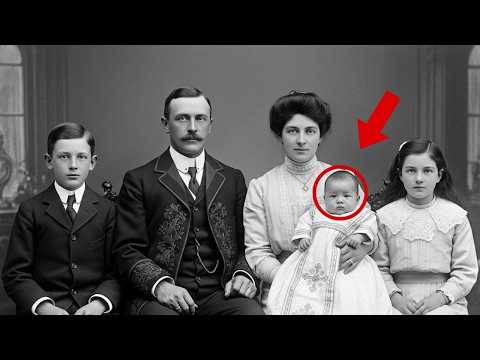
In November 2023, genealogist Rachel Foster was doing routine research for a client when she stumbled upon a photograph that would shatter everything she thought she knew about early 20th-century American families. The image, preserved in the Henderson family’s personal collection in Portland, Oregon, was dated October 1902 and bore the embossed mark of Sterling Photography Studio in Chicago. At first glance, it looked like a typical upper-middle-class portrait: a distinguished gentleman in his forties, his elegantly dressed wife holding an infant, and two well-behaved children standing formally beside them. The setting spoke of prosperity—expensive clothing, elaborate furniture, and the polished composition expected of a professional studio. Nothing seemed out of the ordinary.
But as Foster examined the photograph under magnification, her breath caught. The baby in the mother’s arms had distinctive East Asian features—features that were completely inconsistent with the rest of the family’s northern European appearance. This was 1902, a time when cross-racial adoption was virtually unheard of, especially involving Asian children. Yet the family’s records described the infant as their biological child, with no mention of adoption. The puzzle deepened: why would a white family in early 1900s Chicago adopt an Asian baby, and why had every document erased that truth?
Foster’s discovery launched her into a research odyssey that would uncover one of the most remarkable stories of cross-cultural adoption and humanitarian courage during a period of intense anti-Asian sentiment. She contacted Dr. James Lou, a historian at Northwestern University specializing in Asian-American immigration history. When Lou examined the portrait, he immediately recognized its significance. “This photograph documents something that was extremely rare in 1902,” he explained. “Cross-racial adoption was virtually unknown during this period, especially involving Asian children due to both legal restrictions and intense social prejudice. If this family did adopt an Asian infant, it would represent an extraordinary act of courage and compassion.”
Lou’s expertise revealed that 1902 was a particularly dangerous time for Asian families in Chicago. The Chinese Exclusion Act was in full effect, and anti-Asian violence was rampant. Many Asian children had been orphaned due to violence, disease, or family separations caused by discriminatory immigration policies. The research team began investigating Chicago’s small Chinatown, Christian missions, and social service agencies. Initial findings showed that several Christian missions had operated informal adoption services, placing Asian orphans with sympathetic white families when no Asian families were available—arrangements kept confidential to protect both children and adoptive families from social persecution.
The investigation expanded to city records, immigration documents, and church archives. What emerged was not just the story of one family, but a hidden network of humanitarian assistance operating during one of the most racially hostile periods in American history. The Henderson family, it turned out, had a remarkable pattern of social activism. Thomas Henderson, the father in the portrait, was a successful Chicago businessman who owned import companies trading with Asia. His business dealings had brought him into regular contact with Chinese and Japanese merchants, and surviving correspondence showed respectful relationships at a time when such connections were unusual and sometimes dangerous.
More significantly, both Thomas and his wife Eleanor were active members of Chicago’s First Presbyterian Church, which maintained one of the few Christian missions serving the city’s Asian immigrant community. Church records showed that Eleanor volunteered regularly at the mission, teaching English classes and providing assistance to immigrant families facing discrimination and economic hardship. The Hendersons had also been contributors to organizations advocating for fair treatment of immigrants, and Eleanor had participated in women’s charitable societies that helped vulnerable families regardless of ethnic background. Letters between Eleanor and her sister in Philadelphia expressed outrage at anti-Asian riots and concern for immigrant families who had no legal protections.
Most significantly, the research uncovered evidence that the Henderson family had previous experience with informal adoption arrangements. Church records showed they had temporarily housed several orphan children from various backgrounds while permanent families were located, suggesting they had established reputations as people willing to help vulnerable children. Their involvement in import businesses had given them understanding of Asian cultures rare among white Chicago families, while their church activities had connected them with organizations working to assist immigrant families. This background suggested that the Asian infant in the 1902 portrait represented not an isolated incident but the culmination of years of humanitarian activity and cross-cultural engagement.
Dr. Lou’s investigation of Chicago’s Christian missions led to a breakthrough discovery in the archives of the First Presbyterian Mission. Among the records was documentation from September 1902 about a young Chinese woman named Li Wei who had died from tuberculosis, leaving behind an infant son with no family able to provide care. Li Wei had been brought to Chicago by human traffickers who promised employment but forced her into domestic servitude until she escaped with help from mission volunteers. Severely malnourished and ill, she died within weeks of arriving at the mission. Her infant son, born during her captivity, was healthy but required immediate placement with a family capable of providing proper care.
The documentation revealed that finding placement for Asian children was extremely difficult due to racial prejudice and legal complications. Most potential adoptive families were unwilling to accept children of different ethnic backgrounds, while the small Asian community in Chicago was struggling with poverty and discrimination. Mission workers had approached several families who had previously helped with emergency placement, including the Henderson family. The record showed that Eleanor Henderson had been one of the first people contacted when Li Wei’s infant needed immediate placement. The mission’s correspondence with the Hendersons revealed careful planning to ensure the infant’s safety and the family’s protection from potential social persecution. The arrangement was structured as a formal adoption, with legal documentation prepared to establish the child’s status as a full family member. Most remarkably, the Henderson family had requested that the adoption be handled with complete discretion—not to hide their decision, but to protect the child from potential discrimination and violence that might have resulted from public knowledge of his Asian heritage.
The 1902 family portrait had been taken shortly after the adoption was finalized, capturing a moment when the Henderson family was celebrating their expanded household while also creating a permanent record of their commitment to the Asian infant they had welcomed as their son. Further research revealed the child had been named David Henderson, and his subsequent life story would prove to be as extraordinary as the circumstances of his placement. Mission records documented that David’s biological mother, Li Wei, had been an educated woman from a prosperous Chinese family who had been deceived by human traffickers. Her family in China had apparently been searching for her when she died, but communication difficulties and political tensions made contact impossible.
The Henderson family raised David as a full member of their household, providing him with the same educational opportunities and social advantages available to their biological children. Family correspondence showed deliberate efforts to help David understand his Chinese heritage while ensuring his integration into American society. School records from Chicago revealed that David was an exceptional student who excelled academically and socially. Teachers described him as intelligent, well-adjusted, and popular with classmates, suggesting the Henderson family had successfully protected him from the racial discrimination that might have been expected during this period.
Most remarkably, David went on to achieve extraordinary success that challenged racial stereotypes and social expectations of the early 20th century. He graduated from Northwestern University in 1924 with degrees in both engineering and languages, becoming one of the first Asian Americans to earn advanced degrees from a major Midwestern university. His professional career included groundbreaking work as a translator and cultural liaison during the early decades of American diplomatic and commercial relations with China. His unique background—combining thorough American education with understanding of Chinese culture and language—made him invaluable in facilitating communication between American businesses and Chinese partners. During the 1920s and 1930s, David established several successful import companies specializing in cultural exchange and helped numerous Chinese families immigrate to America through legal channels. His work contributed to improved relations between Chinese and American communities at a time when such cooperation was rare and often discouraged.
The infant whose presence in the 1902 portrait had initially seemed puzzling had grown up to become a bridge between cultures, using his unique position to promote understanding and cooperation that benefited both Chinese and American communities for decades. As Dr. Lou’s research expanded, he discovered that the Henderson family’s adoption of David was part of a larger, largely undocumented network of humanitarian assistance operating in Chicago and other American cities during the early 1900s. This network helped numerous Asian children find safety and opportunity despite the hostile legal and social environment. Investigation of other Christian missions, social service organizations, and sympathetic families revealed that cross-racial adoption occurred more frequently than historical records had previously suggested—but these arrangements were kept confidential to protect both children and families from social persecution and legal complications.
The research team identified at least 12 other cases in Chicago alone where white families adopted Asian children between 1900 and 1910, creating a pattern of humanitarian assistance that operated largely outside official documentation. These families were typically connected through religious organizations, social reform movements, or business relationships that provided them with understanding of Asian cultures. Most were middle-class or wealthy households with progressive social views and connections to organizations advocating for immigrant rights. Their economic resources and social positions provided some protection from community hostility, while their cultural connections gave them appreciation for the value of cross-racial understanding. The network included informal systems for supporting adoptive families and adopted children, including private educational arrangements, social connections, and business opportunities that helped Asian adoptees integrate into American society while maintaining connections to their cultural heritage.
Documentation revealed that this humanitarian network was particularly active during periods of increased anti-Asian violence, providing emergency assistance to families and children who faced immediate threats. The network operated through personal relationships and informal communication rather than official organizations, making it largely invisible to both supporters and opponents of Asian immigration. The Henderson family’s decision to adopt David represented one visible example of a broader pattern of individual courage and compassion that provided opportunities for vulnerable Asian children during one of the most hostile periods in American immigration history. The discovery of this hidden network challenged historical assumptions about early 20th-century race relations and revealed that humanitarian assistance across racial lines was more extensive than previously documented, operating through private initiatives that prioritized children’s welfare over social conventions.
The research team’s investigation revealed why the Henderson family’s cross-racial adoption and similar humanitarian efforts had remained largely hidden from historical documentation. Legal complications made official documentation difficult and sometimes dangerous, as immigration laws and racial classification systems created bureaucratic obstacles that many families avoided through informal arrangements leaving minimal paper trails. Social pressures encouraged adoptive families to minimize public discussion of their children’s origins—not from shame, but as protection against discrimination and violence.
The research revealed that many adoptive families had moved to different cities or states after completing adoptions, scattering documentation across multiple jurisdictions. Most significantly, the adopted children themselves often chose not to discuss their origins publicly as adults, either to protect their adoptive families from criticism or to avoid personal discrimination. This silence prevented their stories from being passed down to subsequent generations. The documentation challenges were compounded by the destruction of many relevant records over the intervening century—mission archives lost to fires and organizational changes, family documents discarded as generations passed without understanding their historical significance.
Dr. Lou’s team found that traditional historical research methods had been inadequate for uncovering these hidden stories because they relied heavily on official records that had deliberately excluded cross-racial adoptions. The discovery required new approaches combining genealogical research, photographic analysis, community archives, and oral history collection. The Henderson family portrait provided a rare piece of visual evidence that had survived the systematic obscuration of cross-racial adoption during the early 20th century, preserving documentation of humanitarian efforts otherwise lost to historical memory.
Following the comprehensive research, Dr. Lou and Rachel Foster organized efforts to ensure that David Henderson’s achievements and his family’s humanitarian courage received appropriate historical recognition. The Chinese American Museum in Chicago organized a major exhibition titled Hidden Families: Cross-Cultural Adoption in Early America, featuring the Henderson portrait alongside documents and artifacts illustrating the broader network of humanitarian assistance. The exhibition attracted national attention and generated new research into similar stories throughout the United States.
Northwestern University established the David Henderson Memorial Scholarship for students pursuing studies in cross-cultural communication and international relations. The First Presbyterian Church of Chicago organized commemorative services acknowledging their historical role in cross-racial humanitarian assistance. Family descendants of both David Henderson and the original Henderson family were located and participated in ceremonies recognizing their ancestors’ courage. The 1902 portrait became an icon representing the hidden stories of courage and compassion that had shaped American society in ways largely forgotten by traditional historical narratives.
Four years after Rachel Foster first noticed the puzzling appearance of the Asian infant, the discovery has transformed understanding of early American cross-cultural families. The portrait now serves as the centerpiece of the permanent collection at the National Museum of American History, where millions of visitors annually learn about the Henderson family’s remarkable story. Dr. Lou’s comprehensive study, Invisible Families: Cross-Racial Adoption in Early America, has become essential reading in courses on immigration history, adoption studies, and early 20th-century social reform.
Contemporary adoption agencies have studied the Henderson family’s approach to cross-cultural adoption, finding that their methods of supporting cultural identity while ensuring social integration remain relevant for modern practices. For the Henderson and Li family descendants, the discovery has provided new understanding of their complex family history. They have established a foundation that continues this humanitarian tradition by supporting contemporary immigrant families and cross-cultural adoption services.
The portrait serves as a powerful reminder that families have always been more diverse and complex than official records suggest, and that individual acts of courage and compassion have shaped American society in ways traditional historical narratives have often overlooked. As visitors study the 1902 portrait today, they see beyond the conventional formal poses to recognize evidence of extraordinary humanitarian courage that provided safety and opportunity for a vulnerable child during one of America’s most racially hostile periods. The baby in the mother’s arms represents not just individual rescue, but the broader potential for human compassion to transcend social prejudice and legal barriers.
The story demonstrates that seemingly ordinary family photographs can preserve evidence of remarkable social courage waiting for researchers willing to question assumptions and investigate the stories behind familiar images. The Henderson family’s legacy reminds us that history is shaped not only by public leaders and official policies, but also by private individuals who choose compassion over conformity and who create opportunities for hope during the darkest periods of social hostility.
What forgotten stories might be hiding in your own family’s old photographs, waiting to be discovered?
Report this article
Select a reason for reporting:






