Emma Castellano had restored hundreds of damaged photographs, but none had ever made her hands tremble over the keyboard. The scan that arrived on a cold March morning seemed routine—a 1927 wedding photo, water-stained and flaking, sent by a woman named Dorothy Harris who wanted it cleaned up as a gift for her elderly mother. Emma opened the file, expecting another few days of pixel-by-pixel reconstruction. She had no idea that this image would pull her into a century-old mystery involving her own surname, a forgotten asylum, and a love so fierce it had been hidden in the shadows for nearly a hundred years.
As she worked, the bride’s face emerged first—young, dark-eyed, with a smile that looked more strained than joyful. Then the groom, stiff and formal. But it was something in the back left corner of the church that made Emma freeze. A man. Half-hidden behind a column, dressed in rough working clothes, his cap pulled low. While every other guest sat facing the altar, this figure stood pressed against the wall, his body angled as if ready to flee. Emma zoomed in, enhanced the area, and felt a chill run down her spine. The man’s eyes were fixed on the bride with an expression of raw, undisguised grief.
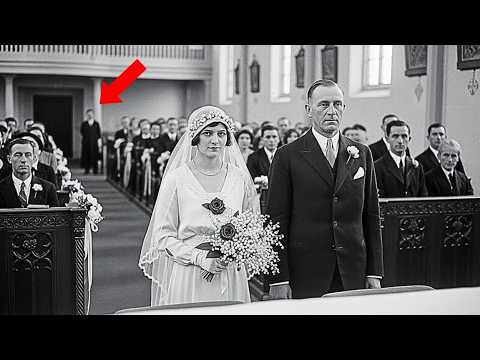
She sat back from her screen, unsettled. Who was he? And why was he hiding during what should have been a joyful celebration? Over the next three days, Emma cleaned and enhanced the image further, and more details surfaced. The man’s knuckles were white from gripping his cap. His weathered face suggested a life of outdoor labor. And in the bride’s bouquet—lily of the valley, traditional for spring weddings—Emma noticed a single red rose, its thorn drawing a tiny spot of blood on her white glove.
“The bride’s uncertain smile suddenly looked different,” Emma later wrote in her notes. “Not shy. Strained. Perhaps even frightened.”
She sent a preview to Dorothy, asking if she knew anything about the man in the background. The reply came within hours. Dorothy explained that her grandmother, Rosa Castellano, had rarely spoken about her wedding day. She had married Gerald Harris, a banker’s son from a prominent Providence family, in April 1927. The marriage had been cold and formal. Rosa had died in 1982, taking her secrets with her. And no one in the family had any idea who the mysterious figure might be.
Emma’s curiosity deepened when she realized the bride’s maiden name was Castellano—her own surname. A coincidence, perhaps, but one that felt significant. She began digging through census records, immigration archives, and church ledgers. The 1920 census listed a Rosa Castellano, age 12, living on Hanover Street in Boston’s North End with her parents, Lucia and Marco, and two younger siblings. Marco was a dock laborer. By 1930, the parents had vanished from the records. Rosa’s siblings appeared in a Catholic orphanage in Worcester, placed there in 1926. Their father was dead—killed in an industrial accident in 1925. Their mother, Lucia, was listed as “unable to provide care.”
But there was no death certificate for Lucia. Emma searched hospital records, asylum registrations, poorhouse admissions. Nothing. Then she found it: an admission record from the Rhode Island State Hospital for Mental Diseases, dated July 1926. Lucia Castellano had been committed, suffering from “melancholia and nervous exhaustion following traumatic loss.” She had been 29 years old, widowed, homeless after a tenement fire, and unable to care for her three children. She would remain institutionalized until her death in 1944—never released, never reunited with her daughter.
Emma’s hands trembled as she read the final record. Rosa had been 19 when she married Gerald Harris. Her mother was alive but locked away. Her siblings were in an orphanage. She was alone, except for an uncle who saw her as a burden. The marriage hadn’t been a romance. It had been a rescue—or a transaction.
But who was the man in the shadows? And why had he been watching with such grief? Emma posted a high-resolution crop of his face on genealogy forums, and three days later, a message arrived from a woman named Angela Rossini in Medford, Massachusetts.
“I think that man in the photograph is my grandfather, Paolo Benedetti.”
Emma called the number Angela had provided before she could second-guess herself. The voice that answered was elderly, warm, and already trembling. Angela Rossini explained that her grandfather Paolo Benedetti had worked the Boston docks, never married, and lived alone in a one-room apartment until his death in 1952. “My father always said his father had loved someone once,” Angela said, “a young woman he couldn’t marry because of circumstances beyond their control.”
Emma’s pulse quickened. She asked if anything of Paolo’s had survived. Angela hesitated, then mentioned a bundle of letters—love letters in Italian, never sent, addressed to someone named Rosa. No surname. Nothing to identify her.
Two days later, Emma sat in Angela’s living room in Medford, holding twelve yellowed letters tied with string. Her Italian was rusty, but the elegant script gave up its secrets slowly. The first, dated August 1926, spoke of Marco Castellano’s death and Paolo’s vow to watch over his friend’s children. “Your father was my brother in all but blood,” he had written. “I will honor his memory by protecting his family.”
But the later letters revealed how protection had deepened into impossible love. By November 1926, Rosa was eighteen, homeless after the fire, her mother committed, her siblings taken to an orphanage. Paolo wrote: “I am too old for you. I have nothing to offer but a dock worker’s wages and a one-room apartment.”
The January letter was worse. Paolo had learned that Rosa’s uncle had arranged a meeting with Gerald Harris. “They will take you to a world I cannot enter,” he wrote. “You will live in fine houses, never worry about hunger or cold. This is what you deserve, and I am selfish to wish otherwise.” He confessed he would have married her tomorrow, worked three jobs, brought her siblings to live with them, found a way to visit her mother. “But I am one man with nothing, and they are offering you everything.”
The final letter, dated March 1927, was the shortest. Paolo had learned the wedding date. “I know I should not come. But I cannot let you go without seeing you one last time. I will stay hidden. I will not interfere. I will not burden you with my grief.”
Emma set the letters down, her vision blurring. Paolo Benedetti had been the man in the shadows—hiding in the corner of St. Augustine’s Church, watching the woman he loved marry another man because he couldn’t give her the security she needed to survive.
Angela was crying quietly. “He was always lonely,” she whispered. “From the moment he watched Rosa walk down that aisle.”
Emma asked if she could copy the letters and share them with Dorothy. Angela agreed at once. “Rosa should be remembered for who she really was,” she said. “A woman who survived impossible circumstances. Who was loved deeply, even though she couldn’t choose that love.”
Emma spent the following week assembling everything into a single document—the enhanced photograph with Paolo’s face pulled from the shadows, the twelve letters transcribed and translated, the asylum records, the census data, the marriage dispensation letter from Theodore Harris. She sent it all to Dorothy with a cover note explaining what she believed had happened: Rosa Castellano, orphaned at eighteen, homeless and destitute, had been loved by a dock worker who couldn’t offer her the security she needed. Her uncle had arranged the marriage to Gerald Harris as a transaction disguised as romance. Paolo had come to the wedding anyway, hiding in the shadows to see her one last time.
Dorothy’s reply arrived the next morning, and it was raw with emotion. She had read everything twice, then shared it with her mother—Rosa’s daughter, now eighty-six. The old woman studied the enhanced photograph for a long time, tracing her finger over Paolo’s face. “My mother used to have nightmares,” Dorothy wrote. “She would wake up crying, calling out for someone named Paolo. My father would get angry, demand to know who Paolo was. She would say she didn’t remember. But now I understand.”
The family decided to share the story publicly. Emma posted it on genealogy forums and Italian-American historical society pages, and the response was overwhelming. Dozens of people came forward with similar stories—immigrant families torn apart by poverty, women forced into marriages of convenience, men who had loved and lost because they couldn’t compete with wealth and security. Several historians contacted Emma, eager to use the case in research on immigrant experiences in 1920s New England.
But the most unexpected response came from the Harris family descendants. Gerald Harris’s grandson wrote to Dorothy, apologizing for what his grandfather had done. “My grandfather wasn’t a villain,” he wrote, “but he participated in a system that treated women as commodities. Rosa deserved better. She deserved to choose.”
Six months after Emma first noticed the man in the shadows, a small group gathered at Mount Hope Cemetery in Boston’s Mattapan neighborhood. Dorothy and her mother had traveled from Providence. Angela Rossini came with her adult children. Members of the Italian-American historical society stood quietly nearby. They gathered before two graves, fifty feet apart. Rosa’s headstone read simply, Rosa Harris, beloved mother and grandmother, 1907–1982. Paolo’s was even simpler: Paolo Benedetti, 1888–1952.
For seventy years, they had rested in the same cemetery, neither knowing the other was so close.
Dorothy’s mother placed a bouquet on Rosa’s grave—lily of the valley, traditional wedding flowers, with a single red rose tucked among them, just as there had been in Rosa’s bridal bouquet ninety-seven years earlier. Angela placed an identical bouquet on Paolo’s grave. “They couldn’t be together in life,” Dorothy’s mother said, her voice strong despite her age. “But we can honor both of them now.”
Emma had brought a framed copy of the enhanced photograph—two separate prints mounted side by side. The left frame showed Rosa at the altar, the red rose visible in her bouquet. The right frame showed Paolo in the shadows, his expression of love and loss preserved forever. The frames were mounted on a memorial bench placed between the two graves, with a plaque explaining the story in brief: Rosa Castellano and Paolo Benedetti, separated by circumstance, united in memory.
As the group gathered around the bench, Angela shared one final discovery. Among her grandfather’s belongings, she had found a small notebook where he recorded important dates. April 16th—Rosa’s wedding day—was marked every year from 1927 until his death in 1952 with a single word written in Italian. Ricordo. Remember.
For twenty-five years, Paolo had privately commemorated the day he lost Rosa, keeping his love alive in solitude.
Then Dorothy’s mother opened a folder and withdrew a single sheet of paper, its edges soft with age. “This was found among my mother’s papers after she died,” she said. “We didn’t understand it then. Now it makes sense.”
The letter was in Rosa’s handwriting, dated 1980, two years before her death. It had no address, no stamp—just a title at the top: To Paolo, Wherever You Are.
She read it aloud. “I have lived a comfortable life. I raised children. I never wanted for material things. But not a day passed that I didn’t think of you standing in the shadows of the church, bearing witness to a choice I had no choice but to make.”
Her voice faltered. “In another life, in another world, I would have said yes to you a thousand times over.”
Emma photographed the bench, the matching bouquets, the two graves now bound by a story finally told. The man in the shadows had a name. And Rosa was no longer just Mrs. Gerald Harris—she was a woman who had carried a secret love for a lifetime.
What would you have chosen, if survival and love could never share the same room?
Report this article
Select a reason for reporting:






