It was just a family photograph—five people, a modest living room, Sunday clothes, and the stiff formality of an era when every image was a monument. But on the left edge, resting quietly on a wooden chair, sat something that didn’t belong. A small, handmade doll of a boy, dressed in a white shirt and dark trousers, its hair far too real for fabric and thread. Historians would spend over a century uncovering the truth. And when they did, it would change everything they thought they knew about love, loss, and the lengths a mother will go to keep her child counted.
James Whitfield had seen thousands of early 20th-century photographs. He was not a man easily moved. But on that Tuesday morning in October 2021, as he zoomed in on the high-resolution scan, something cold and quiet stirred in his chest. The hair was human. He knew it before the forensic anthropologist confirmed it. “Yes, without a doubt,” Dr. Patricia Owens wrote back. “This is human hair, African American, and a significant amount of it.”
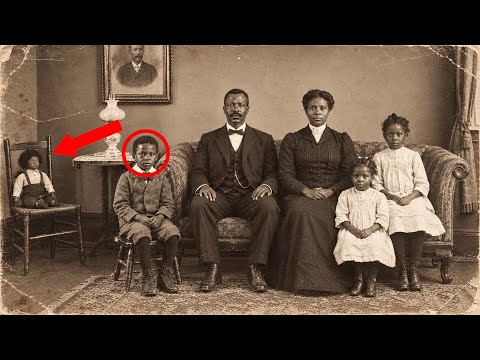
The photograph had arrived at the university archive with almost no metadata—just a rough date, 1910, and a handwritten note on the back: “For those who come after us.” No names. No location. Only a single clue: it had been donated by a small historical society in rural Georgia. James traced it to a collection from an estate in Meriwether County, packed away for thirteen years before being digitized. A volunteer named Dorothy remembered the boxes—and a family Bible. “Some old family Bibles have records written inside,” she said slowly. “Births, marriages, deaths. It’s worth checking.”
That Friday, James drove to the small county library. The Bible was cracked and worn, its first page covered in faded ink. He read the names, his finger stopping on a line written in a shakier hand: Samuel, born March 3, 1903, died February 14, 1910. Age seven. The photograph was dated 1910. A boy in a white shirt and dark suspenders—Sunday clothes for a seven-year-old. There had been a sixth member of this family. His name was Samuel.
James spent the next two weeks combing through county health reports and church records. A tuberculosis outbreak had swept through Meriwether County in the winter of 1909–1910. Children under ten were especially vulnerable. He found a single entry in the Baptist church records: a funeral held on February 17, 1910, for “Samuel, son of Thomas and Ada.” No cause of death. No other details. Just a name and the phrase “returned to the Lord.”
He printed the entry and pinned it above his desk, next to the photograph. He stepped back and looked at them together. The family in their finest clothes. The small doll on its chair, wearing a white shirt and dark trousers, with real human hair on its head. Ada had kept her son’s hair. She had sewn it onto a doll that looked like him. She had dressed it as he would have dressed for church, for a portrait, for any occasion that mattered. And she had placed it on its own chair so that when the family gathered, he was there too.
James sat down slowly. Something very quiet had become very clear. But before he could fully understand, he needed to grasp the tradition itself—not as a footnote, but as a cultural and emotional context without which the doll made no sense. He spent a week researching. What he found was more widespread and more complex than he had imagined.
The practice of preserving human hair as a memento had deep roots in European and American culture. Throughout the Victorian era, hair art was a common and respected form of mourning. Families kept locks of hair from deceased loved ones in lockets, display boxes, and framed arrangements. In Black communities across the South, where systemic exclusion from official institutions meant grief had few formal channels, preserving physical memory took on added significance. There were no elaborate headstones for many. Church records were incomplete. Photographs were rare and expensive. What families kept, they kept carefully.
James read an excerpt from a 1994 academic study that stopped him cold. A researcher had interviewed elderly Black women in Georgia and Alabama about family heirlooms. One woman, then in her nineties, described watching her grandmother make a doll after a child’s death. “The child still needed to be in the house,” the woman recalled. “A mother doesn’t stop being a mother just because the child is gone.” James read the sentence twice. Then he looked at the photograph, at Ada’s expression—that mixture of grief and dignity—and understood exactly what he was seeing.
He now had names: Thomas and Ada. A son named Samuel. A death in the winter of 1910. And a photograph taken in the months that followed. But he wanted to understand more about Ada—the specific decision she made and what it cost her. He returned to the church records and spent an afternoon reviewing the congregation’s minutes between 1905 and 1920. Then, in the April 1910 meeting notes, two months after Samuel’s death, he found something unexpected.
The minutes recorded a discussion about supporting families affected by the tuberculosis outbreak. Several families were named. Thomas and Ada’s was among them. The record noted that Ada had also been ill that winter but had recovered. It also mentioned briefly that the family had requested a formal photograph—a practice the church sometimes facilitated for its members as a way to commemorate important life events. A photograph taken in the aftermath of illness and loss. A mother who had nearly died, who had survived when her son had not. And then she had dressed her remaining children in their best clothes, stood beside her husband in their finest room, and asked that a small doll—a boy doll made from her dead son’s hair, dressed in the clothes of a living child—be placed on the chair beside them before the shutter clicked.
James thought about what that decision required. Not just grief, which was staggering enough, but the practical courage of it. To insist that the photograph include Samuel in the only way available. To sew that doll with her own hands, cut the fabric, shape the body, carefully attach the hair she had saved from her son’s head—while still recovering from her own illness. Then to dress it, to choose the white shirt and dark trousers and small suspenders, the same clothes Samuel would have worn if he had been alive to stand in that room with his family.
There was something else James had been thinking about since the beginning of his research. The photograph had survived. It had passed from family hands through a century of change, through the deaths of everyone who knew what the boy doll meant. And it had arrived, eventually, in a digital archive in Nashville, still holding its secret. Ada had made something that lasted. She hadn’t known it would last. All she knew was that she needed to make it.
By the spring of 2022, James had a story. What he didn’t have was a living connection to it—someone for whom this discovery would be not just historically significant but personally real. He knew the family’s first names. He knew the county. He knew the church. And he knew that three children had survived: the two girls and the boy visible in the photograph. If any of them had children, there was a chance—uncertain, but real—that descendants were still out there.
He began searching carefully, aware that it might lead nowhere. Many Black families from rural Georgia in the early 20th century scattered during the Great Migration, heading north and west for work and safety. Records were sparse, and family ties were often broken by distance and time. James posted an inquiry in a genealogy research group focused on African American family history in the Deep South. He contacted two genealogists who specialized in post-Reconstruction Georgia records. He wrote to three historic Black churches in Meriwether County, explaining what he was looking for.
Six weeks passed. Then, in early May, an email arrived. The sender’s name was Diane. She was sixty-seven, living in Atlanta. She had seen his inquiry through a cousin who did genealogy research. She wrote that her great-grandmother had grown up in Meriwether County, Georgia, and that her name was Ruth. According to family oral history, Ruth had a brother who died very young—a brother whose memory had been folded away somewhere over the decades.
James read the email three times before answering. He asked cautiously, not wanting to lead her. “Has a photograph ever been mentioned in your family’s oral history?” Diane’s reply came the next morning. She had called her mother, Loretta, who was ninety-one and still sharp. Loretta had been silent for a long moment, then said there was one photograph. A family portrait. “Mama Ruth said it was special,” Diane wrote. “She said it had something in it that the family knew about but didn’t talk about. She said her mother put love into that picture in a way no one outside the family would understand.”
James sat with that sentence for a long time. Love in that picture in a way no one outside the family would understand. He picked up the phone and called Diane. They arranged to meet in Atlanta on a Saturday in June.
James brought a large, high-resolution print of the photograph, carefully rolled in a cardboard tube. He also brought his documents—the Bible records, the church minutes, the research on mourning hair practices, the tuberculosis reports. He wanted Diane and Loretta to see everything, to understand not just the conclusion but the path that led to it.
They met in Diane’s quiet southwest Atlanta home. Loretta sat in a high-backed chair, alert with the watchfulness of someone accustomed to paying close attention. When James unrolled the photograph on the coffee table, Diane leaned forward immediately. Loretta went still.
“That’s them,” Loretta said, her voice quiet and certain. “That’s the family.”
James explained everything: the Bible entry for Samuel, born 1903, died February 1910. The tuberculosis outbreak. The church record of the funeral, and the family’s request for a formal photograph in the aftermath of grief. Then, gently, he explained the doll. He showed them the enlarged image—the white shirt, the dark trousers, the small suspenders—and told them what Patricia had confirmed. The hair was human, real, carefully preserved and attached to give the doll the appearance of a specific child. He explained the tradition of mourning hair, the historical precedent, and the deliberate, specific nature of what Ada had made.
Silence filled the room when he finished. Diane put her hand over her mouth. Loretta stared at the photograph, at the small figure on the wooden chair, dressed in Sunday clothes, wearing an expression James recognized—the thing that lived between grief and dignity.
“Samuel,” Loretta said, as if to herself. “That was his name. I never knew his name.”
James said, “Your great-grandmother Ruth is in this photograph.” One of the girls standing beside her mother. She had grown up knowing the picture was special, that her mother had dressed someone to look like her brother and placed him there to be counted. That knowledge had traveled with her through her whole life, even after the details faded.
Loretta reached out and touched the edge of the photograph with her finger, resting it gently on the small figure seated on the chair. “She dressed him for the picture,” she said quietly. “Just like the others. She wasn’t going to leave him out.” It wasn’t a question. It was a recognition, the kind that crosses time without effort.
In the weeks that followed, James completed his formal documentation. The photograph was re-catalogued with its full context—the family name, the names of those pictured, Samuel’s story, and a thorough explanation of the boy doll and the mourning hair tradition that produced it. He also submitted a condensed version to a journal specializing in African American history, where it was accepted for publication in the fall 2022 issue.
The response to the article was significant. Historians and cultural researchers wrote to James from across the country, many noting that this case was among the most fully documented examples of mourning hair practices in an African American domestic context from that era—perhaps the most emotionally complete, given the specificity of what Ada had made. Others wrote about the weight of it: a mother who had nearly died, who had survived to embody her grief in a portrait of her son. And seated him among the living.
But the response that stayed with James longest didn’t come from a historian. It came from Diane, two weeks after the article was published. She wrote to tell him that her mother, Loretta, had read the entire piece, slowly, wearing her reading glasses and sipping a cup of tea. When she finished, Loretta set the article aside and sat quietly for a long time. Then she said: “I want you to thank that man. Tell him Samuel has a name again.”
James read that sentence at his desk on an October afternoon—the same month, a year later, when he had first opened the archive file and noticed something unusual on a small wooden chair at the edge of the frame. He thought about Ada, in the winter of 1910, in the illness, in the loss, in the photograph arranged with such care, in her choice to cut the fabric, sew the body, carefully arrange Samuel’s hair, dress him in his best clothes, and carry him herself to the chair and place him so he faced the camera just as his brothers and sisters did—to insist, in the only way available to her, that her family was not five, but six.
She never knew a historian would find the photograph. She never knew the hair she saved would endure a century and carry her son’s story into a world she did not live to see. She only did what she had to do. What any mother might do, in any time, when the world gives her no other way to say: He was here. He was my son. He mattered.
The photograph had carried that truth all along. It had only been waiting for someone to look closely enough to find it. Some photographs are not records of the past, but messages to the future—written in love, sealed in grief, and addressed to anyone with the patience to read them.
What would you have done, if you were Ada—how would you have kept your child counted?
Report this article
Select a reason for reporting:






