In the dense, unforgiving jungles of Vietnam’s Central Highlands, where visibility was reduced to mere yards and the air hung thick with humidity, a brutal confrontation was about to unfold. It was June 1967, and the paratroopers of the 173rd Airborne Brigade were deep in enemy territory, hunting for North Vietnamese Army (NVA) forces. Suddenly, the eerie silence of the jungle was shattered by gunfire, and a relentless wave of NVA soldiers came crashing down on them. What followed was one of the most grueling and bloodiest battles of the Vietnam War: the Battle of Dak To.
This was no ordinary fight. It was a test of endurance, courage, and sheer will to survive. American troops faced ambushes, relentless assaults, and brutal hand-to-hand combat, all while navigating impossible terrain. For weeks, they fought under constant fire, pushing their limits in a desperate struggle to hold their ground. The stage was set for a full-scale battle, and the 173rd Airborne Brigade was about to face one of its toughest challenges yet.
The strategic importance of Dak To was undeniable. In early 1967, the Central Highlands became a critical battleground. US intelligence indicated that the NVA was building up forces in the region, aiming to cut off enemy supply routes and stop NVA troops from entering South Vietnam from Cambodia and Laos. At the same time, the NVA had a plan of their own: instead of fighting large American units head-on, they wanted to surround and destroy smaller US forces. They set deadly traps, prepared strong defensive positions, and waited for the right moment to strike.
The region’s thick jungle and steep hills gave the NVA an advantage. They knew the terrain, while US soldiers struggled in the extreme conditions. To stop the growing NVA threat, the US sent in the 4th Infantry Division and the 173rd Airborne Brigade, a group of highly trained paratroopers. But instead of waiting for the enemy to attack, US commanders chose a different approach. Major General William R. Peers ordered a series of Search and Destroy missions designed to hunt down enemy forces before they could strike first. This decision led to Operation Francis Marion in April 1967, where US forces clashed with NVA troops in small but fierce battles.
These skirmishes became more frequent, and by June, the US realized the NVA was sending even more troops to the area. The first major engagement happened near Dak To, where American infantry units fought an intense battle against an NVA battalion. Both sides suffered heavy casualties, but it was clear that the enemy was growing stronger. As weeks passed, skirmishes increased, and more US troops were deployed, including paratroopers from the 173rd Airborne Brigade. By June, the situation had become critical. The NVA was launching larger and more aggressive attacks.
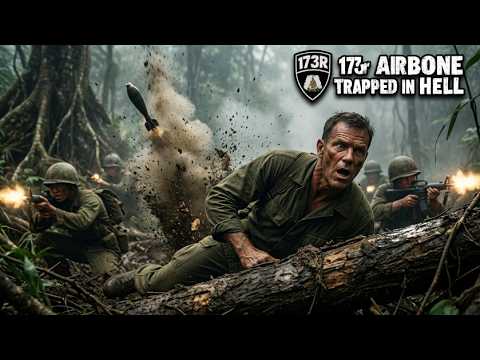
On June 22, 1967, the 2nd Battalion, 503rd Infantry Regiment, was sent to patrol Hill 1338, a high point that offered a strategic view of the surrounding jungle. Alpha Company led the way, moving carefully through the dense foliage. Visibility was almost zero, and the thick fog made it impossible to see more than a few yards ahead. Suddenly, the jungle erupted with gunfire. Hundreds of NVA soldiers ambushed the paratroopers from multiple directions. The attack was swift and brutal. Wave after wave of enemy troops charged at the Americans, forcing them into hand-to-hand combat. Soldiers fought using bayonets, rifle butts, and even their fists to hold their ground.
Despite their bravery, Alpha Company was overwhelmed. One by one, soldiers were shot down. Many called for artillery and air support, but bad weather prevented reinforcements from arriving in time. The fight lasted for hours, but by the end of the day, more than half of Alpha Company was dead. The few survivors escaped through the jungle, carrying their wounded as best they could. The Battle of the Slopes was a disaster for the US Army. 76 American soldiers were killed, making it one of the worst single battle losses of the 173rd Airborne Brigade. Survivors described the horror of seeing their friends slaughtered, bodies left behind, and the enemy showing no mercy.
The battle shocked US commanders. They now understood that the NVA was much stronger and more organized than expected. American forces had underestimated their enemy, and the fight for Dak To was far from over. In response, the US sent more troops and supplies to the region. The 1st and 3rd Brigades of the 1st Air Cavalry Division and the elite South Vietnamese Airborne Task Force were brought in to strengthen defenses. By the end of the summer, the number of US troops in Dak To had doubled. Despite these reinforcements, the NVA was not finished. They had a much bigger plan in mind, and the worst was yet to come.
After the Battle of the Slopes, the US Army knew that the NVA was planning something big. The heavy losses in June proved that the enemy was not only well organized but also determined to push US forces out of the Central Highlands. However, by late summer, NVA attacks suddenly decreased. The jungle became quiet, and US troops found fewer enemy soldiers in the area. At first, American commanders thought they had won. Perhaps the NVA had suffered too many casualties and retreated. But in reality, the enemy was preparing for something much bigger.
While the Americans were reinforcing their positions, the NVA was regrouping and bringing in thousands of fresh troops. By October 1967, they had deployed over 6,000 soldiers, including three full regiments: the 24th, 32nd, and 66th, with another in reserve, the 174th. They were supported by the 40th Artillery Regiment, which meant they had more firepower than before. The NVA’s goal was not just to fight American troops; they wanted to trick them. Their real strategy was to draw as many US forces as possible into the Central Highlands. If enough American troops were tied up in Dak To, they would be too weak to defend major cities during the Tet Offensive, a massive attack planned for January 1968.
To prepare for battle, the NVA built miles of tunnels, trenches, and bunkers. Some of these defenses took over six months to construct, making them incredibly strong. The Americans had no idea how well prepared their enemy was. By October 1967, US commanders knew that the NVA was not finished in Dak To. Intelligence reports showed that large enemy forces were still hiding in the jungle, waiting for the right time to strike. To take control of the region, the US launched Operation MacArthur on October 12, 1967. The goal was simple: find and destroy the enemy before they could launch a full-scale attack. The operation involved the 4th Infantry Division and the 173rd Airborne Brigade, along with South Vietnamese forces. The battle was about to escalate, and the paratroopers of the 173rd would soon face their toughest fight yet.
As part of Operation MacArthur, the 173rd Airborne Brigade was sent on Search and Destroy missions near Hills 823 and 875, located close to the Ho Chi Minh Trail, a major supply route for the NVA. On November 4, 1967, Bravo Company, 4th Battalion, 503rd Infantry Regiment, was ordered to clear Hill 823 of enemy forces. The soldiers advanced carefully, knowing the NVA was likely hiding in the dense jungle. Suddenly, the silence was shattered by machine gun fire and mortar explosions. The NVA had been waiting. They were dug in with fortified bunkers and hidden trenches. The paratroopers were caught in a deadly ambush.
For hours, the battle raged on. The NVA’s position was nearly impossible to attack, as their trenches were interconnected by tunnels, allowing them to reinforce their positions quickly. Every time a bunker was cleared, a new enemy crew would take over. Realizing they could not break through on their own, the paratroopers called for artillery support, using beehive rounds—shells filled with thousands of steel darts. The artillery created gaps in the NVA defenses, allowing the paratroopers to push forward and finally take the hill. But the victory came at a high cost. Many American soldiers were killed or wounded, and the survivors knew that this was just the beginning of the real battle.
After capturing Hill 823, US commanders believed that the NVA was retreating. They ordered Task Force Black and Task Force Blue, made up of units from the 1st Battalion, 503rd Infantry Regiment, to chase after the enemy and destroy them before they could regroup. On November 10, 1967, Task Force Black followed an NVA communication wire left behind in the jungle. They assumed it would lead them to a retreating enemy force. Instead, it led them straight into an ambush. The 8th and 9th Battalions of the NVA 66th Regiment were waiting. The moment the paratroopers entered the area, they were hit with heavy machine gun fire and RPGs. Task Force Black was completely surrounded.
Captain Thomas M. Wayi, the unit’s commander, called for reinforcements, but the thick jungle delayed their arrival. The soldiers had no choice but to fight for their lives. One of the heroes that day was Private First Class John Barnes. When an NVA grenade landed near a group of wounded soldiers, he threw himself onto the grenade, absorbing the explosion to save his fellow paratroopers. He was posthumously awarded the Medal of Honor for his bravery. It took an entire day for reinforcements to arrive. When Task Force Blue finally made it through the jungle, the combined forces were able to push back the NVA and escape the deadly trap. But the battle had been devastating. The 173rd Airborne had suffered heavy losses, and morale was beginning to drop. The soldiers knew that something even worse was coming.
The final showdown would take place at Hill 875, where the NVA had prepared their final stand. The battle for Hill 875 would become the deadliest phase of the entire campaign, testing the paratroopers’ endurance and courage to the absolute limit. As they prepared for the assault, the soldiers of the 173rd Airborne Brigade could only wonder what horrors awaited them on that steep, heavily fortified hill.
On November 18, 1967, a small Special Forces patrol scouted Hill 875 and found the entire 174th NVA Regiment dug into three layers of trenches, tunnels, and machine-gun nests. The 2nd Battalion, 503rd Infantry was ordered to take the hill—but after weeks of fighting, only 290 men remained of the expected 450. That night, artillery and air strikes pounded the summit, and at 9:00 a.m. the next morning, Delta Company led the climb up the ridge.
The first soldier to cross a fallen tree limb was shot dead instantly. Machine guns, mortars, and RPGs rained down from every direction. Delta and Charlie Companies were pinned down within minutes. A second attack at 1:00 p.m. briefly broke the line—First Sergeant Leonard Duran even lobbed a grenade into a bunker—but NVA tunnels let fresh crews replace the dead. Then US artillery mistakenly fell on friendly troops, killing and wounding several Americans. Captain Eugene Kylie of Alpha Company ordered a retreat.
Amid the chaos, a four-man observation team was ambushed. Specialist 4 Carlos Lozada kept his machine gun firing until he was mortally wounded, buying his comrades time to escape. He would receive the Medal of Honor posthumously. But his sacrifice could not save Alpha Company—by afternoon it was overrun, and Captain Kylie was dead. The battalion was surrounded, ammunition running low, and rescue helicopters could not reach them through the enemy fire.
That night, wounded men bandaged themselves with strips of cloth torn from the dead. On November 21, a third assault with artillery, air strikes, and a full battalion push reached the first trench line but was too exhausted to go further. On Thanksgiving Day, November 23, the 4th Battalion, 503rd Infantry attacked from one side while the 1st Battalion, 12th Infantry climbed from the other. At 11:22 a.m., the Americans reached the top of Hill 875—and found it empty. The NVA had slipped away through their tunnels.
The price was staggering: 361 Americans killed, 15 missing, 1,441 wounded, and over 1,000 NVA dead. When the 173rd was pulled back, only 130 men remained uninjured. General Westmoreland called it a major victory, but the soldiers knew the truth—they had been lured into a fight they were never meant to win, and the enemy had vanished to return stronger for the Tet Offensive just two months later.
For the paratroopers of the 173rd Airborne, Dak To was a nightmare they never forgot. Barnes and Lozada earned the Medal of Honor, but many never made it home. Their courage in the jungles of the Central Highlands remains a testament to sacrifice in one of the war’s most brutal battles.
So tell us—was Dak To a true victory, or a costly illusion? Share your thoughts in the comments below.
Report this article
Select a reason for reporting:






