In February 1942, Australia stood on the edge of an abyss. Darwin was burning. Singapore had fallen. And in Tokyo, Japan’s Prime Minister stood before parliament and demanded Australia’s surrender. For a terrified nation, the invasion seemed not just possible—it seemed inevitable.
But what if the truth is more complex than the legend? What if the Japanese records—secret diaries, naval proposals, imperial directives—tell a story that is both more frightening and more surprising than the myth of invasion?
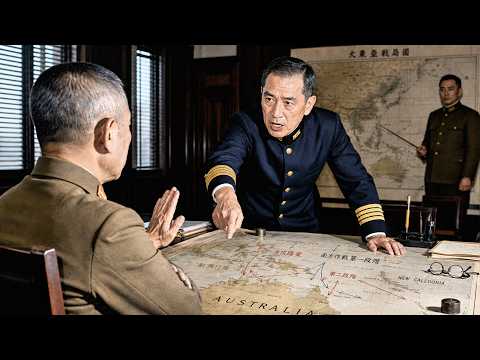
This is the question that has haunted historians for decades. And the answer, buried in archives from Tokyo to Washington, reveals a tale of bureaucratic warfare, desperate logistics, and a plan that was never about landing troops on Australian soil—but about strangling the continent into submission.
The documents survived the war. They bear the handwriting of officers, the stamps of commanders, the weight of imperial approval. They are not propaganda. They are the cold, calculated paper trail of an empire deciding the fate of a nation.
To understand what they reveal, we must first return to the fear. Christmas 1941 was the worst Australia had ever known. Pearl Harbor had been attacked. The great British battleships Prince of Wales and Repulse lay at the bottom of the sea. Hong Kong had surrendered on Christmas Day. Manila fell in early January. And on February 15, 1942, Singapore—the fortress that was supposed to keep the Japanese fleet at bay—capitulated after just two months. Fifteen thousand Australian soldiers marched into captivity.
Four days later, 188 Japanese aircraft attacked Darwin. Two hundred thirty-five people were killed. Eight ships were sunk. The city was left in ruins. In the weeks that followed, Japanese planes struck airfields across northern Australia—Broome, Wyndham, Katherine—at will, meeting no resistance. For the first time, a foreign enemy had brought war to Australian soil.
In the south, sandbags were piled around post offices. Air-raid shelters were dug in Sydney’s Hyde Park. Schoolchildren carried gas masks. Posters at railway stations read: “Trust this or die. The Japanese are coming.” Cars were painted khaki. Women sewed blackout curtains. In Brisbane, rumors spread that Japanese ships had been sighted off Moreton Island. In Perth, families packed their cars and fled east toward the wheat belt, expecting enemy paratroopers at any hour.
In the north, ordinary people prepared for the extraordinary. Farmers dug narrow trenches in their fields. Post offices organized competitions to see who could fill sandbags fastest. Volunteer Defense Corps units—men too old for regular service, mostly World War I veterans—drilled with shotguns and ancient Lee-Enfield rifles in the main streets of towns like Katherine and Broome. In Cairns, the city council quietly buried its silver collection in the botanical gardens. In Tennant Creek, women were told that if the Japanese landed, they should head south into the desert with their children rather than surrender.
On December 27, 1941, Prime Minister John Curtin had already published his New Year’s message in the Melbourne Herald. It contained the sentence that would shape everything Australians thought for the next four years: “Australia looks to America, free of any pangs as to our traditional links or kinship with the United Kingdom.” Behind him, the country was preparing to fight for its life on its own soil.
And there was more to come. On March 3, a Japanese air raid from carriers struck Broome, killing about eighty people, mostly Dutch refugees on flying boats in the harbor. On May 31, three Japanese midget submarines penetrated Sydney Harbor, sinking a converted ferry and killing twenty-one men. Sydney and Melbourne saw Japanese floatplane reconnaissance flights. Japanese submarines sank ships along the east coast within sight of the shore. For a full year, the war did not just feel close. It was close.
This is the Australia of February 1942. This is the crucible of fear. And now the question: did Japan actually intend to invade?
Here is the fascinating thing about this question. Unlike most historical questions, there is a real, material, documented answer. The Japanese kept records. The Imperial General Headquarters kept secret diaries. The Naval and Army General Staffs kept minutes of meetings. The Liaison Conferences recorded their decisions. The Emperor’s directives were written down. When the war ended in August 1945, some of those records were burned in haste in the courtyards of the War Ministry in Tokyo, but a large portion survived. American occupation forces seized what remained. And Japanese historians, along with American and Australian researchers over the following decades, combed through the surviving material.
Paper does not lie. It is a historian. It carries handwriting. It is paired with names. And it contains, in some cases, the seals of the officers who signed it. It is preserved in the Japanese Defense Ministry Archives in Tokyo, in the U.S. National Archives in College Park, Maryland, and in the Australian National Archives in Canberra. Any historian with pre-war Japanese reading ability and enough patience to read a fifty-page administrative record can go and read the same documents that were read at the time. That is a rare thing to say about a historical question. And it is why the argument that follows is, at its core, an argument you can participate in.
One thing you should know before we open the file. Some online sources on this subject are sites promoting particular views. Some argue that Australia faced a mortal invasion threat that was narrowly avoided. Others argue that talk of invasion in Tokyo was the fantasy of a few mid-ranking officers and never had a real chance of becoming policy. Both sides use much of the same documentary evidence. Both sides make arguments about what that evidence actually means. That is normal in history. It is also important. We will go through the documents themselves, and where the interpretation of a document is disputed, we will point that out.
So the first document is a proposal from the Naval General Staff of the Imperial Japanese Navy, dated December 1941. It came from an office in the Naval Staff called the Operations Section of the First Bureau. It was headed by a captain named Sadatoshi Tomioka. Tomioka was the head of the Plans Division. He was, by all accounts, a brilliant, ambitious, and impatient officer. He had spent months looking at a map of the Pacific and asking a specific question: what is the single greatest medium-term threat to everything Japan is about to conquer? His answer was Australia. Not because Australia was strong. Because Australia was, by his calculation, weak.
The Australian Army had two full divisions in the Middle East fighting Rommel. It had a division in Malaya, on its way to destruction. It had, at home, an improvised force of untrained militia and a coastline seven thousand five hundred kilometers long. It had, in the entire country, only a few dozen modern aircraft. Australia was a threat, in Tomioka’s view, because of what it could become if the United States succeeded in overcoming the initial shocks of the war. And if the American war economy did what everyone in the Japanese Navy secretly suspected it would—outproduce Japan tenfold within eighteen months—then America would need a place from which to launch its counteroffensive. That place had to have railways, ports, workshops, airfields, oil depots, food, water, and a friendly government. In the entire South Pacific, only one such place existed: Australia.
Tomioka argued: “Deprive the Americans of Australia, and you deprive them of their starting point.” “Without a base in Sydney or Brisbane, the American fleet crossing the Pacific would have to sail three thousand miles from Pearl Harbor through empty waters, fight, and then sail three thousand miles back home.” That was not possible. If Japan seized northern Australia now, while the Australians were weak and America was still reeling, the Pacific War would be decided before it began.
That was the logic. It is worth pausing on it for a moment because it is not a foolish argument. In fact, when American planners in Washington later read intercepted Japanese communications during the war, they generally agreed with Tomioka’s analysis of Australia’s strategic importance. But they did not agree that anyone had the ships to carry it out.
In December 1941, the Navy formally circulated the idea within the General Staff as an objective for the second phase. After the conquest of Southeast Asia was complete, it was just a memorandum. It was just a proposal. It had no legal force at the time. But it was documented on paper. It moved between offices. It reached the Army. That is the first document.
The second document is the Army’s response. The response came quickly. The Imperial Japanese Army General Staff was a serious institution. It had been running a war in China since 1937. It kept the Kwantung Army in Manchuria facing what it considered the real strategic enemy, the Soviet Union. It ran divisions through Malaya, the Philippines, the Dutch East Indies, and Burma. The men doing the planning were professional soldiers who made their living from mathematical calculations. When they saw the Navy’s proposal on Australia, they did the math.
Their calculation was as follows. To land a force in northern or eastern Australia and advance far enough to control the population centers, it would require at least ten to twelve additional divisions. That is roughly two hundred thousand men, plus their vehicles, weapons, horses, ammunition, fuel, food, and everything else an army consumes in a campaign lasting months against a population defending its own land. To transport ten to twelve divisions across the Timor and Arafura seas, and then supply them over vast distances with no railways and few good roads at the other end, would require, at a minimum, about one and a half million tons of commercial shipping dedicated exclusively to that campaign. Japan did not have one and a half million tons of commercial shipping to dedicate to this purpose. In fact, Japan did not have one and a half million tons of commercial shipping that was not already dedicated to other tasks. Its total pre-war merchant fleet was about six million tons. Of that, nearly half was requisitioned for military use. The rest was needed to transport raw materials: oil from the Dutch East Indies, rubber from Malaya, tin from Indochina, coal from Manchuria to the home islands, without which the entire war economy would stop. Every ton of shipping pulled from that raw materials supply line meant a ton of steel not made, or a ton of aviation fuel not refined, or a ton of food not reaching the city.
There is a specific point in this number that non-specialists sometimes miss. Modern armies do not run on the ammunition and rifles their soldiers carry. They run on tonnage. A World War I division consumed about one hundred tons of supplies per day in the field. A World War II division, with more vehicles and heavier artillery, could easily consume two hundred fifty tons per day. Ten divisions in northern Australia means two thousand five hundred tons of supplies per day passing through ports thousands of miles from the nearest Japanese base. Forever, until the campaign is won. To maintain that supply line would require a merchant fleet dedicated to that task. It also required oil tankers, escort ships, port facilities, coaling stations, and repair docks. Japan had almost none of this south of Rabaul.
The Army did not need geopolitics explained. They replied with a number only. Ten to twelve divisions. One and a half million tons of shipping unavailable. There was another number the Army was thinking about. It was called China. In February 1942, the Imperial Japanese Army had between six hundred thousand and one million soldiers committed to the war in mainland China. Those men could not be brought home. They were pinned down by Chinese nationalist and communist resistance that Japan could neither defeat nor withdraw from. And this was the Army’s own nightmare, the only barrier between Japan and the Red Army in the north. In the summer of 1939, the Soviets had crushed a Japanese army at a place called Nomonhan on the Mongolian border. Every serious Japanese military planner in 1942 believed the Russians might return at any moment. You could not weaken Manchuria for an adventure at the far end of the world.
There was another figure the Army took into account and must be mentioned. It was the memory of 1941 and the sudden winter victories. The Army knew, because it had been present at the decisions, that the opening strike of the Pacific War had been on a knife’s edge. Japan had committed almost every trained division it had. It had won because the enemy was unprepared and because the plans were bold. To attempt to repeat that boldness now at the southern end of the world against a country backed by the entire depth of the Australian continent was not boldness in the eyes of the professional Army. It was recklessness of the kind that could lose the war. That is the Army’s calculation. That is the second document.
On February 6, 1942, the Navy tried again. Nine days before the fall of Singapore, the Naval Ministry formally proposed a plan under which eastern Australia would be invaded at the same time Japanese forces seized Fiji, Samoa, and New Caledonia. The proposal moved through the joint sections of the Army and Navy in Imperial General Headquarters. The Army looked at it. The Army did the same math it had done in December. The Army rejected it.
For anyone not familiar with how the Japanese Empire made decisions in 1942, this sentence needs explanation. Imperial General Headquarters was a joint body. It contained an Army section and a Navy section. Each service had a chief of staff who reported to the Emperor. Neither service controlled the other. For a plan the size of an invasion of Australia, both sections had to agree. If the Army said no, the plan could not proceed. The Army said no.
The Navy did not give up. Its planners went back to Tomioka’s office and reworked the argument, focusing on tactical demands, downplaying shipping requirements, and emphasizing the strategic prize. On February 14, 1942, the day before Singapore’s surrender, the Army and Navy sections of Imperial General Headquarters met again to discuss the matter. Here we come to the most famous line in the documents throughout this story. The Navy sent Captain Tomioka himself to present the case. And he did so forcefully. According to the minutes, he claimed—and this is the surprising part—that Australia could be seized with what he called a “token force.” Not ten divisions, not eight. A token force. He was pushing hard. He believed the Australian militia would not fight, that the country was politically fragile, that a landing in the north would cause the government to collapse within weeks, and that a full occupation would follow without a serious campaign.
The Army officers in the room, by all accounts, were stunned. The keeper of the secret diary of Imperial General Headquarters that day recorded his personal opinion of Captain Tomioka’s argument in one line. The word he used in the original Japanese has been translated into English as nonsense. Some translations render it as utter absurdity. The meaning is the same. A senior Army staff officer, listening to a Navy captain claim that the fifth-largest landmass on Earth could be seized with a token force, wrote in the diary of the highest military command of the Japanese Empire that the whole thing was nonsense. This line matters because it survived the war. It was translated and studied by American, Australian, and Japanese historians in the 1950s and 1960s. It is one of the pieces of evidence at the heart of the debate; it tells us, to this day, in one sentence, what a professional military planner thought of the Navy’s Australia proposal on the day before Singapore fell. He thought it was fantasy.
And here the story stops being simple. The Navy did not leave that room defeated. The Navy left that room with a modified argument. Tomioka’s colleagues heard the ridicule and adjusted the pitch. They abandoned the token force idea. They accepted, on paper at least, that a larger commitment might be necessary. They returned the following week with a more sober version of the same proposal. This time, it was framed as part of a second-phase package that included the seizure of islands east of Australia. The invasion of Australia failed on February 14. But it was revived in a slightly different form before the end of the month.
This is the important thing to remember about paper records. They do not resolve neatly. They do not have a single day when the argument ends. There are meetings, and after each meeting, a slightly different version of the same idea returns. It took only the accumulated weight of repeated rejections across many meetings over weeks to finally move the discussion off the invasion track and onto a different track.
Now, if the story ended there, this video would be short. But it does not end there, because on the same day that Tomioka was described as peddling nonsense in a Tokyo conference room, and three thousand kilometers to the south in Singapore, a Japanese general was preparing to accept the surrender of the largest British army in history. And that general, according to a source we must treat with caution, had his own ideas about Australia.
The general was Tomoyuki Yamashita, commander of the Twenty-Fifth Army, the man who had just conquered Malaya in seventy days. On February 15, he took Singapore. In the days that followed, he reportedly—and this attribution matters—said he now wanted to discuss a plan to invade Australia with Prime Minister Tojo. The source for this is postwar interrogation and secondary memoirs. It is not a document signed by Yamashita at the time, but it is recorded in the records, and it must be taken into account. According to this account, Yamashita believed that the momentum of the Malaya campaign had opened the door. If a small, tough, mobile army could take Singapore from the rear in seventy days, then a similar force could take northern Australia in similar time. He wanted permission to discuss the matter with Tokyo. His request was refused. Again, according to the report, Tojo rejected the plan, citing the length and fragility of Japan’s supply lines.
Then, in the late summer of 1942, Yamashita was transferred to command the First Area Army in Manchuria, a posting widely considered at the time to be a demotion. He did not return to the south until he was sent to defend the Philippines against Douglas MacArthur in 1944. So even the most likely general, based on his recent record, to push such a plan was told no and moved aside, and the paper transactions continued.
On February 27, 1942, the question of invading Australia was discussed by Imperial Headquarters for the last time. At that meeting, the Army made a specific point that had not been in the records before. It said that Australia, according to its intelligence, was defended by a military force of about six hundred thousand men. That figure was exaggerated. The actual number was closer to half that once the divisions in the Middle East and men still in training were subtracted, but six hundred thousand was the number on the Japanese Army estimate sheet on February 27. Six hundred thousand defenders spread across a continent meant a campaign that would take not months, but years. That, from the Army’s point of view, was the end of the discussion.
Five days later, on March 4, 1942, Imperial General Headquarters met to decide formally what Japan’s strategy for the second phase would be. The document they produced that day has a long title. In English translation, it is called the Essential Outline of Recommendations for Future War Leadership. Read it and you will find a mention of the invasion of Australia, but you will find it mentioned in a very specific way. It is listed as a future option to be considered only if all other second-phase operations went well. It is not authorized. It is not scheduled. It is, in the language of a military planning document, reduced in priority to the point of nonexistence. That is the March 4 conference. There the invasion of Australia as an active proposal effectively died.
But something else was born at that same conference. The Navy had lost the argument for invading Australia. But it did not come away empty-handed. Instead, both sides accepted and agreed to an alternative approach. If the Australian mainland could not be occupied, then Australia could still be neutralized as an American base. It could be cut off. It could be isolated. It could be strangled. The plan for doing so was given a code name: Operation FS. F for Fiji, and S for Samoa. The plan also included the seizure of New Caledonia and the reinforcement of positions already being built in the Solomon Islands.
The idea was straightforward. Between Hawaii and Australia lies a chain of small island groups stretching across the empty Pacific. New Caledonia, the New Hebrides, Fiji, and Samoa. These islands were the stepping stones through which American troops, aircraft, fuel, ammunition, tanks, and food had to pass by sea to reach Australia. If Japan seized those stepping stones and turned them into fortified airfields and submarine bases, no American convoy could pass. The lifeline between San Francisco and Sydney would be cut. Australia, cut off from its only serious ally, would eventually run out of the things it could not make itself. Then, according to the Japanese estimate, it would be forced to sue for peace.
The word Japanese planners used in the untranslated documents means something close to choking. Choke Australia. Cut off its air. Wait. To understand why the planners believed the choke would work, you have to understand what Australia was and was not in 1942. It was a nation of seven million people. It produced its own wheat, meat, wool, and coal, but it did not produce significant quantities of aviation fuel, high-octane gasoline, aluminum, most modern electronics, the latest aircraft types, the latest tank types, or hundreds of other things a modern army needs to fight. It imported almost all of that from the United States. Once the American shipping route was cut, Australia’s ability to wage war would begin to fade within months. Its cities would still stand. Its wheat would still ripen, but its air force would be grounded within a year. Its navy would be laid up for lack of fuel. Its army would shrink to what it could carry on its back and fire from a bolt-action rifle. That was the end state Operation FS was designed to achieve. It was no less dangerous than invasion. From the point of view of the Japanese planners, it was more precise and elegant in some ways. Invasions cost entire divisions. Choking costs only a fleet, some island garrisons, and a little time. This was not an invasion of Australia, but it was a plan aimed at Australia, and in its results, had it succeeded, it would have been no less dangerous.
On March 7, 1942, the Naval General Staff formally approved Operation FS as the preferred approach. On March 11, the plan was ratified at the Imperial Liaison Conference, the highest joint civilian-military body chaired by the Prime Minister. On March 13, the plan was presented to the Emperor. On March 15, 1942, Imperial General Headquarters formally ordered the Japanese Army and Navy to implement Operation FS. The order carried the endorsement of Emperor Hirohito himself. The execution date was set for July or August 1942, after the successful completion of three preparatory operations: Operation MO against Port Moresby, Operation RY against Nauru and Ocean Islands, and Operation MI against Midway. That is the plan that was actually approved—not an invasion, but a choking.
While all of this was being decided behind closed doors, the Prime Minister of Japan was speaking about Australia in public. Hideki Tojo was a professional soldier who became Prime Minister in October 1941. In the Japanese parliament, the Diet, in January and February 1942, Tojo gave public speeches demanding that Australia surrender to Japan. He described Australia as a country that had made a mistake by tying its fate to the United States and Britain. He warned that if Australia did not separate itself from the Allied cause, it would suffer for that choice. He offered, in coded language, terms and a place within what Japan called the Greater East Asia Co-Prosperity Sphere, provided Canberra turned away from Washington. Tojo was not talking to Curtin. He knew Curtin would ignore him. He was talking to Japanese public opinion to give a certain character to the war on the southern front. He was also talking to a certain audience inside Australia itself: the few defeatists, appeasers, and communist-leaning figures who might be convinced that resistance was futile.
Tojo was not the only source of pressure. During the first half of 1942, Japanese propaganda broadcasts in English were transmitted to Australia from transmitters in Tokyo, Manila, and captured British stations in Singapore. Announcers with names like “Tokyo Rose” read out the names of Australian prisoners of war, warned Australian mothers that their sons would never return home, and told listeners that the Japanese Army was preparing to end the war on Australian terms. The midget submarine raid on Sydney Harbor in late May was part of that pressure campaign as much as it was a military operation. Its goal was not so much to sink ships as to demonstrate that Japan could reach the heart of Australia’s largest city whenever it wished. In Japanese newspapers published in June 1942, the Sydney raid was written up as a prelude to what was coming.
Curtin did not reply. Australia fortified itself, and in Tokyo, alongside the parliament speeches, Tojo’s planners were quietly drafting what a “day after surrender” arrangement for a defeated Australia would look like. In the files of the Japanese Foreign Ministry, there are drafts of what such an arrangement might include: a puppet Australian government, a resident Japanese governor, a disarmed defense force, and grants to Japan of access to Australian minerals, wool, and wheat. None of that was ever offered to anyone in Australia, but it was written down. It was recorded in the files.
What happened next is the part most Australians know. The two battles in the Pacific that were supposed to pave the way for Operation FS did not do so. They destroyed it. In the Battle of the Coral Sea, in the first week of May 1942, an American carrier task force turned back the Japanese invasion of Port Moresby, known as Operation MO. That was the first time in the war that a Japanese amphibious operation was stopped. Four weeks later, at the Battle of Midway, in the first week of June 1942, the same American carriers sank four Japanese aircraft carriers in a single afternoon, eliminating the offensive arm of the Combined Fleet. Without carriers, Operation FS could not be executed. On July 11, 1942, the operation was formally cancelled. The plan that the Emperor had approved in March, the plan aimed at choking Australia into surrender, had died weeks before Tokyo publicly admitted it.
And now, the archival verdict. In the years following Japan’s surrender in August 1945, American occupation forces seized what remained of the Japanese military archives. Under the supervision of the Supreme Commander for the Allied Powers, teams of American, Australian, and British officers combed through those archives for evidence of Japanese war planning. In parallel, in the 1950s, Japanese researchers began publishing a detailed history from primary Japanese sources, culminating in the official Japanese war history series Senshi Sosho, published by the Military History Department of the National Defense College in Tokyo. Senshi Sosho matters here because it is not an Allied source. It is not a book written by an American historian trying to interpret what the Japanese were doing. It is a book written by former Japanese officers, with access to Japanese archives, in the Japanese language, for Japanese readers. Its volumes on the early Pacific War contain the paper record described in this text. The December proposal, the February meetings, the March conferences, the Emperor’s directive of March 15, and the cancellation of Operation FS in July. Where popular history and Senshi Sosho differ, Senshi Sosho is usually right because it is closest to the original files. And where Senshi Sosho and popular history agree, that agreement is meaningful.
The result of all that work, regarding the specific question of whether Japan officially ordered an invasion of Australia, is firm and clear. No such order was ever issued. No directive from Imperial General Headquarters, no imperial rescript, no operations plan of the Combined Fleet authorized the landing of troops on the Australian mainland. The invasion of Australia existed as a proposal from December 1941 to early March 1942. It was advocated by the Navy. It was rejected by the Army. It was formally set aside on March 4. It was replaced by Operation FS on March 15. Operation FS was cancelled on July 11. That is what the documents say. And this is what the documents do not say.
So the question is answered, and the file is closed. Except that it is not, because the modern debate among historians is not about the documents. Everyone accepts the documents. The debate is about what those documents mean.
There is one school of thought, publicly associated with the former principal historian of the Australian War Memorial, that reads the documents this way. The invasion proposal was raised by a few mid-ranking naval officers. It was rejected by the Army almost immediately. It was never an approved plan with any force. It never received the Emperor’s approval. What was actually approved, Operation FS, was cancelled before a single Japanese soldier set foot anywhere south of Rabaul. According to this interpretation, Australia in 1942 faced a significant strategic anxiety but did not, technically, face an invasion threat. The country was afraid of the wrong thing. Australia’s real war was fought in the Kokoda Track and the Coral Sea, not against an invasion, but against a slower, more cunning strategy of encirclement.
There is another school, associated with a number of academic historians of Australian defense and with the Battle for Australia commemorative movement, that reads the same documents differently. In this interpretation, the fact that the Navy’s proposal was ultimately rejected is less important than the fact that it was raised and supported, and was defeated only by a specific and contingent combination of Army calculations, commitments on the China front, and a lack of shipping. Had those numbers gone the other way, had Japan captured more shipping in the Dutch East Indies, or had the Kwantung Army felt safer against the Russians, the discussion might have taken a different turn. And this school points out that the plan that was adopted, Operation FS, was aimed at Australia. Its purpose was to force Australia to surrender. Had it succeeded, the result for the Australian people would have been very similar to occupation, but without the need for amphibious landings. In this interpretation, to say that Australia was never in danger because there was no invasion order is to focus on the wrong document.
There is a third interpretation, less common in public debate but common in scholarly literature, that neither side has the completely right side of the argument. According to this view, the invasion proposal was real, was seriously discussed, and was rejected for reasons that were themselves contingent. So far, this agrees with the second school. But the plan the Emperor approved as an alternative, Operation FS, was itself a distant and improbable operation that depended on Japan winning at the Coral Sea and Midway, and on the Americans failing to reinforce New Caledonia and Fiji before the Japanese arrived. When those things did not happen, the threat evaporated within weeks. So the strategic danger to Australia, in this interpretation, was real between March and June 1942, and effectively ended by the middle of that year. The country was in real danger for perhaps four months. That is a shorter period of danger than popular memory retains, but longer and more realistic than the most severe skeptics allow.
Both of the first two interpretations use the same evidence. Both positions are respectable and are held by people who have read the primary sources in the original Japanese. That is the state of the debate today, and it is unlikely to be resolved because the debate is not really about what actually happened. It is about what almost happened, and whether that “almost” counts.
There is a final layer worth adding. Some of the most meticulous studies of this question, including the work of the late Japanese researcher Henry Frei, whose book Japan’s Southward Advance and Australia is considered a standard reference, have argued that the debate in Tokyo was more serious than dismissive accounts suggest, and that the institutional weight of the Japanese Army at a particular moment is what tipped the balance toward isolation rather than invasion. This is not a claim that invasion was likely. It is a claim that it was thought about, argued for, and rejected for reasons of logistics rather than any lack of ambition.
So here is the honest answer in three sentences. Elements of the Japanese Navy proposed an invasion of Australia in early 1942 and pressed the case at Imperial General Headquarters more than once. The Japanese Army rejected the plan on the grounds that it would require ten to twelve divisions and about one and a half million tons of shipping that Japan did not have, and the Emperor never approved an invasion of the mainland. What the Emperor did approve on March 15, 1942, was Operation FS, a plan to cut Australia off from America and force its surrender by choking it. And it was only the American victories at the Coral Sea and Midway that ended that.
That is the documented paper trail. That is what the enemy wrote down. The three-sentence answer is the answer that holds up against the evidence. And it does not give either of the popular narratives a decisive victory. It does not say that Australia faced an imminent invasion, because Japan officially decided not to invade. And it does not say that Australia was never in danger, because Japan officially decided to choke it. And that plan was approved at the highest level of the Empire, up to the Emperor himself. Both things are in the same document, six weeks apart.
In February 1942, in the cities of eastern Australia, women were sewing blackout curtains. In the hills behind Darwin, teenage boys of the Volunteer Defense Corps were drilling with old Lee-Enfield rifles in the fields. On the shores of Sydney Harbor, sandbags were being stacked against the sides of buildings that had never needed defending in anyone’s memory. And at the same hour, in a wood-paneled room in Tokyo, a senior Army staff officer was telling a Navy captain that his plan to invade the fifth-largest landmass on Earth with a token force was nonsense. Both things were true at the same time. That is the strangest and most human part of the whole story. The Australians were not paranoid. Their government had every reason to prepare for the worst. The Japanese Prime Minister had publicly recorded his demand for their surrender. The Japanese Navy had, in its official records, a serving captain arguing for their invasion. The war was closer than any war had ever been. The fear was rational.
But the Japanese Army was not lying to itself either. Its planners looked at their maps, their shipping records, and their divisions stuck in China, and said they could not do this. Not because they did not want to, but because they could not. And then a third thing was decided above both of them. On March 15, the Emperor approved a plan that ruled out the direct blow and replaced it with a slower, more patient, encircling one. That plan almost came to pass at the last moment. It failed only because of what happened in a patch of water off New Guinea in early May, and in a patch of water off Midway in early June.
The war that Australians in Melbourne, Perth, and Newcastle were preparing for in February 1942 was not, in the end, the war that Japan approved. It was the war that Japan studied and rejected. The war Japan approved, the war of blockade and isolation and forced surrender, was a different war, and it was in no way less dangerous. The paper records tell us both things. They tell us that the invasion story is not a myth invented by wartime propaganda out of thin air. They tell us that Japanese officers wrote down an invasion of Australia, proposed it, argued for it, and had their argument taken seriously enough that Imperial General Headquarters had to meet twice to decide what to do about it. And the paper records also tell us that at the end of those meetings, the answer was officially and repeatedly no.
If you sit today in the National Archives in Tokyo in the reading room of the Japanese Defense Ministry with a translator beside you, you can read the diaries, the minutes, and the diary entry containing the word “nonsense.” You can read the Emperor’s directive of March 15. You can read Tojo’s speeches to the Diet. You can read all of it in one long afternoon. In the exact order in which it was written. That afternoon of reading will tell you what Australians in February 1942 could not know. That the fear was justified. That the war was real. And that the shape of the war they were preparing to fight was being decided quietly in wooden rooms on the other side of the world, by men who never came to Australia and never would.
Sandbags were placed on one side of the ocean. Papers were passed across desks on the other. Both mattered. Both were part of the same story. And the story ends where the papers end. With an order in March 1942, signed by the authority of the Emperor of Japan, that did not send an army to Australia. It sent a plan to isolate Australia from the world. The plan failed. But the papers remained. And that is what the records really show.
The final document in the file is dated July 11, 1942. It is a single page, signed by the chiefs of the Army and Navy sections of Imperial General Headquarters, and it cancels Operation FS. There is no ceremony in it. No explanation. Just a line.
By then, the wooden rooms in Tokyo were already quiet. The carriers were gone. The debate had moved on to Guadalcanal, where a different war was beginning. The plan to choke Australia died the way most plans die—not with a decision, but with a date.
And yet the papers remained. The proposal, the rejection, the diary entry, the imperial directive. They sat in archives for decades, waiting for someone with patience and a translator. They still tell the same story they told in 1942.
So the question is no longer what Japan planned. The question is what we choose to remember.
If you could stand in that Tokyo reading room and read the file for yourself, what would you conclude—was Australia saved by luck, by logistics, or by something else entirely?
Report this article
Select a reason for reporting:






