Hollywood has a habit of taking monsters and dressing them up as heroes. But when it comes to Bonnie Parker and Clyde Barrow, the makeover was so extreme that it borders on fiction. The 1967 film Bonnie and Clyde is considered a masterpiece, a tragic love story wrapped in a hail of bullets. But according to Jeff Guinn’s biography Go Down Together, the film’s accuracy is a staggering 5%. That means 95% of what you think you know about these two is pure invention.
The real story is darker, bloodier, and far more disturbing than anything Hollywood dared to show.
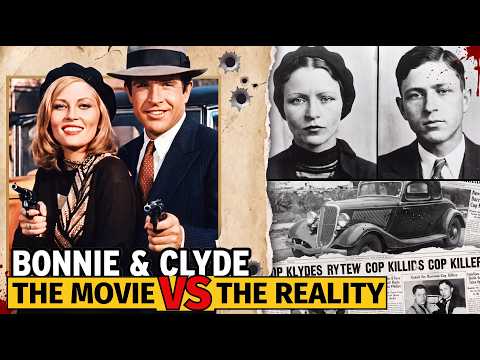
For starters, the film cast Warren Beatty and Faye Dunaway—two of the most glamorous stars of their era. Beatty stood at 6’2″, Dunaway at 5’7″. The real Bonnie and Clyde? Bonnie was 4’11”, Clyde just 5’4″. In an age when the average man was 5’8″, they were notably short. This wasn’t a pair of sleek, athletic outlaws; they were small, unassuming, and easily overlooked.
But their physical stature is the least of the discrepancies. The film paints Clyde as a decent kid pushed into crime by the Great Depression. The reality? Clyde was already a seasoned criminal by age 13, seven years before the Depression hit Texas. Crime was the family business—five of his seven siblings ended up as convicted felons. Poverty didn’t make Clyde a criminal; he was born into it.
In 1930, Clyde was sent to Eastham Prison Farm, one of the most brutal institutions in Texas. He was young, handsome, and innocent-looking—exactly the type that predators target. A convict named Big Ed Crowder made Clyde his personal punching bag. One day, Clyde caved in Crowder’s skull with a lead pipe. It was his first premeditated murder, and another inmate took the fall.
But Eastham wasn’t done with him. To escape the daily beatings and backbreaking labor, Clyde had a friend chop off two of his toes with an axe. Self-mutilation was so common that the guards knew exactly what they were looking at. He entered Eastham a schoolboy and left as a rattlesnake.
When he was paroled in February 1932, he found Bonnie again—they had known each other before. Together, they embarked on a 21-month crime spree that left at least 13 people dead, nine of them lawmen. This was the era of Public Enemy Number One, when John Dillinger dominated headlines. But here’s the twist: Dillinger himself called Bonnie and Clyde “a bunch of arrogant punks” who gave bank robbery a bad name.
And that’s the next myth Hollywood sold you: that they were professional bank robbers. They weren’t. They targeted easy marks—small grocery stores and gas stations in rural towns, the kind of places where working-class people shopped. Their biggest haul was a measly $1,500. They weren’t stealing from the rich; they were stealing from the poor.
The gang wasn’t a fixed cast, either. Clyde’s brother Buck was in and out until he was killed. Buck’s wife Blanche was captured and later wrote a memoir. Then there were young recruits like W.D. Jones and Raymond Hamilton, both Eastham alumni. Hamilton’s recklessness even scared Clyde.
The film portrays their violence as reluctant self-defense, as if every shot was forced. But eyewitnesses tell a different story. On Christmas Day 1932, just one day after 16-year-old W.D. Jones joined the gang, he and Clyde shot and killed Doyle Johnson, a married man, in front of his car in Temple, Texas. Eleven days later, Clyde killed Tarrant County Deputy Sheriff Malcolm Davis during a police ambush. In April 1933, in Joplin, Missouri, the Barrow brothers and Jones killed two more officers, Detective Harry McGinnis and Constable J.W. Harryman. This is the part Hollywood erased entirely.
In June 1933, Clyde was driving 70 mph on a rural Texas road when he missed a warning sign for a bridge under construction—because he couldn’t read. The car flipped into a ravine, and battery acid poured onto Bonnie’s right leg, eating flesh to the bone. She spent the last year of her life barely able to walk. Clyde carried her half the time because she couldn’t run.
The 1967 film never showed Bonnie’s limp. Not once. In reality, both of them limped—Clyde from his missing toes, Bonnie from the acid burn. They weren’t sleek outlaws; they were two crippled, desperate people dragging bodies across the country.
The worst came on Easter Sunday, April 1, 1934. Two young Texas highway patrolmen, H.D. Murphy and Edward Wheeler, pulled over thinking a driver needed help. They were shot dead. A farmer claimed he saw Bonnie laughing as Murphy’s head bounced like a rubber ball. That account was later debunked, but the officers were still dead.
The film also turns Frank Hamer, the legendary Texas Ranger, into a bumbling, vengeful fool who gets captured and humiliated. That never happened. Hamer never saw Bonnie and Clyde until he shot them. His widow sued the filmmakers for defamation and won. The 2019 Netflix film The Highwaymen tried to set the record straight, but most people still believe the myth.
So what finally ended the game? Not brilliant police work—betrayal. A recruit named Henry Methvin, whose father cut a deal with the law, sold out the gang. On May 23, 1934, at 9:15 a.m., Hamer and six men ambushed them on a rural road near Gibsland, Louisiana. They fired 130 to 160 rounds. Deputy Ted Hinton, who had known Bonnie before she went bad, was part of the posse. The coroner counted 17 head wounds and 26 body wounds on Clyde. One bullet severed his spinal column. Some researchers believe there were over 50 bullet holes in total.
What happened next showed exactly how the public felt. The crowd that swarmed the death car was savage. People grabbed spent shell casings from the road. They tore locks of Bonnie’s hair and pieces of her dress. One man tried to shoot Clyde’s trigger finger off—or maybe his ear. Reports vary.
Their funerals were circuses. 20,000 people attended Bonnie’s; 15,000 came for Clyde. But even in death, they couldn’t be together. Bonnie’s mother refused to let Clyde be buried next to her. “She had him in life; she won’t have him in death,” she said. Bonnie never divorced her first husband and was still wearing his wedding ring when she died. There’s an empty plot next to Clyde’s grave, still waiting. Her mother said it would be a cold day in hell before that happened. But her niece wants it to happen sooner rather than later.
The 1967 film turned these two into saints, rebels against a corrupt system. But the truth is far uglier. They weren’t Robin Hood. They were violent criminals who robbed the working poor and murdered at least 13 people. The real story of Bonnie and Clyde isn’t a love story—it’s a cautionary tale about what happens when myth becomes larger than fact.
But the myth didn’t die with them. It grew, fed by newspapers, dime novels, and eventually the silver screen. In the 1930s, the public was hungry for antiheroes. Banks were foreclosing on family farms, and the government seemed deaf to the suffering. So when word spread of a young couple robbing those very banks, the fantasy took root.
Never mind that Bonnie and Clyde rarely touched a bank. The legend was too delicious to resist. Reporters exaggerated their exploits, and photographers staged them—Bonnie posing with a cigar and a shotgun, an image that became iconic even though she didn’t smoke. The real Bonnie hated that photo. She thought it made her look like a hardened criminal, not the romantic figure she wanted to be.
What’s most chilling is how the gang’s violence escalated. It wasn’t just the killings—it was the casual cruelty. In one incident, they kidnapped a man and drove him around for hours before dumping him on a country road. Another time, they shot up a dance hall for no reason. These weren’t reluctant outlaws; they were thrill-seekers with guns.
And yet, the public couldn’t get enough. When Bonnie and Clyde died, souvenir hunters picked the death car clean. The car itself was towed to a garage and displayed for decades, bullet holes and all. People paid to see it, to touch the metal where the blood had dried.
Hollywood, of course, sanitized all of this. The 1967 film ends with a slow-motion ballet of death, the lovers exchanging one last glance. It’s beautiful, tragic, and utterly false. The real ambush was over in seconds—a brutal, ugly slaughter that left their bodies unrecognizable.
So why does the myth persist? Perhaps because we need monsters to be beautiful. We need outlaws to be rebels, not thieves. We need love stories, even if they end in a hail of bullets.
But the truth is simpler and sadder. Bonnie and Clyde were two damaged, desperate people who found each other in a world that had no place for them. They robbed because they were poor. They killed because they were scared. And they died because they ran out of road.
The real tragedy isn’t that they died young. It’s that they were never the heroes we wanted them to be.
The legend lives on, but the facts tell a different story. And maybe that’s the most important lesson of all: we should never let Hollywood choose our heroes for us.
So the next time you hear the twang of a banjo and see two beautiful people driving into the sunset, remember the truth. Remember the toes hacked off with an axe, the leg eaten by battery acid, the 13 bodies in the dust. Bonnie and Clyde weren’t lovers on the run; they were predators with a press agent.
And yet, the myth refuses to die. Every few years, someone makes another film, writes another book, sings another song. We keep polishing the same tarnished coin, hoping it will turn to gold. But it never does.
Perhaps that’s the real curse of Bonnie and Clyde: not the bullets, not the ambush, but the fact that we refuse to let them be who they really were. We need them to be beautiful, because if they were just ugly, then what does that say about us?
So here’s your homework, folks. The next time a Hollywood trailer promises you a tragic romance between outlaws, ask yourself: whose story are they really telling? And more importantly—why are we so desperate to believe it?
Was Bonnie and Clyde a love story, or a lie we told ourselves to make the past easier to swallow? Let me know in the comments below. I’m Mr. V, and this has been The Hidden Lens.
Report this article
Select a reason for reporting:






