The night was supposed to be their ally. But as the first flare burst overhead, searing the darkness into a blinding white, the men of the German paratroopers knew their cover was blown. “Fire the flares!” The order came too late. The sky ignited, and the element of surprise evaporated.
These were no ordinary soldiers. They were the elite of the elite—the same paratroopers who had stormed the island of Crete, hardened by victory and trained for the impossible. Now, their mission was to slip behind Australian lines and destroy fuel and ammunition dumps critical to the defense of Tobruk. “We move fast, we strike hard,” their commander had said. But speed was no longer on their side.
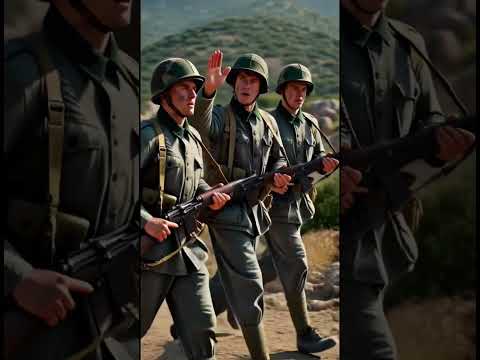
The Australians had been waiting. In the trenches and gun pits, weary-eyed defenders gripped their rifles, watching the shadows for any sign of movement. They knew the paratroopers were coming—the question was when and where. As the flares drifted down on their parachutes, casting dancing shadows across the desert, the stillness broke.
“Stay alert, men. Move silently. To the hills. Advance.” The words were barely a whisper, but the paratroopers obeyed, their boots crunching softly on the rocky ground. They had trained for this—night operations, silent killing, sabotage. But the Australians were not about to let them through without a fight.
In the distance, the low rumble of engines and the clatter of tracks signaled that the defenders were mobilizing. The paratroopers pressed on, their hearts pounding, their breaths shallow. Every shadow could hide an enemy; every sound could betray them. The mission was clear: destroy the supplies, disrupt the defense, and vanish into the night. But with the element of surprise gone, it was now a race against time.
As they crested the first hill, the silhouette of the fuel depot loomed ahead. It was heavily guarded—of that, there was no doubt. The paratroopers exchanged glances, their faces grim. They had come too far to turn back. “For Germany,” one of them muttered, and the others nodded. The night was no longer their ally; it was a witness to what was about to unfold.
The commander raised his hand, and the platoon froze. Below them, in the shallow valley, the fuel depot sprawled like a sleeping beast—canvas-covered drums stacked in neat rows, fuel trucks parked in a rough circle, and the glint of a machine-gun nest at each corner. Two sentries patrolled the perimeter, their boots scuffing the gravel in a slow, steady rhythm.
“Two minutes,” the commander breathed. “Grenades first. Then the charges. No shooting unless we have to.” The men nodded, fingers tightening around cold steel. The sappers among them carried demolition charges in canvas satchels, enough to turn the depot into an inferno.
But before they could move, a sound cut through the night—the sharp crack of a rifle from the eastern ridge. A single shot, then another. Someone had been spotted.
The Australians had set a trap. From the ridge, a heavy machine gun opened up, tracer rounds stitching lines of fire across the hillside. The paratroopers threw themselves flat, dirt spraying around them. “They’re on the ridge! Suppress them!” The commander’s voice was calm but urgent. Two men with MG 34s crawled forward, found cover behind a boulder, and returned fire.
The exchange was brutal and brief. The German machine guns, faster and more accurate, tore through the Australian position. The tracer fire from the ridge faltered, then stopped. Silence returned, broken only by the moan of a wounded man and the distant rumble of trucks.
The commander didn’t waste a second. “Move! Now!” The paratroopers surged down the slope, boots sliding on loose shale. They reached the first row of fuel drums and the sappers went to work, slapping charges against the metal, fuses hissing in the dark.
Then the second trap sprang. A flare burst directly above them, so close that the heat washed over their faces. And with it came the roar of engines—not trucks, but tanks. Two Australian Matildas, their guns already swinging toward the depot, rumbled out from behind a low ridge.
The sappers froze, hands still pressed against the fuel drums. “Tanks! Eleven o’clock!” someone shouted, but the commander was already moving, grabbing the nearest man by the shoulder and shoving him toward the shadows.
“Forget the charges! Get to the wadi! Now!” The order cut through the chaos. The paratroopers broke and ran, scattering like shadows across the open ground. Behind them, the lead Matilda’s main gun barked once, and a fuel drum erupted in a column of orange flame, the blast wave slapping the men off their feet.
They hit the ground hard, ears ringing, sand in their teeth. The second tank fired, and another drum went up, then another, the depot beginning to cook off in a chain of thunderous explosions. The night was no longer dark—it was a hellscape of fire and smoke, and in that light, the paratroopers were painfully visible.
“Into the wadi! Move, move!” The commander’s voice was hoarse now, raw with urgency. The men scrambled down the embankment, sliding on loose rock, dragging their wounded with them. The wadi was a dry riverbed, its banks steep enough to offer cover from the tanks’ guns—for now.
But the Australians weren’t finished. From the ridge line, infantry began to advance, their silhouettes dark against the burning depot. Someone was shouting orders in English, and the crack of rifle fire began to echo down the wadi.
The commander crouched low, his back against the wadi wall, and did a quick head count. Two dead. Three wounded, one badly. The sappers still had half their charges—the mission wasn’t finished, but the depot was already burning. “We’ve done enough damage here,” he muttered. “Now we need to get out.”
But getting out meant crossing open ground, and the Australians were closing in from two directions. The paratroopers checked their weapons, counted their ammunition, and prepared for the worst. The wounded man—a young sapper named Weber—was pale, blood soaking through the field dressing on his thigh. He tried to sit up, gritting his teeth.
“Leave me, Herr Hauptmann,” Weber said, his voice steady despite the pain. “I’ll cover the withdrawal.” The commander looked at him for a long moment, then shook his head.
“No one gets left behind. Not tonight.” He turned to the others. “Weber comes with us. Two men carry him. The rest of you—fix bayonets. We’re going through them.”
The men exchanged glances, but no one argued. They had trained for this, drilled it into their bones a thousand times. A breakout under fire, bayonets fixed, moving fast and striking hard. The commander raised his hand, counted down silently from three, and then they were up and running.
The Australians, caught off guard by the sudden charge, hesitated for a crucial second. That second was enough. The paratroopers hit the first line of infantry like a wave, bayonets flashing in the firelight, and for a moment, the night belonged to them again.
The clash was savage and close. Steel met steel, and the guttural shouts of men fighting for their lives filled the wadi. “Push through! Don’t stop!” the commander roared, driving his boot into an Australian soldier’s chest and shoving him aside. The paratroopers carved a bloody path, their bayonets and rifle butts clearing a narrow corridor through the stunned defenders.
Weber, carried between two comrades, fired his pistol over their shoulders, each shot deliberate despite the pain. “Ammunition low!” someone shouted. The commander didn’t answer—there was no answer to give. They had maybe thirty seconds before the Australians regrouped.
Then the wadi wall opened onto a narrow goat track, barely visible in the smoke. “There! Up the track!” The paratroopers scrambled upward, boots slipping on loose stones, hands clawing at scrub. Behind them, the burning depot lit the valley in flickering orange, and the Australians were already reforming, their voices sharp and angry.
A heavy machine gun opened up from the ridge, but the angle was wrong—the bullets cracked overhead, too high. The commander counted his men as they crested the track: nine left, including Weber, who had gone silent but was still breathing. “Keep moving. Don’t look back.”
They stumbled through the darkness for another hour, putting distance between themselves and the inferno. The desert night, once their enemy, now wrapped them in its cold, quiet embrace. Finally, the commander called a halt in a shallow depression, and the men collapsed, gasping, their faces streaked with soot and blood.
The commander knelt beside Weber, checking his pulse. Weak, but steady. He looked up at the others—grim, exhausted, but alive. “The depot is burning. The Australians will be busy for hours. That’s a victory, even if it doesn’t feel like one.”
One of the men spat into the sand. “We lost four, Herr Hauptmann. Four good men.” The commander nodded slowly. “Yes. And we’ll carry them with us. But right now, we survive. We get back to our lines, we report, and we fight another day.”
As the first gray light of dawn crept over the horizon, the paratroopers rose and began the long walk back, carrying their wounded and their dead. The mission was over—not clean, not perfect, but finished. Behind them, the fuel depot still burned, a pillar of smoke rising into the desert sky.
What would you have done in that wadi—fight to the last man, or run for the hills?
Report this article
Select a reason for reporting:






