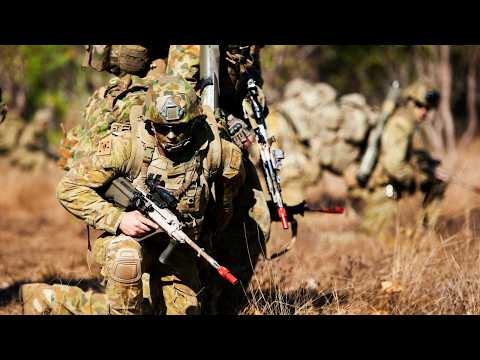
Fort Bragg didn’t break soldiers—it sorted them. For decades, the instructors at the U.S. Army Special Forces Command had a system that produced consistent, reliable data. They knew exactly what a good unit looked like, and they had the stopwatch times to prove it. Then, in 2001, twelve soldiers from the Australian Special Air Service Regiment (SASR) arrived for a routine exchange program. They were quiet, polite, and unassuming. Within 72 hours, the instructors were having conversations they had never had before—not about the Australians struggling, but about the Australians winning. On metrics Fort Bragg had used for years to measure the best soldiers in the world, these visitors were not just competing; they were redefining the standard.
The year was 2001. The world had just changed. Two towers had come down in New York, and every special operations command in the Western Alliance was recalibrating. Joint exercises that had existed as diplomatic formalities were becoming operational auditions. Who moves fast? Who thinks clearly? Who do you want on your left when the ground gets complicated? Fort Bragg, North Carolina, home of the United States Army Special Forces Command, had been running allied exchange programs for years. British SAS, German KSK, French Foreign Legion. The process was well established. Allied units rotated through, ran the course, ticked the boxes, flew home. The relationship was maintained. The benchmarks were rarely touched.
Staff Sergeant Derek Paulson had run 14 of these rotations. He was not a man given to hyperbole. He had a clipboard, a stopwatch, and a scoring system that had produced consistent results across a decade of allied assessments. He knew what a good unit looked like. He had watched British SAS soldiers run his course and understood completely why the regiment had the reputation it did. He had watched German operators and come away with genuine respect for their precision. He had watched French Foreign Legion soldiers carry weight over broken ground in conditions that would have stopped most men and thought quietly that he understood something about what that institution had built. Every unit brought something. Every unit also confirmed in one way or another that Fort Bragg was the standard. That was not arrogance. That was the data accumulated over a decade, stored in filing cabinets and program logs, and the memory of a man who had been watching elite soldiers long enough to know what the ceiling looked like.
The Australians arrived on a Tuesday morning in late autumn. Twelve of them. They came off the transport looking exactly like soldiers who had been on a long flight—tired, slightly stiff, not particularly interested in making an impression. Paulson had seen that before. Units sometimes played it low-key on arrival. Save the performance for the course. That was fine. He ran them through the administrative brief, showed them the building, outlined the schedule for the week ahead. They listened without interrupting. They asked questions about the course layout when the brief was finished. Practical questions. Distance markers, elevation changes, water points, the surface composition on the rock carry route. One of them asked about the timing methodology, whether splits were recorded at fixed points or only at finish. Paulson told him both. The Australian nodded and wrote something in a small notebook. Not a lot. A few words. Then they went to their bunks.
Paulson stood in the briefing room after they had gone and looked at the schedule pinned to the wall. Five days, standard battery. He had run this program enough times to know how it would go. Day one would establish the baseline. Days two and three would show whether the baseline held or softened under accumulated fatigue. By day four, he would have a clear picture. Day five was confirmation and closeout. The pattern had held across 14 rotations. British soldiers faded slightly by day four. German operators were consistent through day three and variable on day five. French Foreign Legion soldiers peaked on day two and held reasonable numbers through to the end. Every unit had a shape. Every shape was readable. He had no reason to expect this rotation to produce anything different.
Day one was a standard physical assessment battery. The same battery Paulson had run for a decade. A timed 5-mile run, a weighted rock carry over uneven terrain, an obstacle course sequence, and a series of combat-relevant tasks that tested grip, upper body endurance, and recovery speed between efforts. It was not designed to be easy. It was designed to produce a ranking. The figures it generated had meaning because they had context. Ten years of Allied units, hundreds of individual operators, a distribution of results that Paulson understood like a map of a country he had lived in his whole life.
They ran the 5-mile course first. Paulson stood at the finish with his stopwatch, the same way he always did. The first Australian crossed the line. He checked the time, wrote it down, said nothing. The second crossed, he wrote it down. By the fifth man, he’d stopped looking at his clipboard between finishes. He was just watching them come in. Steady, no sign of distress. The kind of pace that suggested the 5 miles had not been the problem. When all 12 had crossed, he looked at the column of figures he had written. He checked the stopwatch twice. He walked back to the timing station and pulled the results from the last British SAS rotation. He put the two sets of results side by side. Nothing was broken. No rules had been bent. The times were real.
He found his counterpart, a warrant officer named Holt, who had been coordinating the exchange from the Australian side, eating a sandwich next to the water station. Paulson sat down beside him and put the clipboard on the table between them. Holt glanced at the results, looked up, and kept eating. “Is that typical?” Paulson asked. Holt thought about it. “Middle of the pack,” he said. Paulson picked up the clipboard and walked back to his station. He had four more days of assessment to run. He decided not to form any conclusions until he had the full picture. That resolution lasted approximately 18 hours.
The weighted rock carry came back faster than the 5-mile split had suggested it would. The obstacle course produced times that sat in the top 3% of every result Paulson had ever recorded. The combat task battery, which was specifically designed to punish men whose endurance was front-loaded, whose bodies burned bright and then faded, produced results that were, if anything, more consistent than the run splits. These were not men who had trained for the assessment. They were men who had trained for something else entirely, and the assessment happened to fall well within it.
That evening, Paulson updated the program board in the operations room. He put the day’s results up in the order they would normally appear. Unit performance against the historical benchmark. He stood back and looked at it. The board had looked the same way for a long time. It did not look the same way now. His sergeant major walked in, read the scores, and looked at Paulson. “Day one?” he said. “Day one,” Paulson said. The sergeant major looked at the board again, then at Paulson. “They’re making us look slow.” Paulson said nothing. He did not disagree. Neither of them said anything else for a while. There was nothing particularly useful to say. The data was the data. You did not argue with a stopwatch.
By day three, Paulson had stopped trying to explain the physical results and started paying attention to something else. It was not what the Australians could do. It was how they did it. Most elite units, when running an unfamiliar course in a foreign program, made one of two errors. They either performed conservatively, held something back, treated the assessment as information gathering rather than performance, or they pushed hard enough to peak early and fade by the third day. Both patterns were readable. Both patterns were understandable. The Australians did neither. They ran every evolution at the same pace. Not the same speed, the same pace. There was no day one caution, no day three fatigue. The output was consistent in a way that Paulson had seen in only a small number of individual operators over his career, and never in a group of 12 men simultaneously. It was as though someone had set a dial, and the dial did not move.
Staff Sergeant Ray Stafford noticed it first during the tactical movement exercise on day three morning. Stafford was one of Paulson’s best instructors. Twelve years in special forces, two combat rotations, the kind of soldier whose assessment you trusted because his frame of reference was legitimate. He had seen elite performers from half a dozen nations move through this course. He knew what fast looked like. He knew what trained looked like. He also knew the difference between a man performing at his limit and a man operating well inside it. He had been running the tactical sequence with the Australians since the previous afternoon, observing their decision-making in a series of simulated patrol scenarios. He came back to the operations room during the midday break and sat down across from Paulson without being asked. “They made a call on the eastern route that I’ve never seen a visiting unit make,” Stafford said. Paulson looked up. “What kind of call?” “The right one.” Stafford paused. “First time, no discussion.”
The eastern route in the tactical sequence was a deliberate design feature. It looked slower on the map. It had more elevation change, more exposed terrain in the middle section, and a water crossing that added time. The western route was faster, flatter, and more obvious. Almost every unit, including most Green Beret training cohorts running the course for the first time, took the western route. It was not wrong. It was the reasonable choice given incomplete information. The eastern route was only better if you understood that the western route’s flat section sat in a depression that would be the first place an enemy observation post would cover. You had to have absorbed that principle deeply enough that it operated before conscious deliberation, not after it. Ninety seconds on the map, then east, then moving.
Stafford had asked the patrol commander about it during the debrief. The Australian had looked at him with mild surprise, the way a man looks when he is asked to explain something he considers obvious. “The flat ground is a kill zone,” the Australian said. “You only use flat ground if you own both sides of it.” Stafford told Paulson that the answer had not been aggressive or instructional. It had been conversational, the kind of answer a man gives when he is describing weather. There was no performance in it, no awareness that the answer was impressive. It was simply the answer, delivered the way you deliver something that stopped being a decision a long time ago. Paulson wrote it in his log and underlined it once.
The tactical sequence continued through the afternoon. Two more patrol scenarios, a vehicle interdiction problem, and a hostage situation exercise that Paulson used specifically to assess decision-making under time pressure. The hostage scenario had a correct solution, several acceptable solutions, and one technically legal but operationally catastrophic solution that units under stress occasionally chose. Paulson had introduced it into the program three years earlier after watching a visiting unit select that catastrophic option in real time, calmly, with apparent confidence. And he had never stopped being troubled by it. The scenario existed to find the men who made that choice under pressure. It found them more often than he would have liked. The Australians reached the correct solution in 11 minutes. Clean, confirmed, no backtracking. Two minutes of that 11 were spent confirming rather than deciding. The decision itself had taken nine. The average across all visiting units was 23. The fastest Paulson had previously recorded was 16 by a British SAS team three years earlier. He wrote 11 in his log, looked at it, and did not write anything else next to it. The number did not need a comment.
That evening, Stafford found Paulson looking at the tactical assessment scores alongside the physical results, building a complete picture across five days. The two sets of data told the same story. Not outstanding at one thing, consistently excellent across every domain the program measured, without visible effort and without variance. Paulson had a category in his logs for units that produced one elite performer who elevated the group result. He had a category for units that were physically strong but tactically average. He did not have a category for what he was looking at now. Across every metric, across every day, the distribution was the same. Twelve men performing as though they had been calibrated to the same standard, and the standard was high. “How long have they been doing this?” Stafford asked. Paulson thought about it. The SASR had been active since 1957. The regiment’s selection course had been running in its current form since the 1980s. The tactical doctrine they had just demonstrated in the eastern route decision was not something you learned in the classroom. It was something you learned on the ground over years until it became the first answer your brain produced rather than the considered one. “A long time,” Paulson said.
Stafford nodded. He looked at the scores for another moment, then walked out. Paulson stayed. He was not troubled by the results. He was not defensive about them. He was trying to understand what he was looking at. What kind of institution produced 12 men who could arrive at Fort Bragg after a long haul flight and perform like this, as though it was simply the normal speed of things. He did not have the answer yet. But he knew where to start looking.
On the fourth evening, Paulson sat down with Holt and asked directly—not about the results, about the regiment. Holt spoke the way a craftsman talks about tools used for a long time. “Selection ran three weeks in the bush around Bindoon and the Stirling Ranges,” he said. “No coaching, no feedback, no indication of where you stood. You were either continuing or you were not.”
The pass rate hovered near 20 percent. Some intakes passed fewer than ten. The men who failed were not weak—they failed because selection measured the floor of mental performance, not the ceiling of physical output. “The men who passed were the ones whose floor was still high enough when everything else had been stripped away.”
Paulson understood then. The SASR was not trying to build an army. It was trying to build a standard, and it had decided long ago that the only way to protect the standard was to protect the process that produced it. Lower the bar once, and you had not lowered it once—you had changed what the bar was. The 12 men at Fort Bragg were the answer to a single question: what does it cost to produce a soldier who makes the right decision when everything around him is wrong? The answer was considerable.
Stafford appeared in the doorway. “They finished 22 minutes early,” he said. “All 12 together.” Holt finished his coffee. “Like I said,” he told them both. “Middle of the pack.”
The benchmark had quietly moved. So here’s the question that stayed in that room long after the Australians flew home: if the gap between good and exceptional can be closed, what would you be willing to pay to close it?
Report this article
Select a reason for reporting:






