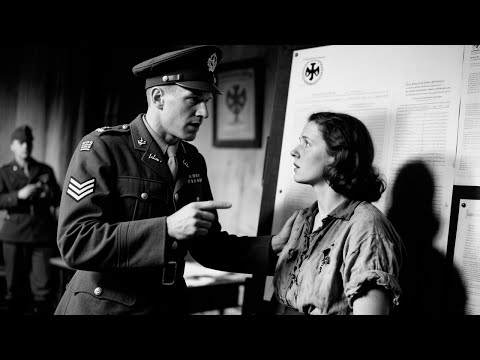
Minnesota, January 1946. Sergeant Michael Yenzen stood in the Camp McCoy administrative office, holding paperwork that could end his military career. Across from him sat Anna Bergman, a German POW scheduled for repatriation to occupied Germany. Her sister, a naturalized American citizen, lived just 40 miles away in Madison, Wisconsin—but military regulations prohibited direct family reunification during the repatriation process. Three days earlier, Yenzen had told Anna, “I’m taking you home. Not to Germany. To your sister.” When the War Department received his official request for humanitarian sponsorship, they launched an investigation that would determine whether compassion or regulations prevailed.
Anna Bergman was 32, a former secretary from Munich, conscripted into auxiliary services in 1943. She worked in a supply depot outside Hamburg until British forces captured her position in April 1945. Classified as civilian auxiliary—not quite military, but affiliated enough to be detained as a prisoner of war—she had a sister. That fact defined everything that followed.
Margarite had immigrated to America in 1936, married a German American engineer named Robert Fischer, settled in Madison, and become a naturalized citizen in 1940. When war began, she found herself trapped between identities: American by citizenship and choice, German by birth and family ties. The sisters had corresponded until 1942, when international mail became impossible. Margarite spent four years not knowing if Anna was alive, writing letters that were never sent, hoping for news that never came.
When the Red Cross began facilitating POW family contact in late 1945, Margarite submitted a request to locate her sister. The response came in November: Anna Bergman, detained at Camp McCoy, Wisconsin, alive, healthy, scheduled for repatriation to Germany in February 1946. Forty miles away. Her sister was 40 miles away, detained as an enemy prisoner while Margarite lived as an American citizen. The proximity was almost cruel.
Margarite went to Camp McCoy in December, filled out visitor request forms, submitted proof of relationship, underwent background checks. The process took three weeks. Finally, on December 28th, she was permitted a two-hour supervised visit with her sister. They met in the administrative office, a WAC officer present to supervise. Both women uncertain how to bridge nine years of separation compressed into two hours under observation.
Margarite spoke first. “You’re alive. I thought… I didn’t know.”
“I’m alive,” Anna confirmed in German-accented English. “A prisoner, but alive.”
They spent the two hours catching up in compressed summaries. Anna described the war years—work, deprivation, capture, transport to America. Margarite described her life in Madison—marriage, work, citizenship, the strange experience of being German in America during war. When time expired, Margarite asked the supervising officer, “Can she come home with me? She’s my sister. I’m an American citizen. Can’t I sponsor her release?”
The officer explained gently. She’s classified as a POW. Regulations require repatriation to Germany after formal surrender and processing. Family reunification through immigration channels would need to wait until after she returns to Germany and applies for a visa.
“But that could take years,” Margarite protested. “And she has no home to return to. Hamburg was destroyed. Our family is gone. Her home is with me now.”
“I understand,” the officer said, “but those are the regulations.”
Sergeant Michael Yenzen was 38, a dairy farmer from rural Minnesota who had been drafted in 1942. He served as administrative personnel at Camp McCoy, processing paperwork, managing records, facilitating the bureaucracy that kept prisoner facilities functioning. He had been present during Margarite’s visit, had overheard the conversation, had watched two sisters reunite only to face forced separation by regulations that seemed designed to prioritize procedure over humanity.
After Margarite left, Yenzen reviewed Anna’s file. Classification: civilian auxiliary. Security risk: low. Skills: clerical. Family: sister in Madison, Wisconsin, naturalized citizen. Repatriation destination: Hamburg, Germany—destroyed. Prospects: minimal. The file was one among thousands. But Yenzen couldn’t stop thinking about it. About two sisters separated by war and regulations. About a woman being sent back to ruins when family waited 40 miles away. About whether following rules was always the right thing when rules created unnecessary suffering.
He made a decision that would risk his career. He would find a legal way to reunite the sisters.
Yenzen spent his evenings in the camp law library, hunched over regulation manuals under a bare bulb, tracing the tangled architecture of POW repatriation and immigration law. The framework was complex, built to handle millions of displaced persons while maintaining security and processing efficiency. Most rules were clear: POWs returned to their country of origin after formal surrender and processing. Exceptions existed for intelligence cooperation, medical necessity, special reconstruction skills—but nothing explicitly covered family reunification when family members were already on American soil.
Then, buried in a supplementary volume on humanitarian provisions, he found something. American citizens could sponsor displaced persons for immigration if they could prove four things: a family relationship, financial support capability, no security concerns, and compelling humanitarian circumstances. The provisions were designed for post-repatriation immigration, not for preventing repatriation entirely. But the language was ambiguous enough that Yenzen thought he could make a case.
He needed documentation. He needed Margarite’s cooperation. And he needed approval from superiors who would probably reject the request—but might possibly see merit in a humanitarian exception.
Yenzen called Margarite in early January. He explained what he’d found, outlined the plan. Margarite would formally sponsor Anna for immigration under humanitarian provisions. Yenzen would prepare the paperwork, arguing that forcing Anna to return to Germany only to apply for immigration later created unnecessary hardship when family sponsorship was available immediately.
“Will this work?” Margarite asked.
“Honestly?” Yenzen replied. “Probably not. The regulations weren’t designed for this. But sometimes the right thing is worth attempting even when success is unlikely.”
“What happens if it fails?”
“Anna gets repatriated as scheduled in February. You apply for her immigration through normal channels. It takes years, but eventually works. The difference is whether we try to prevent unnecessary separation or accept it as inevitable.”
Margarite didn’t hesitate. “I’ll do whatever you need. Tell me what documents to provide.”
Yenzen spent two weeks assembling the most comprehensive humanitarian sponsorship package ever submitted from Camp McCoy. Anna’s complete service record, showing her role as civilian auxiliary with no combat involvement. A security assessment confirming she posed no threat. Margarite’s citizenship papers, financial records, proof of stable housing. Letters from Margarite’s employer, neighbors, and church attesting to her character. Photographs of destroyed Hamburg, showing Anna had no home to return to.
He wrote a cover memo explaining the situation, acknowledging this was unconventional, arguing that regulations should serve humanitarian goals rather than obstruct them when circumstances warranted exception. On January 15th, 1946, he submitted the package through proper channels to the War Department’s POW affairs division in Washington.
Then he told Anna what he’d done.
Yenzen found her in the camp library where she often spent recreation hours. He sat down across from her, spoke quietly so others wouldn’t overhear. “I submitted paperwork to the War Department,” he said. “Requesting humanitarian exception to your repatriation. Asking that you be released directly to your sister’s custody rather than sent back to Germany.”
Anna stared at him. “Why would you do this?”
“Because it’s the right thing,” Yenzen said simply. “Your sister is 40 miles away. You have no home in Germany. The regulations are designed for general cases, not for specific circumstances like yours. Someone needs to ask for exception. I’m asking.”
“But if they say no, you will have caused trouble for yourself for trying to help me. Possibly.”
Yenzen agreed. “But I’m a dairy farmer from Minnesota who got drafted. Worst case, I get reprimanded and go back to farming when I’m discharged. I can live with that.”
Anna felt tears burning her eyes. “You said you submitted paperwork. What did you tell them? What reason?”
“I told them the truth,” Yenzen said. “That forcing you back to Germany only to apply for immigration years later creates unnecessary hardship when immediate family reunification is possible. That your sister is an American citizen willing and able to sponsor you. That you pose no security risk. That humanitarian circumstances warrant the exception to standard procedure.”
He paused, then added: “And if they approve, then I’m taking you home. Not to Germany. Home. To your sister. To Wisconsin. To the life you should have had nine years ago when war interrupted it.”
Weeks passed with no response. Anna continued her routine at Camp McCoy—work detail in the laundry, meals in the mess hall, recreation hours, the structured boredom of captivity. But now she carried impossible hope alongside the resignation she’d learned to maintain. Margarite called Yenzen weekly, asking for updates. He had none. The War Department moved slowly, processing thousands of cases, dealing with the complexities of postwar demobilization and repatriation.
Other prisoners noticed Anna’s distraction. She told a few about the situation—the sister in Madison, the sergeant’s intervention, the waiting for impossible approval. Some were supportive. Others thought she was being naive, that bureaucracies didn’t grant exceptions, that hope was more painful than acceptance.
One woman, Helga, said bluntly, “They’ll say no. They always say no. You should prepare yourself.”
“Maybe,” Anna replied. “But Sergeant Yenzen thought it was worth trying. I have to honor that by hoping.”
February 1st was Anna’s scheduled repatriation date. As the date approached with no word from Washington, Yenzen prepared contingency plans—ensuring her transfer would go smoothly if the answer was no. On January 28th, one week before departure, a telegram arrived from the War Department’s POW Affairs Division: Case number 462891 under review. Hold repatriation pending decision. Stop.
Yenzen called Margarite immediately. “They’re reviewing it. They haven’t said yes, but they haven’t said no either. And they’ve delayed her repatriation—which means they’re seriously considering it.”
“How long until they decide?” Margarite asked.
“No idea. Could be days, could be weeks. But the fact that they’re reviewing rather than automatically denying is positive.”
He told Anna that evening. She absorbed the news with careful composure, not allowing herself to fully hope, but unable to completely suppress it either.
The investigation was more thorough than Yenzen had anticipated. Investigators contacted Margarite, verified her finances and housing, interviewed neighbors and employers. They reviewed Anna’s complete service record, interviewed prisoners who had known her, checked with British authorities who had processed her capture. It wasn’t hostile. It was methodical—building a case file, ensuring that if they granted exception, it would be defensible if questioned.
Then Major Thomas Harrison called from Washington. “Your request is unusual, but not unprecedented. I need to ask you directly: is there any impropriety in this case? Any relationship between you and the prisoner beyond professional?”
“No, sir,” Yenzen said firmly. “I met her sister during a family visit. I reviewed the case file. I recognized that forcing this woman back to Germany when immediate family reunification was possible seemed unnecessarily cruel when alternatives existed. That’s the extent of my involvement.”
“And you’re willing to stand by this request despite potential professional consequences?”
“Yes, sir. Because it’s the right thing to do.”
Harrison was quiet a moment. “Sergeant, I appreciate your conviction. We’re completing our review. You’ll have a decision within ten days.”
The decision arrived February 12th, 1946. A telegram to Camp McCoy: Attention Sergeant Michael Yenzen. Case number 462891 approved. Prisoner Anna Bergman released to custody of sponsor Margarite Fischer. Humanitarian exception granted pursuant to Section 12, Clause 4. Process release immediately. Stop.
Yenzen read it three times, certain he was misunderstanding. Then he walked to the camp commander’s office and showed Colonel William Morrison. Morrison read it, then looked at Yenzen. “They actually approved it. Sergeant, you challenged standard procedure, argued for humanitarian exception, and the War Department agreed with you. That’s unprecedented.”
“I just wanted to help two sisters reunite, sir.”
Morrison smiled. “Well, you did. Process her release. And Sergeant—this goes in your service record as exemplary initiative and humanitarian leadership. You should be proud.”
Yenzen found Anna in the mess hall during lunch. He sat down beside her, spoke quietly. “They approved it. You’re being released to your sister’s custody. Today.”
Anna’s fork clattered to her tray. “Today? Right now?”
“Right now. Pack your belongings. Your sister is on her way—I told her this morning.”
Anna started crying, unable to speak. Around them, other prisoners noticed, began asking what was happening. When they learned, the table erupted in quiet celebration—women hugging Anna, congratulating her, some crying themselves at witnessing impossible bureaucracy yielding to compassion.
Two hours later, Margarite arrived. She and Anna were reunited in the administrative office—this time without time limits, without supervision, without the looming separation of repatriation. Yenzen handled the paperwork, release forms, custody transfer, immigration documentation. When everything was complete, he walked the sisters to Margarite’s car.
“You told me you were taking me home,” Anna said in English she’d been practicing. “You kept your promise.”
“Wasn’t just me,” Yenzen replied. “Your sister fought for you. The War Department recognized special circumstances. Lots of people made this possible.”
“But you started it,” Margarite said. “You saw two sisters who needed each other and decided regulations shouldn’t prevent reunion. ‘Thank you’ doesn’t seem adequate.”
“It’s adequate,” Yenzen assured her. “Seeing you two together is adequate. Drive safely.”
He watched them drive away, Anna looking back through the rear window, waving until the car disappeared around the bend toward Madison.
News of the humanitarian exception spread through military administrative channels. Some officers praised Yenzen’s initiative. Others felt he’d set dangerous precedent. The War Department issued a memo clarifying that humanitarian exceptions would be considered case by case—that Anna’s situation represented unique circumstances, not blanket policy change. But they acknowledged that when regulations created unnecessary hardship and viable alternatives existed, exceptions could be warranted.
Yenzen received three more requests from Camp McCoy prisoners with family connections in America. He reviewed each case, helped prepare documentation for two that met criteria. Both were eventually denied—their circumstances differed enough from Anna’s that exception wasn’t warranted. The third was approved six months later, setting additional precedent that humanitarian consideration wasn’t a one-time anomaly but an available tool when truly warranted.
Anna moved into Margarite’s house in Madison. The adjustment was strange—going from prisoner to free civilian overnight, from institutional routine to independent life, from enemy alien to legal immigrant in process of becoming American. She found work as a secretary, applied for permanent residency, attended English classes, participated in the German-American community that welcomed her cautiously at first and warmly as her story became known.
She wrote to Yenzen periodically. In 1947: “I am working for a law firm now, processing immigration paperwork for others. I see how difficult the system is and appreciate even more what you did.” In 1949: “I received my citizenship today. When they asked where I wanted to call home, I said Wisconsin. That’s where my sister is. That’s where my life restarted. Thank you for making that possible.”
Yenzen was discharged in June 1946, returned to Minnesota, resumed dairy farming. He rarely spoke about the war, considered his service unremarkable—except for one case where he’d managed to help two sisters when regulations almost prevented it. In 1951, he received a letter from the War Department recognizing his exceptional humanitarian service in the Bergman case. He framed it, hung it in his barn where no one but him would see it—not from modesty, but from perspective. He had helped one person at a time when millions needed help. That it mattered to Anna and Margarite was sufficient.
Anna and Margarite lived within blocks of each other in Madison for forty years. They raised families, worked, participated in community life, and remained close in a way that war’s interruption had threatened to make impossible. They spoke German together privately, English publicly. They negotiated the bicultural identity that defined German Americans in the postwar period—proud of heritage, committed to adopted country, working to prove that German ethnicity didn’t mean German nationalism.
In 1985, a historian researching POW family reunification interviewed them. Asked what Yenzen’s intervention had meant, Margarite said, “He gave us back nine years. The years war stole. We couldn’t recover them, but we could start rebuilding from where we were rather than spending additional years separated by bureaucracy.”
“He taught me that even in systems that seem rigid, humanity can find space,” Anna added. “That one person seeing injustice and deciding to address it can matter more than all the regulations that create injustice.”
The Bergman case remained relatively obscure—a footnote in administrative histories—but it set precedent that humanitarian exceptions were possible when circumstances warranted and proper documentation supported them. Between 1946 and 1948, approximately thirty similar cases were approved using the Bergman case as template. Not many in the context of hundreds of thousands repatriated, but significant for those thirty individuals and their families who were spared years of unnecessary separation.
Anna died in 1995 at 81. At her funeral, her daughter read from letters Anna had saved—correspondence with Yenzen spanning nearly fifty years. The last letter, written by Yenzen months before his own death in 1994, said simply: “I’ve been thinking about that day I told you I was taking you home. I meant it literally—to your sister, to Madison. But I’ve realized it meant something larger. Taking you home to possibility, to future, to the life you should have had. Thank you for reminding me all these years why that mattered.”
That’s the legacy. Not grand policy reform or thousands of lives affected. Just one sergeant, one prisoner, one sister, and the choice to make “I’m taking you home” mean something more than following orders or accepting that separation was inevitable because regulations said so. Sometimes the most important victories are the smallest ones. And sometimes taking someone home means something far larger than geography—it means refusing to accept unnecessary suffering when alternatives exist, even when those alternatives require challenging systems that seem unchangeable.
What would you have done in Sergeant Yenzen’s position—follow the regulations, or risk everything for a stranger’s chance at home?
Report this article
Select a reason for reporting:






