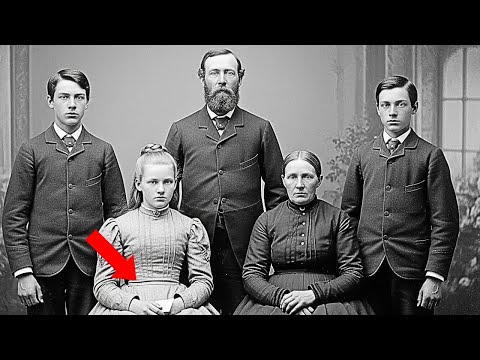
Dr. Robert Chen had seen thousands of old photographs in his career as a cultural historian, but something about the Schneider family portrait made him pause. The morning fog over Philadelphia’s Germantown neighborhood had barely lifted when he pulled up to the Victorian house on Chelten Avenue, its estate sale promising a treasure trove of German-American artifacts. Inside, the air was thick with the smell of old wood and lavender, and boxes of photographs and letters crowded every room. Robert moved methodically, examining daguerreotypes and family Bibles until he found a wooden trunk filled with portraits from the late 1800s—stiff poses, formal clothing, serious expressions. But one photograph stood out. A family of five, posed in a studio with a painted backdrop, stared solemnly at the camera. All except the young girl, about fourteen, whose eyes held a quiet desperation. Her right hand rested in her lap, fingers clenched in an unnatural way, as if hiding something. Robert turned the photo over: “The Schneider family, Philadelphia, September 1879. Friedrich, Margarethe, Johann, Heinrich, and Clara.” Clara. The name echoed in his mind.
He bought the entire trunk for $50 and rushed back to his office at the University of Pennsylvania. The university had recently acquired sophisticated software that could enhance and colorize old photographs, revealing details invisible to the naked eye. As the high-resolution scan appeared on his screen, Robert zoomed in on Clara’s hand. There was definitely something there—a small irregularity in the photograph’s texture, something clutched between her fingers. His heart rate quickened. He spent the entire afternoon adjusting contrast, sharpening edges, and removing scratches. As the image became clearer, the Schneider family emerged with striking detail: Friedrich, a stern man with hard eyes; Margarethe, exhausted and lined with worry; the two teenage sons, both with their father’s rigid posture. But Clara was different. Her shoulders were hunched, her jaw tight, and her eyes—when Robert enhanced them—showed unmistakable fear. He began the colorization process, referencing period-appropriate colors, but his focus remained on her hand. He zoomed in closer, enhancing the resolution until he could see individual pixels. Between Clara’s clenched fingers was a small piece of paper, folded tight and pressed into her palm. This was intentional. She had deliberately positioned her hand to hide something from the camera’s obvious view, yet preserve it in the photograph. Robert adjusted the image settings, increasing contrast and sharpness. The paper became more distinct. There was writing on it, tiny letters barely visible even with digital enhancement. After another hour of manipulating the image, applying multiple filters, he finally made out two words in careful, small script: “Help me.”
Robert sat back in his chair, staring at the screen. A fourteen-year-old girl in 1879 Philadelphia had hidden a desperate plea in a family photograph. But why? What was happening to her? And did anyone see the message in time to help? He needed to find out more about the Schneider family. He pulled out his phone and called his colleague at the Philadelphia Historical Society. “Margaret, it’s Robert Chen. I need your help with something urgent. I just found a photograph that I think documents a crime.”
Margaret Foster met Robert the next morning. She was a genealogist who had spent thirty years researching immigrant families in the city, and if anyone could trace the Schneiders, it was her. Robert showed her the restored photograph on his laptop, zooming in on Clara’s hidden message. Margaret’s expression grew serious as she studied the image. “That poor child,” she said quietly. “She was terrified. You can see it in every line of her body.” They began with the 1880 census records, searching for the Schneider family in Philadelphia. The German immigrant population had been substantial in the late 1870s, with entire neighborhoods in Germantown, Northern Liberties, and South Philadelphia populated primarily by German-speaking families. After two hours, Margaret found them. The 1880 census, taken in June of that year, listed the Schneider household on Wayne Street in Germantown: Friedrich Schneider, age 46, occupation butcher; Margarethe E. Schneider, age 42, occupation keeping house; Johann Schneider, age 19, occupation butcher’s apprentice; Heinrich Schneider, age 17, occupation butcher’s apprentice. But Clara was not listed.
“She’s not there,” Robert said, his voice tense. “The photograph was taken in September 1879. The census was June 1880. She should be there, but she’s not.” Margaret’s fingers flew across the keyboard, pulling up death records from late 1879 and early 1880. “If she died, there should be a death certificate. German families were usually meticulous about recording deaths.” They searched through hundreds of records—tuberculosis, influenza, childbirth complications, accidents—the causes that claimed so many lives in that era. But there was no death certificate for Clara Schneider. “What if she ran away?” Robert suggested. “Or what if someone helped her escape?” Margaret pulled up marriage records next. In the late 1800s, girls as young as fourteen could be legally married with parental consent, a practice particularly common in immigrant communities where arranged marriages were still accepted. “Here,” Margaret said suddenly, her finger on the screen. “Marriage license issued September 28th, 1879. Clara Schneider, age 14, to Herman Vogel, age 47.” Robert felt sick. Three weeks after the photograph. “They were planning to marry her off to a man in his late forties. That explains the photograph,” Margaret said. “September 1879—it would have been taken right before the wedding. A formal family portrait to commemorate the occasion.” “Except Clara didn’t want to marry him,” Robert said, looking at the hidden message again. “She was asking for help. The question is, did anyone help her? And who was Herman Vogel?” Margaret was already searching. “Let’s find out.”
Margaret found Herman Vogel’s name in several city directories from the 1870s. He was a prosperous German immigrant who owned a textile import business on Market Street. He had been married once before; his first wife had died in 1877, leaving him childless. “He was wealthy,” Margaret said, reading through the business records. “Very wealthy.” His company imported fabrics from Germany and sold them to Philadelphia’s garment manufacturers. “And Friedrich Schneider was a butcher,” Robert added. “Working class.” “This wasn’t just an arranged marriage—it was a business transaction. Vogel probably offered money or business advantages to the family.” But the question remained: what had happened to Clara? The marriage license had been issued, but Robert needed to know if the marriage had actually taken place. Margaret searched through church records. Most German immigrant families in Philadelphia attended Lutheran or Catholic churches, and marriages were meticulously documented. After checking records from six different German churches in the Germantown area, she found something. “Here. St. Michael’s Lutheran Church. Marriage ceremony scheduled for October 5th, 1879, between Herman Vogel and Clara Schneider.” Margaret paused. “But there’s a notation: the ceremony was canceled. No reason given.” “She didn’t marry him,” Robert said, feeling a surge of hope. “Something happened between September 28th, when the license was issued, and October 5th, when the ceremony was supposed to happen. Someone saw her message and helped her.”
Robert looked at the photograph again, studying every detail. The portrait had been taken at a professional photography studio—the painted backdrop and professional lighting made that clear. In the bottom right corner, embossed in faint gold lettering, was the photographer’s mark: “Wilhelm Hartman, Photographer, Germantown.” “The photographer,” Robert said. “Wilhelm Hartman. He would have been the one who developed the photograph. He would have seen Clara’s message.” Margaret immediately began searching for information about Hartman. She found advertisements for his studio in old Philadelphia newspapers, city directory listings, and even a few surviving examples of his work in the historical society’s collection. “Wilhelm Hartman immigrated from Baden in 1865,” Margaret read from a biographical sketch. “He opened his photography studio in Germantown in 1872. He was known for his portraits of German immigrant families. He was also—” she paused, reading more carefully, “—he was known for progressive views and his support for women’s rights. There are several newspaper articles mentioning him at suffrage meetings and reform gatherings.” Robert felt the pieces beginning to fit together. A progressive photographer who supported women’s rights would have been exactly the kind of person to notice Clara’s hidden message and understand what it meant. “We need to find out more about Hartman,” Robert said. “He’s the key to this story.”
The Philadelphia Historical Society’s archives contained a small collection of Wilhelm Hartman’s business records, donated by his descendants in the 1960s. Margaret brought out three boxes of materials—appointment books, correspondence, financial ledgers, and scattered personal notes. Robert and Margaret spent hours carefully examining documents from 1879. Hartman’s appointment book showed the Schneider family portrait scheduled for September 15th, 1879. There was a notation beside it: “Family portrait, pre-wedding payment, $3.50.” But tucked between the pages of the appointment book, they found something else—a small piece of paper with notes written in German.
Margaret, who read German fluently, translated: “September 15th, 1879. The Schneider girl, Clara. Noticed during development of the negative—small paper in her hand. Message: ‘Help me.’ The family intends to marry her to Herman Vogel, a man three times her age. The girl is clearly unwilling. I must consider what can be done.” Robert felt his pulse quicken. He saw the message. He understood what was happening.
They continued searching through Hartman’s papers. Three days later, September 18th, there was another note: “Made inquiries about Herman Vogel. His reputation is not good. His first wife died under suspicious circumstances—officially listed as accident, but neighborhood rumors suggest otherwise. I cannot allow this child to be given to such a man.” The next entry was dated September 22nd: “Spoke with Pastor Dietrich at St. Michael’s. He says the marriage contract has already been signed. Friedrich Schneider received $200 from Vogel. The family is poor and desperate. They see no other choice. Pastor Dietrich is troubled but says he cannot refuse to perform the ceremony without cause. I asked: ‘Is a child’s unwillingness not cause enough?’ He had no answer.”
Margaret and Robert exchanged glances. “Hartman was trying to stop the marriage through official channels,” Margaret said. “But the church wouldn’t help.” The entries continued. “September 25th—contacted the Society for the Protection of Children. They say that arranged marriages, while distasteful, are not illegal if parental consent is given. They can do nothing unless there is evidence of physical abuse. A hidden message in a photograph is not sufficient evidence. September 28th—the marriage license was issued today. I have one week before the ceremony. I must find another way.”
Then, dated October 1st, there was a longer entry: “I have made a decision. This evening I visited the Schneider household on the pretense of delivering the family portraits. I asked to speak with Clara privately, saying I needed her approval of her individual likeness. Friedrich was suspicious, but Margarethe interceded. She seems more sympathetic to her daughter than her husband.” Robert read faster, his excitement growing. “Clara confirmed what I suspected. She does not wish to marry Vogel. She has met him three times and is terrified of him. He speaks crudely, drinks heavily, and has already told her she will not be permitted to leave the house without his permission once they are married. She begged me to help her, but she has nowhere to go. Her family needs the money Vogel has promised.”
The next document in Hartman’s papers was a letter, carefully preserved in a protective sleeve. It was dated October 2nd, 1879, and addressed to someone named Carolyn Porter in New York City. Margaret read the letter aloud, translating from German: “Dear Carolyn, I write to you regarding a matter of utmost urgency. A young German girl in Philadelphia, age fourteen, is being forced into marriage with a man of poor character three times her age. I have exhausted all official channels—the church, the Society for the Protection of Children, even the police have told me they cannot intervene in what they call a private family matter. I remember you once told me about your work with the Underground Railroad before the war, and how some of those same networks now help women and girls escape dangerous situations. I know this is an extraordinary request, but I believe this child’s life may depend on it. Can you help? I can provide train fare and any necessary documentation. Please reply with urgency. The wedding is scheduled for October 5th.”
“The Underground Railroad,” Robert said quietly. Some of the people who had helped enslaved people escape to freedom before the Civil War continued their work afterward, helping other vulnerable people—including women fleeing forced marriages or abusive situations. They found Carolyn Porter’s reply dated October 3rd: “Wilhelm, I received your telegram and am responding immediately by express post. Yes, we can help the girl. There’s a safe house in Philadelphia run by a woman named Ruth Becker on Spring Garden Street. Take the girl there. Ruth will provide shelter and arrange transportation to New York. From there, we have contacts who can help her begin a new life—work, housing, education if she desires it. You must understand the risks. The family will certainly search for her. Herman Vogel, if he is as you describe, will not accept the loss of his investment quietly. The girl must be prepared to leave behind everything she knows. But better a hard new beginning than a life of misery and abuse.”
Margaret found the address mentioned—Spring Garden Street, in what was then a working-class neighborhood of Philadelphia. “Ruth Becker. I know that name. She was a Quaker abolitionist who ran a boarding house for working women in the 1870s and ’80s. I’ve seen her name in women’s suffrage records.” They continued through Hartman’s papers. October 4th, 1879: “It is done. This morning I sent word to Clara through a trusted source—a German woman who does laundry for the Schneider family. The message told her to leave her house tomorrow morning when her father and brothers leave for the butcher shop. I will be waiting at the corner of Wayne Street and Shelton Avenue with a carriage. Margarethe knows. The mother knows and has quietly given her consent. She slipped her daughter’s birth certificate and a small bag of clothes out of the house yesterday. A mother’s heart, even in such circumstances, knows what is right.”
Robert felt emotion welling up. “The mother helped her.” The final entry was dated October 5th: “Clara is safe. I collected her this morning as planned. We went directly to Ruth Becker’s house on Spring Garden Street. The girl wept with relief and terror both. Ruth was extraordinary—calm, reassuring, practical. She has done this before.”
Margaret and Robert spent the rest of the day piecing together what happened after Clara’s escape. Newspaper articles from October 1879 painted a vivid picture. “German butcher reports daughter missing,” the Philadelphia Inquirer wrote on October 6th, noting the girl was scheduled to marry Herman Vogel that afternoon. Two days later, Vogel accused Hartman of interference, claiming witnesses saw his carriage near the Schneider home. “Mr. Hartman has denied any wrongdoing, stating only that he believes no child should be forced into marriage against her will.”
A German-language paper, Der Deutsch Correspondent, revealed the community was splitting over the case. Thirty-two women signed a letter praising Hartman’s courage. “That such marriages are legal does not make them moral.” No charges were ever filed. By late October, the coverage had faded—but what became of Clara?
In Ruth Becker’s coded journal, they found the answer: “Received KS, age 14… travel to New York under name Emma Weber.” Tracing Emma Weber led to the Brooklyn Female Academy, where Wilhelm Hartman quietly paid her tuition until 1890. She became a teacher, married Thomas Fletcher in 1892, and raised three children.
Her obituary in 1947 described her as “a tireless advocate for women’s rights and education.” In a letter marked to be opened after her death, Emma wrote: “Wilhelm Hartman saw my hidden cry for help and saved my life… courage, both to ask for help and to give it, can change everything.”
Robert stood before the exhibition, watching visitors study Clara’s portrait. For nearly 150 years, that tiny note had waited in plain sight. Two words folded into a palm—a message that reached across a century.
What would you have done, had you been the one to develop that photograph?
Report this article
Select a reason for reporting:






