In March 2024, an unremarkable cardboard box sat among hundreds of items at an estate auction in Richmond, Virginia. Inside that box was a photograph that would unravel a family secret buried for over a century. Lot 47 miscellaneous photographs and documents circa 1880 to 1920. The winning bid was $35.
The image showed four people posed in an elegant photography studio. A man and woman sat formally, their two young children standing beside them. The photograph was dated 1889 on the studio’s embossed label, Lavine Studios, 147 Royal Street, New Orleans, Louisiana. At first glance, it appeared to be a typical late Victorian family portrait, but several details made it unusual. The man’s skin tone was noticeably darker than his wife’s. The children appeared even lighter than their mother.
In 1889, New Orleans, this combination told a specific story. This was a mixed-race Creole family, part of the city’s complex racial hierarchy that existed briefly between the end of slavery and the implementation of Jim Crow laws.
Dr. Rebecca Walsh, a historian specializing in post-Reconstruction southern communities, purchased the box and brought the photograph to Georgetown University’s digital imaging laboratory. What she hoped to find was basic information about the family’s identity. What she actually discovered would lead to one of the most remarkable genealogical investigations in recent American history.
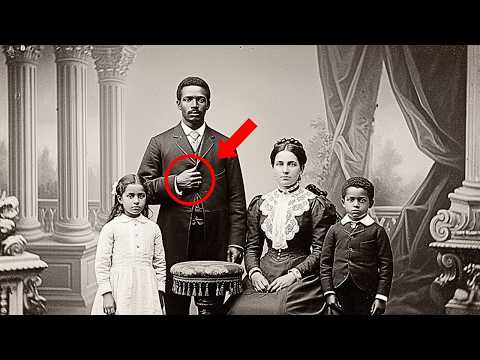
When the photograph was scanned at 50 times magnification, microscopic text became visible along the bottom edge. The words were written in elegant French script, so tiny they would have required a jeweler’s magnifying glass to inscribe: “Libre, “May our children be free.” But that wasn’t the only hidden message.
Enhanced imaging revealed that the man’s hand, pressed against his vest, was positioned over what appeared to be a hard object beneath the fabric. The pressure created visible indentations that when magnified showed clear markings. A date: September 15th, 1889.
Researchers cross-referenced this date with historical records. 15 days after this photograph was taken, Louisiana would hold a constitutional convention that would effectively strip voting rights from black citizens and usher in an era of brutal segregation. Two weeks after that convention, the man in the photograph, later identified as Antoine Dubois, would vanish from all historical records. His wife and children would disappear, too. But unlike Antoine, they would reappear with new names, new identities, and crucially, a new race.
The family had made a choice that would echo through five generations. And in 2024, that choice would finally be exposed.
Lavine Studios occupied a modest building on Royal Street in New Orleans’ French Quarter during the 1880s and 1890s. The studio was unusual for its time. Owner Jean Baptiste Lavine openly advertised his services to gens de couleur libres, free people of color, in a city where most white-owned businesses refused to serve black or mixed-race clients. Historical records show that Lavine’s clientele included New Orleans’ distinctive Creole community—people of mixed African, French, and Spanish heritage who had occupied a complex middle ground in the city’s racial hierarchy. Some were wealthy, educated, and owned property. Many spoke French as their first language. During Reconstruction, some had even held public office.
But by 1889, that world was collapsing. White supremacist organizations were regaining political power throughout the South. States were implementing new laws designed to segregate and disenfranchise black citizens. Louisiana’s constitutional convention was scheduled for late September 1889, and everyone knew what was coming. The end of whatever fragile racial tolerance had existed.
The Dubois family’s decision to visit Lavine Studios in mid-September was not random. Research into the studio’s ledgers preserved at the Historic New Orleans Collection revealed that Lavine charged different rates for different types of portraits. A standard family sitting cost $2, but for $5, Lavine offered what he discreetly called a “documentation service”—high-quality portraits with extra copies and careful preservation. The Dubois family paid $7, a significant sum in 1889, equivalent to roughly $200 today. The extra cost included something specific: microscopic engraving on the photograph itself, a service Lavine provided for clients who wanted to hide messages that could only be read with magnification.
Why would a family need to hide a message in their own portrait? The answer lay in what was about to happen. The Louisiana Constitutional Convention of 1898 would implement grandfather clauses, literacy tests, and poll taxes that effectively ended black voting rights. It would also enforce strict segregation laws and prohibit interracial marriage. Mixed-race families like the Dubois family were about to become illegal.
The photograph, researchers now understand, was evidence. Antoine and Celeste Dubois were creating a record of their family’s existence before the family was forced to cease existing. The hidden message, “May our children be free,” was not a wish. It was a farewell.
The family that sat for this portrait in September 1889 would never be together again. Within weeks, they would make a choice that millions of American families faced: sacrifice their identity or sacrifice their safety. They couldn’t have both.
Modern digital imaging technology has revolutionized historical research. What was invisible to previous generations of historians can now be revealed with specialized scanning equipment and image analysis software. When the Dubois photograph underwent high-resolution scanning at Georgetown University, the process captured details at a microscopic level. Each square inch of the original photograph was divided into thousands of digital pixels, allowing researchers to examine areas that would be impossible to see with the naked eye.
The French inscription along the bottom edge was the first discovery, but it wasn’t the last. Dr. Martin Chen, the imaging specialist conducting the analysis, noticed unusual patterns in other areas of the photograph. The mother’s hand, resting on her daughter’s shoulder, wore a distinctive ring. When magnified, the ring’s design became clear: an unusual compass rose with what appeared to be numbers engraved around its circumference. Further enhancement revealed these were geographic coordinates—29.951 N, 71.048 W. Those coordinates pointed to a specific location in New Orleans, a property in the Tremé neighborhood, one of the oldest African-American communities in the United States.
Property records from 1889 showed the land was owned by Antoine Dubois, the man in the photograph. But the most significant discovery came from analyzing the photographic backdrop itself. Victorian photographers used painted backgrounds to give portraits an elegant setting. The Lavine Studios backdrop showed classical columns and draped fabric, typical for the era. But high-magnification scanning revealed something hidden in the painted drapery. Extremely faint writing, visible only because the paint had aged differently over the text. The words were instructions: “Certificate of free birth. Fourth drawer behind the saint metal.”
This cryptic message appeared to reference a location where important documents were hidden. In the 19th-century South, certificates of free birth were legal documents proving that a person of African descent had been born free, not enslaved. These certificates were valuable. They could be the difference between freedom and slavery, between having legal rights and having none. The message suggested that Antoine and Celeste had hidden their family’s documentation somewhere specific.
But where? And why include these directions in a photograph? Researchers realized the photograph served multiple purposes. It was a family portrait, yes, but it was also a map, a message, and a legal record, all encoded in an image that appeared innocent to casual observers. The Dubois family was preparing for a future where they might need to prove who they were, where they came from, and what they had lost. They were creating evidence that could survive, even if they couldn’t stay together.
Tracing what happened to Antoine Dubois after September 1889 required extensive archival research across multiple states. The trail began with New Orleans city records, where Antoine disappeared from the city directory after October 1889. Property records showed he transferred ownership of his Tremé property to his wife Celeste in late October—an unusual action at a time when married women rarely held property in their own names. Then came a gap. For three months, no records of Antoine Dubois existed anywhere. He had vanished.
In January 1890, a man named Anthony Dubois appeared in employment records for the Southern Pacific Railroad in Houston, Texas, working as a porter. The records listed him as “colored” and noted he had recently arrived from Louisiana. This matched the timeline of Antoine’s disappearance. Census records from 1900 confirmed this was the same man. Anthony Dubois, age 42, birthplace Louisiana, residing in a segregated black neighborhood in Houston. He had remarried a black woman named Sarah Washington. They had three children.
Letters preserved by Sarah’s descendants revealed the emotional cost of Antoine’s choice. In one letter to a friend in New Orleans written in 1892, Sarah wrote, “My husband carries a great sadness. He had a family before me, but won’t speak their names. Sometimes I hear him crying at night.” Another letter from 1898 was more direct. “Anthony showed me a photograph yesterday—a woman and two children. He says they’re in a better place now, where they’ll have opportunities he could never give them. He says he did the right thing, but the right thing is killing him.”
The photograph Sarah referenced had to be the 1889 Lavine Studios portrait. Antoine had kept a copy hidden among his possessions, a reminder of the family he had sacrificed everything to protect. Antoine Dubois died in Houston in 1924 at age 66. His death certificate listed his occupation as railroad porter, his race as negro, and his marital status as married to Sarah Dubois. Under children, it listed only the three children he had with Sarah. His first family, Marie and Thomas, were not mentioned. Legally, historically, officially, they no longer existed as his children. The color line he couldn’t cross had erased them from his life.
But the photograph remained, hidden evidence of a family that law and society had declared impossible. Antoine had chosen their freedom over his happiness. He died having never seen them again.
While Antoine Dubois disappeared into the segregated black communities of Texas, his wife and children executed a carefully planned transformation. In December 1889, three months after the family photograph was taken, a woman named Celeste Beaumont appeared in Mobile, Alabama city records. She listed herself as a widow with two children, Marie and Thomas. Her listed race: white. The name change was subtle but significant. Celeste Dubois became Celeste Beaumont. French Creole became French aristocratic. Mixed race became white.
The transformation required more than just a new name. It required documentation, references, and most importantly, belief. Church records from Mobile’s Sacred Heart Catholic Church show the Beaumont family’s arrival. Father Michael O’Connor, the parish priest, noted in his records that Mrs. Beaumont presented proper letters of introduction from New Orleans, though curiously no specific church was named. She enrolled her children in the parish school, donated generously to the church, and quickly integrated into Mobile’s white Catholic community.
How did she obtain these proper letters? Research suggests Celeste had help. New Orleans in the 1880s had a network of Creole families who assisted those attempting to pass into white society. Some Catholic priests, particularly those with French or Spanish backgrounds, were known to provide documents that obscured racial heritage. For families like the Dubois—with light skin, French language skills, Catholic faith, and sufficient wealth—crossing the color line was difficult but possible.
The children’s school records provide insight into how thoroughly Celeste reconstructed their identities. Marie and Thomas were enrolled as having recently arrived from Paris, France with their widowed mother. Their previous education in New Orleans was described as private tutoring by French governesses. This narrative explained any gaps in their documentation while adding an aristocratic element that discouraged too many questions.
By 1895, Celeste had remarried. Her new husband, Harold Whitmore, was a white merchant who owned a successful import business. The marriage certificate listed Celeste’s race as white, her birthplace as New Orleans, her parents as deceased French immigrants. The children took the Whitmore surname. Marie Dubois became Marie Whitmore. Thomas Dubois became Thomas Whitmore.
Their father, Antoine, was erased from official records, replaced in the family narrative by a fictional French aristocrat who had died tragically, leaving Celeste a young, beautiful widow. The Beaumont identity had been temporary, a transitional phase. The Whitmore identity would be permanent.
Through this second marriage, Celeste secured her children’s future in white America. The cost was everything they had been. The benefit was everything they could become.
By 1920, the divergence between Antoine’s descendants and Celeste’s descendants illustrated the stark reality of racial division. In Houston, Antoine’s children with Sarah—James, Robert, and Dorothy—grew up in the Fourth Ward, attending colored schools with a fraction of the resources. James became a railroad porter like his father. Robert worked as a janitor despite completing nurse training. Dorothy taught in the colored school system, earning half what white teachers made.
Meanwhile, in Mobile and later Atlanta, Marie and Thomas Whitmore attended well-funded white schools. Marie graduated from a private women’s academy and married a banker. Thomas attended Auburn University, then started his own company. By 1920, Thomas owned property, voted in elections, and served on the city council. Same genetic heritage. Same parents. Completely different Americas.
Census records from 1920 illustrate this division statistically. Antoine’s Houston descendants lived in neighborhoods where the average home value was $800, where 60% of adults had no formal education beyond primary school, where average life expectancy was 48 years. Celeste’s descendants lived where average home value was $4,500, where 80% of adults had high school education or beyond, where average life expectancy was 63 years.
The gap wasn’t just economic. It was existential. Antoine’s grandchildren grew up with colored-only water fountains, separate entrances, and the constant threat of violence. Celeste’s grandchildren grew up with access, opportunity, and the safety of whiteness.
Letters from this period preserved in both family lines reveal an interesting pattern. Neither family spoke about the past. Antoine’s descendants knew their grandfather had lost a family but were never told details. When asked, Antoine would say only, “They went to a better place. Don’t ask me more.” Celeste’s descendants were told their grandmother was French Creole from New Orleans, but specifics were vague. When pressed, Celeste would say, “That world is gone now. We are Whitmores.”
Both families were carrying secrets. Both had learned that survival required forgetting. But the 1889 photograph existed, buried in an estate box, waiting to reveal what everyone had worked so hard to hide. The past, it turned out, wasn’t as buried as they believed.
When Dr. Rebecca Walsh published her preliminary findings in the Journal of Southern History in September 2024, she had no idea her research would reach the descendants themselves. The article, titled “Hidden Messages in Late Victorian Photography: A Case Study from New Orleans,” included the enhanced image of the Dubois family alongside Walsh’s analysis of the hidden inscriptions and the family’s apparent decision to separate along racial lines.
The journal had modest circulation, mostly academic readers. Walsh expected perhaps a few fellow historians would find it interesting. Instead, two readers found it personally devastating.
Margaret Beaumont, a 58-year-old civil rights attorney in Charleston, South Carolina, saw the article shared on a genealogy forum. She immediately recognized the name Celeste Beaumont—her great-great-grandmother. Family history said Celeste was a French Creole widow who had married Harold Whitmore in Mobile. Margaret had always been proud of her Creole heritage. But the photograph Walsh published showed something Margaret’s family had never mentioned: Celeste’s first husband. And he was unmistakably black.
At almost the same time, James Mitchell, a 62-year-old Baptist minister in Atlanta, Georgia, saw the same article shared in a group dedicated to African-American genealogy. His family oral history included stories about his great-grandfather, Antoine, who had lost his first family under mysterious circumstances. James had assumed they had died. But the photograph showed they had been alive—and the article explained they had crossed the color line.
Both Margaret and James contacted Dr. Walsh within days of each other. Neither knew about the other’s email. Walsh found herself facing an ethical dilemma she had anticipated but hoped to avoid. Should she connect these descendants?
Margaret’s DNA test results, conducted after reading Walsh’s article, showed 18% African ancestry. James’s results showed 12% European ancestry. The genetic evidence confirmed what the photograph and documents suggested. They were cousins. Same great-great-grandparents. Same genetic heritage.
But Margaret had grown up white in white neighborhoods, attending white schools, benefiting from white privilege. James had grown up black, facing segregation, discrimination, and the ongoing impacts of systemic racism. They shared blood but had lived entirely different American experiences.
And now they had to decide: Did they want to meet? Could they reconcile their family’s past with their present identities? Was truth more important than the comfort of not knowing?
Dr. Walsh sent both of them a message, including the other’s contact information. Then she waited to see if 135 years of separation could be bridged.
Margaret Beaumont and James Mitchell agreed to meet in New Orleans, the city where their shared ancestors had made their impossible choice 135 years earlier. Dr. Walsh arranged the meeting at Lavine Studios’ former location on Royal Street. The building now housed a restaurant, but the second floor remained largely unchanged from 1889. The owner, aware of the historical significance, allowed them to use the space.
Margaret arrived first, accompanied by her daughter, Claire, a documentary filmmaker who insisted on recording the meeting. James arrived minutes later with his son, David, a high school history teacher. The four stood awkwardly in the room where their great-great-grandparents had once posed for a photograph that would haunt their descendants more than a century later.
“I don’t know what to say,” Margaret began. “I have spent my entire life believing I knew who I was, who my family was. And now—”
James nodded. “My grandfather, Antoine, died when my father was young. We knew he’d had sadness in his life, but we thought it was about people who died. We didn’t know they were alive, just living as white people.”
The conversation that followed lasted four hours. Dr. Walsh, present as a moderator and historian, recorded it for her research. The transcript reveals the complexity of their reactions. Margaret expressed anger at the deception, grief for the loss of her true heritage, and confusion about her own identity.
“I’ve practiced civil rights law for 30 years,” she said at one point. “I fought housing discrimination, voter suppression, police violence against black communities. And the whole time I was benefiting from a choice my ancestor made to abandon her blackness. How do I reconcile that?”
James spoke about the burden his family had carried. “Antoine worked himself to death as a railroad porter. His children—my grandfather and great-aunts—faced Jim Crow, segregation, violence. They couldn’t vote, couldn’t get fair wages, couldn’t protect themselves from discrimination. All while their half-siblings or cousins lived as white people with access to everything. That anger doesn’t go away just because we’re all family.”
But there were also moments of connection. When Margaret showed photos of her grandmother, James immediately saw the resemblance to his own grandmother. Both women had inherited Celeste’s distinctive cheekbones and eyes. When James shared stories about Antoine’s love of music, Margaret revealed that her family had similar traditions—French songs passed down through generations.
They were strangers, but they were also family. And somehow they had to figure out what that meant.
The meeting in New Orleans was only the beginning. In the months that followed, Margaret Beaumont and James Mitchell each faced difficult reckonings within their own families and communities.
For Margaret, the revelation meant reassessing her entire identity. She had always identified as white with Creole heritage—adding an element of cultural distinction but not changing her racial classification. Learning that her great-great-grandfather was black, that her ancestor had deliberately hidden this heritage, forced her to confront uncomfortable questions about privilege and complicity.
Her work as a civil rights attorney took on new meaning and new complications. When she disclosed her family history during a community forum on reparations, the reaction was mixed. Some praised her honesty and saw her story as illustrating the arbitrary nature of racial classifications. Others questioned whether she had any right to speak on issues affecting black communities when her family had chosen to abandon that identity.
Her daughter Claire’s documentary about their family discovery became a flash point. Some viewers saw it as a powerful exploration of how racial categories had destroyed families. Others criticized it as centering a white woman’s journey of self-discovery while glossing over the real suffering experienced by those who couldn’t or wouldn’t pass.
James faced different challenges in his Atlanta congregation. The revelation about his ancestor’s first family sparked intense debate about forgiveness, privilege, and family loyalty. Some church members felt Antoine had been a victim who made an impossible choice. Others felt he had enabled his wife’s abandonment of their community and that subsequent generations had benefited from that abandonment.
James’s son, David, incorporated the family story into his high school history curriculum, using it to teach about the one-drop rule, passing, and the construction of racial categories. But this too became controversial when some parents complained that the curriculum made white students feel guilty about their ancestors’ choices.
The broader public response to Dr. Walsh’s research and the subsequent media coverage ranged from fascination to fury. Genealogy forums debated the ethics of exposing family secrets. Academic journals published competing analyses of whether Walsh had the right to reveal information that could devastate living people. Descendants from other families who had passed contacted Walsh—both seeking help and demanding she stop publicizing these stories.
The Dubois photograph, once an obscure artifact in an estate sale box, had become a lightning rod for debates about race, identity, history, and who gets to decide which truths should be revealed. Antoine and Celeste, frozen in their 1889 portrait, had no idea their choice would still be causing anguish 135 years later.
As of February 2025, the legacy of the Dubois family photograph remains complex and unresolved. Margaret Beaumont and James Mitchell have maintained contact, meeting several times and developing what Margaret describes as a cautious kinship. They’ve connected their extended families. Margaret has 12 living relatives descended from Celeste. James has 17 descended from Antoine.
Not all of these relatives wanted to participate in the reunion. Some of Margaret’s relatives refused to acknowledge the African heritage. Some of James’s relatives felt the Beaumont-Whitmore descendants had no right to suddenly claim family connection after generations of benefiting from whiteness.
Dr. Rebecca Walsh’s research expanded into a book, Hidden in Plain Sight: Families Who Crossed the Color Line, published in fall 2024. The book documents not just the Dubois family but 17 other similar cases she discovered through subsequent research. Her work has been both praised for illuminating a little-known aspect of American racial history and criticized for potentially exposing families who preferred their secrets remain buried.
The original 1889 photograph now resides in the Smithsonian’s National Museum of African American History and Culture, donated jointly by Margaret and James. It’s displayed alongside the enhanced versions showing the hidden messages, with explanatory text describing how one family portrait illustrates the impossible choices faced by mixed-race families during the Jim Crow era.
The property in New Orleans’ Tremé neighborhood that once belonged to Antoine Dubois still exists. James Mitchell visited it in 2024, standing outside the building where his great-great-grandfather had once lived with his first family. A historical marker now identifies it as the Dubois Family Property—Site of Family Separation, 1889.
Perhaps most significantly, the discovery has prompted both families to reconsider their histories and identities. Margaret Beaumont now identifies as a mixed-race woman and has become an advocate for recognizing the descendants of those who passed as a distinct group within discussions of racial justice. James Mitchell has expanded his ministry to focus on healing racial divisions and acknowledging complex family histories.
The descendants face an ongoing question: What do they owe to Antoine and Celeste’s memory? Should they honor the choice to separate, recognizing it was made under impossible circumstances? Or should they reject it, seeking to reunite what Jim Crow forced apart?
There are no easy answers. But the photograph remains. A family frozen in time, smiling uncertainly at a future they could not imagine, carrying secrets they hoped would stay hidden forever. Instead, modern technology revealed what they tried to hide.
And now, the question passes to us: If you discovered your own family had buried a truth this profound, would you dig it up—or let it rest?
Report this article
Select a reason for reporting:






