David Park had cataloged hundreds of antique photographs, but the moment he reached page 17 of the crumbling leather album, something cold settled in his chest. The sepia image showed a prosperous family arranged in a stiff Victorian pyramid—parents, four boys, an elderly woman—but the little girl on the left didn’t belong. Her body angled away, her eyes wide with a fear that pierced through 120 years of silence. And her hands, clasped tightly at her waist, clutched a small, folded piece of paper.
His breath caught. The paper had writing on it—faint, cramped letters, clearly penned by a child.
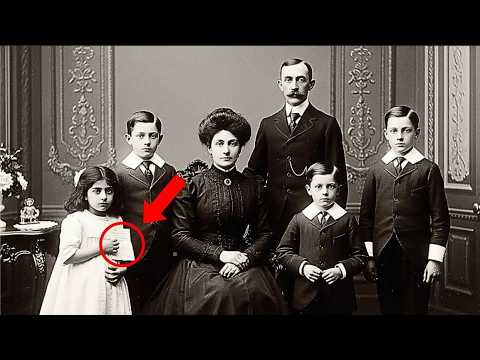
David rushed the photograph to the society’s digital lab, his pulse hammering. Under high-resolution scanning and enhancement software, the blurred edge of the note sharpened into a single word: “Help.” His hands trembled as he refined the image further. “Help me,” he whispered to the empty room. Along the folded edge, fragments of other words emerged—please, take, home—and at the bottom, where the girl’s thumb pressed against the paper, a partial address: 1247 Chester St.
He sat back, blood roaring in his ears. This wasn’t a family keepsake. It was a hidden cry for rescue, preserved in plain sight for over a century.
His colleague Margaret Chen found him still staring at the image eight hours later. When she saw the enhanced note, her face went pale. “David, this could be evidence of something terrible.” Together they traced the album back to Patricia Brennan, whose grandmother Catherine Morrison had donated it. Census records revealed the family: Edward and Clara Morrison, four sons, and a girl listed in 1910 as an “adopted daughter” named Maria Rossi—Italian, age 11. But there were no legal adoption papers. Maria had simply appeared in the Morrison household between 1903 and 1904.
Margaret’s voice dropped. “This wasn’t an adoption. This was something else entirely.”
David’s search of Italian-language newspapers from 1903 turned up a small, heartbreaking notice: Missing Maria Rossi, aged 5 years, disappeared from family home at 1247 Chester Street on June 8th. Her parents, Giuseppe and Francesca, had begged for information for months. By 1904, they had returned to Italy, broken and penniless. Maria was never found.
She had been living two miles away, hidden in the Morrison house, clutching a note that no one ever read.
David found the photographer’s journal—James Webb had noticed the girl’s terror, her clenched hands, her silent plea. He wrote: “She looked at me as though begging for help, and I did nothing.” The Morrisons were wealthy clients. He couldn’t afford to question them.
Now David stared at Maria’s small, frightened face. She had tried to leave a clue. She had tried to go home. And for 120 years, her message had waited in the dark.
Margaret broke the silence first. “We need to find out what happened to Maria after 1910. Did she ever escape? Did she ever learn the truth about her parents?” David nodded, already pulling up census databases. The 1920 record was the first blow. Maria Rossi, age 22, still under the Morrison roof—but the entry no longer said “adopted daughter.” It said “servant.”
“They stopped pretending,” Margaret said, her jaw tight. “The moment she was old enough to work, they dropped the fiction.”
By 1930, Maria had finally left. City directories placed her in a boarding house on Chestnut Street, working as a seamstress—the same grueling piecework her mother Francesca had done to survive. In 1932, she married Antonio Duca, a construction laborer, at St. Mary Magdalene de’ Pazzi Church. The same church her parents had begged for help in 1903.
David felt a strange ache in his chest. After everything, Maria had found her way back to the Italian immigrant community the Morrisons had tried to erase.
The 1940 census showed Maria and Antonio in South Philadelphia with three children. Modest means, hard work, a life built from nothing. But one document stopped David cold: a 1945 naturalization petition filed by Maria Duca, formerly Rossi. In the section for birthplace, she had written, in careful script: Philadelphia, Pennsylvania—daughter of Giuseppe and Francesca Rossi.
“She never forgot,” Margaret whispered. “After forty years, she still claimed them.”
Maria died in 1968 at seventy. Buried at Holy Cross Cemetery. David found no record that she had ever reconnected with her birth parents—no letters, no travel, no reunion. Giuseppe and Francesca had returned to Italy in 1904 and vanished from the records. The note in her hand had been her only attempt to reach them.
David spent the next week drafting a research report, documenting every fragment: the disappearance, the fabricated adoption, Webb’s guilty journal entry, Maria’s lifelong silence about her stolen childhood. He sent it to the Philadelphia Inquirer, and on a Sunday in September 2024, the story ran with the photograph on the front page. “Hidden Message in 120-Year-Old Photo Reveals Child Trafficking in Philadelphia’s Gilded Age.”
The response was immediate. Hundreds of emails flooded in—historians, genealogists, descendants of immigrant families. But one message stood apart. It came from a woman named Isabella Romano in South Philadelphia.
“I think Maria Rossi Duca was my great-great-grandmother,” she wrote. “My grandmother used to tell us how her mother was taken from her family as a child and raised by strangers. She kept a small photograph of herself that she looked at sometimes and cried. Could this be the same one?”
David called her within the hour. Isabella was a high school teacher, fifty-two, and she had never heard the full story. “My grandmother said Maria’s parents were Giuseppe and Francesca Rossi,” she told him, her voice unsteady. “She said Maria was stolen when she was very young, and her parents went back to Italy without her. But we never knew who took her or what happened.”
He sent her everything. Two days later, she called back in tears. “I showed the photograph to my mother, who’s eighty-three. She recognized it immediately. Maria kept a copy her entire life, hidden in a drawer with her important papers. We never understood why she’d keep a picture where she looked so frightened.”
Isabella paused, steadying herself. “Now we know. It was evidence. She kept it as proof of what was done to her.”
She asked to visit the society. When she stood before the original photograph, staring at her great-great-grandmother’s small, terrified face, she wept openly. “She was just a baby, and she was brave enough to write that note. She tried to leave a clue. And no one listened.”
David handed her the dossier—the timeline, the enhanced images, Webb’s journal, the desperate newspaper notices Giuseppe and Francesca had placed week after week. “I want to tell her story,” Isabella said firmly. “Maria never found her parents. But she had children, grandchildren, great-grandchildren. We can give her voice back.”
Over the following weeks, Isabella returned to the society nearly every afternoon, often bringing her mother, Rosalie, whose memories of Maria were fragmentary but vivid. “She never spoke English at home,” Rosalie recalled, seated in David’s office with a cup of tea growing cold in her hands. “Only Italian. And she sang to us—old songs from Naples that my grandmother said came from her own mother, long before Maria was taken.”
David exchanged a glance with Margaret. Those songs were a thread—a fragile, unbroken line back to Giuseppe and Francesca, carried across decades of silence.
Isabella began combing through her family’s stored boxes, searching for anything Maria might have left behind. In a dented tin of sewing supplies, beneath a pincushion and a bundle of faded threads, she found a small cloth pouch. Inside were three items: a worn scapular, a lock of dark hair tied with a blue ribbon, and a single photograph, creased and softened by a lifetime of handling.
It was a studio portrait of a young Italian couple, taken in Naples in the 1890s. On the back, in faded ink, Maria had written two names: Giuseppe e Francesca.
David scanned the photograph at maximum resolution and ran it through facial recognition software, comparing it against immigration records from Ellis Island. The match came back within hours. Giuseppe Rossi and Francesca Esposito, arrived 1897 aboard the SS Alesia, from a village called San Cipriano. The same couple whose desperate notices had filled the Italian-language newspapers of Philadelphia in 1903.
Margaret was already searching Italian civil records. “There’s a digitized archive from the Salerno province,” she said, scrolling rapidly. “Births, marriages, deaths. If they went home in 1904, there should be a paper trail.”
She found it by nightfall. A death record for Giuseppe Rossi, dated 1911, in San Cipriano—cause listed as complications from a lung injury sustained in a factory accident years earlier. And beside it, a marriage record from 1906: Francesca Esposito, widow, remarried to a local farmer named Pasquale Ferraro.
“She didn’t die of grief,” Margaret said quietly. “She remarried. She survived.”
But the most extraordinary discovery came three days later. A baptismal register from the parish of San Cipriano listed the children of Pasquale Ferraro and Francesca Esposito—two daughters born in 1908 and 1911. And in the margin of the 1908 entry, the priest had added a note in elegant Latin script: Pro filia Maria, in America deperdita, mater semper orat.
“For her daughter Maria, lost in America, the mother prays always.”
Isabella read the translation twice, then pressed her hand to her mouth. “She never stopped,” she whispered. “Francesca never stopped praying for her. Even after she remarried, even after she built a new life—she was still waiting for Maria to come home.”
David pulled up the passenger manifests again, searching for any Rossi or Ferraro who might have traveled to America in the decades after 1904. Nothing. Francesca had never returned. But among the records, he found something he had overlooked: a 1923 letter, filed in the Philadelphia Italian consulate’s correspondence archive, addressed to the consulate in Naples.
It was from a South Philadelphia seamstress named Maria Duca, formerly Rossi, requesting information about her parents’ whereabouts. “I am told they returned to Italy in 1904. I do not know if they live. I do not know if they remember me. I am their daughter, taken from them as a child. Please, if you can find them, tell them I am alive and I have never forgotten them.”
The consulate’s reply, filed beneath it, was curt: No record found. Unable to assist.
“She tried,” Isabella said, her voice cracking. “In 1923, she tried to find them. And they told her no record found.”
David sat back, the weight of it settling over him. Maria had spent her adult life searching in the only ways available to a working-class woman with no money and no connections—through a consulate that dismissed her, through a church that had once tried to help her parents, through a silence that swallowed everything.
Margaret cleared her throat. “There’s one more thing. The baptismal register—the daughters Francesca had after remarrying. One of them, Carmela Ferraro, born 1908. If she married and had children, there could be descendants still living in San Cipriano.”
Isabella looked up sharply. “Maria has family in Italy. Living family. Cousins we never knew existed.”
David was already opening a new browser tab, searching for the current parish records of San Cipriano. “If we can find them,” he said slowly, “they might have letters. Photographs. Maybe even something Francesca kept—something she wanted Maria to have, if she ever came home.”
The room fell silent. Outside the window, the Philadelphia evening had turned violet and gold, the same sky that had once hung over a five-year-old girl clutching a note in a photographer’s studio, praying someone would see her.
“Write to them,” Isabella said. “Write to the parish. Tell them Maria’s story. Tell them we found her.”
David sent the letter to San Cipriano’s parish priest on a Tuesday. Six weeks later, a reply arrived—not from the priest, but from a woman named Giulia Ferraro, Carmela’s granddaughter. “My grandmother always spoke of a lost cousin in America,” she wrote in halting English. “She said our family had a ghost named Maria, and that Francesca prayed for her every night until she died in 1948.”
Enclosed was a photograph: Francesca, older now, seated beside her two daughters. On the back, in her own hand, she had written “Per Maria, se mai torna.” For Maria, if she ever returns.
Isabella held the photograph and wept. “She waited her whole life,” she whispered. “And Maria never knew.”
In April 2025, the exhibit gained one final panel—Francesca’s photograph, the prayer, the 1923 consulate letter. Maria’s plea had finally crossed the ocean and found the family it was meant for.
What would you have done, had you been James Webb in that studio in 1904?
Report this article
Select a reason for reporting:






