It was just a family portrait from 1910—a black family of five, dressed in their Sunday best, posed in a modest living room. At first glance, nothing seemed unusual. But when historian James Whitfield zoomed in on the left edge of the frame, his heart stopped. There, seated in a small wooden chair, was a handmade boy doll. And its hair—dark, dense, and finely curled—was undeniably human.
James had spent 17 years cataloging photographs from the American South, but he had never seen anything like this. The doll was dressed in a miniature white shirt, dark trousers, and tiny suspenders—the exact clothes a young boy would have worn to church. Its posture was deliberate, its placement in the family portrait unmistakable. This was not a child’s toy left carelessly in the background. This was a statement.
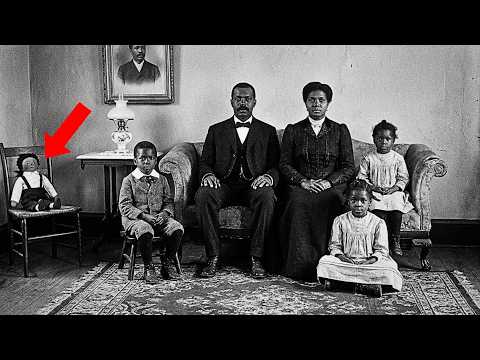
He reached out to a forensic anthropologist, Dr. Patricia Owens, who confirmed his suspicion: the hair was real, African-American, and had been carefully preserved. “Whoever made this figure used real hair,” she said. “This is a portrait of someone—a boy the family knew.” The word hung in the air: mourning hair. A tradition practiced across many communities, especially those with few resources, few formal ways to mark loss. But James had never seen it incorporated into a figure dressed as a specific child, placed in a family portrait.
James began to dig. The photograph had been donated to a Georgia historical society, part of a collection from an elderly woman who died without heirs. A volunteer remembered a Bible among the boxes—an old family Bible with handwritten records. James drove to Meriwether County and found it. His finger stopped on a line near the bottom of the page: “Samuel, born March 3rd, 1903, departed February 14th, 1910, 7 years old.” The photograph was dated 1910.
Samuel. A sixth member of the family. A boy who had died just months before the portrait was taken. James’s research revealed a tuberculosis outbreak in the winter of 1909–1910, and a church record of a funeral on February 17th. The mother, Ada, had been ill herself but survived. Then, two months later, the church minutes noted that the family had requested a formal portrait—a practice the church sometimes facilitated for members marking significant life events.
Ada had saved her son’s hair. She had sewn it onto a figure dressed to look like him, dressed as he would have been for church, for a portrait, for any occasion important enough to mark with care. And she had placed him in his own chair, so that when the family gathered to be seen, he was seen too. “A mother doesn’t stop being a mother just because the child is gone,” one elderly woman had recalled in a 1994 study, describing a similar figure made by her grandmother.
James now had names: Thomas and Ada, their son Samuel, and three surviving children—two girls and a boy. He posted queries in genealogical groups and contacted churches. Six weeks later, an email arrived from Diane, 67, of Atlanta. Her great-grandmother Ruth had grown up in Meriwether County and had a brother who died young. Diane’s mother, Loretta, 91, remembered a portrait. “Mama Ruth said it was special. That there was something in it that the family knew about but didn’t talk about. She said her mother had put love into that picture in a way nobody outside the family would understand.”
James met Diane and Loretta in June. He unrolled the photograph on the coffee table. Loretta went very still. “That’s them,” she whispered. “That’s the family.” He explained everything—the Bible, the outbreak, the mourning hair tradition. And then he pointed to the boy doll. “Samuel,” Loretta said, almost to herself. “That was his name. I never knew his name.” She reached out and touched the small figure in the chair. “She dressed him for the portrait. Same as the others. She wasn’t going to leave him out.”
James published his findings, and the story spread. But the response that stayed with him longest came from Diane. Her mother had read the article slowly, then set it down and said, “Tell him that Samuel has a name again.” James thought about Ada—the illness, the loss, the deliberate care she had taken to sew her grief into the shape of her son and seat him among the living. She could not have known that a historian would find the photograph, that the hair she saved would survive a century. She only did what she needed to do. What any mother might have done when the world gave her no other way to say: He was here. He was mine. He mattered.
The photograph had always held that truth. It had simply been waiting for someone to look closely enough to find it. And now, as James stared at the image one last time, he realized that some images are not records of the past—they are letters to the future, written in love, sealed in grief, and addressed to anyone patient enough to read them.
But the story did not end with the article. In the months that followed, something quieter and more personal began to unfold—something James had not anticipated and could not have engineered.
Diane invited him back to Atlanta in the fall. Not for another interview, not for documentation, but for a family gathering. Loretta had decided, at 91, that she wanted to see the photograph hung on her own wall. She had it framed in dark walnut, the kind of frame Ada might have chosen, and she asked James to be there when it went up.
He arrived on a Saturday afternoon to find the living room full of people. Cousins he had never met, aunts and uncles and second cousins twice removed, all of them drawn by the story of a name that had come back from the dead. “They came because of Samuel,” Diane told him quietly at the door. “Word went through the family. Everybody wanted to see him.”
Loretta sat in her high-back chair, watching as her grandson lifted the frame onto the nail above the mantel. When it was level, she nodded once, and the room went quiet. James watched a dozen faces turn toward the portrait—the five living figures in their Sunday clothes, and the small boy doll in his wooden chair at the edge of the frame.
What happened next, James would later describe as the moment the photograph stopped being history and became something else entirely.
A young woman near the back of the room—Diane’s niece, James learned, a schoolteacher in her thirties named Camille—stepped forward and asked if she could say something. She had been researching the family on her own, she said, ever since Diane had shared the article. She had gone back through boxes of old papers in her mother’s attic, and she had found something no one had seen in decades.
She held up a small, yellowed envelope. Inside was a single lock of hair, tied with a faded blue thread. On the envelope, in pencil, in a hand that was shaky and old, someone had written two words: “Samuel’s hair.”
The room went very still. Loretta’s hand rose to her mouth. Diane sat down slowly on the arm of the sofa. James felt the hair on his own arms lift, the way it had the first morning he had zoomed in on the wooden chair.
Camille explained that the envelope had been tucked inside a sewing tin, along with buttons and thread and a small pair of scissors. Her mother had kept the tin for years without knowing what the envelope contained. “I think Ada made two,” Camille said, her voice unsteady. “One for the photograph. And one to keep.”
James asked, carefully, if he could examine the lock. Camille handed it to him. He held the envelope in his palm and felt the weight of it—almost nothing, a few strands of hair, and yet heavier than anything he had held in years. The curl pattern was the same. The color, the texture, the fine tight coil—it matched the hair on the doll in the photograph. It matched the hair of a boy who had died in the winter of 1910, at seven years old, of tuberculosis, in a rural county in Georgia.
Loretta spoke from her chair, her voice quiet but clear. “She kept him close,” she said. “She put him in the picture so the world would see him. And she kept a piece of him in the sewing tin, so she could hold him whenever she wanted.”
James looked around the room at the faces of Samuel’s descendants—great-grandnieces and great-grandnephews, cousins and kin who had never known his name until a historian in Nashville noticed something odd in a wooden chair. They were standing in a living room in Atlanta, more than a century later, and Samuel was there with them. Not as a doll. Not as a lock of hair in an envelope. But as a name spoken aloud, a story told, a life counted.
Camille asked if she could keep the envelope. Loretta said no—it should go to the county historical society, she said, so that other families might see it and know what was possible. But first, she wanted it photographed. Beside the portrait. So that the two pieces of Ada’s grief—the one she showed the world and the one she kept for herself—could be seen together, at last.
James took the photograph himself, standing in Loretta’s living room with the framed portrait on the mantel and the small yellowed envelope in Camille’s hands. He pressed the shutter and thought about Ada, about the winter of 1910, about a mother who had nearly died and had survived to sew her son into the shape of memory.
When he looked at the image on his camera screen, he saw something he had not expected. The light from the window had fallen across the frame in a way that made the boy doll seem almost to glow—the white shirt bright, the dark trousers sharp, the small curls catching the afternoon sun. For just a moment, it looked as though Samuel were sitting in that chair in Loretta’s living room, not in a photograph from 1910, but here, now, among his family.
James lowered the camera. He did not believe in ghosts. But he believed in memory, and in the stubborn, beautiful ways that love refuses to be erased. Ada had made sure of that. She had taken what the world would have forgotten and stitched it into something that could not be ignored.
He packed up his equipment slowly, and before he left, Loretta took his hand and held it for a long moment. “You found him,” she said. “You gave him back to us.”
James shook his head. “He was never lost,” he said. “He was just waiting.”
Outside, the Atlanta evening was cooling, the sky turning the color of an old photograph—sepia and gold and fading light. James sat in his car for a while before starting the engine, thinking about the envelope in Camille’s hands, the lock of hair that had waited a century in a sewing tin, and the mother who had put her love into a picture in a way that nobody outside the family would understand.
He understood now. And he knew that somewhere, in whatever place holds the stories we have not yet found, Ada was smiling.
James drove back to Nashville with the image on his camera and a quiet certainty in his chest. He submitted the second photograph—the portrait and the envelope together—to the county historical society, just as Loretta had asked. They displayed it in a small case by the front desk, with a printed card that read: “Samuel, 1903–1910. Counted.”
Months later, Diane sent him a photo of her own. Loretta had passed away peacefully in her sleep, and beside her bed, on the nightstand, stood a small framed copy of the portrait. “She wanted him close at the end,” Diane wrote. “Just like Ada did.”
James sat with that for a long time. A century apart, two women had reached for the same small figure in the dark—one sewing him into being, the other keeping him near. Love, it turned out, had a longer memory than grief.
Some stories end when the historian closes the file. This one didn’t. It simply passed from hand to hand, like a lock of hair in a yellowed envelope, waiting to be held again. So tell me—what object in your own family has been quietly keeping someone’s name alive?
Report this article
Select a reason for reporting:






