In March 1971, a routine audit at a Saigon headquarters uncovered a single sheet of paper that should never have existed. No classification, no signature, just eleven paragraphs describing a confrontation that ended with the words “complete breakdown in Allied Command Authority.” The investigator copied it, and within 48 hours was ordered to destroy it. He did—but not before mailing a second copy to his brother in Sydney. That copy sat in a desk drawer for thirty years, waiting to be found. This is the story it told.
The page described four minutes on the morning of February 23rd, 1971, eight kilometers southwest of Bin Duong, in jungle the Americans called the Iron Triangle. Four minutes that pitted a 34-year-old Australian sergeant against a 38-year-old US Army major—two men with completely incompatible philosophies of war.
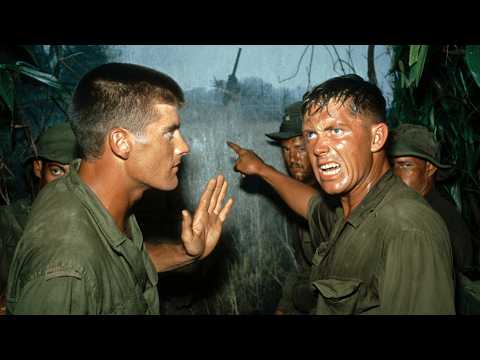
Sergeant Keith Paxton had run 127 patrols through that jungle. He moved silently, struck only with overwhelming advantage, and vanished. Major Vincent Corrosa had learned his trade at West Point and Fort Benning: fire superiority, artillery prep, body count. He was not a bad officer—just a conventional one, which in Vietnam in 1971 was almost the same thing.
Their collision came during a planning meeting for a three-company ARVN sweep. Corrosa laid out the map, confident. Paxton said three words: “Won’t work, sir.” The room went silent.
Paxton didn’t ask permission. He stepped to the map and pointed. The landing zones were too close to enemy trails. The elephant grass offered no fields of fire. The open paddy would backlight the ARVN soldiers. “This is how you take casualties, sir,” he said, flat as a tire gauge.
Corrosa’s ears turned red. “Your role is to observe and report, not to question operational planning.” Paxton replied, “I’m not going.” The major threatened a formal complaint. Paxton welcomed it—and promised one of his own.
What happened next was reconstructed from interviews thirty years later. The operation launched at 0600 without Paxton. By 0930, two ARVN soldiers were dead and seven wounded—exactly as Paxton had predicted. The insertions were heard kilometers away. The elephant grass swallowed tactical cohesion. The flooded paddy slowed the third company to a crawl, and when the ambush came, they were standing in open water with the sun in their eyes.
That evening, Corrosa found a handwritten note on his desk: “Two dead, seven wounded. You were told.” No signature. He crumpled it and submitted his report without amendment.
But the story didn’t end there. Three weeks later, Corrosa requested Paxton’s advice through official channels. The next operation, planned Paxton’s way, killed seventeen VC with zero friendly casualties. Over the following months, Australian sergeants advised nineteen major ARVN operations. Casualty rates dropped by 63%.
Neither government ever acknowledged it. The document remained buried. But a lesson had been learned—one that would surface again and again, in oral histories and personal papers, whenever someone knew exactly what to look for.
The archivist who first processed that donation in 2002 was named Helen Brady, a former schoolteacher with twenty years of cataloguing experience and a quiet obsession with the small wars Australia fought and then forgot. She read the eleven paragraphs twice, then a third time, and understood immediately what she was holding.
She did not file it with the general Vietnam collection. She created a sub-series, innocuous on its face—“Miscellaneous Allied Liaison Papers, 1968–1972”—and placed the single sheet at the back, behind a sheaf of routine supply requisitions. It would surface only if someone requested the box by number and read it cover to cover.
Helen Brady retired in 2009. Before she left, she typed a private note and slipped it into her own desk drawer, not the archive’s. It read: “Someone will come looking for this. When they do, don’t make it easy, but don’t make it impossible.”
They came looking in 2014. A doctoral candidate from the University of New South Wales named Daniel Okafor was researching the mechanics of allied command friction in Phuoc Tuy, and a footnote in a declassified MACV memo had pointed him toward the phrase “complete breakdown in Allied Command Authority.” He requested the box. He read every page. And on a Tuesday afternoon in a reading room with fluorescent lights buzzing overhead, he found the sheet.
What struck him first was not the content but the absence of it—no letterhead, no file number, no signature. A document with no author and no home. He photographed it, cited it in his dissertation, and spent the next three years trying to find out who had typed it.
The typewriter was the thread. Australian Defense Force issue, a model used almost exclusively by signals clerks in task force headquarters at Nui Dat. That narrowed it to a handful of men. Okafor traced them one by one.
Two had died. One refused to speak. The fourth, a retired warrant officer named Trevor Ellison living in Townsville, agreed to a phone call and then, unexpectedly, to a meeting. He was eighty-one years old and had never told anyone what he was about to say.
“I typed it,” Ellison said, sitting in his carport with a cup of tea going cold beside him. “I wasn’t supposed to. But I’d heard the whole thing through the wall of the briefing room, and then I heard about the two boys who died, and I thought somebody ought to write it down.”
He had not signed it because he was a clerk, not a commander, and clerks did not attach their names to things that made majors look foolish. He had filed it in the incident folder because that was the only place he could think of where it might survive.
“I never expected anyone to find it,” he said. “I expected it to get shredded. But I couldn’t not write it. You understand? I couldn’t not.”
Okafor asked him the obvious question—why had he kept silent for forty-three years? Ellison looked out at the mango tree in his yard for a long moment.
“Because it wasn’t my story to tell,” he said. “It was theirs. Paxton’s and the major’s. I was just the fella with the typewriter.”
He paused, and then he added something that Okafor would quote in every interview he gave for the rest of his career.
“But I’ll tell you what I learned, sitting in that headquarters. The army doesn’t learn from its victories. It learns from the things it’s ashamed of. And it only learns those if somebody writes them down and hides them somewhere a stubborn bastard might find them.”
Ellison died eight months later. His obituary made no mention of the document. But in his will, he left a single instruction: that his medals be donated to the Australian War Memorial, and that they be filed in the same sub-series as the eleven paragraphs—so that anyone looking for one would find the other.
Daniel Okafor finished his dissertation in 2017. It was well-received, cited in a handful of journals, and then—like most dissertations—promptly forgotten by everyone except the small circle of people who cared about the subject. Okafor did not forget. He kept digging.
He tracked down the South Korean NCOs next. One had emigrated to California in 1975 and died in 2011. The other, a man named Park Joon-ho, was still alive in 2018, living in a small apartment in Incheon, and he agreed to meet.
Park remembered the planning meeting with a clarity that unsettled Okafor. “The Australian stood up and told the American he was wrong,” Park said through a translator. “I had never seen this. In my army, this does not happen. I thought the sergeant would be arrested. Instead, three weeks later, the American asked for his help.”
Park paused, then added something Okafor had not expected. “I wrote to my commander about it. I said, this is how we should fight. He wrote back and told me to stop thinking about it.”
Okafor asked what Park had done with that letter. Park shrugged. “I kept it. I keep everything. I am old now. Someone should have it.”
What Park gave him was a manila envelope, water-stained and taped at the corners, containing three items: the letter from his commander, a hand-drawn sketch of the March 17th operation, and a photograph.
The photograph showed nine men standing in a clearing, squinting into the sun. Paxton was in the center, lean and unsmiling, a cigarette in his hand. Park was to his left. And on Paxton’s right, in a sweat-stained uniform with his sleeves rolled up, was Major Vincent Corrosa—not the polished West Point officer of the planning meeting, but a man who looked like he had spent the night in the jungle and had not slept.
Okafor had never seen a photograph of the two men together. No official record of the operation existed, no commendation, no citation. But here they were, standing shoulder to shoulder in the mud, and the expression on Corrosa’s face was not resentment. It was something closer to relief.
“The major was different after that day,” Park said. “He listened more. He asked questions. He was not the same man.”
Okafor asked whether Park thought Corrosa had been humiliated by the whole affair. Park considered the question for a long time.
“No,” he said finally. “He was freed. Before, he had to be right. After, he only had to be effective. This is a better way to live.”
Okafor flew home with the photograph scanned at high resolution and a new question burning in his mind: if Corrosa had truly changed, why had he never spoken publicly? Why had he let the record stay buried?
The answer, when it came, was not what he expected. It arrived in 2019, in a letter forwarded to him by the Army Heritage and Education Center—a letter Corrosa had written in 2005 to a young captain who had asked him for advice about advising foreign forces.
Corrosa’s reply was one page, handwritten, and it ended with a paragraph that Okafor would read aloud at a conference three years later, his voice catching on the last line.
“You will be tempted to believe that your rank entitles you to deference. It does not. It entitles you to responsibility. The finest soldier I ever met held no rank above sergeant and came from a country most of my colleagues could not locate on a map. He told me I was going to get men killed, and he was right, and I have spent thirty-four years trying to be the kind of officer who would have listened the first time. I am still trying.”
Okafor published his findings in a small military history journal in 2020. The article was read by a few hundred people, most of them veterans or academics, and then it might have faded away like everything else. But one reader was different: a young Australian army captain named Sarah Chen, who was about to deploy as an adviser to a partner force in the Middle East.
She tracked down Okafor’s email and wrote to him. “I read your article three times,” she said. “I’m shipping out in six weeks. What else should I know?”
Okafor sent her the photograph of Paxton and Corrosa, the one Park had given him. He told her about Ellison and the typewriter, about the note that said listen to the Australians, about the three words Paxton had said that started everything. She wrote back a single line: “I’m Australian. I’ll be the one they need to listen to.”
He replied: “Then make sure you say it. And make sure someone writes it down.”
That is how the lesson survives. Not in archives or official histories, but in the quiet chain of people who pass it on—a clerk with a typewriter, an archivist with a hunch, a historian with a stubborn streak, a captain with a deployment ahead of her. The document is still there, waiting. The question is whether we are willing to look for it.
What would you have done, standing in that planning room in 1971—and what will you do the next time expertise confronts authority?
Report this article
Select a reason for reporting:






