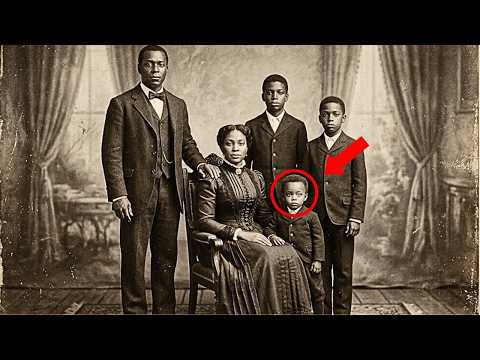
The photograph was small enough to fit in the palm of a hand, its edges yellowed and brittle with age. Taken in New Orleans in the spring of 1870, just five years after the Civil War, it showed a black family of five posed with quiet dignity. The father stood tall, his jaw set with pride, one hand resting on his wife’s shoulder. She sat with perfect composure in the center, their three children arranged around them in clothes that seemed far too fine for a family history should have forgotten. For over a century, the image sat in a private archive, uncataloged and unseen. Then a researcher zoomed in on the youngest child—a three-year-old boy staring directly into the camera—and stopped cold. One eye was dark brown. The other was pale green.
That single biological detail would unravel a mystery stretching back 200 years, crossing an ocean, and rewriting the story of a family that history tried its hardest to erase.
Dr. Nadia Osei almost didn’t answer the call that Tuesday morning in March 2019. She was at Howard University, buried in grading, when Professor Roland Tate’s voice came through with a restrained excitement that made her pause. “I found something,” he said. “A photograph. I think you need to see it.”
Three days later, Nadia stood in the Amistad Research Center in New Orleans, holding the carte de visite in its archival sleeve. The family in the image was composed with obvious care—the father in a dark wool jacket, the mother in a dress with careful pleating, the children arranged like a portrait of quiet defiance. Nadia studied it for a long moment. Then Roland handed her the magnifying loop. “Look at the youngest one,” he said quietly. “Look at his eyes.”
She leaned in. The child’s right eye was dark brown. His left eye was pale green. “This is heterochromia iridis,” Nadia murmured. “In a black child in 1870, the most likely explanation is a genetic variant.” She set the loop down carefully. “The OCA2 variant that produces green pigmentation in one eye while leaving the other with normal melanin levels has only been observed in one specific geographic region—the Volta River basin in northern Ghana. Outside of it, it is essentially absent.”
Roland stared at her. “You’re saying that child’s eyes can tell us where his family came from?”
“I’m saying that if that child’s DNA matches what I think it does, this photograph just became the most important piece of evidence I have ever seen.”
The donated materials were sparse: a water-damaged land deed for a property in Tremé dated 1871, a faded prayer card, and a single handwritten page—a partial family record. At the top, a name: Elias. Below it, Cora. And below those, three children: James, born 1862; Samuel, born 1865; Thomas, born 1867. Thomas. The youngest. Three years old at the time of the photograph.
Nadia photographed each document and then stood quietly. “Elias and Cora,” she said. “No last names recorded.” Roland nodded. “Common practice. Many freed families used only first names in private records.” Nadia looked back at the page. “I need to find living descendants,” she said. “If Thomas survived to adulthood and had children, a DNA sample could confirm everything.”
Back at Howard, she immersed herself in Reconstruction-era records. The 1870 Census gave her an anchor: Elias, age 34, laborer; Cora, age 29; James, 8; Samuel, 5; Thomas, 3—all on St. Claude Avenue in Tremé. The ages matched perfectly. The 1880 Census showed the same family ten years older, Thomas now 13 and attending school, his father listed as a carpenter. Then the trail went quiet. The 1890 Census had been destroyed in a 1921 fire, swallowing thousands of black family histories whole.
She called Roland. “I may have him through 1900, but I need genealogical help.” Roland didn’t hesitate. “Call Josephine Marks. She’s in Atlanta. She’s been tracing black Louisiana families for 30 years. If Thomas has living descendants, she’ll find them.”
Josephine answered on the second ring. Within 60 seconds, Nadia understood why Roland had recommended her without hesitation. She was 71, retired from teaching, and had spent two decades building one of the most comprehensive private databases of black southern genealogy in the country. “Thomas, born 1867, New Orleans. Father Elias, mother Cora, St. Claude Avenue,” Josephine repeated back. “Give me a week.”
She called back in four days. “I found him. Thomas lived to 1931. He and his wife Iris had four children. One granddaughter, Della, moved to Chicago in 1943 during the Great Migration. Della had two sons. One of them, Curtis, is still living. He’s 83, in Evanston. He doesn’t know the photograph exists, but I found a number for his daughter, Patricia. She’s the one you want to call first.”
Nadia sat very still. A living descendant. A direct line from the three-year-old boy with one brown eye and one green eye to a woman named Patricia in Evanston, Illinois, in 2019. 149 years, the distance between then and now felt very small. She picked up the phone and dialed.
Patricia’s voice was warm but cautious. “Who did you say you were again?” she asked. Nadia explained, carefully, about the photograph and the archival donation. There was a long pause on the line. “My grandfather used to talk about a family picture,” Patricia said slowly. “Something his grandmother Della kept. He said it was lost.” Nadia’s heart quickened. “It’s not lost,” she said. “I have it. And I think you need to see it.”
Two weeks later, they met at a coffee shop in Evanston. Patricia was 54, a high school history teacher with close-cropped natural hair and watchful eyes. She listened without interrupting as Nadia explained the heterochromia, the OCA2 variant, and the census trail from Thomas to Della to Curtis to her. When Nadia finished, Patricia was quiet for a long moment. “My grandfather Curtis used to say Della called it the family picture,” she said finally. “He looked for it for years. Then he stopped talking about it.”
Nadia reached into her bag and set a high-resolution print of the photograph on the table. Patricia looked at it for a very long time. Her eyes moved slowly across the image—the father, the mother, the two older boys—and then finally the youngest child on his mother’s lap. Her hand moved to her mouth. “The eyes,” she whispered. “Yes,” Nadia said. Patricia looked up. Her own eyes were dark brown, but around her left iris, barely visible, was a faint irregular ring of green pigmentation. Not full heterochromia—a trace. The gene had not disappeared. It had simply quieted.
“What does this mean?” Patricia asked. “Scientifically, I mean.”
“I need a DNA sample from you, and ideally from your father Curtis,” Nadia said. “If the OCA2 variant is present in your family’s genome in the configuration I believe it is, I can tell you exactly where in West Africa your family’s line originates.” Patricia set down her coffee. “How exactly?” “To the region,” Nadia said. “Possibly to the ethnic group, maybe closer.”
The samples arrived at the Howard University Genetics Lab on a Thursday morning. Buccal swabs from both Patricia and her father Curtis, who had agreed to participate after a long phone call with Nadia. Curtis was 83, and had grown up hearing fragments of a story he could never fully assemble. His grandmother Della had told him once that their family had come from far away, further than anyone knew. He had taken it as old woman’s poetry. Now he wasn’t sure.
Nadia and her graduate assistant, Devon, ran the full analysis over the following ten days. The results were unambiguous. The OCA2 variant, present in both Patricia and Curtis, was a specific single nucleotide polymorphism—rs1800407—occurring in conjunction with two additional rare variants on the same gene locus. This three-variant combination had been documented in the scientific literature only once before, in a 2014 study of communities in the Upper East Region of Ghana near the town of Baku, along the Gambaga Escarpment. The study had identified the combination in approximately one in 4,000 individuals in that specific population, and noted its near-complete absence in all other populations surveyed worldwide.
Devon looked up from the screen. “That’s remarkable,” he said quietly. Nadia was already on the phone with Dr. Kwame Asante at the University of Ghana. “Kwame, I need to know if there are living family clusters in the Baku area carrying the rs1800407 combination with the two flanking variants I’m going to send you. I think I found a diaspora connection that goes back to the slave trade era.” There was a pause. “Send me the data,” Kwame said. “And Nadia, if this is what you think it is, you need to be prepared for what comes next.”
She looked at the photograph pinned above her desk. Thomas’s two mismatched eyes looked back at her across 150 years. “I know,” she said. “Send me what you find.”
Kwame worked quickly. Within a week, he had a preliminary answer. The three-variant combination existed in his database in samples from eleven individuals, all from four villages in the Baku Municipal District along the Gambaga Escarpment. The villages were small, the largest fewer than eight hundred residents, and had maintained strong genetic isolation due to geography and cultural practice. They belonged to the Kusasi ethnic group, an agricultural people who had lived in the region for centuries.
But what Kwame found next made him call Nadia immediately. In the oral history records at the University of Ghana’s Institute of African Studies, there was a documented account collected in 1987 from an elder in one of the four villages. It described the forced removal of a large number of people during the late eighteenth century—a raid by slave traders operating through the Ashanti middleman network, targeting Kusasi settlements along the escarpment around 1790 to 1810. The elder had named families and clans, and he had described one man taken in the raids, known in the village as someone with one eye dark as earth, one eye light as river water.
Nadia felt the room shift around her. “It’s him,” she whispered. “Or his father, or his grandfather. Someone in that line.” “The convergence is compelling,” Kwame said carefully. “The variant, the geographic specificity, the oral history, the physical description.” “I need to go there,” Nadia said. “I thought you would say that,” Kwame replied. “I’ll arrange it.”
Nadia landed in Accra on a humid Tuesday evening and drove north the following morning with Kwame, a translator named Abena, and a doctoral student named Fifi, who had grown up in the Upper East Region. The drive to Bawku took nearly twelve hours, north through Kumasi into the flat savanna where the sky became enormous. They arrived after dark and slept in a guest house, then drove the last twenty kilometers to the villages along the escarpment the following morning.
The village elder who received them was a man in his late seventies named Adongo. He sat with them under a large neem tree with the composed, unhurried manner of someone who understood that some conversations require the full weight of patience. Nadia showed him the photograph on her laptop screen. Adongo looked at the image for a long time. He did not speak immediately. Around them, the sounds of the village continued without pause. Then he leaned forward and pointed to Thomas, the youngest child on his mother’s lap.
He said something in Kusaal that Abena translated quietly: “The eyes of the Ada.” Kwame murmured, “He recognizes the trait. It’s known in the village, associated with a specific family lineage.” Adongo spoke again at length. The Ada family had been among those taken in the late eighteenth century raids. The oral history recorded their names. The trait—one dark eye, one light—had appeared in that line for as far back as anyone could remember, and it had not been seen in the village since the raids. It was considered a mark of the family, something that had gone away with them and never come back. Until now.
Nadia turned the laptop toward Adongo and let him look again. “Tell him,” she said to Abena, her voice steady despite everything she was feeling, “that they survived. Tell him the family survived.”
The video call took three months to arrange. There were logistics, time zones, technology access, translation, and the careful emotional preparation of everyone involved. On a Sunday morning in November 2019, Curtis sat in his living room in Evanston with Patricia beside him, a laptop open on the coffee table. On the screen, connected from a community center in Baku, sat three members of the Ada family—a man named Erasmus, his sister Agnes, and an elder woman, their grandmother, who had lived her whole life on the escarpment and had heard the story of the taken ones since childhood.
It was not a dramatic meeting in the cinematic sense. There were no shouts, no immediate tears. It was quieter than that and more profound. Curtis, who had said little through the entire process, leaned forward when the elder woman began to speak. Abena translated her words slowly. She was recounting the names from the oral history, the names of those taken, and among them, a name—a man’s name—the one associated with the eyes preserved in village memory for over two hundred years.
Curtis listened to the name. He was quiet for a moment. Then he said very softly, “My grandmother Della used to say that name. I thought it was just something old she remembered. I didn’t know it meant anything.” It had meant everything. It had traveled from a village on a West African escarpment across the Atlantic Ocean, through the horror of the Middle Passage, through slavery, through emancipation, through the Great Migration, through a century and a half of silence—carried in the DNA of a child who sat on his mother’s lap in a New Orleans photography studio in 1870 and looked directly into a camera with one dark eye and one pale green eye, as if he knew, somehow, that someone would eventually look back.
The photograph had never been just a photograph. It had been a message, written in the oldest language there is—the language of blood, of inheritance, of a family that refused every possible obstacle to be erased. And now, at last, it had been read.
What would you say if a single photograph from your own family’s past held a secret waiting 150 years to be discovered?
Report this article
Select a reason for reporting:






