In February 1908, Pat Garrett—the man who killed Billy the Kid—climbed down from his buggy on a lonely road outside Las Cruces to relieve himself in the brush. A single bullet entered the back of his head. He fell into the dirt and never got back up.
It sounds like another story you’ve heard: Billy the Kid himself, shot from ambush in a dark bedroom. But what if the two stories are the same? What if the man who killed Billy the Kid was killed by the man he supposedly killed?
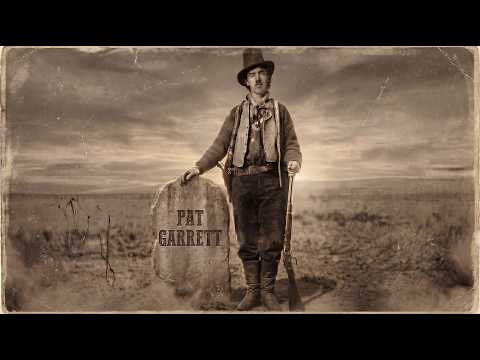
For 145 years, the official record says Garrett shot the Kid dead on July 14, 1881, in Fort Sumner, New Mexico. The Kid was 21. End of story. Or beginning of a different one.
Because when Garrett was killed in 1908, a cowboy named Wayne Brazel confessed and was acquitted. Not a single person in southern New Mexico believed Brazel acted alone. Land disputes, old enemies, corrupt ranchers, a rising politician named Albert Fall—every theory points to powerful men who wanted Garrett quiet.
But one name is missing from that list: Billy the Kid.
One man had a motive larger than any landowner or politician. One man had spent 27 years living under another name because Pat Garrett let him walk away from Fort Sumner alive.
To understand why Billy would want Garrett dead in 1908, start with the night Billy supposedly died. The killing at Pete Maxwell’s house has a problem. It’s always had a problem.
There was no autopsy. None at all. The most famous outlaw in America was shot dead in a darkened room at midnight, and not a single doctor ever examined the corpse. Every other notable outlaw of that era was photographed in death—Jesse James, the Daltons, the Younger brothers. But for Billy the Kid, there is no death photograph. There has never been one.
The body went into a coffin built fast by men who never saw the face in good light. The coroner’s inquest was conducted within hours, with jurors loyal to Sheriff Garrett. No medical examination. Garrett brought two deputies that night—John Poe and Tip McKinney—but they had never met Billy the Kid in life. They could not identify him.
Only one man in that bedroom claimed to know the face of the outlaw: Pat Garrett himself. And he was the shooter.
He was the only living witness who knew the victim, the investigator, and the following year the author of the official account. One man held every pin in the room.
Now look at what Garrett gained. The territorial reward was $500. Citizens raised an additional $7,000. A year later, the legislature granted him another $500—after Garrett bought $500 worth of drinks for the legislators who voted on it. In 1881 currency, the total equals more than a quarter of a million dollars today. The reward was paid for the story of the killing, not for the corpse.
Garrett became famous. He toured, gave interviews, became sheriff of Doña Ana County, served as a Texas Ranger captain, and President Theodore Roosevelt appointed him collector of customs in El Paso. None of that was available to a Louisiana saloon gambler before July 14, 1881.
All of it traces back to a single bullet fired in a dark room with no witness who could identify the victim.
The silence at the other end of the gun matters, too. Billy the Kid was the only person ever convicted of a crime arising from the Lincoln County War. The men who ran the Santa Fe Ring needed Billy gone before he could testify to what he knew. Governor Lew Wallace had broken his pardon promise. Billy spent his last year writing letters to Wallace reminding him of his debt. Wallace stopped answering.
So the Ring needed Billy silent, and Pat Garrett was their newly appointed sheriff—the instrument of that silence. Whether the silence came through a real bullet or a staged one made no difference to the men paying for it.
In 2003, the sheriffs of Lincoln and DeBaca Counties petitioned to exhume the grave in Fort Sumner for DNA testing. The state of New Mexico blocked that petition. It remains blocked today.
If the official story is solid, the test ends every question. But the state won’t run that test.
So if Billy the Kid walked out of Fort Sumner alive that night, where did he go?
The most developed survival account comes from an old man in Hico, Texas, who went by Brushy Bill Roberts. In 1948, a probate investigator named William Morrison tracked him down. Roberts told Morrison he was Billy the Kid. He said Garrett had shot a different man that night—a drifter named Billy Barlow—and passed the body off as the Kid’s.
Roberts said he fled to Mexico, lived among the Yaqui, returned under aliases, rode with Pancho Villa, married four times, and grew old. Historians dismiss him: records show Roberts was born in 1879, which would have made him two years old when Billy died. The official record calls him an impostor and moves on.
But set the impostor question aside. Look at the geography. The survival narrative places its subject in a specific corridor for 27 years: northern Mexico, the Texas border country, southern New Mexico, Wild West shows, Villa’s revolution along the Rio Grande, a small Texas town called Hico. Now look at where Pat Garrett spent those same 27 years. Roswell. Uvalde. Las Cruces. El Paso. The line runs 600 miles through Texas and New Mexico, along the Mexican border.
If Billy the Kid was alive, the two men were never very far apart. They lived along the same rivers, in the same cattle towns. They could have crossed paths a hundred times in 27 years. There is no documented meeting between them—because a documented meeting would have collapsed the whole arrangement. The silence isn’t evidence that nothing happened. The silence is the precondition of everything that did.
Then came Garrett’s final years, and that silence became dangerous. He lost the customs job in 1906. Roosevelt told him to his face there would be no reappointment. He returned to his ranch outside Las Cruces, drinking heavily, gambling, drowning in debt. A broke, drunk, desperate Pat Garrett was a problem for every man who knew what he knew.
On the morning of February 29, 1908, Garrett climbed into a buggy with two men: Carl Adamson driving, Wayne Brazel riding in the back. Four miles from town, on a stretch of road through Alameda Arroyo, the buggy stopped. Garrett got down to relieve himself. A bullet entered the back of his head. A second struck him in the stomach as he lay there.
Brazel confessed within hours, claiming self-defense. He was acquitted in less than a day. He went home and lived another quarter century. No one else was ever charged.
Almost no one believed Brazel pulled that trigger alone. The angle was wrong for a face-to-face defense. Adamson was a known associate of the El Paso underworld—and the brother-in-law of a contract killer named Jim Miller, who had at least a dozen killings to his name. Multiple witnesses placed Miller in the area that day. Before he was lynched in Oklahoma the following year, he allegedly confessed to the killing of Pat Garrett.
Historians believe the architects met in an El Paso hotel room in the fall of 1907: W.W. Cox, Oliver Lee, Albert Fall, Print Rhodes, and Jim Miller. That is the official suspect list. It has been for over a century. And it explains why Garrett was inconvenient to powerful men in 1908. But it doesn’t explain the angle of the shot. It doesn’t explain the certainty of Brazel’s confession. And it can’t explain the man who’s missing from it.
Look at what the men on that list actually had to lose. Cox wanted water rights—he was still on his ranch whether Garrett lived or died. Lee carried a grudge, but he’d already been acquitted. Fall was a politician on the rise; Garrett’s death made his life easier, but Garrett alive would not have ended his career. None of them faced ruin. None of them faced the gallows.
One man’s entire existence depended on Pat Garrett’s silence. The moment Garrett opened his mouth about the night of July 14, 1881, that man would lose his name, his family, his freedom, his life. He had 27 years invested in remaining dead. And that man was officially in the ground at Fort Sumner—which is exactly what made him the perfect suspect, and exactly why no investigator in 1908 could have possibly named him.
So how does a man who is officially dead arrange the murder of the only person who can prove he’s alive? Quietly, and through another man. He never appears in the room. He never signs his name. He trusts a small number of people, puts money where it needs to go, and disappears back into the corridor. Wayne Brazel didn’t need to know who paid him. Carl Adamson didn’t need to know. Jim Miller didn’t need to know. A bag of cash passed through several hands and ended up on a hotel table with no fingerprints.
We cannot prove this happened. The documented record can’t prove it, because the documented record can’t prove Billy survived. Those two questions are tied to the same grave in Fort Sumner. If that grave holds the body of a man who is not Billy the Kid, the official story of 1881 collapses—and the entire suspect list for the 1908 murder has to be rewritten. One name belongs at the top. The name no investigator at the time could have named, because the man who carried it was, as a matter of public record, deceased.
In 2003, two New Mexico sheriffs petitioned the state to exhume the grave for DNA testing. The state refused. The state still refuses. The reason given involves the integrity of historic grave sites. The reason not given is what it actually accomplishes: keeping every question about the night of July 14, 1881, and every question about the morning of February 29, 1908, permanently unanswered.
In 1881, Pat Garrett held the pen. He wrote the official account, chose the witnesses, selected the inquest jury. For 27 years, his version of that night was the only version that mattered. And then on a Las Cruces road in February 1908, the pen passed to someone else. Pat Garrett fell into the dirt with a bullet in the back of his head. The official story of his death was written almost immediately by the man who benefited from it. Wayne Brazel acted alone. Self-defense. Case closed.
The state of New Mexico has held that story for 118 years. It has held the story of Fort Sumner for 145 years. Both stories require a body that’s never been examined. Both stories require a witness who is no longer alive to testify. And both stories serve the same purpose every official story ever served: to protect the people who held the pen.
If Billy the Kid lived, then he held the pen at the end. He outlasted the sheriff and the ring and every man who could prove he was still alive. Somewhere in a New Mexico newspaper in the first week of March 1908, an old man in a small Texas town read a headline that closed his account with Pat Garrett. The first draft of history is always written by whoever survives to write it. At Fort Sumner, that was Garrett. At Las Cruces, it was someone else. The body in the grave belongs to whoever the state allows it to belong to. And the state has decided twice now that no one gets to ask.
So here’s my question for you: if the state of New Mexico ran that DNA test tomorrow and the grave came back empty—would you believe the official story ever again?
Report this article
Select a reason for reporting:






