Dr. James Okafor had spent fifteen years reconstructing lost genealogies, but nothing prepared him for the moment Diane walked into his office with a photograph pressed against her chest like a lifeline. The rain outside mirrored the storm inside him as he carefully opened the envelope and revealed a family portrait from 1882—a black family, dignified and formal, their names erased by history. But as he zoomed in on the youngest girl at the edge of the frame, his breath caught. One eye was dark brown, the other a pale blue-gray—a genetic anomaly that had gone unnoticed for over a century. That single detail would unravel a story of survival, loss, and an unbreakable biological thread stretching back to the banks of a river in Sierra Leone.
James’s hands trembled as he scanned the image at high resolution. The girl’s heterochromia was unmistakable, a hallmark of Waardenburg syndrome—a genetic condition that doesn’t skip generations. “This didn’t start with her,” he whispered. The realization hit him like a physical blow: somewhere in her ancestry, a mutation had been passed down through the horrors of slavery, through forced migrations and erased identities, surviving against all odds. And now, 140 years later, it was about to speak.
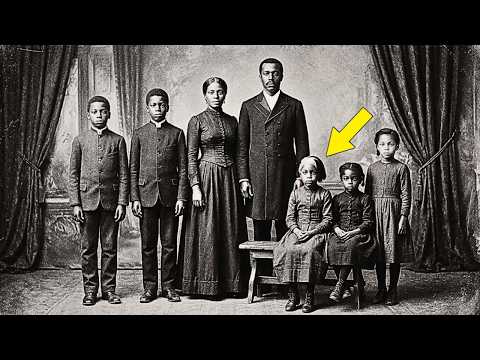
Diane knew almost nothing about the photograph. It had been handed down through four generations of women, always with the same cryptic instruction: “Keep this. It matters.” No names, no letters, no oral history—just a silent command that had outlived everyone who might have explained it. James turned to his colleague, Dr. Patricia Ewen, a geneticist who had worked with him on ancestry cases before. Together, they examined the other faces in the frame. The mother’s face was partially shadowed, but digital enhancement revealed a faint streak of lighter hair at her temple—a white forelock, another Waardenburg marker. “She’s the carrier,” Patricia said quietly. “The mutation came through her.”
The next step was inevitable: the Freedmen’s Bureau records. James searched by physical description, looking for any notation of unusual eye pigmentation. After hours of scrolling, a labor contract from 1866 appeared on his screen. The contracting party was a woman named Eliza. Beside her name, in a bureau agent’s careful handwriting, was a parenthetical note: “One eye brown, one eye gray blue, distinctive.” James’s hands went still on the keyboard. He had a name, a birth year, a location. But the question remained: where did Eliza come from before South Carolina?
The answer lay in a slave manifest from 1849, a coastal shipping record from Charleston. Among the listed individuals was a girl, age approximately 18, first name Eliza. Beside her description, the agent had written two words: “Eyes different.” Two words that had waited 175 years to mean something. James called Diane immediately. “I found her,” he said. “Her name was Eliza, and I know where she came from.” But the full truth would require more than documents—it would require Diane’s own DNA, a mitochondrial sequence that would trace her maternal line back across the Atlantic to a specific river valley in West Africa.
When Patricia called with the preliminary results, her voice held the restrained excitement of a scientist on the verge of a breakthrough. “The mitochondrial haplogroup is L3,” she said, “specifically a subclade associated with Sierra Leone. And the Waardenburg mutation matches a variant documented in exactly one population group: the Mende people.” James knew the name. The Mende had been among the most heavily targeted ethnic groups during the final decades of the transatlantic slave trade. Their culture, their language, their social structures had been violently disrupted. And now, a genetic thread was pulling them back into the light.
But the most astonishing discovery was yet to come. In the archives of the Amistad Research Center in New Orleans, James found a letter dated 1891, written by a woman who identified herself only as “a woman who was once called by another name.” The letter described a childhood in a village near a river, being taken at night by men who spoke an unfamiliar language, a ship, and the forced adoption of a new name: Eliza. And then, near the end, a passage that made James set down his coffee cup and sit very still: “My mother had eyes that did not match. One dark as river mud, one pale as morning sky. She told me it was a sign that we came from a particular place and that no matter how far we were taken, that sign would follow us.”
James read the sentence four more times. Then he called Diane and read her the letter over the phone. When he reached the passage about the eyes, she made a sound he could not quite name—not a word, not a cry, something in between. “She wrote it herself,” Diane finally said. “In her own hand. She remembered everything.” The geography in the letter matched the Sewa River Valley in Sierra Leone, a Mende heartland. The DNA, the mutation, the letter—they all pointed to the same place, the same people, the same origin. A family photographed in 1882 with no recorded name had come from the banks of that river, their ancestor taken during the final brutal years of the slave trade.
Diane came to James’s office one last time, the photograph still in its cardboard envelope. He laid everything out in order: the Freedmen’s Bureau record, the labor contract, the DNA analysis, the letter, the maps. She listened without speaking, then looked at the little girl at the edge of the frame—the girl whose pale right eye had caught the studio light in a way no one had noticed for a century and a half. “Her name was Eliza,” Diane said quietly, “but somewhere on the Sewa River she had another name, and now I know where to look for it.” She picked up the photograph and held it against her chest, both arms around it, the same way she had carried it into the office six weeks before. DNA does not forget. It cannot be confiscated, burned, or renamed. It simply waits. And sometimes, after long enough, someone finally knows how to read it.
But knowing where to look was not the same as finding. The name Eliza had carried on the Sewa River was not written in any archive James could search, because the Mende did not keep written records of their children. Names lived in memory, spoken at birth, sung at naming ceremonies, carried through the generations by voices rather than ink. To recover that name, James would need something far more fragile than a document: he would need a living link.
He began with the letter itself, reading it again with a new question in mind. The woman who had become Eliza had described her village with the precision of someone who feared forgetting. A river bend shaped like a sleeping animal. A grove of kapok trees where the elders held council. A hill she could see from her mother’s doorway, its summit flat as a table. James marked each detail and sent them to a colleague at Fourah Bay College in Freetown, a historian named Dr. Amara Sesay who had spent her career mapping Mende settlements along the Sewa before the colonial period.
Her reply came three days later, and it was cautious. “The river bend and the flat-topped hill could match three villages,” she wrote. “But the kapok grove is specific. Only one settlement I know of kept a council grove that survived into the twentieth century. It was called Gbengbe.” She attached a scanned colonial map from 1892, the ink already fading, a small cluster of dots along the Sewa’s southern bend. One of them was labeled with a name that had been misspelled by a British surveyor and never corrected.
James sat with the map for a long time. Gbengbe. A place that might not exist anymore, its people scattered by war and trade and time, its name surviving only in a surveyor’s error. He wrote back to Amara with a single question: Was there anyone left to ask?
The answer took a week. Amara had traveled south from Freetown, along roads that turned to mud in the rains, to a town called Sumbuya where an elderly woman named Mama Hawa was said to be the last living keeper of the old songs from that stretch of the river. Amara sat with her for two days before she asked the question. When she finally did, Mama Hawa did not answer at once. She sent for a pot of palm wine, poured a small libation onto the earth, and began to sing.
The song was a naming song, one of the old ones, passed down from mother to daughter for longer than anyone could count. It listed the children of a lineage, one name after another, a chain of voices reaching backward. And near the beginning of that chain, Mama Hawa sang a name that made Amara’s pen stop moving. She sang it twice, the way the old singers did when a name was important: Nyandengbe. It meant, roughly, the one who sees with two rivers.
Amara called James that evening, her voice unsteady over the crackling line. “The name is Nyandengbe,” she said. “And James, the song says she was taken as a girl. It says her mother’s eyes did not match. It says the family waited at the river for many seasons, and then stopped waiting.” James wrote the name on his notepad, then sat looking at it. Eliza had been a name imposed by force, a label written in a ledger. Nyandengbe was the name her mother had given her, sung into her at birth, remembered by a woman on the same river 180 years later.
He called Diane that night, later than was polite, and read her the name. She was silent for so long he thought the call had dropped. Then she said, very quietly, “Say it again.” He did. She repeated it after him, slowly, the way you learn a word in a language you are only beginning to speak. “Nyandengbe,” she said. “That was her name. That was her real name.”
There was more, Amara told him the next morning. Mama Hawa had asked why the name was needed, and when Amara explained—the photograph, the eyes, the family in a distant country—the old woman had nodded as though this were the most natural thing in the world. She said the lineage had always known that some of its children had been carried across the water. She said the songs remembered them. And then she asked for something in return.
“She wants a copy of the photograph,” Amara said. “She wants to see the child’s face. She says if the eyes are as they were described, then the song is true, and the family should know that the river has not forgotten them either.” James looked at the image on his screen, the little girl at the edge of the frame, and understood that the story was no longer only about the past. It had become a conversation, and someone on the other side of the ocean was waiting for a reply.
James printed the photograph on archival paper and mailed it to Sumbuya. Three weeks later, Amara sent back a photograph of her own: Mama Hawa holding the portrait in both hands, her eyes closed, her lips moving. “She was singing to her,” Amara wrote. “She sang the naming song again, and this time she sang it for the child in the picture.”
Diane framed the photograph and hung it in her hallway, no longer a mystery but a beginning. She booked a flight to Freetown for the spring. “I want to hear the song myself,” she told James. “I want to stand where the kapok trees were.”
On the morning she left, James stood at his office window and looked at the rain. Fifteen years of strangers on his walls, and now one of them had a name—two names, in fact. The one that was taken and the one that was remembered.
DNA does not forget. But neither do songs. And sometimes, if you are very lucky, the two of them finally meet.
What name would you want the river to remember you by?
Report this article
Select a reason for reporting:






