In the shadowed annals of the Vietnam War, where secrets were buried deeper than the jungle canopy, one name whispered through the ranks like a ghost story—Jerry Shriver. Known as ‘Mad Dog,’ he wasn’t just a soldier; he was a force of nature, a myth stitched from equal parts courage and chaos. Even hardened warriors like Medal of Honor recipient Jim Fleming spoke of him with a reverence tinged with fear: “Shriver convinced me that for the rest of my life, I would not go into a bar and cross someone I didn’t know.” That single sentence paints a portrait of a man whose presence alone could chill the blood of the bravest.
But who was Jerry Shriver really? To understand, you have to step into the world of MACV SOG—the Military Assistance Command Vietnam Studies and Observations Group—a unit so clandestine that its operations were denied by the U.S. government. These were the ghosts of war, conducting top-secret raids into Cambodia, Laos, and North Vietnam, where the rules of engagement were written in blood and shadow.
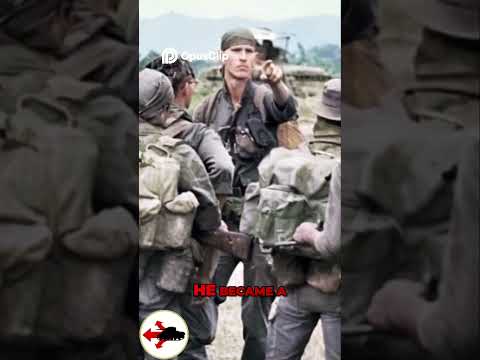
Shriver thrived in this crucible. His tactics were unorthodox, even by the already unconventional standards of SOG. He moved through the jungle like a predator, unpredictable and lethal, leaving a trail of awe and unease among his peers. He was the kind of soldier legends are made of—and nightmares, too.
In the thick of Southeast Asian jungles, where every leaf could hide an enemy and every silence screamed of danger, Shriver became more than a man. He became a symbol of the madness and brilliance that defined America’s most secretive warriors. His story is one of daring, defiance, and the fine line between heroism and havoc.
To hear Jim Fleming tell it, Shriver was a man you didn’t cross—not in a bar, not in the field, not ever. That respect, forged in the fires of combat, speaks volumes about the man behind the myth. But myths have a way of growing, and Shriver’s legend only deepened with each mission, each impossible feat, each whispered tale among the troops.
As we delve into the life of Jerry ‘Mad Dog’ Shriver, we’ll uncover the truth behind the legend. From his early days to his fateful missions, from the men who loved him to the enemies who feared him, his story is a testament to the extraordinary and the extreme. The jungle remembers, and so do those who survived alongside him.
But for now, picture this: a lone figure, clad in camouflage, slipping through the shadows of a hostile land, a ghost among ghosts. That was Shriver. And his story is just beginning.
The stories that circulated about Shriver in the SOG compounds had a way of sounding like tall tales—until you met the men who swore they were true. One such man was a radio operator named Delgado, who claimed he once watched Shriver walk into a village controlled by the Viet Cong, alone and unarmed, and walk out an hour later with a map of the local tunnel network and a bottle of rice wine tucked under his arm.
“He didn’t speak a word of Vietnamese,” Delgado would say, shaking his head. “Didn’t need to. He just had a way of making people understand him.” No one ever fully explained what happened in that village, and Shriver never bothered to. He had a habit of treating his own exploits like minor errands, a shrug and a grin his only commentary.
That grin was legendary in its own right. It was the kind of smile that appeared right before something went terribly wrong for the other side—or, occasionally, for his own men. Shriver operated on instinct, and his instinct had a wicked sense of humor. He once rigged a captured enemy radio to broadcast a loop of American rock music into a North Vietnamese encampment for three straight days, then ambushed the patrol sent to find the source.
His men learned to trust his madness, even when it made no sense. “You stopped asking questions after a while,” one recon team leader recalled. “You just followed him and hoped the jungle was in the mood to cooperate.” More often than not, it was.
But the jungle has a memory of its own, and it does not forgive recklessness forever. Shriver’s luck—if it could be called luck—was built on a razor’s edge of calculation and audacity. He knew the terrain better than most, could read the wind and the water and the silence of birds. Yet even the best readers of the wild make mistakes, and in SOG, a mistake was measured in body bags.
The mission that would come to define him—and haunt the men who survived it—began as a routine prisoner snatch deep inside Laos, in a sector so hot that even the seasoned recon teams called it the Devil’s Backyard. Shriver volunteered to lead the team. Of course he did.
What happened in those jungles over the next seventy-two hours would be whispered about for decades, debated by historians, and denied by the Pentagon. And it would cement Jerry Shriver’s place among the ghosts of MACV SOG—not just as a myth, but as something far more complicated.
Because legends, as Jim Fleming knew all too well, are rarely born from clean victories. They are born from the mess, the blood, and the choices no one else would make.
The team inserted before dawn, sliding through the elephant grass like shadows given flesh. Shriver had chosen five men—Delgado on the radio, a Cherokee knife-fighter named Hollis, a young point man called Reyes, and two Montagnard scouts who knew the terrain better than any map. They moved without speaking, the only sounds the soft suck of mud and the distant call of a bird that wasn’t a bird.
“Three days,” Shriver had told them back at the launch site, his voice flat as a knife blade. “We go in, we grab a prisoner, we come out. No heroics. No souvenirs. And if it goes wrong—” He’d paused, that famous grin flickering. “It won’t.”
By noon on the second day, it had gone wrong.
The prisoner snatch had been clean enough—a North Vietnamese courier separated from his unit, taken down with a chokehold and a gag before he could shout. But the extraction route ran through a valley that the Montagnards called the Sleeping Serpent, and the serpent was very much awake. An NVA company had moved in overnight, and suddenly Shriver’s six men were staring at a hundred rifles.
Hollis would later say that Shriver didn’t hesitate. He didn’t even blink. “We go through them,” he said, as if discussing which trail to take. Reyes, all of nineteen years old, looked like he might be sick. Delgado keyed his radio and whispered coordinates for an emergency extraction, but the nearest chopper was forty minutes out.
Forty minutes in the Devil’s Backyard was a lifetime.
Shriver did what Shriver always did—the unthinkable. He split the team. Hollis and the Montagnards would take the prisoner up the eastern ridge and call in airstrikes on the valley floor. Shriver, Delgado, and Reyes would draw the NVA away, downhill, toward the river. “Make noise,” he ordered. “Make them angry. Angry men make mistakes.”
They made plenty of noise. Shriver fired a captured AK-47 into the air, shouted in broken Vietnamese, and crashed through the underbrush like a herd of elephants. The NVA company, trained to pursue, took the bait. They came pouring down the slope, and for twenty minutes it was a running gunfight through bamboo and mud, bullets cutting the leaves to confetti.
Delgado took a round through the calf and kept running. Reyes lost his helmet and his rifle in the same stumble but didn’t stop. And Shriver—Shriver was everywhere, a blur of motion, firing, reloading, laughing that terrible laugh that made even his own men wonder if he was entirely human.
They reached the river. The current was fast and brown, swollen with monsoon rain. On the far bank, the jungle was thick enough to swallow an army. But between them and the water was a sandbar, and on that sandbar, the NVA had set up a machine gun.
Shriver didn’t slow down. He grabbed Reyes by the collar and Delgado by the arm, dragging them both toward the water. “Swim or die,” he said, and it wasn’t a suggestion. The machine gun opened up, chewing the sandbar into geysers of mud and grit, but Shriver was already moving—not away from the gun, but toward it, firing his AK from the hip in a wide, reckless arc that forced the gunners to duck.
It bought them ten seconds. Ten seconds was all Delgado and Reyes needed to hit the water. The current grabbed them like a fist and pulled them under, spinning them through the brown chaos. Delgado’s leg screamed with every stroke, but he kept swimming, kept kicking, kept breathing. Reyes surfaced once, gasping, and saw Shriver still on the sandbar—standing tall, reloading, that grin visible even through the spray.
“Go!” Shriver shouted. “I’m right behind you!”
He wasn’t.
The choppers came in low over the ridge, rotors hammering the treetops, and Hollis’s team made it out with the prisoner and the Montagnards intact. Delgado and Reyes were pulled from the river half-drowned and bleeding, but alive. They waited on the extraction pad, counting heads, counting seconds, counting the impossible.
Shriver never came out of the jungle.
For three days, the SOG compound buzzed with rumors. He’d been captured. He’d gone to ground. He’d found a village and was drinking rice wine with the enemy, laughing that laugh. But the patrols found nothing—no body, no blood trail, no sign. Just the sandbar, the river, and the silence of a jungle that had swallowed a man whole.
“He’s not dead,” Delgado insisted, months later, when the paperwork was filed and the official story was written. “Men like Shriver don’t die. They just disappear.”
And maybe he was right. Because in the years that followed, the stories kept coming. A Green Beret in ’71 swore he saw Shriver in a bar in Bangkok, older, quieter, but with the same grin. A Montagnard elder told of a white ghost who walked the old trails, alone, unarmed, untouchable. No one ever proved anything. No one ever tried.
Jerry ‘Mad Dog’ Shriver became what he always was—a myth. A ghost among ghosts. The jungle remembers, and so do the men who followed him into the dark.
But what do you think happened to Shriver? Did he die on that sandbar, or is he still out there, somewhere in the green, waiting for the next mission? Let us know in the comments.
Report this article
Select a reason for reporting:






