Dr. Marcus Wright had spent years studying the darkest chapters of Ozark history, but nothing prepared him for the moment his fingers brushed against a simple wedding photograph from 1898. The rain hammered against the auction house windows as he unwrapped the faded image, revealing a young couple frozen in time. The groom stood tall and rigid, his jaw set like a man guarding a secret. The bride, barely twenty, wore a plain white dress and an expression that was neither happy nor sad—just blank, resigned. It was the kind of portrait Marcus had seen a hundred times before. Until he noticed the fabric peeking from the groom’s coat pocket.
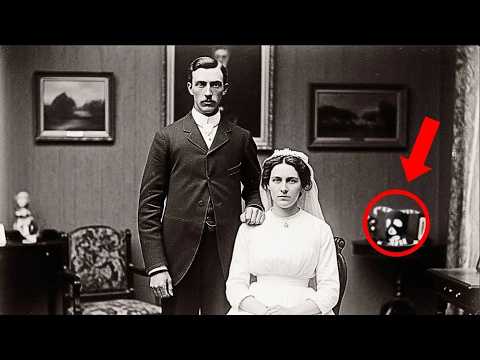
His breath caught. Even in the sepia tones, the shape was unmistakable: a crude white cloth mask with dark horns painted on the forehead. A Bald Knobber mask. The vigilante group had terrorized southern Missouri in the 1880s, their horned masks a symbol of nighttime raids, whippings, and murder. By 1898, they were supposed to be gone. Yet here was one, hastily stuffed into a bridegroom’s pocket as if forgotten. Marcus zoomed in on the high-resolution scan, his hands trembling. The mask’s weave, the brush strokes of the horns—it was real. And the groom, identified only as “William” on the back, had worn it.
Marcus had dedicated his career to the Bald Knobbers, collecting every scrap of evidence he could find. But this photograph was different. It wasn’t just a historical artifact; it was a confession. William and Sarah, wedding day, May 7th, 1898. Foresight, Missouri. No last names. No other clues. Just a bride with empty eyes and a groom with a killer’s mask in his pocket.
The next morning, Marcus drove three hours through winding Ozark roads to the Teny County Courthouse. The county clerk, Dorothy, had worked there for thirty years and knew the archives better than anyone. When Marcus showed her the photograph, her face went pale. “Lord have mercy. That’s a Knobber mask, plain as day.” Together, they pulled the leather-bound marriage licenses from 1898. There it was: William Thornton married Sarah Elizabeth Dockery on May 7th. Witnesses were James Thornton—probably his brother—and Martha Dockery, Sarah’s mother.
But the records after that were sparse. The 1900 census listed William and Sarah as farmers in the isolated Bull Creek area. Then nothing. No 1910 census, no property sales, no death records. They had simply vanished. Dorothy dug deeper and found a death certificate for Sarah Elizabeth Thornton, filed June 1899. Cause of death: accidental drowning in Bull Creek. She was twenty-one years old.
Marcus felt a chill. A young wife drowning just thirteen months after her wedding, in a creek only a hundred yards from her own house, in June when the water was usually low? Something was wrong. He asked for the sheriff’s report. It was brief: Sarah’s body found by a neighbor, Henry Walsh. Dr. Pritchard ruled drowning. Husband William stated she went to fetch water and never returned. No signs of foul play. Case closed.
But Marcus knew better than to trust a closed case from 1899. He tracked down Henry Walsh’s great-granddaughter, Ruth, who lived in Branson. She brought a worn leather journal to their meeting. “My great-grandfather kept a journal,” she said. “He wrote things he was afraid to tell the sheriff.” The entry dated June 15th, 1899, made Marcus’s heart pound. Henry had found bruises on Sarah’s arms and neck. She was wearing her nightdress, not day clothes. William showed no grief. And two nights before Sarah died, Henry’s wife had seen five or six masked men on horseback riding toward the Thornton place—one of the horses belonged to William.
Marcus stared at the journal. The Bald Knobbers weren’t just a historical footnote. They were still active in 1899, and William Thornton was one of them. Sarah had married into a world of violence and terror. And she had paid for it with her life.
But the story was far from over. Ruth mentioned an unmarked grave in the Thornton family cemetery, a pile of fieldstones far from Sarah’s plot. “Could be another victim,” she said. Marcus knew he had to find out. He had a diary to read, a trunk to open, and a 125-year-old mystery to solve. The mask in the photograph was just the beginning.
Marcus spent the following week in the Teny County records room, pulling every document that mentioned the Thornton name. Tax rolls, land deeds, circuit court filings—he read them all. Most were mundane. But one entry in a county commissioner’s ledger from 1899 stopped him cold: a payment of forty dollars to William Thornton for “services rendered to the county.” The signature beneath the authorization belonged to Sheriff Eli Campbell, the same man who had closed Sarah’s case in a single afternoon.
Forty dollars was nearly three months’ wages for a farmer. Marcus photographed the ledger page and cross-referenced the date—August 1899, two months after Sarah’s death. Whatever “services” William had performed, the sheriff had paid him handsomely for it, and the timing was impossible to ignore.
He brought the finding to Detective Frank Chen, who studied the ledger with narrowed eyes. “This changes the shape of the investigation,” Chen said. “If the sheriff was paying Thornton, that’s not just complicity. That’s a working relationship. Thornton wasn’t hiding from the law. He was useful to it.” Chen requested the full commissioner’s ledger for 1898 and 1899, hoping to find more payments. What came back was more disturbing than either of them expected.
Between March 1898 and November 1899, the county had paid William Thornton six separate sums totaling two hundred and fifteen dollars. Each payment was authorized by Sheriff Campbell and described only as “services rendered.” The largest came in September 1898—the same month Isaiah Washington’s cabin burned near Hollister.
Marcus sat back in his chair, the pieces sliding into place. William Thornton hadn’t just been a masked rider. He had been the sheriff’s instrument, a man paid to do the violence the law could not openly sanction. The Bald Knobbers had not simply survived into the 1890s—they had been absorbed into the machinery of local power.
But that raised a darker question. If William was the sheriff’s man, who had ordered Sarah’s death? Had William acted alone, silencing a wife who knew too much? Or had someone above him decided she was a liability?
Chen pulled the 1900 census again and noticed something he had missed. In the household two doors from the Thorntons, listed as a boarder, was a man named Elias Pruitt—identified in a later record as a former deputy under Sheriff Campbell. “Pruitt would have been in his twenties then,” Chen said. “If he’s still alive, he’d be over a hundred and twenty. But his family might still be around.”
Marcus traced Elias Pruitt’s descendants to a granddaughter, Carolyn Pruitt-Bell, living in Joplin. He called her that evening. She was wary at first, but when Marcus mentioned the Thornton name, her voice changed. “My grandmother used to talk about her father-in-law,” she said slowly. “She said he carried a guilt his whole life. She said he kept a box he wouldn’t let anyone touch, and when he died in 1958, my grandmother burned most of it. But she kept one thing. She said it frightened her too much to destroy.”
Marcus asked what it was. There was a long pause on the line. “A letter,” Carolyn said. “Written by a woman. Dated June 1899. My grandmother hid it inside a Bible, and it’s still there. I’ve never read it. I was always too afraid.”
Marcus’s mouth went dry. “Mrs. Pruitt-Bell, I think that letter might be from Sarah Thornton. I think she wrote it the night she died.” Another pause, longer this time. Then Carolyn said she would bring the Bible to Springfield the next morning. Marcus barely slept, staring at the ceiling and wondering what a dead woman had written to the man who may have helped kill her.
Carolyn Pruitt-Bell arrived at Marcus’s office at nine sharp, clutching a worn King James Bible wrapped in a plastic grocery bag. She was a small woman in her sixties with careful eyes and hands that trembled as she set the book on his desk. “I didn’t sleep much last night,” she admitted. “Kept thinking about that poor girl.”
Marcus put on his cotton gloves and opened the Bible to the Book of Psalms, where a single folded sheet of paper had been pressed flat for over a century. The handwriting was small and hurried, the ink faded to brown. He recognized it at once from Sarah’s diary—the same looping letters, the same desperate slant.
June 14th, 1899. To whoever finds this— The letter began with a plea, not to God, but to any human being who might read it. Sarah wrote that she had hidden copies of her diary in three places, fearing William would find and destroy them. She named the men she had seen in her husband’s company: James Thornton, Elias Pruitt, a man called Dock Hollister, and two others she knew only as the Ridge brothers.
But it was the final paragraph that made Marcus’s hands shake. “Sheriff Campbell knows everything. He came to our house in April and argued with William about a woman named Rebecca. William said she had been dealt with. The sheriff said there must be no more mistakes. I heard them through the wall. If I die, it will not be an accident.”
Marcus read the passage aloud to Chen over the phone. The detective was silent for a long moment. “So the sheriff wasn’t just paying Thornton,” Chen said finally. “He was directing him. That’s conspiracy at the highest level of county government.”
There was more. Sarah’s letter described a meeting she had overheard in May 1899, when Sheriff Campbell had ordered William to “quiet” a farmer near Protem who had threatened to testify about the Hollister fire. The farmer’s name was Amos Ketchum. Marcus searched the 1900 census and found no Amos Ketchum in Teny County. He found a death record instead—dated July 1899, cause listed as “consumption.” But the attending physician’s signature was the same Dr. Pritchard who had ruled Sarah’s drowning accidental.
“Two convenient deaths in two months,” Chen said. “Both signed off by the same doctor. Both connected to Thornton and the sheriff.” He paused. “Marcus, I think we’re looking at a network, not a lone killer. And if Elias Pruitt kept this letter hidden his whole life, he wasn’t just a witness. He was afraid. Which means he may have been part of it.”
Carolyn, who had been listening from the doorway, spoke up quietly. “My grandmother said something else once. She said her father-in-law never slept through the night. He’d wake up shouting a name. A woman’s name.” She met Marcus’s eyes. “It wasn’t Sarah. It was Rebecca.”
Marcus felt the room tilt. Elias Pruitt had known Rebecca Hayes. He had been there when she was killed. And he had carried that guilt for sixty years, hiding a dead woman’s letter inside a Bible like a confession he could not bring himself to make aloud.
Chen arrived within the hour, and together they photographed every page of Sarah’s letter. He planned to submit it as evidence in the reopened historical investigation, but both men knew the legal system could only do so much against men long dead. “The living are who matter now,” Chen said. “The Pruitt family deserves to know the truth about their ancestor. And Sarah’s descendants deserve to know she tried to expose the whole conspiracy, not just her husband’s crimes.”
Marcus nodded, but his mind was already racing ahead. Sheriff Campbell. The name kept returning. If the sheriff had ordered murders and paid for them with county funds, there had to be more records—more payments, more names, more victims. He pulled up the commissioner’s ledger again and began searching for every entry signed by Eli Campbell between 1895 and 1901.
What he found would take weeks to untangle. But one line, dated October 1897—the same month Rebecca Hayes disappeared—made his blood run cold. “To E. Campbell, reimbursement for expenses incurred in the matter of the Hayes woman. $12.50.” The county had paid its sheriff to clean up after a murder.
Marcus stared at the ledger entry, the cold arithmetic of murder laid bare in county ink. Twelve dollars and fifty cents. That was the price Teny County had paid to make Rebecca Hayes disappear. He photographed the page and sent it to Chen, who replied within minutes: “We have enough to name Campbell in the report. But he’s been dead since 1911. The question now is what we do with the truth.”
Marcus knew the answer. He spent the next six months compiling every document—Sarah’s diary, her final letter, Henry Walsh’s journal, the sheriff’s ledger, Isaiah Washington’s testimony—into a single archive. The Missouri State Historical Society agreed to host a permanent exhibit. Sarah’s photograph, with the mask still visible in William’s pocket, became its centerpiece.
On the opening day, Carolyn Pruitt-Bell stood before the display and read Sarah’s final words aloud to a crowd of descendants, historians, and reporters. When she finished, no one spoke. Then a woman in the back—Sarah’s great-great-grandniece—began to clap. The applause spread until the room thundered with it.
Marcus stepped outside into the gray Missouri afternoon. The rain had stopped. He thought of Sarah, twenty-one years old, writing by candlelight, hiding her testimony in a trunk because she believed someone, someday, would find it. She had been right.
What secrets do you think are still buried in the Ozarks, waiting for someone to dig them up?
Report this article
Select a reason for reporting:






