Dr. Jennifer Walsh had examined thousands of antique photographs in her career, but none had ever gripped her like the sepia portrait she found buried in a box of a stranger’s estate. Two sisters, posed in a lavish drawing room, their smiles frozen in 1923. At first glance, it was a picture of Jazz Age elegance—until she looked into the older sister’s eyes. There was desperation there, a barely controlled panic that made Walsh’s blood run cold.
She couldn’t look away. The younger sister, Virginia, radiated confident optimism, her bobbed hair perfect, her silk dress new and beaded. But Catherine, the elder, standing behind her, gripped the chair back with white knuckles. Her smile was a mask, and her eyes—those eyes—seemed to be watching something beyond the frame, as if monitoring a threat only she could see.
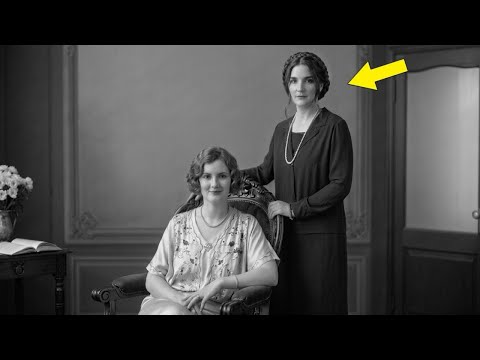
Walsh’s training told her this was no ordinary family portrait. The photographer’s own notes, discovered in the Sterling Studio archives, confirmed her suspicion. “Older sister appeared reluctant throughout consultation,” the appointment book read. “Payment in advance by younger sister.” Sterling had even marked the session with an asterisk—a warning that something was deeply wrong.
As Walsh dug deeper, the story of the Peton sisters began to unravel. Their father, a shipping magnate, had controlled every aspect of their lives. His will had trapped Catherine in a gilded cage: a modest allowance, revoked if she married without approval or moved more than fifty miles from Chicago. Virginia, the younger, inherited everything—and with it, power over Catherine’s every move.
Letters from the family housekeeper painted a chilling picture. “Miss Catherine is like a bird in a gilded cage,” Margaret O’Brien had written. “Mrs. Davies makes all the decisions… Miss Catherine works from morning until night, but receives little recognition.” Virginia had even sabotaged Catherine’s one chance at love, pressuring their father to ruin her fiancé’s medical practice until he abandoned the engagement.
By the spring of 1923, Catherine was a prisoner in her own home, her identity erased, her future stolen. The portrait captured the exact moment she realized there was no escape. Her smile was for the camera; her eyes were for the life she would never have.
But Walsh’s investigation was only beginning. What she would discover next—a hidden diary, a sudden death, and a transformation no one saw coming—would turn this story of despair into one of the most remarkable tales of liberation she had ever uncovered.
The diary surfaced in a box of uncatalogued papers from the Ashford estate—a small, leather-bound volume Catherine had kept during the worst years. Walsh recognized the handwriting immediately from the letters. The entries were brief, almost clinical, as if Catherine had trained herself to record facts without feeling them.
“April 15, 1923. Sat for the portrait today. Virginia chose the dress. I was told to stand behind her, to look proud. I did as I was told.” The next line was nearly illegible, the pen pressed hard enough to tear the page. “I am so tired.”
Walsh read on, her unease deepening. The entries from that spring grew shorter, more mechanical. Catherine noted Virginia’s dinner parties, the flowers ordered, the silver polished—never her own thoughts. But one entry, dated late March, stopped Walsh cold.
“Dr. Hartwell asked me what I would do if I were free. I could not answer. I have forgotten how to want anything.”
It was the sentence of a woman who had been taught, patiently and thoroughly, that her desires were a form of betrayal. Walsh set the diary down and stared at the portrait again. The white knuckles. The watchful eyes. Catherine wasn’t monitoring a threat in the room—she was monitoring herself, making sure the mask never slipped.
The breakthrough came from an unexpected source: Charles Davies, Virginia’s widower. Walsh tracked down his grandson, who produced a bundle of letters Charles had written after Virginia’s death in the influenza epidemic of 1924. They revealed a man quietly horrified by what he had witnessed.
“I did not understand, while my wife lived, how completely she had arranged her sister’s life,” Charles had written to a cousin. “Catherine asked my permission for the smallest things—a new hat, an afternoon call. I told her she need never ask me again, and she wept.”
Walsh felt the weight of that scene—a grown woman weeping because someone had finally treated her as an adult. She cross-referenced the date with Catherine’s diary. The entry was uncharacteristically long.
“Charles says I may do as I please. I do not know what pleases me. I sat in the garden for an hour and simply breathed. It was the first hour of my life that belonged to me.”
But liberation, Walsh realized, was not a single moment. The diary entries that followed were halting, uncertain—Catherine second-guessing every choice, apologizing to servants out of habit, catching herself waiting for Virginia’s approval long after Virginia was gone. Recovery, Walsh saw, was its own kind of labor.
Then came the entry that changed everything Walsh thought she understood. Dated 1926, it was written in a steadier hand.
“I met a woman today at the charity who told me her sister controls her money and tells her she is ungrateful. I recognized every word. I told her: your gratitude is not a debt. I wonder, now, who first told me that. No one did. I had to learn it alone.”
Walsh leaned back in her chair, the portrait propped before her. Catherine had not merely escaped—she had turned her captivity into a map for others. The desperate eyes in the photograph had not been the end of her story. They had been the beginning of a long, quiet rebellion.
Walsh wanted to know what had become of the woman who wrote those words. The charity Catherine had joined in 1925 was the Women’s Educational Alliance, a modest organization on Chicago’s Near West Side that offered night classes in bookkeeping, typing, and civic literacy to working women and recent immigrants. Its surviving records, held at the Chicago History Museum, listed Catherine Peton as a volunteer instructor and later as chair of the finance committee.
Her fellow volunteers had left behind their own impressions. “Miss Peton is the most patient teacher I have ever observed,” one colleague had written in a 1927 newsletter. “She never corrects a student’s error without first asking what the student intended. She says a woman who is listened to once will trust herself twice.”
Walsh read that line three times. It was Catherine’s own history, distilled into a teaching method—the exact thing she had never received and had learned, painfully, to give herself.
The Alliance’s annual reports told a quieter story of growth. Enrollment in the bookkeeping course tripled between 1926 and 1930. Catherine had personally petitioned three downtown banks to hire graduates, and two had agreed. “Economic independence is not a luxury for women,” she had told a reporter from the Chicago Defender in 1929, in one of her rare interviews. “It is the door through which every other freedom must pass.”
The reporter had asked about her family. Catherine’s answer was brief and careful. “I was fortunate to learn the value of self-reliance later than most. I try to spare other women that delay.” She had not mentioned Virginia by name. Walsh noticed the omission—not bitterness, she thought, but a boundary. Catherine had stopped letting her sister occupy every room she entered.
The marriage to Dr. Robert Mitchell in 1932 appeared in the records as a small, unremarkable notice in the Tribune’s society pages—a stark contrast to the lavish coverage of Virginia’s wedding a decade earlier. Walsh found a photograph of the ceremony in Catherine’s papers. She wore a plain navy suit and a hat she had clearly chosen herself, and she was laughing. Not the practiced smile of 1923. A real, unguarded laugh, caught mid-breath.
On the back, in Catherine’s hand: “Robert asked what I wanted. I said a quiet wedding and a loud life. He agreed to both.”
Walsh traced Robert Mitchell through medical directories. A widowed physician, fourteen years Catherine’s senior, he had served on the board of the Alliance before their marriage—which meant he had known Catherine as a colleague, as a woman with work and opinions, before he ever knew her as a possible wife. Walsh suspected that was the point.
His obituary in 1951 described a man who had championed his wife’s advocacy work and had, in his own quiet way, refused to let his practice accept patients who dismissed their wives’ symptoms as nerves. “He learned that from Catherine,” a colleague recalled. “He said she had taught him to listen twice before speaking once.”
The phrase struck Walsh as an echo. Listening twice. Trusting twice. Catherine had built a whole life out of the second chance she had been denied for so long—and then handed the method to everyone she met.
But Walsh’s research also revealed the limits of that life. Catherine never had children, and the correspondence suggested it was not for lack of wanting. A letter to Helen Morrison Clark from 1934 was unusually raw.
“The doctors say my nerves are too fragile for motherhood, and I believe them, though I wonder if the nerves they mean are the ones Virginia wore down to threads. Robert says we will build our family from the girls at the Alliance. He is right. There are so many who need a door held open.”
Walsh sat with that for a long moment. The damage Virginia had done had not vanished when Virginia died. It had followed Catherine into her body, into her marriage, into the choices she was told she could not make. And still—still—she had held the door open for others.
The final folder in the archive contained a single item Walsh had not expected: a letter from Catherine to her younger self, written in 1940 and never sent, tucked inside the back cover of the old diary.
“To the woman in the photograph: you will not believe me yet, but the room you are standing in is not the whole world. Keep your eyes open. One day you will walk out of that frame, and no one will tell you where to stand. I promise you this. I am writing from the other side of it.”
Walsh closed the folder. The portrait lay beside her on the desk, and for the first time the desperate eyes no longer looked trapped. They looked patient. They looked like someone waiting, with terrible endurance, for a door she had already begun to open.
Walsh presented her findings at the Chicago Women’s History Project that autumn, the portrait projected behind her. She described the white knuckles, the watchful eyes, the will that had trapped a woman in a fifty-mile radius. The room was silent. “We celebrate sacrifice,” Walsh said, “without asking who is being sacrificed, and for what.”
Afterward, an older woman approached the lectern. She introduced herself as a retired social worker who had trained with the Alliance in the 1950s. “Miss Peton—Mrs. Mitchell by then—interviewed me for my first placement,” she said. “She asked what I wanted. Not what I was willing to do. What I wanted. No one had ever asked me that.”
Walsh smiled. The door Catherine had opened was still swinging, decades later, in rooms she would never see.
The portrait now hangs in the museum’s permanent collection, displayed beside Catherine’s unsent letter. Visitors linger there, studying that frozen smile, learning to see the panic beneath it—and the patience.
Because the woman in the photograph did walk out of the frame. She just had to do it alone, one small decision at a time, until the room she was standing in was finally hers.
So here is the question worth asking yourself: whose smile in your own life is a performance—and have you ever thought to ask them what they actually want?
Report this article
Select a reason for reporting:






