In 1957, a former United States Marine sat down at a typewriter in New Jersey. His name was Robert Leckie. He had been a private in the First Marine Division. He had landed on Guadalcanal in August 1942. He had survived. Twelve years had passed since the Pacific War ended. And now, Leckie was writing a book. The book would be called Helmet for My Pillow. It would become one of the most important first-hand accounts of the Pacific War ever written. It would sit on shelves in American homes for decades. It would be read by men who had served beside him. It would be read by sons and grandsons of men who had not come home. And much later, long after Leckie himself was gone, the book would form the basis of a television series that would carry his story to millions of people who had never heard a shot fired in anger. But that was the future. In 1957, Robert Leckie was a man at a typewriter, and he was writing about something that he wanted the world to remember. He was writing about the Australians.
He wrote about being billeted with an Australian family in Melbourne in 1943, after Guadalcanal. He wrote about the way they fed him when he came down off the troopship looking like a corpse. He wrote about the way they treated him as if he were one of their own sons. He wrote about meeting Australian veterans of Tobruk and the Kokoda Track in pubs and listening to them describe a war that was different from his own. He wrote about a song he had never heard before called Waltzing Matilda.
Robert Leckie was one Marine. He was not the only one. This is the story of what American Marines wrote about Australian diggers in the Pacific War, and why those words mattered. Because the soldiers of one nation looking at the soldiers of another and saying, in print, in their own names, with their own reputations on the line: These are real soldiers. That is something that does not happen often in history. And when it does happen, it is something worth holding on to.
To understand what the Marines wrote, you have to understand where they were when they first encountered the Australians. In August 1942, the 1st Marine Division landed on a malaria-soaked island in the Solomons called Guadalcanal. The division commander was a soft-spoken Virginian named Alexander Archer Vandegrift. At 55, Vandegrift carried the Marine Corps in his bones. Thirty-three years, Haiti, Nicaragua, China. Every brushfire war the United States had asked its Marines to fight in the long quiet between the two great ones. At Guadalcanal would be the first division-sized command of his life. He was about to do so with very little air cover, very little naval cover, and almost no clear idea of how many Japanese were on the island he had just been ordered to take.
What Vandegrift did have, though he did not yet fully understand it, was a tiny, scattered, almost forgotten network of Australians sitting on islands all around him. These men were called coastwatchers. They were Australian Navy Intelligence. They had stayed behind on the islands when the Japanese came with radios and a small number of Solomon Islander helpers, and they watched the sea lanes from hiding places the Japanese never quite found. The full story of who they were and how they operated is told elsewhere. What matters for the Marines on Guadalcanal is what those Australians sent into the air.
And when the Marines came ashore on Guadalcanal, the coastwatchers became the eyes of the 1st Marine Division. From hidden positions across the Solomons, Australian coastwatchers could see Japanese bombers taking off from Rabaul on the two-hour flight south to attack Henderson Field. Two hours was enough time. Two hours was the difference between Marines being caught on the ground and Marines being in the air, climbing, ready, waiting in the sun. The messages were short. They came in often. They saved Marine lives. The operational detail of how those messages were composed and transmitted belongs to another story. For Vandegrift on Guadalcanal, those messages were the difference between survival and annihilation.
After the war, Vandegrift wrote about it. He had risen to Commandant of the Marine Corps by then, the first Marine to hold that rank as a four-star general. He had been awarded the Medal of Honor for Guadalcanal. He could have written about anything in his memoir. He could have credited himself, his staff, his battalion commanders, the courage of his Marines, and of course he did credit those men. They deserved it, but he also wrote in plain language that the campaign would not have been won without the Australians. The Coast Watchers, Vandegrift said in substance, saved his division. The warnings they gave him allowed his fighter pilots to scramble. They gave him intelligence on Japanese troop movements. They told him when reinforcement convoys were coming down from Rabaul. They sheltered downed American airmen. They walked rescued men back through the jungle to the coast and got them home.
The Marines who came off Guadalcanal in late 1942 and early 1943 were skin and bone. They had lost something like a quarter of their effective strength to malaria, dengue, dysentery, and combat. Photographs of the division when it reached Australia for rest show men with cheekbones sticking out and uniforms hanging off shoulders. They had to be carried up the gangplanks of the troopships in some cases. They had to be hospitalized by the hundreds when they arrived, and when they arrived, they arrived in Melbourne.
The decision to send the first Marine Division to Melbourne instead of to Auckland or back to the United States had been made for logistical reasons. The Marines were exhausted, sick, and emotionally finished. They needed somewhere safe. Australia was safe. The Japanese threat to the Australian mainland had been contained by Coral Sea and Midway. The Australians had asked for American troops to be billeted in their cities to help boost civilian morale and to demonstrate that the allies were finally on the offensive. And so in early 1943, the troopships came up the Yarra River and the first Marine Division came ashore in Melbourne.
What happened next is one of the most extraordinary chapters in the social history of the Second World War. The Marines were not put up in barracks. There were not enough barracks. Many of the men were billeted in the homes of Melbourne families. They walked off the gangplank, were given a sheet of paper with an address, and were told to go and find the family who had volunteered to take them in. The families were ordinary Melburnians, working people, tradesmen, clerks, widows whose husbands were in North Africa with the Australian Imperial Force, couples whose sons were prisoners of war in Changi, families who had lost a boy at Greece or Crete or in the jungles north of Port Moresby, and these were the people who opened their front doors to the American Marines.
Leckie wrote about it. Other Marines wrote about it. The recollections are remarkably consistent. The Marines were astonished. They had expected to be treated as foreigners, perhaps with suspicion, perhaps with the polite distance that allied troops often receive in cities not their own. Instead, they were treated as if they were lost sons coming home. They were fed. They were given the best chair in the front room. They were taken to family Sunday dinner. They were introduced to the neighbors. They were invited to dances. They were brought to football games at the Melbourne Cricket Ground, they were taken on weekend trips to the country. They were in many cases set up with somebody’s daughter or somebody’s niece or somebody’s cousin. And from that period, more than 10,000 marriages eventually resulted between American servicemen and Australian women. Lifelong marriages, children, grandchildren. American families today who trace their Australian grandmothers back to that strange and beautiful Melbourne winter of 1943.
It was not just hospitality. Leckie understood, even as a young private in his twenties, that there was something more than hospitality in what these families were doing. There was an unspoken transaction. The Australians were not strangers to war. They had lost 48,000 men in the First World War. They had a name in their cities and towns and country crossroads for the men who had not come back. And the name was sacred. Now, they were losing men again. Many of the families taking in Marines had their own boys overseas. Some had already had the telegram. Some were still waiting. And what they were doing for the Marines was, in part, what they would have wanted some foreign family to do for their own sons in Cairo or in Bardia or in the jungle above Kokoda. Leckie picked that up. He wrote about it.
Years later, in 1957, sitting at his typewriter in New Jersey, he wrote about an Australian family that had taken him in and treated him better than he had been treated by anyone in his life. He wrote about the woman of the house, the way she folded his laundry, the way she set a place for him at the table as if he had always been there. He wrote about the husband, a tradesman, who would come home at night and talk with him about the war as if he were already a man, not a boy. He wrote about how strange it was to be that far from home and to feel less foreign than he had ever felt anywhere. That was the gift of Melbourne.
And then, there was the song. Marines on shore leave in Melbourne kept hearing the same tune in the pubs. It was a strange song, unlike anything they had heard at home. The words made very little sense to an American ear. It was about a swagman, a man tramping with a swag by a billabong under the shade of a coolibah tree with a jumbuck in his tucker bag. None of these words meant anything to a Marine from Pennsylvania or Texas or Brooklyn, but the melody — the melody was something else.
Waltzing Matilda was already by 1943 the closest thing Australia had to an unofficial national anthem. It had been written by the poet Banjo Paterson in 1895. It had been adopted by the troops who marched into Egypt in 1914 and into the Western Desert in 1941. It had been sung by Australian prisoners of war in German camps. It had been sung by Australian troops dying in the jungles of New Guinea. And in 1943, in the bars of Melbourne, the Marines of the First Marine Division began to hear it night after night.
They liked it. They liked it more than that. They learned the words. They learned the harmonies. They began to sing it themselves on the marches, in the camps, on the troopships. By the time the division left Australia in late 1943 to fight at Cape Gloucester on New Britain, Waltzing Matilda had been adopted in everything but official designation as the marching song of the First Marine Division.
Think about that for a moment. A United States Marine Corps division, an American formation, taking as its unofficial anthem the folk song of another country. Not a country whose language was different, not a country whose alliance was distant, but a country whose hospitality, whose families, whose veterans, whose women, and whose ordinary kindness had reached so deeply into these young Americans that they could not let go of the song that the Australians sang. And so they took it. They took it with them to Cape Gloucester. They took it to Peleliu. They took it to Okinawa. They sang it in jungle camps and on the decks of troopships. After the war, they sang it at division reunions. There is film of the surviving veterans of the 1st Marine Division in their seventies and eighties in the 1990s standing together in American Legion halls singing Waltzing Matilda and not one of them needed the words.
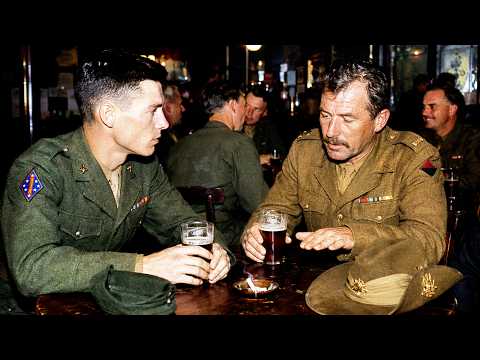
That is what the Australians did for the Marines. Leckie wrote about it, but Leckie also wrote about something else that he encountered in Melbourne. And this is the part of his memoir that has stayed with readers across generations. He wrote about meeting Australian veterans in pubs, old soldiers, older than him mostly, men who had been in the Australian Imperial Force in North Africa, men who had stood in the lines at Tobruk for 242 days under German guns, men who had been at El Alamein, men who had been at the Kokoda Track, men who had been at Buna and Gona, men who knew what war was in a way that even after Guadalcanal, even after what Leckie had seen, he was not sure he yet knew.
He wrote about them quietly. He did not romanticize them. He did not make them into legends in his pages. He let them be what they were, which was ordinary working men with leather faces and missing teeth and beers in front of them talking about a war that was nothing like the one their American friends had just survived.
The Australian veterans of Tobruk had a name they had been given by their enemies. The Germans on the perimeter of the besieged port in 1941 had taken to calling them the Rats of Tobruk, intending it as an insult. The Australians had heard the name and taken it for themselves with delight. They wore it like a badge. The Rats of Tobruk had held a port under siege from the German Africa Corps from April to November 1941, 242 days, eating bad food and drinking brackish water, and dying in handfuls every day to Stuka raids and artillery, and they had not broken. When the siege was lifted, they had marched out dirty and proud into history.
Leckie sat across from these men in Melbourne pubs and listened. He had been on Guadalcanal. He had earned his stripes. He was not a green boy anymore, but what he heard from the Tobruk men was different. The desert war they described was nothing like the jungle war he had survived. The enemy was different. The terrain was different, and yet, listening to them, he understood that the soldiers were the same. The thing inside the men who had held Tobruk was the same thing that had been inside the Marines who had held Henderson Field. It was endurance. It was the willingness to stay when you had every reason to leave. It was the refusal to break.
Then, there were the Kokoda men. The Kokoda Track is a footpath that runs over the Owen Stanley Range in the highlands of Papua New Guinea. It connects the south coast at Port Moresby to the north coast near Buna. It is 96 kilometers long. It climbs through mountain peaks above 2,000 meters. The path is narrow. The mud is constant. The rain comes most days. The leeches are everywhere. The humidity is suffocating, and in 1942, the Japanese had pushed across the north coast and were coming over the range attempting to reach Port Moresby, and from there to threaten the Australian mainland.
The Australian troops who held them were at first militia units, the 39th Battalion, young men, many of them not yet eighteen. They had been raised inside Australia for home defense and were never supposed to fight overseas. They were thrown onto the track because there was no one else to throw. They fought a brutal fighting withdrawal, outnumbered, out-supplied, sick, hungry, exhausted, against veteran Japanese infantry who had taken Singapore and Rabaul. They lost battles. They lost men. They kept falling back, but they did not break. And then the regular Australian Imperial Force came up from the rear, the experienced Tobruk veterans, and the line was stiffened, and slowly, foot by foot, the Australians pushed the Japanese back the way they had come, until, at the end of 1942, the Japanese were at the beachheads of Buna and Gona, and the Australians were on the offensive.
The Kokoda Campaign was, in human terms, one of the most savage infantry actions of the entire Pacific War. And the men who had fought it sat in Melbourne pubs in 1943, alongside the Tobruk men, alongside the Marines of Guadalcanal, drinking beer, and not talking about it very much. Leckie wrote about that, too. He wrote about the strange quietness of the Australians. They were not quiet men by nature. They were loud, irreverent, profane, fond of jokes, fond of music, fond of trouble. But when the subject of their own war came up, they tended to go quiet. They might mention a place. They might mention a friend who had not come home. They might describe a single incident in a flat voice. And then they would change the subject. They would buy you another beer. They would ask you about your sister back home. Leckie understood. He was learning to be that way himself.
This is why what Robert Leckie wrote in Helmet for My Pillow about the Australians mattered. It was not that he praised them. It was that he understood them. He recognized them. The Marines of the First Marine Division, coming off Guadalcanal, had been changed by what they had seen. They were no longer ordinary American boys. Something had been added to them and something had been taken from them and they did not have a word for it yet. When they met the Australian veterans in Melbourne, they recognized the same change. They saw men who had been to a place that they themselves had only just begun to visit. And there was in that recognition a kind of brotherhood that did not need to be spoken.
That is what Leckie wrote about and he was not the only one. Eugene Sledge was another United States Marine. He served as a 60mm mortarman in K Company of the 3rd Battalion, 5th Marine Regiment, 1st Marine Division. He fought at Peleliu in late 1944 and at Okinawa in the spring and early summer of 1945. After the war he went home, finished his education, became a biology professor in Alabama and for thirty years he did not talk about what he had seen. Then, in 1981, he published a memoir titled With the Old Breed. It is by general critical agreement one of the finest memoirs of war ever written in the English language.
Sledge did not arrive in the Pacific in time for the Melbourne period. He came into the 1st Marine Division as a replacement after the Cape Gloucester campaign. But he served with men who had been in Melbourne. He absorbed the stories. He encountered Australian troops in the latter campaigns of the war and he wrote about them in his memoir. He wrote about the Australian troops he saw in the staging areas of the Pacific. He wrote about the songs the Marines sang that had been picked up from the Australians. He wrote about the older men in his own division who would speak with affection of Melbourne the way other men spoke of a hometown they had loved.
There is a passage in With the Old Breed in which Sledge reflects on what bound the Marines of the 1st Division to the Australians. It was not just gratitude for hospitality. It was, he wrote, the recognition by one set of fighting soldiers of another set of fighting soldiers. The 1st Marine Division had earned its reputation in the Solomons. The Australians had earned theirs at Tobruk and on Kokoda. When two such formations recognized each other, the recognition was permanent. There was no breaking it. Sledge wrote that a Marine who had been at Peleliu, in the worst of the Pacific fighting, in conditions that had broken many men, took the time in his memoir to record what the Australians had meant to his division. He was not the only one.
There was Robert Eichelberger, not a Marine, a United States Army general, three-star, commander of the 8th Army in the Southwest Pacific. Eichelberger was the principal American ground commander who worked with the Australian land forces under General Sir Thomas Blamey during the New Guinea campaigns. He fought beside Australians at Buna in late 1942 and early 1943, the operation that ended the Kokoda campaign by destroying the Japanese beachheads. He saw the Australians fight. He saw them at their best and at their worst, and after the war, he wrote about it. Eichelberger’s memoir was published in 1950. It was called Our Jungle Road to Tokyo. In it, he wrote repeatedly and without qualification about the combat effectiveness of the Australian forces. He wrote about their courage. He wrote about their stubbornness. He wrote about their tactical sense in the jungle. He wrote about their refusal to leave wounded comrades behind. He wrote about their officers and their non-commissioned officers and their privates. He praised them in language that no American general at his level had ever used about a foreign army, before or since.
Eichelberger was no fool. He knew what his words would do. He knew that to praise the Australians in print, in his own memoir, with his rank on the cover was to make a permanent statement. He made it anyway. He made it because he believed it. Vandegrift wrote it. Leckie wrote it. Sledge wrote it. Eichelberger wrote it. Marine after Marine, American officer after American officer going home from the Pacific carried the same memory. These were real soldiers. The Australians were real soldiers. And in the small towns of the United States in the years after the war when ordinary Americans picked up a memoir of the Pacific and tried to understand what their husbands and sons had seen, the memoirs told them this. The Marines had not fought alone. They had fought beside Australians. And the Australians had been the equal of any soldiers they had ever stood next to. That was the gift the Marines gave back.
Now, the relationship between the Marines and the Australians was not all in Melbourne pubs and folk songs. There was fighting. There was combat. There was the hard slow work of taking back the islands of the South Pacific from the Japanese Army. And that work brought the Marines and the Australians into the field together on more than one occasion. The 1st Marine Division went from Melbourne to New Britain in late 1943. On the 26th of December 1943, the Marines landed at Cape Gloucester on the western tip of New Britain. The operation was intended to neutralize the great Japanese base at Rabaul on the eastern end of the same island. The Marines fought through the jungle and the swamps for four months. The fighting was wet, bitter, and exhausting. Conducted in conditions that veterans afterwards described as worse in some respects than Guadalcanal itself. By the end of April 1944, the western half of New Britain was effectively in Marine hands. The strategic objective of isolating Rabaul had been achieved. The 1st Marine Division was withdrawn for refit and then, in stages, Australian forces working under General Sir Thomas Blamey took over the long grinding work of containing the remaining Japanese forces on New Britain. By the end of the war, more than 90,000 Japanese troops were still on New Britain. They were not destroyed in open battle. They were contained, bottled up, starved, and ultimately marched into surrender in September 1945. The Australians did that work.
It was on Bougainville. The United States Marine Corps and the United States Army landed at Empress Augusta Bay on Bougainville in November 1943. The 3rd Marine Division established the perimeter around the airfields at Torokina. The Marines beat off a series of fierce Japanese counterattacks through early 1944. By the end of 1944, the American forces on Bougainville were withdrawn for use in the Philippines campaign and the Australian 2nd Corps took over. The Australians on Bougainville did not sit on the defensive. The Australian commander, Lieutenant General Stanley Savige, decided that the remaining Japanese forces on the island, perhaps 40,000 strong, would be hunted down and broken. From late 1944 through to the end of the war, the Australian 2nd Corps conducted an aggressive offensive campaign across the island. They fought the Japanese in the jungle. They fought them on the high ground. They fought them in the swamps of the south coast. By the time the war ended in August 1945, the Japanese forces on Bougainville had been driven to the southernmost tip of the island and were near collapse.
The decision to undertake offensive operations on Bougainville was controversial in Australia at the time. Some Australian politicians and journalists argued that, with Japan being driven back to its home islands by the American advance across the central Pacific, there was no need for further Australian offensives in the South Pacific. The argument was made that men were being lost in operations that no longer mattered to the outcome of the war. The Australian soldiers who fought those campaigns took a different view. They believed that the Japanese forces still on Bougainville and on New Britain and elsewhere across the South Pacific were not going to surrender simply because the war was being lost elsewhere. They believed that those Japanese forces had to be defeated in the field or contained so tightly that they could not break out in order to protect the civilian populations of the islands they occupied. And they believed that the work the Marines had begun in 1943 was work that had to be finished. The Marines, when they wrote about it afterwards, agreed.
The Australians in Marine memoirs were the troops who finished what the Marines started. The Marines kicked in the door. The Australians did the long, hard, unglamorous work of clearing the house. In Marine memoirs of the Pacific War, this division of labor is described again and again, and it is described with respect. The Marines knew what the Australians had done. They knew the cost. They knew that the casualties suffered by Australian troops on Bougainville and on New Britain and in the New Guinea campaigns of 1944 and ’45 had been incurred in operations that the wider war no longer demanded. They knew that the men who had fought those campaigns had done so because the job needed to be done. And they had done it. That to a Marine was the highest possible measure of a soldier.
Leckie returned to all of this in his memoir. He had not fought beside the Australians on Bougainville. He had not been on New Britain in the long containment campaign. By that point in the war, his own military service had taken a different path. But he had been to Melbourne. He had drunk with the Tobruk men and the Kokoda men. He had been welcomed into an Australian home. He had heard Waltzing Matilda sung in a Melbourne pub by men who had no idea that they were teaching it to a generation of Americans who would carry it across the rest of the Pacific war and beyond. And in 1957, sitting at his typewriter in New Jersey with the manuscript of Helmet for My Pillow taking shape page by page, Leckie understood that what he was writing was not just a memoir of his own service. It was a record of something that had passed between two armies and two peoples and which, if no one wrote it down, would slip out of memory the way so many wartime experiences slip out of memory once the men who lived through them begin to die.
So, he wrote it down. He wrote about Melbourne. He wrote about Waltzing Matilda. He wrote about the Australian family that had taken him in. He wrote about the veterans of Tobruk and Kokoda. He wrote about the silence of those men and the way they would change the subject when their own war came up. He wrote about how, more than a decade after the fact, the memory of Melbourne was for him the warmest memory of the war. It is one of the strangest sentences in Pacific war literature. Robert Leckie, who had survived Guadalcanal, who had landed at Cape Gloucester, who had been in fighting that had killed men he loved, said in print that the warmest memory of the war was a city, an Australian city, a city full of strangers who had become, for a few months, his family.
He was not alone in that. Marine after Marine wrote it. Veteran after veteran said it at reunion after reunion. Long after the war, when the First Marine Division held its annual gatherings, men would gather in a corner of the room and the talk would turn to Melbourne. There were men who had married Melbourne women and had stayed married to them for fifty years. There were men whose children had been born of those marriages and whose grandchildren now lived in California and Pennsylvania and Texas. Half American and half Australian with cousins and aunts and uncles in Brunswick and Footscray and Brighton, the threads of those connections woven in 1943 ran through the second half of the twentieth century and into the twenty-first.
Eugene Sledge, writing his own memoir twenty-four years after Leckie, found the Australian thread still running through the division he had joined. The veterans of Melbourne were already older men by the time Sledge served with them. They would speak with affection of Australia in a way that Sledge, who had never been there, found difficult to understand at first, but he came to understand it. He wrote about it. He recognized the way Leckie had recognized in the Tobruk men that something had happened in 1943 that the men who had been there would carry with them for the rest of their lives. And it was carried into combat. The 1st Marine Division landed on Peleliu in September 1944. The fighting on Peleliu was by any measure among the worst of the Pacific War. The Marines suffered shocking casualties on the coral landscape of an island that some American commanders later admitted should never have been assaulted at all. Sledge was there. He fought through Peleliu. He came out of it changed, but even on Peleliu, in the foxholes at night, the Marines of the 1st Division sang Waltzing Matilda.
That detail, more than any other, sums up what the Australians had given them. A song from a country far away, a song about a swagman by a billabong, sung in the foxholes of a Pacific island by American Marines holding off Japanese infantry. It is one of the most peculiar pieces of cultural transmission in the history of warfare. It is the reason that when you watch films of 1st Marine Division reunions in the 1970s and ’80s and ’90s, you see old men singing an Australian folk song with tears in their eyes.
The Australians, of course, had their own opinions of the Marines. The relationship was not all in one direction. The Australian press during the war, particularly in 1942 and ’43, sometimes complained that American servicemen were taking Australian girls away from Australian men, that they had too much money, that they wore better uniforms, that they were too brash, too loud, and too free with their attentions. The phrase used at the time was that the Americans were overpaid, oversexed, and over here. There were brawls in Brisbane in November 1942 between American and Australian troops. The brawls became known as the Battle of Brisbane. It was an ugly business. There were deaths. The relationship was not perfect, but underneath the friction of two armies sharing the same cities, the same trains, the same dance halls, and the same girls, there was a deep mutual respect between the fighting men.
Australian troops who served alongside Marines in the South Pacific praised them. They wrote about the Marines in their own memoirs. They told their grandchildren about them. The Australian official histories of the war, which run to many volumes, repeatedly note Marine effectiveness and Marine valor. The men who had been at Tobruk and Kokoda, the men who knew what soldiers were, looked at the United States Marine Corps and recognized it for what it was, which was an army of fighting men of the first rank. The Marines knew this. They felt the recognition coming back to them. They understood that they had been weighed by Australians who knew the weight of a soldier, and they had not been found wanting. It went both ways. It was always going both ways. That was why the bond formed. That was why it lasted.
Robert Leckie, in 1957, was writing in part to preserve that bond. He understood by then that the men of his generation were going to start dying. Not all at once, not for many years, but the death of his generation had already begun. He had seen friends die in the war. He had seen others die in the years after of injuries that had never fully healed, of cancers that may or may not have had something to do with the islands they had fought on, of car accidents and heart attacks and the ordinary attritions of middle age. He knew that within thirty or forty years all of them would be gone. He knew that what they had done would survive only in books. So, he wrote a book.
He took his time over it. He wrote at night after work on weekends. He drafted and redrafted. He thought about what to include and what to leave out. He thought about the men he wanted to honor and the men he wanted to remember. He thought about the families that had taken him in. He thought about the song the Marines had carried home with them and that they still sang when no one else was listening. The book came out in 1957. It found its audience slowly. It became over the decades one of the canonical Pacific War memoirs. It influenced other writers. It changed the way Americans thought about what their fathers and grandfathers had done in the South Pacific.
And when in the early years of the twenty-first century, the producers of an American television series began to look for source material for a major dramatic treatment of the United States Marine Corps in the Pacific, they came to Robert Leckie’s book. The series was called The Pacific. It was produced by Tom Hanks and Steven Spielberg. It first aired in March 2010. It ran for ten episodes. It drew its source material from three Marine memoirs principally. And one of them was Helmet for My Pillow. The character of Robert Leckie was portrayed by an actor. The scenes of Melbourne in 1943 were filmed. The Australian families, the pubs, the Tobruk veterans, the way the Marines, sick and gaunt and exhausted, had been received by ordinary Melburnians and made well again. Millions of people watched it. Many of them were Americans who had never thought twice about Australia. Many of them were Australians who had never thought twice about the 1st Marine Division. They watched it together, in a sense, across the years. And in households on both sides of the Pacific, when the Melbourne episode ended, there were grandfathers and grandmothers who said, “Yes, that is how it was. That is what we did. That is what they did for us.”
This is what books do when they are written well by men who were there. This is what one Marine, sitting at a typewriter in New Jersey in 1957, was able to do. He preserved a memory. Vandegrift had preserved his own memory of the Coastwatchers in his memoir. He had named them. He had thanked them. He had said in print that they had saved his division. The Coastwatcher Service of Australia, those quiet men in the high ground above the Solomons’ coast, would never be forgotten by the United States Marine Corps because a four-star general had put it on the record. Sledge had preserved his memory in With the Old Breed. He had recorded the affection that the older Marines of his division still felt for Melbourne years after the fact. He had explained, in language that no other Pacific memoir matched for its honesty, what bound the Marines to the Australians. Eichelberger had preserved his memory in Our Jungle Road to Tokyo. He had praised the Australian land forces in the highest possible terms a senior American general could use about a foreign army. He had made it impossible for any future history of the Pacific War to be written without acknowledging the Australian contribution.
And Leckie, Robert Leckie, the private, the lowest of the four ranks in question, the young man who had been a kid when the war started and a hardened veteran by the time he came off Guadalcanal, Leckie had preserved the memory in the most intimate form of all. He had preserved the memory of an Australian family, the way they had set a place for him at their table, the way they had treated him as their own, the way an entire city of strangers had taken in the sick and exhausted survivors of one of the worst infantry campaigns of the Second World War, and had nursed them back into men, Marine after Marine, general and private, officer and enlisted. The same memory, the same gratitude, the same recognition. These are real soldiers. These are real people. These are the kind of men and women you do not forget.
And so, in the closing pages of Helmet for My Pillow, Leckie wrote about the meaning of what he had seen. He did not preach. He did not lecture. He simply set down what he believed. Then he finished the manuscript. It was late one evening in 1957. The kitchen was quiet. The street outside was quiet. New Jersey was sleeping. Robert Leckie pulled the last page out of the typewriter and laid it on the stack beside him. The stack was thick. It represented years of work. It represented the dead and the living. It represented a city he had loved and a family that had been kinder to him than he had any right to expect. It represented an army from another country that had stood beside his own and that had, by their conduct in places like Tobruk and Kokoda and Bougainville and New Britain, earned the respect of every Marine who had ever served alongside them.
Leckie looked at the typescript on his desk. The words on those pages would travel. He could not yet know how far. He could not yet know that the book would still be read more than sixty years after he had finished it. He could not know that his account of an Australian family in Melbourne in 1943 would, in time, be filmed by Steven Spielberg and Tom Hanks and shown to millions of people who had not yet been born when he had written it. He could not know any of that. But he could know one thing. He could know that he had done what he had set out to do. He had written about the Australians. He had written about the Coastwatchers who had saved Vandegrift’s division. He had written about the families of Melbourne who had taken in the survivors. He had written about the song they had given the First Marine Division and that the division had carried with them across the rest of the Pacific War and that they still sang at their reunions. He had written about the men of Tobruk and the men of Kokoda and about how a young American Marine in a Melbourne pub had looked across the table at men who had been to a place he had only just begun to visit and had understood that he was sitting with brothers.
He had written it. It would survive him and every reader who came after, every American who picked up the book in their living room in 1960 or 1970 or 2020 close the pages knowing what one Marine private had wanted them to know. The Australians were real soldiers. The Australians had been there. They had fought hard. They had taken their losses. They had not broken. They had finished the work the Marines had started and they had done it without complaint. They had opened their homes. They had taught the Marines a song. They had married their daughters to the boys from Texas and Pennsylvania and Brooklyn. They had become for the duration of the war and for long afterwards brothers and sisters and family and in the long aftermath when the Marines came home and tried to explain to their wives and children and grandchildren what the war had been. Many of them found that the easiest way to explain the best of it was to tell a story about Melbourne, about a family, about a pub, about a song.
Robert Leckie put the cap back on his typewriter. He pushed his chair back from the desk. He stood up and stretched. The hour was late. The neighborhood was sleeping. Somewhere across the world in Melbourne, the morning sun was coming up over the Yarra River. Somewhere in a Melbourne suburb, a family that had taken in a young Marine in 1943 was sitting down to breakfast, perhaps with the same china that had been set for him at their table fourteen years before. He turned out the light. The manuscript sat on the desk. The words were finished. The words would carry the story of the Australians as one American Marine had seen them. They would survive him by decades. And in the dark of the kitchen on the desk the typescript stack of pages waited. Pages about Guadalcanal and the Coastwatchers, pages about Melbourne and the families, pages about Waltzing Matilda and the men of Tobruk and the boys of Kokoda, pages about an army from another country that had stood beside his own and had been everything that good soldiers are supposed to be. The pages waited. They would do their work. They would travel from his desk to a publisher, from a publisher to a printer, from a printer to bookstores, from bookstores to the homes of readers, and from those homes into the long memory of a people. The words about Australian diggers that one Marine private had laid down in the quiet of a New Jersey kitchen in 1957 would travel across decades and convince a generation of readers and then another generation and then another that the diggers had been real soldiers. The kind of soldiers you do not forget. The kind of soldiers your own soldiers were honored to have stood beside. The kind of soldiers whose families took you in and treated you as one of their own. The kind of soldiers who, more than eighty years after the fact, are still remembered in the books of the men who fought beside them as among the finest soldiers any American Marine ever saw.
That is what Robert Leckie wrote. That is what Eugene Sledge wrote. That is what Robert Eichelberger wrote. That is what Alexander Vandegrift wrote. Marine after Marine, general after general, memoir after memoir, the same memory, the same gratitude, the same words in different forms, year after year, decade after decade, until the message could not be missed. These were real soldiers. These were the Australian diggers in the Pacific War, and the Marines who had stood beside them never forgot.
And now, more than eighty years on, the question passes to us: when the last of those men falls silent, will we still remember what they wrote — and will we still recognize, when we see it, a real soldier?
Report this article
Select a reason for reporting:






