Emily Chun had restored thousands of photographs in her eight years as a specialist in San Francisco, but nothing had prepared her for the damage she saw in March 2024. The image—two young women, arms around each other, smiling in high-collared blouses—was water-stained, torn, and obscured by mold. It was just a simple portrait of friendship, until restorers found the letter hidden in the corner.
Her client, Margaret Leu, had inherited it from her grandmother’s estate. “I don’t even know who these people are,” Margaret had said. “But my grandmother kept this photo in a locked box her entire life. It must have meant something.” Emily began the painstaking digital restoration, and as she worked on the lower right corner, she noticed a small rectangular shape—darker than the surrounding damage. It was paper. A tiny piece of paper, folded multiple times and adhered to the photograph itself, camouflaged by decades of grime.
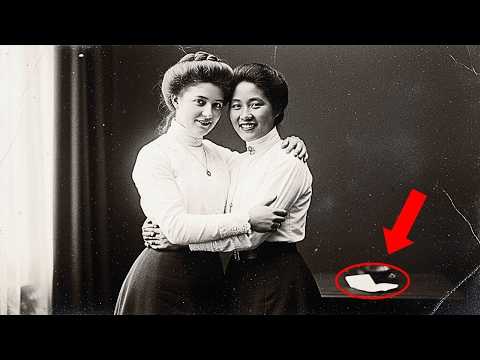
Her pulse quickened. She called Margaret immediately. “I found something in your grandmother’s photograph. Something that was intentionally placed there.” Margaret arrived within the hour, and together they stared at the enhanced image. “What is it?” she asked. “I think it’s a letter. A very small one, folded and sealed into the photograph itself. But I can’t remove it without potentially damaging both the photo and whatever is written on the paper. We need a conservator.”
Margaret’s voice dropped. “My grandmother was Chinese. She came to America as a child in the 1890s, but she never talked about her early life here. She always said it was too painful to remember.” Emily looked at the Chinese woman in the photograph—her joyful expression, her arm around her friend. “I think we’re about to find out why.”
Dr. James Morrison, a paper conservator from the San Francisco Museum of Modern Art, arrived three days later. He examined the photograph under magnification, his expression growing more intrigued. “This is extraordinary,” he said. “The paper was sealed using rice paste—a traditional adhesive. Whoever did this wanted it to stay hidden, but also wanted it to survive.” Over the next two hours, James worked with tools so delicate they seemed surgical. He softened the century-old adhesive and slowly, millimeter by millimeter, separated the tiny folded paper from the photograph.
When it was finally free, he placed it on a clean white surface. The paper was yellowed and fragile, folded into a square no bigger than a postage stamp. Using micro-forceps under magnification, James began to unfold it. Each crease had to be softened carefully to prevent cracking. Margaret gripped Emily’s hand, both women barely breathing.
Finally, the letter lay flat—two inches by three inches, covered in tiny, meticulous script. James projected the image onto a large monitor. The handwriting was elegant despite its microscopic size. It was dated October 15th, 1903, and began, “My dearest Catherine,” Emily looked at Margaret. “Do you know anyone named Catherine in your family history?” Margaret shook her head, transfixed.
They continued reading together, and with each line, the heartbreak became more evident. “By the time you read this, if you ever do, I will be gone. Not dead, but gone from San Francisco, from America, from your life. The new immigration laws mean I must leave. And there is nothing either of us can do to stop it.”
That evening, Emily researched the Chinese Exclusion Act and its amendments. What she learned filled her with anger and sadness. The 1882 law had been the first federal law to explicitly ban immigration based on nationality. It prohibited Chinese laborers from entering the country and prevented Chinese immigrants already here from becoming citizens. In 1902, Congress had extended the act indefinitely. For Chinese women, the situation was even more dire—the Page Act of 1875 had effectively banned them from immigrating based on racist assumptions. Families were systematically separated.
Emily called Margaret the next morning. “I think I understand what happened. The woman in the photo with Catherine—your ancestor—was being deported under the exclusion laws. That’s why the letter talks about her being gone from America.” Margaret was silent for a long moment. “My grandmother’s name was May,” she finally said. “Mei. She was born in San Francisco in 1891, which would have made her about twelve in this photo. But wait—if she was born here, wouldn’t she have been a citizen? Why would she be deported?”
“That’s what we need to find out,” Emily said. She contacted Dr. Lisa Wong, a historian at UC Berkeley who specialized in Chinese American history during the exclusion era. Dr. Wong agreed to meet them the next day. In her office, surrounded by books and historical documents, she examined the photograph and the letter carefully. “This is remarkable,” she said. “Personal correspondence from this period is incredibly rare. Most Chinese immigrants were afraid to keep written records that might be used against them.”
“Can you help us understand what happened to May?” Margaret asked. Dr. Wong spent two hours combing through digitized records from the Angel Island Immigration Station and the San Francisco Immigration Bureau. Finally, she found what she was looking for. “Here. Mei, born in San Francisco 1891, deported October 1903, age 12. Reason for deportation: fraudulent birth certificate.” Margaret gasped. “Fraudulent? What does that mean?”
Dr. Wong’s expression was grim. “It means someone challenged whether May was actually born in San Francisco. Under the exclusion laws, Chinese people born in the US were citizens and couldn’t be deported. But immigration officials often accused Chinese families of creating false birth records. They would bring in witnesses who claimed the birth never happened, or they would find minor inconsistencies in paperwork and use that as justification for deportation.”
“So May might have been a real citizen, but they deported her anyway?” Emily asked. “Almost certainly. This was common practice. Thousands of Chinese Americans, including children born here, were deported on trumped-up charges. It was ethnic cleansing, dressed up as immigration enforcement.” Emily looked at the photograph again—at twelve-year-old May’s bright smile, her arm around her friend Catherine. “She was just a child.”
“Yes,” Dr. Wong said sadly. “And Catherine, whoever she was, tried to preserve their friendship in the only way she could—by hiding this letter in their photograph, creating a time capsule of a bond that the government tried to erase.” Finding information about Catherine proved more challenging than expected. The letter provided few clues—no last name, no family details, only the depth of her affection for May and her anguish at their forced separation.
Emily returned to the photograph itself, examining every detail. The photographer’s mark in the corner, partially obscured by damage, read Morrison Photography Studio, 1903, San Francisco. She searched historical records and found that Morrison Photography Studio had operated on Market Street from 1895 to 1920. The studio’s client ledgers had been donated to the San Francisco History Center, and Emily requested access immediately.
Three days later, she sat in the history center’s reading room, carefully turning pages of faded handwriting, recording every photograph taken in October 1903. On October 10th, she found the entry: “Portrait. Two young ladies. Names: Miss Catherine Morrison and Miss Mei. Paid in full, $2.50.” Katherine Morrison—the photographer’s daughter. Emily felt a surge of excitement. She searched census records and found the Morrison family: Robert Morrison, age 45, photographer; wife Catherine, age 42; daughter Catherine, age 20; son William, age 18.
Catherine would have been May’s age, give or take a few years. They must have grown up together, perhaps meeting through Robert’s photography business, which likely served the diverse communities of San Francisco. Emily found Catherine again in the 1910 census, still living with her parents, now aged 27 and working as a clerk. In 1920, Catherine appeared as Catherine Morrison Reed, married to James Reed, a banker. They had one son, Robert, age four. The trail continued through subsequent decades. Catherine lived a long life, dying in 1978 at age 95. Her obituary in the San Francisco Chronicle described her as a devoted wife, mother, and grandmother who had been active in community service and social justice causes throughout her life.
But there was something else in the obituary that caught Emily’s attention. “Mrs. Reed was a founding member of the Chinese American Citizens Alliance and worked tirelessly for the repeal of discriminatory immigration laws. She maintained correspondence with friends around the world and was known for her remarkable collection of international letters preserved in multiple volumes.” Emily called Margaret immediately. “Catherine spent her life fighting the laws that took May away from her. And the obituary mentions a letter collection. We need to find Catherine’s descendants.”
Margaret was quiet for a moment. “Emily, what if the letters include correspondence with May? What if they stayed in touch?” “That’s exactly what I’m hoping.” Emily searched genealogy databases and found Catherine’s grandson, David Reed, age 73, living in Berkeley. She called him that evening, her heart racing as she explained the discovery.
“I know about the photograph,” David said immediately. “My grandmother kept it on her desk her entire life. When she died, my father found dozens of boxes in her attic, all filled with letters. He donated most of them to UC Berkeley’s archives, but he kept some of the personal ones. They’re in my garage. I’ve been meaning to go through them for years.” “Would you be willing to look for letters from someone named Mei?” Emily asked. “Mei?” David repeated slowly. “That name—yes, I’ve seen it. There are boxes specifically labeled ‘May Canton.’ My grandmother told me once that May was her best friend, that they’d been separated when they were young, but never stopped writing. I never understood what she meant until now.”
David Reed’s garage held seventeen boxes, carefully labeled and preserved, containing hundreds of letters exchanged between Catherine Morrison Reed and Mei from 1904 to 1954. “My grandmother was meticulous,” he explained. “She kept every letter May sent, organized by year.” The earliest, dated January 1904, was written in Chinese and translated by Dr. Wong: “I have arrived in Canton after a voyage of 37 days. Everything here is strange and frightening. I am supposed to be Chinese, but I feel entirely American. Most of all, I miss you.”
Catherine’s reply was equally heartbreaking: “I go to the pier sometimes and imagine I can see across the ocean to where you are. My father says I am foolish to grieve for someone I cannot help. But how can I not grieve when half my heart is gone?” Over the decades, the letters traced two lives lived in parallel—May becoming a teacher in Canton, Catherine marrying and joining the fight for civil rights.
In 1924, Catherine wrote: “I think of you as my sister, not just my friend. Sisters separated by an unjust law, but sisters nonetheless.” May’s final letter, from March 1954, confessed: “You kept me alive in your heart when the government tried to erase me from existence. I will die knowing I was loved.” Catherine died just eight months after May. David believed she died of a broken heart.
The exhibition, Letters Across the Ocean, opened in San Francisco in September 2024. Visitors wept before the restored photograph and the tiny hidden letter. In November, Margaret flew to Hong Kong to meet May’s granddaughter, Susan Chen. “My grandmother spoke about Catherine often,” Susan said. “She made me promise to keep the photograph safe, to remember that she had been American once before they took that away from her.”
Susan brought out a wooden box containing Catherine’s letters, preserved with the same care. She and David then unpacked quilts—two nearly identical quilts sewn from scraps of fabric exchanged across the ocean, mirror images of a friendship that refused to die. “They never got to see each other again,” Margaret said, “but we can honor them by being here together.”
On October 15th, 2025, exactly 122 years after Catherine hid her letter, a ceremony was held at Angel Island. Margaret, Susan, and David spoke before a permanent installation honoring Catherine and May. “May survived because of Catherine,” Margaret said. “Because one person refused to forget her.” As the sun set over the bay, the two families stood together, watching the water that had separated their grandmothers for 51 years.
Catherine and May were gone, but their legacy remained—in letters carefully preserved, in a photograph with a hidden promise, in a story proving that love and loyalty can survive anything, even the cruelest laws, even the widest oceans, even time itself. What hidden story in your own family’s past might be waiting to be found?
Report this article
Select a reason for reporting:






