July 1943. The Russian steppe trembles under the roar of engines and the thunder of artillery. The 2nd SS Panzer Division “Das Reich” is hurled into the cauldron of the Battle of Kursk, the largest armored clash in history. But this is not just another battle for the men of Das Reich—it is a culmination of brutality forged in the blood-soaked fields of Ukraine.
Two years earlier, they had marched into the Soviet Union as part of Operation Barbarossa, leaving behind a trail of destruction and terror. Now, at Kursk, they face the full might of the Red Army. The division’s commander, Walter Krüger, knows the stakes: victory or annihilation. Yet, even as they prepare for the assault, the ghosts of their past atrocities linger—tactics honed on civilians that will soon be unleashed on a French village.
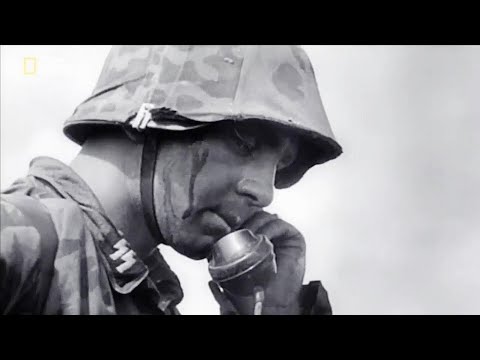
The battle begins with a ferocious Soviet barrage. Tanks explode, men scream, and the earth itself seems to shatter. Das Reich’s panzers, including the formidable Tiger tanks, push forward through minefields and anti-tank guns. “Forward! No retreat!” shouts an officer, his voice barely audible over the chaos. The division’s soldiers, many of them young and indoctrinated, fight with a desperate ferocity, driven by loyalty to the Führer and the belief in their own superiority.
But the Red Army is relentless. Wave after wave of Soviet infantry and T-34 tanks crash against the German lines. Half of Das Reich’s men will fall on the Eastern Front, their bodies swallowed by the vast, unforgiving landscape. The survivors, hardened by years of war, carry the scars of Kursk deep within them.
As the battle rages, the division’s ranks begin to change. By the time of the D-Day landings, Das Reich is no longer solely German. To replenish their depleted numbers, they recruit youngsters from Hungary, Croatia, and Romania—all allies of Germany. Even former Soviet prisoners of war are freed in exchange for signing up, as long as they swear allegiance to the Waffen-SS. Many of these new recruits hail from Alsace, a French region annexed by the Third Reich in 1940. Their loyalty, however, is fragile, and their presence foreshadows the dark deeds to come.
At Kursk, Das Reich fights on, but the tide is turning. The Soviet counteroffensive is relentless, and the division is eventually forced to retreat. The battle that was meant to break the Red Army instead breaks the back of the German war machine. Yet, for Das Reich, the war is far from over. They will be pulled back, refitted, and sent to a new front—one where their brutality will shock the world.
The men of Das Reich do not know it yet, but their path leads to Oradour-sur-Glane, a quiet French village that will become synonymous with their name. The atrocities they committed in the East are about to be repeated on Western soil. But that is a story for another time…
By the spring of 1944, the survivors of Kursk had been pulled back to the south of France to refit and rearm. The quiet of the Dordogne countryside was a world away from the frozen steppe, yet the men of Das Reich carried the East with them. They had learned that terror was a weapon, and they wielded it without hesitation.
In the villages and towns of southern France, the division’s presence was felt immediately. Patrols moved through the streets with cold efficiency, and the locals watched from behind shuttered windows. The Germans were not merely occupiers—they were predators.
Among the new recruits was a young Alsatian named Anton. Conscripted into the Waffen-SS against his will, he spoke French with the same fluency as the villagers he was now ordered to watch. He was a stranger among his own people, wearing the uniform of their enemy. Each night, he lay in his bunk and listened to the older soldiers boast of what they had done in Russia—the villages burned, the prisoners shot, the women and children herded into barns.
One evening, a veteran named Brandt noticed Anton’s silence. “You think this is hard?” he sneered, leaning close. “Wait until the partisans start. Then you’ll see what we do to those who resist.” Anton said nothing, but the words settled into his bones like frost.
The partisans were indeed growing bolder. Ambushes and sabotage had become a daily occurrence, and the German high command demanded reprisals. Orders came down from Berlin: the division was to break the resistance at any cost. The men of Das Reich understood what that meant. They had done it before.
In the town of Tulle, just days before, the division had exacted a terrible revenge for partisan attacks. Ninety-nine men were hanged from lampposts and balconies, their bodies left swinging as a warning. The news spread quickly through the region, and fear followed in its wake.
But Tulle was only the beginning. The division’s commander, Heinz Lammerding, had a more sweeping lesson in mind. A message had reached him of a German officer captured by the Resistance near a village called Oradour-sur-Glane. The name meant nothing to him—just another dot on the map of a hostile land.
On the morning of 10 June 1944, the men of Das Reich received their orders. They were to move on Oradour-sur-Glane, surround it, and search for the missing officer. What happened next would be written in fire and blood, a crime that would echo through the decades.
Anton stood among the ranks as the trucks rumbled to life. He did not know what awaited them in the village ahead. But as the convoy wound through the sunlit fields, he felt a cold certainty settle over him—the East had followed them here, and it would not be satisfied until the lesson was taught again.
The convoy reached the outskirts of Oradour-sur-Glane shortly before two in the afternoon. The village lay peaceful under the summer sun, its stone houses and gardens giving no sign that anything was amiss. Children played in the square, and women hung laundry on the lines. It was a scene so ordinary that some of the younger soldiers shifted uneasily in their seats.
Anton watched from the back of the truck as the first squads dismounted and spread out. They moved with practiced efficiency, sealing off the roads and cutting the telephone wires. No one in the village yet understood what was happening. A few curious faces appeared at windows, then disappeared behind curtains as the gray uniforms multiplied.
Major Dickmann, a veteran of the Eastern Front with a face like carved stone, gathered the officers. “The town is to be searched. All inhabitants are to be assembled in the square for identity checks,” he ordered. His voice was flat, businesslike. “No one leaves. No one hides.” The words were simple, but every man who had served in Russia knew what they meant.
The soldiers began to sweep through the streets, knocking on doors and ordering families into the open. “Raus! Schnell!” The villagers complied, confused but compliant, clutching children and belongings. They were herded toward the fairground and the church, their faces pale with uncertainty.
Anton was assigned to a squad clearing the northern quarter. He kicked open a door and found an old man sitting at a table, a half-finished meal before him. The man looked up, not with fear, but with a weary resignation. “Vous êtes Français?” he asked quietly, noticing Anton’s accent. Anton said nothing. He gestured with his rifle toward the door.
In the square, the crowd had grown to several hundred. Women, children, and the elderly stood in tight clusters, murmuring to one another. The men had been separated and were being led toward the barns and garages. A young mother clutched her infant and asked a soldier what was happening. He shrugged and looked away.
Then came the order that would damn them all. Dickmann stood before the assembled women and children and announced, in broken French, that explosives had been found in the village and that the population would be held as hostages until the culprits were identified. It was a lie, and everyone knew it.
The women and children were pushed toward the church. The heavy doors creaked open, and the crowd was forced inside. Anton watched as the youngest children clung to their mothers’ skirts, their small faces bewildered. The doors swung shut behind them, and the soldiers took up positions outside.
In the barns, the men of Oradour were waiting. They did not yet know what was coming, but the silence of the soldiers, the coldness in their eyes, told them enough. Some began to pray. Others tried to break through the walls with their bare hands. It was too late.
The first shots rang out from the church. The sound was muffled, then sharp, then constant—a roar that seemed to shake the very stones of the village. From inside the church came screams, then smoke, then silence. The soldiers had thrown grenades into the nave and set fire to the building.
In the barns, the men heard the screams and knew their turn had come. Machine guns opened up in a deafening rhythm, cutting down the rows of prisoners where they stood. Anton stood frozen at the edge of the carnage, his rifle shaking in his hands. He had not fired. He could not.
When the guns fell silent, the soldiers moved among the bodies, finishing the wounded with pistol shots. Brandt walked past Anton and spat on the ground. “You’ll learn,” he said. “Or you’ll die.” The village was set ablaze, house by house, until the smoke blotted out the sun.
By nightfall, Oradour-sur-Glane was gone. Six hundred and forty-two men, women, and children lay dead. The men of Das Reich climbed back into their trucks and drove away, leaving behind only ash and silence. Anton sat in the corner of the truck, his uniform stained with soot, and stared at nothing.
In the weeks that followed, the division was ground down in the hedgerows of Normandy, its ranks shattered by Allied fire. Some of the killers of Oradour died in those same fields, their crimes buried with them. Others escaped, slipping back to Germany or vanishing into the chaos of defeat. Anton survived the war, but he never spoke of that day—not to his family, not to anyone.
He lived out his years in a quiet Alsatian town, and every June he would walk to the edge of the forest and stand alone among the trees. He carried Oradour inside him, a wound that never healed. The world moved on, but the ghosts of that village did not.
Decades later, the ruins of Oradour-sur-Glane still stand, preserved as a memorial. Visitors walk through the empty streets and read the names of the dead. And they ask the same question that has haunted history: how could ordinary men do such a thing?
What do you think—was Anton a victim, a coward, or a man who simply chose to survive? Share your thoughts below.
Report this article
Select a reason for reporting:






