She was a Russian nurse with auburn braids and porcelain skin, tending to the wounded in the muddy trenches of Manchuria. He was a Siamese prince, a son of the King of Siam, studying in the glittering salons of St. Petersburg. Their worlds were never meant to collide. But when they met in a crowded salon in 1906, something shifted—something that would defy empires and break hearts.
Ekaterina Desnitskaya was not born to be a princess. She was born in Lutsk in 1886, daughter of a state councilor. By eighteen, she was an orphan, studying nursing in St. Petersburg. When the Russo-Japanese War broke out, she volunteered, bandaging wounds and assisting surgeons under fire. She returned with the St. George Cross—and a courage that would define her life.
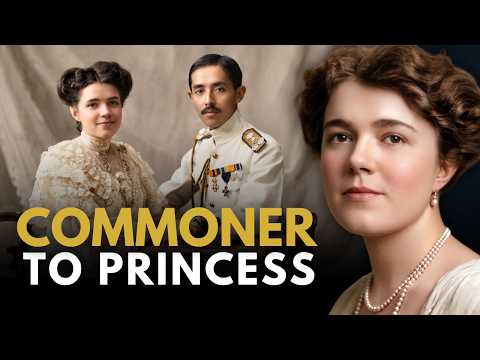
Prince Chakrabongse was different from anyone she had ever met. He was intelligent, polite, and utterly alone in a cold city. He had mastered Russian, earned the rank of colonel, and wore the Order of St. Andrew. But it was his loneliness that drew her in. He proposed, and she accepted—despite his warning that Siamese law allowed multiple wives. He swore he would never see another woman in that role.
Their wedding was a secret. In Constantinople, far from the eyes of the Russian Tsar and the Siamese King, the prince converted to Orthodox Christianity. For her. They honeymooned in Cairo, then sailed to Singapore. He left her there, under the care of his servants, while he returned to Bangkok alone to prepare the way.
For months, Katya waited in a foreign land. When she finally arrived in Bangkok, she was not welcomed. The King refused to acknowledge her. She was not allowed into the palace. The young couple was given a separate residence—Paruskavan Palace, a gilded cage. A young woman of twenty, in a strange country, with a strange language and a strange culture. The sky was orange-green during the monsoon. The food was unfamiliar. The servants spoke a language she did not understand. The court looked down on her.
But Katya did not break. She learned Thai with fierce determination. She studied court protocol. She designed the palace interior. She planted a garden despite the heat and lack of fresh water. She treated the servants when they fell ill, and they began to love her—not for her position, but for her humanity. In her letters to her brother Ivan, she wrote only of the beauty of the tropics, the character of her husband, and the newness of everything. Never a word of bitterness.
On March 28, 1908, a son was born: Prince Chula. The boy had his father’s dark eyes and his mother’s white skin. By a strange coincidence, he was born on the same day of the week and almost the same hour as his father and his uncle, the future King. The family considered it a sign. Before his death in 1910, King Rama V finally came to see his grandson. The boy looked at him without fear and smiled. The King’s heart softened, and he granted Chula the title of Prince of the Blood.
When the King died, his son took the throne and officially recognized his brother’s marriage. Katya Desnitskaya became Chula Chakrabongse—a full princess of the Siamese royal family. She had achieved the impossible, alone, without allies. She spoke fluent Thai, knew every detail of court etiquette, and had become an integral part of the family. She had won their respect.
For seven years, they were happy. They built a white house on the shores of the Gulf of Siam, a house that looked like a ship anchored on white sand. There, in that quiet isolation, they found a warmth that the palace had never offered. Those were the years Katya would later remember as the only ones that were truly theirs.
But happiness is fragile, and the world was changing. While Katya was traveling in China, Prince Chakrabongse grew close to a young Thai princess named Chavalit. She moved into his house. Siamese law permitted it—he had told Katya this long ago, in St. Petersburg, when it had seemed only an abstract idea. Now it was real.
Katya could not accept it. She had given this man and this country everything. She had left her homeland, learned the language, endured isolation, won over the court, raised his son. She had been present, always. And now, this. The prince did not understand that his relationship with Chavalit would leave him without Katya. He was accustomed to Siamese customs. He did not think it was a betrayal. But she did.
She asked for a divorce. She got it, along with a suitable settlement. In 1919, Katya left Bangkok, determined never to return. But she was forced to come back a year later. On May 11, 1920, Prince Chakrabongse died suddenly. He was thirty-seven. Too young. Unexpected. Katya attended the funeral. She mourned him in her own way. She buried him herself. She visited his grave in the Royal Pantheon in Bangkok every day. Then, she left again. Forever.
Her husband’s relatives did everything in their power to keep her away from her son. Chula was raised in the royal court, surrounded by uncles and aunts. Katya had no place there, so she chose dignity and departed. The storms of the twentieth century carried her around the world, from Bangkok to Shanghai. Her brother Ivan, now a respected literary scholar, was living there. She found him and stayed nearby for a while. There, she met an American engineer named Harry Clinton Stone, whom she later married.
They moved first to the United States, then to Paris, to the outskirts of the French capital. There, Katya lived out the remainder of her turbulent life. On January 3, 1960, Ekaterina Desnitskaya died in Paris at the age of seventy-three.
Prince Chula, who lost both his parents, was placed under the guardianship of his uncle, the King. He was sent to study in Great Britain, attending Harrow School and then Trinity College, Cambridge. He became a passionate racing driver, traveled throughout Europe, and wrote a series of books on racing with his cousin Prince Birabongse. He married an Englishwoman named Elizabeth Hunter and settled in England. They had a daughter named Narisa, Katya’s granddaughter.
Narisa grew up and co-wrote a book with her mother titled Katya and the Prince of Siam. Published in several languages, it became the primary source for this story. Chula maintained contact with his mother, though he could never fully forgive her for leaving the palace so abruptly. He outlived Katya by only three years, dying of cancer in 1963.
Katya entered the official history of the Siamese royal family of the Chakri dynasty forever, as Her Highness Catherine, wife of Crown Prince Chakrabongse and mother of Prince Chula. Paruskavan Palace, where she lived during her years of isolation, is open to tourists today. In the living room, her photographs are displayed, an integral part of the history of an entire era.
Katya’s story is a quiet whisper in the shadowed gardens of Paruskavan, an echo of an age when two cultures and two worlds collided. She was like a delicate lotus with a heart of ice: fragile on the outside, yet able to withstand any storm. She gave up luxury for silence and her dignity, writing her unique page in history.
But the story does not end there. For Narisa, growing up in England, the grandmother she never knew was a mystery. Her mother Elizabeth would speak of Katya only in fragments—a Russian lullaby, a recipe for borscht, a photograph of a woman with auburn hair and eyes like winter. Narisa began to dig, to trace the steps of the woman who had crossed empires for love and then walked away from it all.
She traveled to Bangkok, to the Paruskavan Palace, now a museum. She stood in the room where her grandmother had planted a garden in the tropical heat. She read the letters Katya had written to her brother Ivan, stored in a Moscow archive. And she found something unexpected: a diary, hidden in a box of old photographs, written in Russian, that had never been translated.
The diary revealed a side of Katya that the official history had forgotten. It spoke of her loneliness in those first months at Paruskavan, of the nights she cried into her pillow, of the way she learned Thai by tracing the letters in the sand of her garden. It spoke of her love for Chakrabongse—not as a prince, but as a man who laughed at her jokes and held her hand under the monsoon rain.
And it spoke of the betrayal that broke her. Not the arrival of Chavalit, but something deeper: the moment she realized that Chakrabongse had never truly understood her sacrifice. He had thought she would accept his second wife as Siamese women did. He had not known that for her, love was not a matter of custom but of choice.
Narisa closed the diary and wept. She had never known her grandmother, but she felt her presence in that room, in the scent of jasmine that drifted through the window, in the silence that followed the last page. She decided then to finish what Katya had started: to tell the whole story, without shame, without bitterness.
Narisa spent the next three years translating the diary, cross-referencing it with court records and family letters. She discovered that Katya had written one final entry, dated the day before she left Bangkok for the last time. It was not angry. It was not bitter. It was a prayer—for her son, for the man she had loved, for the country that had never fully accepted her.
“I do not regret a single step,” Katya had written. “Not the trenches, not the cold, not the golden cage. I regret only that love was not enough to bridge the distance between two worlds. But perhaps that is not a failure. Perhaps it is simply the truth.”
Narisa published the diary alongside her mother’s book, and the world finally saw Katya as she truly was—not a tragic figure, not a victim, but a woman who chose her own path and walked it with her head held high. The book became a bestseller in Thailand, and for the first time, the royal family publicly acknowledged her contribution to their history.
In 2008, on the centenary of Prince Chula’s birth, a ceremony was held at Paruskavan Palace. Narisa stood in the garden her grandmother had planted, now overgrown with tropical flowers, and read a passage from the diary aloud. Among the guests was a distant cousin of the Siamese royal family, who wept openly. “She was more Siamese than any of us,” he said afterward. “She just didn’t know it.”
The diary now rests in the palace museum, in a glass case beside Katya’s photographs. Visitors pause there, reading the translation printed on the wall, and many leave with tears in their eyes. For here is a truth that transcends borders and centuries: love is never wasted, even when it ends in heartbreak.
Katya’s story is no longer a whisper. It is a voice—clear and strong—reminding us that courage is not the absence of fear, but the refusal to let fear define us. She crossed empires for love, and when love failed, she crossed them again for dignity.
What would you have done, in her place—stayed in the golden cage, or walked away with nothing but your name?
Report this article
Select a reason for reporting:






