Imagine being the son of a king, growing up inside a fortress surrounded by gold-tipped cannons and mechanical tigers that roar when you wind them up. Your father controls one of the wealthiest kingdoms in all of India, commands an army with weapons so advanced that European generals write home about them in fear, and answers to no one. Then, one night, a cannonball tears through the walls of your city, and by dawn, your father is dead, face down in a pile of bodies, his jeweled sword belt already stripped off by a British soldier. You’re a child, maybe eight, maybe twelve. A red-coated officer stands above you and tells you your kingdom no longer exists.
This is not fiction. This is what happened to the sons of Tipu Sultan, the Tiger of Mysore, on the 4th of May, 1799. It was the day the British East India Company finally destroyed the last serious obstacle to their total domination of Southern India. But the story of what happened next—what became of those children, those princes born into absolute power—is a story that almost nobody talks about. And it is one of the most haunting downfalls of any royal family in modern history.
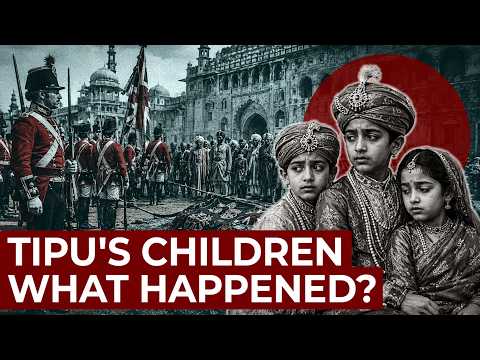
Because the children of the Tiger of Mysore didn’t just lose a throne. They lost everything. Their home, their dignity, their names. And within just a few generations, their descendants—the bloodline of one of the most powerful rulers the Indian subcontinent had ever known—would be found pulling rickshaws through the streets of Calcutta.
So, let’s go back. Let’s go to the beginning, because to understand what happened to the children, you first have to understand the father.
Tipu Sultan was born on the 1st of December, 1751, in the hill fort of Devanahalli, just north of what is now Bangalore. His father was Hyder Ali, one of the most remarkable self-made military leaders in Indian history. Hyder Ali wasn’t born into royalty. He was the son of a minor military officer in the service of the Wodeyar dynasty, the traditional rulers of the kingdom of Mysore. But Hyder Ali had something that most men of his station didn’t: a mind for strategy, an instinct for power, and an absolute refusal to accept his position in the world as permanent.
By the 1750s, Hyder Ali had risen through the ranks of the Mysore army. He studied French military tactics, hired European officers to train his soldiers, and introduced flintlock muskets, drilled infantry, and modern artillery into a fighting force that had, up until that point, relied heavily on traditional cavalry charges. And then, in 1761, Hyder Ali effectively seized control of the kingdom of Mysore. The Wodeyar king remained on the throne in name, a puppet shown to the public once a year, but it was Hyder Ali who ran everything. He became the de facto ruler, and he turned Mysore into one of the most formidable military states in all of South Asia.
Hyder Ali fought the British in the First Anglo-Mysore War. He didn’t just hold his ground—he humiliated them. He marched his army to the gates of Madras and forced the East India Company to sign a peace treaty on his terms. It was a shocking defeat for the British, and it sent a message across the subcontinent: Mysore was not to be trifled with.
But Hyder Ali died in 1782 during the Second Anglo-Mysore War, leaving behind a kingdom at war and a 28-year-old son who would have to carry the fight forward. That son was Tipu Sultan.
Now, Tipu wasn’t just inheriting a throne—he was inheriting a war. And he didn’t flinch. He had grown up on the battlefield. By the age of 15, he was commanding cavalry units alongside his father. By his 20s, he had distinguished himself in multiple engagements against the British and their allies. He was fluent in multiple languages, including Arabic, Persian, Kannada, and Urdu. He was deeply religious, intensely private, and absolutely consumed by a single idea: that the British East India Company had to be expelled from India.
Tipu modernized Mysore’s economy. He introduced new coinage, a new calendar, new systems of land revenue. He invested in infrastructure, planted trees, built roads, and expanded trade with the Middle East, China, and the Ottoman Empire. And most critically, he expanded and perfected a weapon that would literally change the course of military history: the Mysorean rocket.
These were iron-cased rockets, far more advanced than anything the British had seen before. They had a range of nearly 2 kilometers and could be fired in devastating volleys. Years later, after seeing these weapons in action, the British would reverse engineer them, and those British versions of Tipu’s rockets would eventually become the ancestors of modern rocket artillery. So, when people call Tipu Sultan the pioneer of rocket warfare, they’re not being dramatic. They’re being accurate.
Tipu also understood something that many of his contemporaries did not: the importance of alliances. He reached out to the French, to the Ottoman Empire, to the rulers of Afghanistan, building a network of diplomatic relationships designed to counter British expansion. He was not simply a warrior. He was a strategist, a statesman, and in many ways a visionary. The economy of Mysore reached its zenith during his reign. Silk production flourished, trade routes expanded, and his administration was remarkably centralized and efficient for its time. Even British officers who fought against him acknowledged his capabilities. Sir Walter Scott, the celebrated Scottish novelist, hailed Tipu Sultan as a legendary warrior. He was feared, respected, and by many of his subjects, genuinely loved.
But despite all of this, Tipu Sultan was fighting a losing war. The British had the numbers, the alliances, and the relentless institutional machinery of the East India Company behind them. The Third Anglo-Mysore War ended badly for Tipu. In 1792, after the siege of Seringapatam, he was forced to sign the Treaty of Seringapatam. The terms were devastating. He had to cede half of his kingdom. He had to pay an enormous indemnity. And in a move designed to humiliate him personally, the British demanded that he surrender two of his sons as hostages.
These were boys. One was about 8 years old, the other about 10. Their names were Muiz-ud-din and Abdul Khaliq. They were taken from their father and handed over to Lord Cornwallis, the Governor-General of India, as living collateral to ensure Tipu complied with the treaty. Accounts from the time describe the scene with almost cinematic detail. The two princes were brought to the British camp with an escort of 200 sepoys and a party of horsemen. Cornwallis personally reassured the boys that they would be well cared for. Major Alexander Dirom, an eyewitness, noted that the eldest boy was dark in complexion with a long, thoughtful countenance and carried himself with great ease. The younger prince was described as remarkably fair with large, full eyes and a more animated appearance.
These boys lived in British custody at Fort Madras, where they attended concerts, plays, and dances. They were treated respectfully, almost like curiosities, paraded through British social life as symbols of a conquered enemy’s compliance. In 1794, after Tipu had fulfilled the terms of the treaty, the princes were returned. They had a few years of peace, but Tipu never forgot the humiliation. He never stopped planning, never stopped seeking alliances, never stopped preparing for the inevitable final confrontation with the British.
He sent secret emissaries to Napoleon, to the Ottoman Sultan, to the governor of Mauritius, asking for military support against the British. Some of these letters were intercepted. And they gave the British exactly the pretext they needed. In 1799, Governor-General Lord Wellesley launched the Fourth Anglo-Mysore War. He assembled a massive force: over 50,000 soldiers, including 22,000 East India Company sepoys, 4,000 European troops, and 16,000 horsemen supplied by the Nizam of Hyderabad, who had been brought into the British fold as an ally.
Leading the storming column was Major General David Baird, a man who had a deeply personal grudge against Tipu. Twenty years earlier, Baird had been captured and held prisoner by Tipu’s father, Hyder Ali, for 44 months in the dungeons of Seringapatam. He had spent those years chained to another prisoner in a dank cell. He never forgot it.
The siege of Seringapatam began on the 5th of April, 1799. Tipu’s capital was an island fortress surrounded by the river Kaveri. The British knew they had to strike before the monsoon season raised the river levels and made the fortress impregnable. For weeks, they bombarded the walls. Tipu’s forces fought back with everything they had, including those famous Mysorean rockets, which terrified the British soldiers. But it wasn’t enough.
Tipu had been betrayed. Mir Sadiq, one of his most trusted ministers, had been secretly collaborating with the British. At the critical moment, Mir Sadiq withdrew his troops from key defensive positions, opening gaps in the fortress walls. On the 4th of May, the British launched their final assault. The storming party, led by Baird, clambered over the breach in the walls. The fighting was ferocious. Between 6,000 and 10,000 of Tipu’s soldiers and civilians were killed, and somewhere in the chaos, on a narrow gateway near the northern wall, Tipu Sultan himself fell.
There are different accounts of exactly how he died, but the most widely accepted version is that he was shot multiple times while fighting on foot, sword in hand, refusing to surrender. His body was found hours later buried under a pile of the dead and the dying. His eyes were still open. His jeweled sword belt had already been taken. The Tiger of Mysore was dead, and his children—12 sons and several daughters—were now prisoners of the British East India Company.
The aftermath was swift and calculated. Lord Wellesley had no intention of allowing Tipu’s heirs to become symbols of resistance. The kingdom of Mysore was officially restored to the Wodeyar dynasty, the old Hindu ruling family that Hyder Ali had sidelined decades earlier. A five-year-old Wodeyar prince was placed on the throne, a puppet king under British supervision. Tipu’s family would have no part in the new arrangement. They were a problem to be removed quietly and permanently.
Within weeks of the fall of Seringapatam, the British began relocating Tipu’s family. The four eldest sons—Fateh Hyder, Abdul Khaliq, Muiz-ud-Din, and Mohi-ud-Din—along with their mothers, wives, and an enormous entourage of servants, retainers, and extended family members, were transported roughly 200 miles east to Vellore Fort in the Carnatic region. This wasn’t a gesture of hospitality; it was a deliberate act of isolation. The British wanted Tipu’s heirs far away from Mysore, far from anyone who might rally around them, far from any memory of their father’s kingdom.
At Vellore, the family was housed in a palace complex within the fort. Each prince received an annual pension—Fateh Haidar, the eldest, got 50,000 rupees a year. Lord Valentia observed that Fateh Haidar conducted himself with the utmost propriety, despite being declared illegitimate. But beneath this surface of pensions and propriety, something else was brewing.
The princes were not broken. They were angry. For seven years they lived in a gilded cage, monitored and scrutinized. Then, in 1806, the British introduced dress regulations that ordered Indian sepoys to shave their beards and abandon religious markings. It was a direct assault on identity and faith.
Tipu’s sons saw an opportunity. They didn’t create the anger—they weaponized it. Using a family wedding as cover, they gathered conspirators at Vellore Fort. Just after midnight on July 10, 1806, the Vellore Mutiny erupted. Sepoys turned on their British officers, killing over 100. They tore down the British flag and raised the flag of the Mysore Sultanate, proclaiming Fateh Haider as their king.
For a few hours, it looked like the sons of the Tiger had done the impossible. But it didn’t last. Major Coote escaped and alerted the garrison at Arcot. Sir Rollo Gillespie’s relief force stormed the fort, and the massacre that followed was brutal. Hundreds of sepoys were killed, some blown apart by cannon fire at close range. The mutiny was crushed in less than a day.
The fallout was enormous. Lord Bentinck was recalled to England in disgrace, and the dress regulations were quietly withdrawn. But for Tipu’s sons, the British now viewed them as a genuine threat. The decision was made to remove them from southern India entirely.
In 1806, the entire family—nearly 300 people—was put aboard ships and transported to Calcutta, over 1,000 miles away. The logic was brutally simple: surround them with the machinery of British power, far from anyone who remembered their father. One prince, Abdul Khaliq, reportedly died at the Sandheads before reaching Calcutta. The cause was never clearly explained. Some historians have described it as convenient.
The surviving family arrived in a city still under construction. They were eventually moved to three smaller houses in Tolly Gunge, on the malarial southern fringes. Fifty-two people were settled there, given pensions carefully calculated to keep them dependent. Every aspect of their lives was monitored. Their letters were read. Their visitors were logged. They had to seek explicit permission for things as mundane as riding a horse within their own estate.
These were not exiles living in genteel retirement. These were prisoners, watched every single day.
And then they started dying. One by one. The climate of Bengal was vastly different from Mysore—the heat oppressive, the humidity crushing, the mosquitoes carrying diseases the family had never been exposed to. The psychological toll was just as severe. Many princes sank into inactivity and what contemporaries politely called “a surfeit of good living.”
In the space of about 30 years, 11 of Tipu Sultan’s 12 sons died. Think about that. Twelve sons. Eleven dead within three decades.
The youngest, Ghulam Ahmad, was barely a year old when his father was killed. He grew up entirely in exile, never knowing his homeland, and died at 27 or 28—a colonial subject dependent on a pension from the very empire that had destroyed his family. Fateh Haidar died in 1815, with a special police force stationed at his house, watching him until his final breath.
By 1842, only three of the twelve sons were still alive. By 1851, there was just one: Ghulam Muhammad Sultan Sahib.
Ghulam Muhammad was four years old when his father was killed. But unlike many of his brothers, he adapted. He learned to navigate the British bureaucracy, convinced the authorities to continue the family stipend, and began investing in the community. He constructed the Tipu Sultan Shahi Mosque in 1832—it still stands today as one of Kolkata’s most prominent mosques. He also built a large estate in Tollygunge, an estate that would eventually become the grounds of the Tollygunge Club and the Royal Calcutta Golf Club—two of the most elite institutions of British colonial society.
The very land Tipu Sultan’s son developed with his pension money became a playground for the people whose empire had destroyed his family.
Ghulam Muhammad died on August 11, 1872. He was the last surviving son of the Tiger of Mysore. With his death, the direct line of Tipu’s sons was extinguished. But the bloodline continued through their children and grandchildren—and this is where the story takes its most devastating turn.
As the generations passed, the pensions shrank. The British were meticulous about this. Each successive generation received less. The family continued to grow, but the resources available to sustain them did not. Land was gradually lost, sold off, or simply taken. The trust established to manage the remaining estates became, according to numerous reports, a source of mismanagement and exploitation rather than support.
By the 20th century, the descendants of Tipu Sultan in Kolkata had largely fallen into poverty. By the 21st century, many were destitute.
Reports from the last two decades paint a picture almost impossible to reconcile with the family’s origins. Descendants of the Tiger of Mysore working as rickshaw pullers, hauling passengers through the streets of Kolkata for $1 to $1.25 a day. Others working as tailors, electricians, cycle repairmen, domestic servants. Men named Shahzada—meaning prince. Men named Sultan. Men named Nawab. These are not honorary titles. These are actual names passed down through generations, the last linguistic remnants of a royal identity stripped of every other marker.
One descendant, Anwar Ali Shah, a seventh-generation member of the family, told journalists he earned an average of $1 to $1.25 per day pulling a worn-out cycle rickshaw. He rides through Prince Anwar Shah Road, a major thoroughfare in Kolkata literally named after his great-grandfather. He passes through it every day, earning barely enough to feed his two children, riding on a road that bears his family’s name but offers him nothing.
His brothers live in a dilapidated structure on the same narrow street. One runs a small eatery, another pulls a rickshaw, another does upholstery work. Together, they represent the direct biological legacy of one of the most powerful rulers in Indian history. And they are, by any measurable standard, among the poorest people in the city.
The total number of direct descendants of Tipu Sultan living in Kolkata is now estimated at around 45. Many others left over the decades, scattered across India and Bangladesh. The community that once numbered nearly 3,000 has dwindled to a handful of families clinging to a name and a memory the modern world has largely forgotten.
There have been attempts at rehabilitation. Various state governments in Karnataka have proposed initiatives to support the descendants, to recognize their heritage, to restore some measure of dignity. Some have been recognized as belonging to a royal lineage, but the concrete results have been minimal. The estates that were once in the family’s name—including the grounds of the Tollygunge Club and the Royal Calcutta Golf Club—are worth, by some estimates, hundreds of millions of dollars. But they are controlled by the trust, not by the family. The descendants see none of it.
And every year, on the 20th of November, the descendants of Tipu Sultan gather in Kolkata to celebrate his birthday. They dress in their best clothes, visit the mosques Ghulam Muhammad built, and speak of their ancestor with enormous pride. Then they go back to their crumbling homes and their difficult lives.
It is, in a very real sense, one of the most extreme cases of downward social mobility in recorded history. A family that ruled an empire that challenged the greatest colonial power on Earth, that pioneered military technology, that built palaces and minted coins, reduced within seven or eight generations to pulling rickshaws and repairing bicycles.
But the story doesn’t end in despair. Because there is one remarkable thread in this family’s history that redeems the narrative in the most unexpected way.
Noor Inayat Khan. Born in Moscow in 1914 to an Indian Sufi saint father and an American mother, Noor was a descendant of Tipu Sultan’s extended family. Her father traced his lineage back to the Tiger of Mysore. Noor grew up in Paris, studied child psychology, and became a musician and writer. She translated the Jataka tales of the Buddha into English. She was, by all appearances, a quiet, sensitive, artistic young woman with no obvious connection to warfare and espionage.
And then the Second World War began.
When France fell to Nazi Germany, Noor and her family escaped to England. Despite being a pacifist by temperament, she enlisted in the Women’s Auxiliary Air Force. She trained as a wireless radio operator, and her fluency in French caught the attention of the Special Operations Executive—Britain’s secret wartime organization dedicated to espionage and resistance behind enemy lines.
On February 8, 1943, Noor Inayat Khan was recruited into the SOE. She became the first female radio operator infiltrated into Nazi-occupied France, landing in June 1943. Her trainers had doubts about her toughness, but her skill with wireless equipment and her language abilities were too valuable to pass up.
In France, Noor operated under enormous danger. The Gestapo hunted SOE agents relentlessly, and the average life expectancy of a wireless operator in occupied territory was measured in weeks. But Noor transmitted crucial intelligence back to London. When her network was compromised and her colleagues captured, she was offered extraction back to England.
She refused. She was the last SOE radio operator still functioning in Paris, and she knew that if she left, there would be no link between the French Resistance and London.
She stayed. And she was eventually betrayed. Captured by the Gestapo, she was imprisoned, tortured, and classified as especially dangerous because of her refusal to cooperate. She was transported to Dachau concentration camp. On September 13, 1944, at the age of 30, Noor Inayat Khan was executed. According to some accounts, her final word was “Liberté.”
The great-great-great-granddaughter of Tipu Sultan—the man who fought the British Empire with rockets and tigers—died fighting the Nazis as a British spy. The irony is staggering. The descendant of a king destroyed by the British gave her life fighting for Britain against fascism.
After the war, Noor was posthumously awarded the George Cross by Britain and the Croix de Guerre by France. In 2012, Princess Anne unveiled a memorial bust of Noor in London. In 2020, she became the first Indian-origin woman honored with a blue plaque at her former London home. And in 2025, the French postal service issued a commemorative stamp in her honor as one of the figures of the French Resistance.
From rickshaw pullers in Kolkata to a war heroine memorialized on a French postage stamp, the legacy of Tipu Sultan’s bloodline contains both the lowest depths and the highest peaks of human experience.
So what do we make of all this? The British did not simply defeat Tipu Sultan. They dismantled his legacy with surgical precision. They killed the king, exiled the heirs, separated the family from their homeland, their identity, and their wealth. They monitored them. They diminished them. They let time and poverty do the rest.
It was a template the British would use again and again across their empire. You don’t just conquer people—you erase the symbols around which they might unite. You take the sons of kings and turn them into pensioners. You take the pensioners and turn them into paupers. And eventually, the memory itself fades.
But memories are stubborn things. Tipu Sultan is still remembered as the Tiger. His mechanical tiger sits in the Victoria and Albert Museum in London, still a symbol of Indian resistance to colonial power. His rockets changed warfare forever. His fort at Seringapatam is a pilgrimage site. And in Kolkata, the descendants who bear his name still gather every year, still tell the story, still refuse to forget.
There is something profoundly important about that refusal. Because the story of Tipu Sultan’s children is not just a story about defeat. It is a story about what empires do to the families they conquer. It is a story about how power is transferred, how wealth is extracted, how identities are eroded across generations. And it is a reminder that the consequences of colonialism don’t end when the flags come down. They echo through centuries, through bloodlines, through the names on the streets that the descendants of kings can no longer afford to live on.
Consider the scale of this collapse. In 1799, the kingdom of Mysore had a GDP estimated to be among the highest in the Indian subcontinent. Tipu Sultan commanded tens of thousands of soldiers. He minted gold coins stamped with his own insignia. He maintained diplomatic relations with some of the most powerful nations on Earth. Two hundred and twenty-seven years later, his direct descendants earn the equivalent of a few dollars a day. They live in buildings that are falling apart. They have no political power. They have no economic leverage. They have nothing but a name—a name that the streets of Kolkata still bear, but that the city itself seems to have forgotten.
The Tiger of Mysore has been dead for more than 200 years, but his cubs are still here, and their story is far from over.
If you found this story as powerful as I did, please consider subscribing to the channel. It means the world, and it helps us continue telling the stories that history has tried to bury. I’ll see you in the next one.
But before you go—what do you think? Should the descendants of Tipu Sultan receive compensation from the estates that were built with their family’s pension money? Or is the past simply the past? Let us know in the comments below.
Report this article
Select a reason for reporting:






