Dr. Michael Torres had digitized thousands of historical photographs during his fifteen years at the Library of Congress, but few stopped him cold like this one. The 1854 daguerreotype showed five Black children playing in the dirt yard of an Ashford plantation in Georgia. Their faces were blurred, their bodies frozen by the long exposure time required for early photography. The image came with documentation claiming it showed the contentment and happiness of our negro children who spend their days in carefree play. It was textbook pro-slavery propaganda from the 1850s, designed to counter abolitionist criticism by depicting enslaved people—especially children—as happy and well-treated.
Michael had seen hundreds of such photographs. They always unsettled him, knowing the lies they told, the reality they concealed. But something about this one felt different—perhaps the children’s expressions, or how their bodies were positioned, or the strange quality of the ground beneath them.
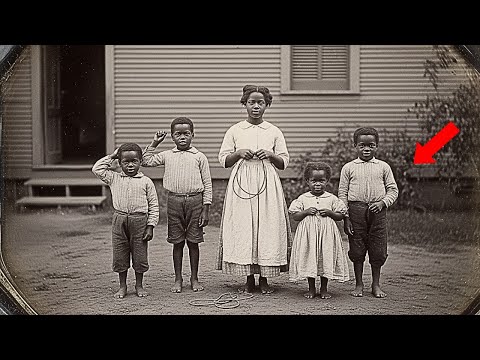
He loaded the high-resolution scan into imaging software for archival documentation. Standard procedure required examining every inch for damage or details needing preservation. He started with faces, ages ranging from five to ten, then clothing, the simple cotton garments typical of enslaved children. Then he focused on the ground—bare dirt packed hard by foot traffic, with struggling grass patches in Georgia red clay.
As Michael increased magnification on the area around the children’s hands and feet, his breath caught. Objects littered the dirt, partially buried, half obscured by shadow in 1854 photography limitations, but unmistakably present. Small metal bands, chain links, carved wooden shapes—crude toys perhaps, or something darker.
Michael leaned back, heart racing. He zoomed further, adjusting contrast and brightness, using digital enhancement to reveal details invisible to the naked eye in the original photograph. The metal bands were shackles—child-sized shackles, small enough for thin wrists and ankles. The chains—the children were literally playing with chains, using them like jump ropes, draped across arms like bracelets. The wooden objects were toys carved from something horrible: punishment posts, broken tools, the very materials of their enslavement.
Michael grabbed his phone with trembling hands. Dr. Jennifer Washington, director of the American Memory Project, needed to see this immediately. This wasn’t just propaganda. This documented something far more disturbing.
Jennifer Washington arrived within twenty minutes, bringing Dr. Raymond Foster, a historian specializing in childhood slavery. They crowded around Michael’s monitor, examining the enhanced images he’d prepared.
“I’ve magnified each visible object,” Michael explained, displaying close-ups. “At least a dozen items within three feet of the children. All appear to be restraint instruments, or objects repurposed from plantation punishment equipment.”
Raymond leaned closer, his expression darkening. “That’s a wrist shackle,” he said, pointing to a small iron band near the leftmost child’s foot. “Look at the size. Designed for maybe a six- or seven-year-old.”
Jennifer examined another image. “This chain—the center girl is holding it like a jump rope. You can see both hands gripping it, curved as if she was mid-swing when told to freeze for exposure.”
“Look at this wooden figure,” Michael said, zooming further. “It’s carved to look like a doll. But the wood is wrong. Too dark, too weathered, and metal fragments embedded in it. Nails maybe, or iron pieces.”
Raymond’s face paled. “That’s from a whipping post. The discoloration is blood stain soaked into wood over years. Someone—probably one of these children—carved a toy from the post where enslaved people were punished.”
Silence filled the room. Jennifer paced to the window overlooking the National Mall. “We need full context. Who took this? Why? And did the photographer know what these children were playing with?”
Michael pulled up documentation. Charles Whitfield, a Savannah professional photographer specializing in plantation portraiture, hired by owners to create images for northern newspapers and abolitionist meetings as evidence that slavery was humane.
“So this was propaganda,” Raymond said.
“Whitfield was paid to show happy, well-treated enslaved people, but he either didn’t notice what surrounded these children or—”
“—or didn’t care,” Jennifer finished. “Because to him and those who commissioned this, the objects were invisible. Just debris. They literally couldn’t see the horror because they refused to acknowledge these children as fully human.”
Raymond began taking notes. “I need Ashford plantation records. If these restraints were child-sized, there should be documentation. Purchase orders, blacksmith invoices, maybe punishment logs.”
“Those logs exist?” Michael asked, horrified.
“Sometimes,” Raymond said grimly. “Not all plantations kept them, but some did. Meticulous records of every punishment, including to children.”
Jennifer studied the children’s faces again. “Their expressions aren’t naturally smiling. Their mouths smile, but their eyes don’t. This is performative joy. Doing what they were told for the camera.”
Raymond Foster arrived at the Georgia Historical Society on a humid morning, armed with a specific materials list. The archivist, Mr. Henry Crawford, had prepared several boxes from the Ashford Plantation collection—vast archives donated in the 1920s, largely untouched since.
“The Ashfords were meticulous recordkeepers,” Mr. Crawford explained, leading Raymond to a climate-controlled research room. “Everything from daily weather to livestock inventories and yes, punishment records. Disturbing to read, I warn you.”
The first box contained plantation ledgers from 1850 to 1860. Raymond found what he needed within an hour. A Charleston blacksmith invoice dated March 1852 for restraints. Juvenile size, quantity six sets, total cost $42. Significant expense in 1852—equivalent to roughly $1,500 today. Someone paid substantial money for custom-made child restraints.
The second box held punishment logs—exactly as horrific as feared. Meticulous records of every whipping, confinement, every punitive measure administered to enslaved people at Ashford, including children. The entries were clinical, emotionless.
March 15th, 1853. Girl, age seven, named Patience, 10 lashes for dropping pottery. June 3rd, 1853. Boy, age nine, named Samuel, confined in shackles 24 hours for attempting to learn reading.
Raymond’s hands shook photographing each page. The logs confirmed children as young as five faced physical punishment for offenses that were simply normal childhood behavior—dropping things, playing during work time, showing curiosity.
Then he found an entry that made his blood run cold. August 12th, 1854. Photographer Whitfield arrived from Savannah. Children prepared for portrait. Restraints removed for photography session duration, 2 hours. Play activity supervised in yard. Restraints reapplied following session.
The date matched exactly—August 12th, 1854. The children had been temporarily released from restraints specifically for the photography session. Brief freedom designed to create carefree childhood illusions for northern audiences. But the entry confirmed something else: restraints were routine, not exceptional punishment. Standard practice for controlling enslaved children at Ashford.
Raymond continued through the records, building a comprehensive picture. Enslaved children worked from age five or six, initially light tasks, graduating quickly to demanding labor. Minimal food, no education, harsh punishment for any perceived disobedience. In a separate ledger, he found a birth registry listing enslaved children born between 1844 and 1854.
Cross-referencing ages and punishment logs, Raymond identified the five photographed children. Sarah, age ten. Thomas, age eight. Patience, age seven. Samuel, age six. Little Grace, age five. The registry included mothers’ names, but no fathers—common practice reflecting the plantation’s refusal to acknowledge enslaved families.
Finding enslaved people’s descendants requires patience, creativity, and access to fragmentary records. Raymond partnered with Dr. Angela Morris, a genealogist specializing in African American family history, to trace the lines of the five photographed children. They started with post-emancipation records—the 1870 census, the first to list formerly enslaved people by full names.
In Burke County, Georgia, where Ashford Plantation had been located, they found several families with the surname Ashford, indicating they’d taken their former enslavers’ name—common practice. Among them: Sarah Ashford, age twenty-six, living with husband Robert and three children. The age matched perfectly. She’d been ten in 1854, twenty-six in 1870.
“That’s her,” Angela said, pulling up the census record. “Sarah from the photograph. She survived the war, married, had children. Now we trace forward.”
The trail led through marriage records, death certificates, property deeds. Sarah lived until 1903, dying at age fifty-nine in Atlanta, where she’d moved after the war. Her children and grandchildren scattered across Georgia and eventually to northern cities during the Great Migration.
After two weeks of intensive research, Angela found a living descendant: Dr. Lorraine Hayes, a retired Philadelphia educator, great-great-granddaughter of the photographed Sarah. Raymond called her on a Tuesday evening, nervous about explaining his discovery.
Dr. Hayes answered on the second ring, voice warm but cautious when Raymond identified himself as a historian researching Ashford Plantation. “My grandmother told stories about that place,” Dr. Hayes said. “Nothing good. What have you found?”
Raymond explained the photograph, the dirt objects, the plantation records documenting brutal treatment of enslaved children. He sent enhanced images as they spoke. The line went silent.
Then: “That’s my great-great-grandmother. That little girl holding the chain.”
“We believe so. Yes. Sarah, age ten, in 1854—the oldest child in the photograph.”
“She’s playing with a chain,” Dr. Hayes said, voice thick with emotion. “Like it’s a toy. Like it’s a jump rope.”
“Records indicate she’d been restrained with those chains earlier that same day,” Raymond said gently. “Removed temporarily for the photograph, then reapplied afterward. We think she and the other children played with objects that had been used to punish and control them because those were the only objects available.”
Dr. Hayes was crying now. “My grandmother used to tell a story about how her grandmother Sarah would never let the family children play with anything metal. No toy soldiers, no tin cups, nothing. She said metal was trouble. We thought she was just superstitious. But this—this explains it.”
While Raymond traced descendants, Michael Torres and Jennifer Washington investigated Charles Whitfield, the photographer. What they discovered complicated the narrative unexpectedly. Whitfield had been a successful Savannah photographer, operating a studio from 1848 until his death in 1872. His client list included wealthy plantation owners, merchants, politicians. He was known for flattering portraits and, increasingly in the 1850s, propaganda images designed to counter abolitionist criticism.
But Michael found something unexpected in Whitfield’s personal papers at the Savannah Historical Society: a private journal kept from 1850 to 1865. Entries were sporadic, often months between updates, but revealed a deeply conflicted man.
A July 1854 entry, just before photographing the Ashford children, read: “I am hired to create lies with my camera. Plantation owners want images of smiling slaves, well-fed children, orderly fields. They want proof their peculiar institution is humane and just. But what I see through my lens tells different stories. I see people in chains, children who should play but instead labor, families torn apart at auction blocks. Yet I take their money and create demanded images because I have a family to feed and a business to maintain. I am complicit in evil and I know it.”
Michael shared this with Jennifer, who read it with growing surprise. “He knew he was creating propaganda. Felt guilty but kept doing it.”
“There’s more,” Michael said, pulling up another entry dated August 1854—the Ashford photographs’ exact month. “Today I photographed children at the Ashford place. The overseer arranged them in the yard, told them to play naturally, as if such a thing were possible. I saw what surrounded them. Shackles, chains, whipping post pieces carved into crude toys. Children literally playing with bondage instruments. I framed the shot to include these objects, knowing Ashford wouldn’t see them, knowing northern critics wouldn’t look closely enough. But they’re there, in the image, preserved forever. Perhaps someday someone will see what I saw. Perhaps someday this photograph will testify to truth rather than the lie it was commissioned to tell.”
Jennifer sat back, stunned. “He did it deliberately. Knew the objects were there, made sure they were visible. This wasn’t accidental documentation—it was intentional subversion.”
They found more entries describing similar subtle rebellion. Whitfield photographed enslaved people with visible whipping scars, captured deep sadness in supposedly happy portraits, deliberately framed shots that included evidence of poor living conditions. He created paid-for propaganda while embedding truth for anyone looking closely enough.
“But he never spoke out publicly,” Michael noted.
“No,” Jennifer agreed. “He chose quiet resistance over open defiance. Safer, but also less effective. Still—without his choice to include those objects, we might never have known the full truth.”
To understand exactly what the children had been playing with, Jennifer brought in Dr. Patricia Chen, a forensic archaeologist specializing in slavery-era artifacts. Patricia examined the enhanced images with a practiced eye. “These objects are consistent with restraint devices used throughout the South in the mid-nineteenth century,” she confirmed. “The wrist shackles were mass-produced in northern factories, ironically, and sold to southern plantations.”
She pointed to the carved wooden figures. “Enslaved people, including children, created toys from whatever materials were available. Wood from punishment posts, broken tool handles, even auction block pieces. There’s an archaeological term—adaptive reuse—but that clinical language doesn’t capture what it really means: people taking dehumanizing objects and transforming them into daily life.”
Patricia organized a small excavation at the former Ashford site, now a state wildlife preserve. Three feet below the surface, in 1850s soil layers, her team found two child-sized iron shackles, corroded but intact, and carved wooden fragments. Most poignantly, a small wooden top, a child’s toy, carved with the initials S.A.
“Sarah Ashford,” Raymond breathed.
Six months later, the Library of Congress held a press conference. The photograph hung on a massive screen behind Jennifer. “For 170 years, this image existed as pro-slavery propaganda,” she began. “But these children were not playing with toys. They were playing with the instruments of their own enslavement—and they bore witness the only way they could.”
Dr. Hayes stepped forward, voice steady. “My great-great-grandmother Sarah was ten when this was taken. She was told to smile, to prove slavery was kind. So she picked up a chain and held it where the camera could see.”
In August 2025, exactly 171 years later, a memorial was dedicated at the former plantation site. Bronze sculptures of the five children stood beneath the oaks, the chains and shackles rendered impossible to overlook. Raymond read the names aloud—Sarah, Thomas, Patience, Samuel, Grace—and with each one, a descendant came forward to place flowers.
After the ceremony, Dr. Hayes stood alone before the sculpture of Sarah, looking at those knowing, determined eyes. “You did it,” she whispered. “We see you.”
When you look at an old photograph, what might be hiding in the corners that you’ve never been taught to see?
Report this article
Select a reason for reporting:






