Most people look at Biltmore and see the pinnacle of American wealth: 250 rooms, 125,000 acres, a French chateau in the Carolina mountains lit by electricity while the valley below still used candles. But Biltmore is not a monument to Vanderbilt fortune. It is where that fortune went to die.
The house drained nearly every dollar its owner could reach. It lost money every year it stood. And to clear the ground for it, an entire mountain community was bought, moved, and quietly erased from existence. This is the true cost of America’s most beautiful home.
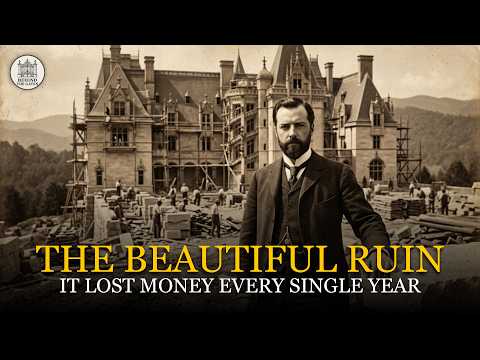
George Washington Vanderbilt was the eighth child, the quiet reader, the one who received the smallest share of America’s greatest fortune. Born in 1862, he was the grandson of Cornelius “Commodore” Vanderbilt, who left behind a fortune of over $100 million—billions in today’s money. But the Commodore didn’t believe in splitting his empire. He left the bulk to one son, William Henry, George’s father, who doubled it to around $200 million before his death in 1885.
George, the youngest, received $2 million from his grandfather, another million from his father on his 21st birthday, and about $5 million in cash plus a $5 million trust fund when his father died. Compared to ordinary Americans, it was unimaginable wealth. Compared to his siblings who ran railroads and built marble palaces on Fifth Avenue, it was the portion of the son no one expected to make noise.
And George didn’t make noise. He was shy, bookish, and intensely private. He read in multiple languages and collected books above all else, growing a personal library of 10,000 volumes on display and a comprehensive collection of nearly 22,000. He was the opposite of his party-throwing family. He didn’t crave the spotlight; he craved a quiet retreat. A place to think, to read, and to build something serious and permanent far from the clamor of New York.
In his quiet nature lay the seeds of everything that followed. A man with less money couldn’t have built Biltmore. A man with a louder nature might never have wanted to. His ambition took shape in the mountains of western North Carolina. In the late 1880s, George visited Asheville with his mother. Something in those high blue peaks and distant views captivated him. He decided then that he would build a country estate there—not a summer cottage, but a great house, a working estate, a private world of farms and forests, a scholar’s kingdom in the Appalachian hills.
He was in his mid-twenties, single, rich, and free to spend his liquid fortune on a single idea. And he chose to spend most of it on this one. Consider the scale of what he set out to make. The finished house would contain 250 rooms. It would cover roughly 175,000 square feet—more than four acres under one roof. Inside, 35 bedrooms for family and guests, 43 bathrooms, 65 fireplaces, three separate kitchens. It would stand at the center of an estate that at its peak reached about 125,000 acres—closer in size to a national park than a private garden. It would be the largest privately owned home in the United States, a title it still holds today.
A shy man, given the smallest share of his family’s wealth, decided to build the largest house his country had ever seen. There is something almost touching in that ambition, and something doomed in it too. Because $5 million, however vast it seemed, is a fixed number. A house of that size is not a fixed number. It is an appetite that cannot be satisfied. And George Vanderbilt was about to discover that an appetite that size does not stop at the money you have allotted for it.
He enlisted the best men in America to help him. Richard Morris Hunt, the most fashionable architect of the age, would design the house in the style of 16th-century chateaux of the Loire Valley. Frederick Law Olmsted, the man who designed Central Park, would shape the surrounding land in what became the last great work of his long career. They were giants in their fields, in their late years, drawn to a final masterpiece.
Everything about the project was the best that money could bring, and George brought it without any apparent hesitation. He didn’t want a modern house. He wanted a permanent one, something that would stand, admired, centuries after everyone who built it was gone.
But before Hunt could raise a wall, before Olmsted could plant a single tree, George Vanderbilt needed something no architect or landscape genius could provide. He needed the land. And the land he wanted, with its wooded hills and river valley south of Asheville, was not empty wilderness waiting for a great man’s vision. It was farmland. It was inhabited. It was home to dozens of families who had lived and worked and buried their dead there for generations.
Before Biltmore could rise, that world had to be gathered up piece by piece and made to disappear. Here begins the true cost of Biltmore.
To build an empty paradise, George Vanderbilt first had to empty a valley that was anything but empty. Starting in May 1888, just 23 years after emancipation, his agents began quietly buying land in the Asheville area. They did not announce that a Vanderbilt was assembling acreage for a private estate. They moved through intermediaries, parcel by parcel, so the truth about the scale of what was being assembled would stay hidden as long as possible.
By 1895, they had assembled numerous parcels totaling about 100,000 acres, and the estate would eventually reach roughly 125,000 acres. The land was assembled from about 700 separate tracts. Within that fabric were more than 50 working farms and at least five cemeteries. This was not a virgin frontier. It was a populated agricultural landscape worked by both white and black families, many with deep roots in the valley.
North Carolina had originally sold this land after it was taken from the Cherokee through land grants in the late 18th and 19th centuries. Farms passed through generations, and on some of those farms, before the Civil War, enslaved people worked the fields and lived among the landowners. This history is not a footnote here. It is the ground itself. The author Wilma Dunaway calculated that in 1860, over 41% of farmers in the Appalachian counties of North Carolina used enslaved labor or a mix of enslaved and hired labor to work their land. In that same year, there were a total of 1,933 enslaved people held in Buncombe County alone, the county that includes Asheville and the future estate.
The valley that George Vanderbilt admired for its distant views was, in living memory, a landscape of slavery. And the people most connected to it were about to form the most striking part of this story. Because the most remarkable community in the path of the estate was a settlement called Shiloh.
Shiloh was made up of about 28 African American landowners, with a total population exceeding 100 people by 1888. Many of them had been enslaved in these same mountains before emancipation in 1865. In the 23 years that followed, they achieved something rare and hard-won in the post-war South. They became owners of the very land they had once worked in bondage. They had a church, Shiloh African Methodist Episcopal Zion, and among its trustees was a man named Reverend Boston Jenkins.
These are the details that must stay with the viewer for the rest of this story. Reverend Boston Jenkins owned the very plot of land on which Biltmore House and its stable complex now stand. The largest private home in America sits on land that, within a generation of emancipation, belonged to a black minister who had once been enslaved.
When George Vanderbilt’s agents came, they came for that land too, and they got it. Now comes the part that complicates the simple version of this story, and the film owes the viewer the honest version. Vanderbilt did not steal this land, and he did not cheat the people who sold it to him. The records show the opposite. The average prices paid for most of the Shiloh land were about $37 per acre, which was above fair market value at the time. Across the broader purchase, prices ranged from a few cents per acre for poor mountain land to $1,000 for the single acre on which the Shiloh church stood. One acre, $1,000.
When the estate acquired the church land, an updated church building was moved to a plot donated by the estate, and ownership was transferred to the Shiloh residents. The community reformed a short distance away and became known as “New Shiloh,” which still maintains its own history today.
So hold both truths together, because the truth of Biltmore lies in the space between them. Vanderbilt paid above market price. He moved and rebuilt the church. He did not evict families into the open. And yet the community vanished from the valley. This is the quiet, disturbing center of the whole story. No crime was committed here, and that is precisely what makes the answer so difficult. It was legal, generous, and final.
Almost no one could refuse Vanderbilt’s money and stay, because a farm cannot remain a farm when Vanderbilt buys the land on every side of it. A community cannot hold together when a single estate closes around it like water around a stone. Imagine the calculations from the inside, not as an accusation against any one family, but as a clear picture of the choice each one faced.
You farm the land your family has worked for years. Your neighbors are selling, one by one, at prices they never dreamed of seeing. The estate’s boundary creeps closer every season. Your road now passes through Vanderbilt’s property. Your church has already been moved. And a man arrives with an offer far beyond what your acres would fetch in any fair market. You are not being robbed. You are being made an offer no reasonable person could refuse. And when you accept it, and the next neighbor accepts it, the valley you were born in ceases to exist. Not by eviction, but by signature.
And consider who was signing. They were not faceless tenants. The land was originally Cherokee land, sold by the state through land grants after the Cherokee were removed. Then it was farmed, and on some parts of it, people were enslaved before the war. Then, after emancipation, some of those families did what was nearly impossible in the post-war South. They bought the land they had once been forced to work.
For a black family in the mountains of North Carolina in the 1870s and 1880s, a deed was far more than property. It was tangible proof of freedom, the difference between being a person and being property, recorded in the county records. Shiloh was that proof, with 28 landowners, over 100 people, a church, and a name. And within one generation of winning it, they sold it because the richest family in the country made an offer a poor community could not reasonably refuse or survive refusing.
New Shiloh carried the name a short distance away. But the original land, the land so hard-won, the land that meant freedom, became a lawn and a horse stable. There is no crime in the deed book. There is only a community that climbed all the way from slavery to ownership in 20 years, then watched that ownership taken from them in a decade at a fair price by a man building a garden.
That is how you erase a place without committing a crime. You buy it fairly, all of it, then plant trees over the fields and lawns over the farms, and within a decade nothing remains to show that anyone was ever there but you.
The dairy kept the estate alive, but it could never carry the house. Even after Edith sold the forest, the ledgers bled. By 1930, the family had no choice but to open the gates to strangers for two dollars a ticket. Forty thousand visitors poured through in the first year alone.
In 1969, the house finally turned a profit. Seventeen dollars. That was the grand total after seventy-four years. The chateau that cost $4.4 million had earned seventeen dollars.
Today Biltmore survives as a business—tickets, wine, weddings. The scholar’s private kingdom is gone. What remains is a monument to what wealth erases, including itself.
So tell me: was Biltmore worth what it cost—a fortune drained and a community buried—or are some dreams better left unbuilt?
Report this article
Select a reason for reporting:






