The desert night was supposed to belong to the Afrika Korps. Rommel’s panzers had swept across Libya, their lightning thrusts shattering Allied lines and earning a reputation for invincibility. But in the darkness, a different kind of war was being fought—one that would haunt German soldiers long after the guns fell silent.
They came without warning. Small teams of Australians, faces blackened, moving like shadows across the sand. Grenades would crack, submachine guns would stutter, and then they were gone, vanishing into the night before the stunned defenders could even react. The Germans called them the Desert Devils. And for the men of the Afrika Korps, the fear of what lurked in the dark would become far more terrifying than any tank charge.
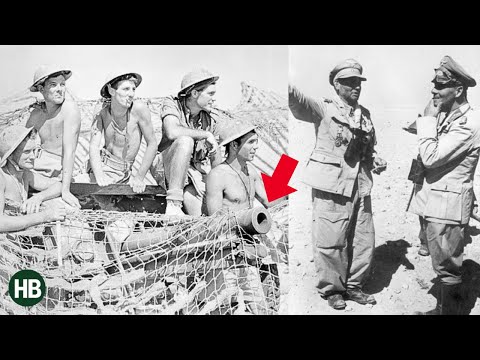
It began at Tobruk. April 1941. The port city was a vital supply hub on the Libyan coast, surrounded by thirty miles of defensive works—anti-tank ditches, barbed wire, concrete bunkers. Inside, a mixed force of Australians, New Zealanders, Poles, and other Commonwealth troops prepared to make a stand. At the heart of the defense was the Australian 9th Division, men who had already learned that survival in the desert demanded more than discipline. It demanded audacity.
They stripped off their uniforms, favoring shorts and wide-brimmed hats. They commandeered captured Italian trucks and turned them into mobile raiding platforms. They traveled light, moved fast, and fought with a ferocity that caught the Germans completely off guard. Rommel expected Tobruk to fall in days. Instead, it held for 241 days—and the Australians weren’t content to simply defend.
Within weeks, German commanders began receiving reports that made no sense. Patrols were vanishing. Outposts were being hit in the dead of night. Forward positions were harassed constantly, not by large formations, but by small, elite teams that seemed to materialize out of the darkness. The Australians weren’t defending. They were attacking. And they were doing it on their own terms.
These night raids were not random acts of aggression. They were meticulously planned. Australian intelligence mapped German positions, identified weak points, and noted patrol patterns and shift changes. Then they exploited every gap. Small teams of six to twelve men would slip out after dark, cross no man’s land in complete silence, and strike with grenades, submachine guns, and bayonets. By the time reinforcements arrived, the Australians had vanished, leaving only confusion and fear in their wake.
One German officer later wrote, “They came at night, fast and silent. You’d hear a grenade, some firing, and by the time you responded, they were gone. It was like fighting ghosts.” The psychological toll was immense. German soldiers couldn’t sleep. Every sound could be an Australian patrol. Every shadow could be the enemy. The darkness became something to dread.
The raids were only part of the equation. The Australians combined physical aggression with tactical deception. They moved their guns constantly, so German counter-battery fire always hit empty positions. They used decoys—canvas and sandbags—to draw attention away from real threats. They maintained strict radio discipline, frustrating German signals intelligence and creating operational uncertainty. German commanders found their own intelligence constantly outdated by the time they acted on it. How do you plan an assault when you never know what’s real?
The siege of Tobruk lasted 241 days. When Operation Crusader finally forced Rommel to retreat, the Australians were withdrawn for a much-needed rest. But their reputation had been cemented. The Desert Devils had done more than hold a fortress—they had planted the seeds of a fear that would only grow.
By July 1942, Rommel’s renewed offensive was pushing deep into Egypt, and once again the Australians stood in his path—the same 9th Division, now hardened by experience and hungry for another fight. At Tel el Eisa, a low ridge in the northern sector of El Alamein, German and Italian positions were dug in deep. Rommel considered the sector secure. He was wrong.
July 10th, 2:30 a.m. The Australians attacked—but this was no raid. This was a coordinated night assault backed by artillery. The 25-pounders opened up first, not in a sustained barrage but in precision fire on pre-registered targets: strong points, machine gun nests, communication trenches. Crack. Crack. Crack. The shells walked forward in a creeping barrage, and the infantry followed a hundred yards behind, moving through the darkness with practiced coordination.
Bren guns laid down suppressing fire. Mortars dropped illumination rounds that turned night into flickering daylight. The Germans were caught completely off guard. They had expected the Allies to attack in daylight with armor support. Instead, they faced an infantry assault in darkness—the one environment where German defensive doctrine broke down.
Australian section tactics were brutal in close quarters. Grenades first, submachine gun bursts, bayonets if needed. They cleared trenches systematically, one position at a time, with a speed that gave defenders no time to organize resistance. By dawn, Tel el Eisa was in Australian hands. Over a thousand prisoners were taken, German lines were shattered, and Rommel’s northern flank was exposed.
But the deeper wound was psychological. This wasn’t just an attack—it was proof that the Australians could coordinate large-scale operations with the same aggression they had shown in small raids. And now broader deception operations were amplifying their edge. British deception units flooded the airwaves with false intelligence, suggesting a massive Allied push forming in the south. Rommel shifted his reserves to meet a threat that didn’t exist. The real assault came from the north, led by the Australians.
Veterans described the sensory overload of these night assaults—tracer rounds arcing through the darkness, the distinctive crack of 25-pounders mixed with the thump of mortars, sand kicked up by explosions turning the air thick and choking. And through it all, the Australians advanced with mechanical precision. Not the wild charges of desperate defenders, but controlled aggression backed by coordination that shouldn’t have been possible in darkness.
This was desert warfare evolved. Small unit firepower, artillery coordination, deception operations—all integrated into a doctrine that turned German advantages into liabilities. The Afrika Korps had trained to fight armies in daylight. The Australians were teaching them to fear the night.
By October 1942, the final phase of El Alamein had begun. Montgomery’s offensive was pushing west, but in the northern sector, the Australians were fighting a different battle—one that would break the enemy’s spirit before the first shot was fired. Ruin Ridge, a low rise of insignificant terrain, became critical not for its strategic value but for what it revealed about German psychology.
The Germans had begun to dread nightfall. Every evening, they manned their positions at full alert. Every shadow was investigated. Every sound was treated as a potential raid. The veterans of Tobruk among the Australian ranks knew exactly what this meant: the psychological victory was complete. By October, the Australians didn’t need to strike every night. The threat alone did the work. Fatigue and false alarms hollowed out German positions before the first grenade even blew.
One Australian officer later recalled, “We didn’t even need to attack every night. The Germans would be on alert, expecting us, exhaust themselves, and be vulnerable when we did hit them.” Captured documents told the same story. German unit diaries mentioned constant infiltration attempts, aggressive enemy patrols, and an inability to rest forward positions. Operational logs noted fatigue, confusion, and fear of infiltration following repeated Australian raids.
This was the breaking point—not a single catastrophic defeat, but a cumulative psychological collapse. The fear of darkness. The terrifying knowledge that any night could bring grenades and submachine guns into your trench. The realization that your officers couldn’t protect you, your defenses couldn’t stop them, and your intelligence couldn’t warn you. German veteran accounts described them with fear. The Desert Devils.
Australian veterans noticed the shift. Early in the war, German troops were confident, aggressive, well-coordinated. By El Alamein’s final weeks, they were defensive, reactive, exhausted. Not because of armor battles or air superiority, but because of small teams of men who had mastered the darkness and refused to let their enemy rest.
German doctrine emphasized combined arms in daylight: panzers supported by infantry, Stukas providing close air support, artillery coordinating with ground movements. All of it required visibility, communication, and coordination. The Australians stripped all that away. They fought at night, disrupted communications, and created uncertainty that made coordination impossible.
One German NCO interviewed after the war put it simply: “We were trained to fight armies. They fought like hunters, and we were the game.” When the final breakthrough came at El Alamein, the northern sector collapsed faster than anywhere else on the line. The Australian 9th Division sector—the Germans weren’t just defeated. They were demoralized. Units that had sworn to hold to the last man retreated in disorder. Officers who had led charges in France and Russia now struggled to maintain cohesion.
The psychological foundation of German military confidence had cracked. And it cracked because a group of Australians had spent eighteen months teaching them to fear the dark.
The 9th Division’s story didn’t end at El Alamein. Their tactics—the night raids, the deception, the relentless aggression—evolved into doctrine. When Australian troops rotated to the Pacific theater, they brought those lessons with them. The jungle wasn’t the desert, but the principles remained: small unit coordination, aggressive patrolling, disrupting enemy sleep and morale, making darkness your ally instead of your enemy.
The same men who had hunted Germans in the sand now hunted Japanese in the jungle. The terrain changed. The tactics adapted. The aggression remained constant. Australian commando units pioneered jungle infiltration tactics that directly descended from desert patrol methods—forward observation, intelligence gathering, hit-and-fade, psychological pressure. Japanese war diaries from New Guinea operations mentioned Australian patrols with the same dread German diaries had shown: constant harassment, no rest, uncertainty about enemy positions.
The lessons from Tobruk and El Alamein became formal doctrine. Australian Army training manuals incorporated night operations, deception techniques, and aggressive patrolling as standard practice. What the 9th Division had pioneered under siege became the foundation of Australian infantry tactics for the rest of the war. Elements of these methods echoed in British commando and US unit patrolling doctrines across multiple theaters.
The posthumously compiled Rommel papers called the Australians the best soldiers he faced in North Africa—high praise from a commander who had fought across Europe and Africa. They specifically mentioned the Australian aggressive spirit and mastery of patrol operations. But the papers were diplomatic. They didn’t mention the fear, the psychological toll, the way his troops dreaded facing them. That truth came from the enlisted men—the soldiers who had spent months staring into the darkness, waiting for the Desert Devils to strike.
The legacy continues. Modern Australian special forces trace their lineage directly to these desert raiders. The same emphasis on small unit excellence. The same aggressive mindset. The same willingness to take the fight to the enemy regardless of circumstances.
From Tobruk to Kokoda, from El Alamein to Vietnam, from the Middle East to Afghanistan, the thread runs unbroken through Australian military culture. Adapt. Be aggressive. Master the environment. Make the enemy fear you.
The 9th Division wrote that doctrine in sand and blood. And the Germans learned it the hard way—not in a single decisive battle, but in a thousand sleepless nights, in every shadow that might have been a raider, in every dawn that came without rest.
The Desert Devils were quick to fight, quick to adapt, and absolutely relentless when it mattered most. They didn’t just win battles. They broke the will of an enemy that had never known fear—until the darkness came alive.
So here’s the question that lingers long after the guns fell silent: what is more terrifying—the enemy you can see coming, or the one who owns the night? Tell us in the comments below.
Report this article
Select a reason for reporting:






