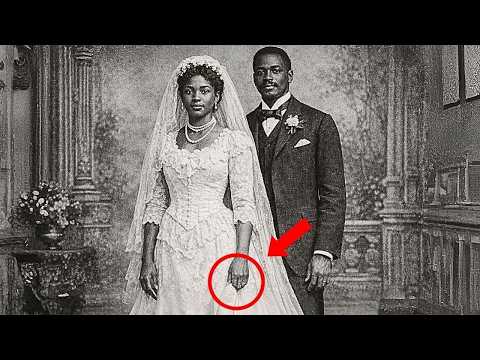
David Harper had seen thousands of photographs in his fifteen years as a historian at the New Orleans Heritage Museum. But something about this particular portrait stopped him cold.
It was a humid Tuesday afternoon in April 2024 when he unpacked the latest donation from the estate of Eleanor Rouso—a woman who had passed away at 103, leaving behind boxes of family memorabilia that no living relative wanted to claim. The photograph was tucked between layers of yellowed tissue paper, its silver frame tarnished but intact.
David carefully lifted it into the light streaming through his office window. The image showed a Black wedding couple from 1883. The bride in an ivory dress with delicate lace sleeves and a long veil. The groom in a crisp dark suit with a boutonniere pinned to his lapel. They stood before an ornate backdrop typical of professional portrait studios of that era, their expressions captured in that peculiar stillness that early cameras demanded.
The bride was striking—not conventionally beautiful by the standards of the time, but there was something magnetic about her direct gaze into the lens. Her dark hair was styled elegantly beneath her veil, and a strand of pearls circled her neck. The groom stood slightly behind her, one hand resting formally on her shoulder, his face composed in solemn dignity.
For a Black couple to afford such a formal portrait in 1883 Louisiana—barely eighteen years after the end of slavery—spoke volumes about their determination to document this moment, to claim their place in history.
David turned the frame over, searching for any inscription. On the back, written in faded brown ink, were simply two names: Clara and Thomas, June 14th, 1883. Nothing more.
He flipped it back and studied the image more closely, noting the remarkable clarity for its age, preserved with obvious care through generations. It was then, as the afternoon sun shifted angle and illuminated the glass differently, that David noticed something unusual.
He reached for his magnifying glass—the one he kept on his desk for examining details in historical documents. Leaning closer, he focused on the bride’s hands, which were clasped together at her waist in the traditional pose of brides from that era. But there was something in her right hand.
David’s pulse quickened as he adjusted the magnifying glass, bringing the bride’s hands into sharper focus. Between her clasped fingers, partially concealed by the folds of her dress and the angle of her hands, was a small piece of fabric.
At first glance, it might have been dismissed as part of her dress or a decorative handkerchief—brides often carried such items in portraits. But something about the way she held it, the deliberate positioning, the tension visible even in a century-old photograph, suggested this was no ordinary accessory.
He moved to his desk and switched on the high-intensity lamp he used for archival work, positioning the photograph directly beneath it. The additional light revealed more detail.
The fabric appeared to be white or cream-colored, roughly the size of a man’s pocket square. But as David examined it more closely, he could see there were markings on it. Tiny, precise markings that looked almost like embroidery or careful stitching.
His hands trembled slightly as he reached for his phone and snapped several high-resolution photos of the portrait, then transferred them to his computer. Using photo enhancement software, he zoomed in on the bride’s hands, adjusting contrast and brightness to bring out every possible detail.
The markings became clearer. They weren’t random decorative patterns. They looked deliberate, systematic—almost like coordinates or symbols. The stitching formed what appeared to be numbers and directional markers, incredibly tiny and precise.
David sat back in his chair, his mind racing. In 1883, Louisiana was in the midst of Reconstruction’s brutal aftermath. Black communities lived under constant threat—the rise of white supremacist violence, the systematic dismantling of civil rights gains, the terror campaigns designed to keep formerly enslaved people subjugated.
For a Black bride to hide something in her wedding portrait, to carry it so carefully, so deliberately, suggested this was far more than a sentimental keepsake.
He looked at the groom’s face again—at Thomas’s solemn expression. There was something in his eyes, not fear exactly, but awareness, a gravity that went beyond wedding day nerves. And Clara, the bride, despite her formal pose, had the slightest tension around her mouth, as if she were holding her breath, holding something back.
David knew he had stumbled onto something significant. But what? And why would someone encode information in a wedding photograph?
The questions multiplied in his mind as the afternoon light faded and shadows lengthened across his office.
The next morning, David arrived at the museum an hour early, the photograph carefully stored in an archival sleeve in his leather satchel. He had barely slept, his mind consumed by possibilities.
Before diving deeper, he needed to understand the context—who Clara and Thomas were, where they lived, and what their world looked like in 1883 Louisiana.
He started with the museum’s own archives, pulling record books and city directories from New Orleans in the 1880s. The name Thomas was common, but combined with Clara and a wedding date of June 14th, 1883, he hoped to narrow it down.
Hours passed as he scanned through handwritten entries, cross-referencing church records, marriage licenses, and census data. The work was painstaking, but David had learned long ago that history revealed itself slowly through patience and persistence.
By mid-morning, he found a promising lead: a marriage license registered at the Orleans Parish Courthouse. Clara, age 24, and Thomas, age 27, married June 14th, 1883. The license listed Thomas’s occupation as carpenter and noted they resided in the Treme neighborhood—one of the oldest Black neighborhoods in America, a community that had been free people of color even before the Civil War.
David felt a surge of excitement. Treme had been a center of Black culture, resilience, and resistance for generations. If Clara and Thomas lived there, they would have been part of a tight-knit community that looked after its own, that kept secrets when necessary, that understood survival required more than just endurance.
It required strategy.
He pulled property records next, searching for any address associated with Thomas’s name. He found it: a small lot on St. Philip Street, purchased in 1881. The fact that Thomas owned property just two years after Reconstruction ended spoke to either extraordinary fortune or extraordinary determination. Most Black families in that era rented, sharecropped, or lived in conditions barely better than slavery.
Ownership meant something.
David then turned to newspaper archives, searching for any mention of Clara or Thomas in the years surrounding their wedding. The Times-Picayune and other papers from that era rarely mentioned Black citizens unless reporting crimes or reinforcing racist stereotypes. But sometimes, if one looked carefully, there were small notices—obituaries, property transactions, church announcements.
He found nothing about Clara or Thomas directly, but he did find something else that made his breath catch: multiple reports throughout 1883 and 1884 of Black families mysteriously disappearing from New Orleans, particularly from neighborhoods like Treme. The articles framed these disappearances with suspicion, suggesting criminal activity or irresponsibility.
But David, reading between the lines of racist journalism, recognized another possibility entirely.
David knew he needed expert help to decipher the markings on the fabric Clara held. He contacted Dr. Angela Freeman, a textile historian and professor at Tulane University who specialized in nineteenth-century American needlework and coded fabrics. They had collaborated on previous projects, and David trusted both her expertise and her discretion.
Angela arrived at the museum that afternoon, her enthusiasm evident the moment David showed her the enhanced photographs. She studied them in silence for several minutes, occasionally zooming in on specific sections, her expression growing more animated with each passing moment.
“David, do you know what you have here?” she finally asked, her voice barely above a whisper. “This isn’t decorative embroidery. These are navigational markers. See these patterns? The way the stitches form specific angles and groupings? This is coded information.”
She pulled out her tablet and began comparing the stitching patterns to historical examples she had documented over the years. “During slavery and even after emancipation, Black communities used textiles to communicate secretly. Quilts are the most famous example—the Underground Railroad quilts with their coded patterns. But handkerchiefs, scarves, even dress hems were used to pass information that couldn’t be written down safely.”
Angela traced her finger across the screen, following the stitched lines. “These marks here, if I’m reading this correctly, are geographic coordinates—not in the modern latitude-longitude system we use today, but in a directional coding system. See how this cluster of stitches forms what looks like a compass rose, and these longer lines radiating out? Those would indicate directions and distances.”
David leaned closer, his excitement building. “Directions to where?”
“That’s what we need to figure out,” Angela said. “But based on the complexity and the care taken to hide this in a wedding portrait, I’d guess these coordinates led to safe locations—places where people could hide, rest, or escape. The Underground Railroad didn’t end with the Civil War, David. The network adapted, continued during Reconstruction and especially after it collapsed in 1877. Black people still needed ways to escape violence, to find safety.”
She pulled up a historical map of Louisiana on her tablet. “In 1883, this state was a powder keg. White supremacist groups were terrorizing Black communities—burning homes, lynching people who dared to vote or own property or simply exist with dignity. The federal troops had withdrawn. Black people were left defenseless against organized violence.”
David thought about the newspaper reports of disappearing families. “So Clara was carrying a map—a way out, possibly,” Angela said carefully. “Or a way to find others who had already left. Look at this section here.” She pointed to a particularly dense area of stitching near the edge of the fabric. “This pattern repeats three times. In textile coding, repetition often indicated emphasis. These were important locations—places you absolutely needed to know about.”
Over the following days, David immersed himself in the history of Treme during the 1880s. What he discovered painted a picture of a community under siege, yet fiercely resilient. The neighborhood had been a haven for free people of color since the early 1800s—a place where Black musicians, artisans, and entrepreneurs built lives of dignity and culture despite constant oppression. But by 1883, that world was collapsing. The gains of Reconstruction—voting rights, political representation, land ownership—were being systematically stripped away through violence and legal manipulation. The Louisiana Constitution of 1879 had disenfranchised most Black voters. White supremacist organizations operated openly, attacking Black families with impunity. The message was clear: Black people would be forced back into submission by any means necessary.
David found records of churches in Treme that had served as meeting places and centers of resistance. St. Augustine Catholic Church, established in 1841, had been a cornerstone of the free Black community. He wondered if Clara and Thomas had been married there, if the church had played a role in whatever network the fabric coordinates represented.
He decided to visit Treme himself—to walk the streets where Clara and Thomas had lived, to see if any physical traces of their world remained.
On a warm Saturday morning, he drove through the neighborhood, parking near St. Philip Street. The address from the property records no longer existed as a standalone structure—the lot had been absorbed into a larger development decades ago—but the surrounding blocks still held buildings from the late 1800s, their weathered facades testaments to survival. He walked slowly, imagining what these streets had looked like in 1883: horse-drawn carts instead of cars, gas lamps instead of electric lights, and always the undercurrent of danger—the knowledge that violence could erupt at any moment without warning or consequence for the perpetrators.
At St. Augustine Church, David found the parish office open. An elderly woman named Mrs. Delacroix, a longtime parishioner and volunteer archivist, greeted him warmly when he explained his research. Her eyes lit up when he mentioned the names Clara and Thomas and the date 1883.
“We have marriage records going back to the church’s founding,” she said, leading him to a small room lined with leather-bound ledgers. “Let me see what we can find.”
She pulled a volume from 1883 and carefully turned the yellowed pages. There, in an elegant script, was the entry: Clara, spinster, and Thomas, bachelor, united in holy matrimony on the 14th day of June in the year of our Lord, 1883. But it was the notation in the margin that made David’s heart race. Witnesses: Samuel and Ruth. And next to their names, in tiny script, almost invisible: conductors.
The word conductors changed everything. David knew immediately what it meant. Conductors were the guides who helped enslaved people escape to freedom along the Underground Railroad. But the Underground Railroad had officially operated before the Civil War ended in 1865. Why would conductors still be identified in 1883, nearly two decades after emancipation?
Mrs. Delacroix saw the question in David’s eyes. She gestured for him to sit, then settled into her own chair with the careful movements of someone who carried decades of stories. “Young man, the Underground Railroad never truly ended. It transformed. My grandmother told me stories—she was born in 1879, lived through all of this. After Reconstruction failed, after the federal troops left and the violence came back worse than ever, Black people still needed ways to escape.”
She spoke quietly, as if the walls themselves might be listening. “Even now, they called it different things—the network, the chain. Some people just called it ‘the way through.’ It wasn’t about running north anymore. That path was known, watched, sometimes blocked. This was about moving between safe communities, about disappearing when your name got on the wrong list, when your family was threatened, when you had no other choice.”
David showed her the enhanced photographs of the wedding portrait, pointing out the fabric Clara held. Mrs. Delacroix studied it for a long moment, then nodded slowly. “My grandmother mentioned something like this. She called them passage cloths. Women carried them because women were searched less often, suspected less often. The information was hidden in plain sight—disguised as decoration or sentiment.”
“Do you know where these coordinates might have led?” David asked.
Mrs. Delacroix stood and moved to a large map of Louisiana on the wall, its surface marked with pins and notes from various historical projects. “In the 1880s, there were several communities that took people in. Some were settlements deep in the bayou where law enforcement rarely went. Others were farming communities further north near the Arkansas border, where Black families had established themselves and looked after newcomers. And then—” She paused, her finger hovering over a spot near the Gulf Coast. “There were the maritime routes.”
“Maritime routes?”
“Ships,” she explained. “Black sailors, fishermen, port workers—they moved people out through New Orleans Harbor to ports further east and north. Mobile, Pensacola, even as far as Charleston. From there, people could start new lives, sometimes even leave the country entirely. Some went to Mexico, to Caribbean islands—anywhere away from the violence.”
David felt the pieces beginning to connect. Clara’s fabric might have been more than just a map of land routes. It could have included information about ships, departure times, contact names at various ports. The repetitive pattern Angela had noticed might have indicated the most reliable routes—the ones that had successfully moved people to safety multiple times.
“What happened to Samuel and Ruth?” David asked. “The witnesses listed as conductors?”
Mrs. Delacroix’s expression grew somber. “I can check our records, but—” She trailed off, and David understood. Conductors lived dangerous lives. Many disappeared, were killed, or were forced to flee themselves.
Back at the museum, David and Angela worked late into the evening, enlisting Marcus, a cartography specialist, to translate Clara’s stitched coordinates into actual locations. “These were starting points—safe houses where people gathered before a journey,” Angela explained, tracing the shorter lines. One aligned with St. Augustine Church. Another pointed to the French Market. A third led to Bayou St. John, where water offered escape into the wetlands.
Marcus pulled up an 1883 shipping chart. “A regular packet service ran between New Orleans and Mobile—mixed cargo and passengers. Perfect cover for moving people.” Clara wasn’t just carrying a map for herself. She and Thomas were conductors. The portrait was an insurance policy, preserving critical information in plain sight.
David found Thomas first in a property record from 1891: the St. Philip Street lot transferred to Clara alone, marked simply “widow.” Thomas had died in 1889—injuries sustained, no details. In 1889 Louisiana, for a Black man helping people escape, that could mean anything.
Clara’s story continued. The 1900 census listed her as a seamstress, living alone. Then David found an oral history from the 1930s: “They took my Thomas for helping people get to safety… The cloth I carried on my wedding day was my promise to him, to our people.” She had kept the work alive for decades after his murder.
Patricia, Clara’s great-great-niece, wept when David showed her the portrait. “We thought all of that was lost in Katrina.” From a worn shoebox she produced another passage cloth and Clara’s journal. One entry, dated June 14th, 1920, read simply: “Thomas, I kept my promise. The way through remains open.”
On the anniversary of their wedding—June 14th, 2025—Patricia’s family stood before the portrait in the museum’s new exhibition. Clara gazed back across 142 years, her hand still holding that tiny map to freedom.
What would you have risked to keep such a promise?
Report this article
Select a reason for reporting:






