May 1st, 1944. Lieutenant General George S. Patton walks into Dwight Eisenhower’s headquarters, half expecting to leave without an army. He had slept well, he wrote in his diary, and trusted his destiny. But the air in the room was thick with tension. Eisenhower, the Supreme Commander, sat him down and said, “George, you have gotten yourself into a very serious fix.” Patton, never one to mince words, offered to make it easy. “If saving me was hurting Eisenhower,” he said, “throw me out.” Ike waved that away. “The real cost,” he replied, “would be depriving me of a fighting army commander.”
Thirty-six days before the landings in France, Patton was training the real Third Army in England. On paper, he commanded something far bigger: an army group of 11 divisions and 150,000 men, by MI5’s own count. Not one of those men existed. Across the Channel, Hitler’s 15th Army was guarding the coast that phantom army was supposed to hit. Two days before this meeting, Eisenhower had told Washington he was close to sending Patton home. So, what do you do with a general who can’t stop talking when the enemy is listening for his name?
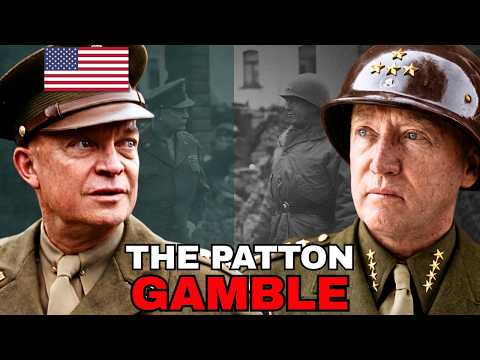
The trouble had started six days earlier, on April 25th, in the small town of Knutsford, Cheshire. A welcome club for American soldiers was opening, and Patton was asked to say a few words to about 60 people. By Eisenhower’s reports, he said it seemed to be the destiny of America, Great Britain, and Russia to rule the world. So, they had better get to know each other. In the newspaper versions, Russia had gone missing. The next day, Marshall cabled: “The Senate had been about to confirm a list of permanent promotions, Patton’s among them. This, I fear, has killed them all.” Patton’s excuse, in Ike’s cable of April 29th, was that he did not, repeat, not know a reporter was present. The repeat was cable language, guarding the not. Ike’s verdict: “He simply does not keep his mouth shut.” He was seriously contemplating the most drastic action.
Everyone knew what drastic looked like. That same spring, Major General Henry Miller, Ike’s West Point classmate, told a hotel dining room the invasion would come before June 15th. Eisenhower had him reduced to colonel and sent home. One sentence at dinner, two stars gone. Marshall’s answer quoted the Washington Post: “Whatever his merits as a tactician, Patton had shown glaring defects as a leader of men.” Remember that phrase. But Marshall gave the other side, too. Patton was the only available army commander who had fought Rommel and run a landing followed by a fast campaign. If Courtney Hodges, for example, could do it as well, all well and good.
Now, the other half of Patton’s job. His phantom army group sat in Kent and Essex, aimed at the Pas de Calais, the shortest crossing. It was built from radio traffic, dummy landing craft, and double agents. The best of them, a Spaniard MI5 called Garbo, ran 27 sub-agents who didn’t exist either. From January to D-Day, he and his German handlers in Madrid traded more than 500 radio messages, four transmissions a day. Hitler hardly needed convincing. On May 27th, he told Japan’s ambassador, Baron Oshima, that he expected the invasion at the Pas de Calais and would not pull troops from there, even if a first landing came somewhere else. The Allies decoded Oshima’s report. Hitler’s plan was to wait at Calais. The Allied plan was to make sure he never stopped waiting.
Same coast, same calendar. For invasion night, the planners added something stranger: a fleet made of foil. German radar showed ships as bright echoes. Strips of aluminum foil, cut to match the radar, threw back the same kind of echo. Bombers would fly a tight racetrack over the Channel, each lap starting slightly ahead of the last, so the cloud crept toward France at the pace of ships, not airplanes. On a German screen, a convoy. All that spring, meanwhile, Allied bombers kept working over French railyards and bridges. Routine work.
Before the decision lands, one quick favor. If a general nearly losing his army over a welcome club speech is news to you, tap like, so YouTube knows Footnotes deserves an audience. And stay close. Soon, 16 bombers will fly circles over the Channel for 5 hours. And that night is the reason this video exists.
May 1st, the same day Patton sat in that chair, Marshall cabled again. Regarding Patton, he wrote, “The decision is exclusively yours. Forget the War Department. Consider only Overlord.” Exclusively yours. Two words that took Washington out of the room. May 3rd, Eisenhower answers and says it plainly: “I have decided to retain him in command.” Patton stays, but not on the beaches. Third Army would not cross on D-Day at all. Its commander would spend the invasion in England, still the face of an army that did not exist. And the deception now rested on people far below his rank.
June 5th, Woodhall Spa, Lincolnshire, home of 617 Squadron, the Dambusters. That same evening, far to the south at Greenham Common, Eisenhower was walking among the paratroopers of the 101st. For a month, these crews have practiced a strange kind of flying without being told what for. John Bell, a bomb aimer, is 21. On the 5th, they are finally briefed: “Tonight, you are helping the invasion.” In the same squadron flies Nick Nillins, a Wisconsin farm boy who crossed into Canada in 1941 to learn to fly. He has since transferred to the American Air Force and still flies a British bomber. Midnight, the first eight Lancasters take off. By Bell’s account, they form a line 2 miles apart, 3,000 ft up, 180 miles an hour. Each plane carries two crews because nobody can fly this pattern for long. In the back, Bell and a second man work the flare shoot with bundles of foil. A green light means throw. A bundle goes out roughly every 3 seconds. Heading toward France, the strips get bigger, and heading back, they get smaller. So, the echo seems to swell as it approaches. Up front, Nealands flies by the stopwatch. 35 seconds on course, a controlled turn, 32 seconds back, a slow turn, and start again just ahead of the last lap. Circle after circle that carries him forward at 8 miles an hour. 2 hours of that before the second pilot takes the seat.
Below them, 18 small boats push toward Cap d’Antifer, about 50 miles from the real beaches, running jamming gear and filling the air with the radio chatter of a fleet. Farther north, six Stirling bombers paint a second phantom fleet toward the Pas-de-Calais. Partway through the night, a second flight of eight Lancasters slips in behind the first. The foil never stops falling.
3:00 in the morning, Garbo’s radio is ready with an urgent message for Madrid: The invasion force is about to leave for France. MI5 has cleared it, timed to arrive too late to matter. Madrid doesn’t answer. The German operator has missed the appointment. That silence will do Garbo more good than the message ever could. By five, the foil flights are done. Did any of it work? Years later, Bell admitted there were doubts. But, in his words, the main thing was that the Germans were puzzled. Behind the bombers, the last of the foil drifts down onto an empty sea.
Which seat would you rather have had that night? Hours of circling in the dark, never knowing if anyone was fooled, or the radio, waiting on an operator who never came on? Comments are open.
So, the title’s question. The expected move was the Miller treatment. Send him home and hand Third Army to Hodges, six weeks before the biggest landing in history. What Eisenhower actually did was keep Patton, keep him off the beaches, and let his name stand guard in Kent, while the real armies went ashore in Normandy. Then, the enemy’s clock started. On June 8th, according to the published MI5 archive, the German High Command authorized the first SS Panzer Division and 15th Army forces to move to Normandy. In the early hours of June 9th, Garbo sent a very long message. Patton’s army group hadn’t moved. Normandy was a diversion. The real blow would fall on the Pas de Calais. The report went all the way to Hitler. The moves were halted.
Hold that thought, though. May 3rd is still waiting. And it changes this picture. By MI5’s count, two armored and 19 infantry divisions stayed in the Pas de Calais through July and August, waiting for 11 divisions that existed only on paper. Eisenhower’s own report dates the first 15th Army division heading west to July 25th, 49 days after D-Day. He called it a belated and fruitless attempt. Wow. Four days later, Berlin informed Garbo that the Führer had awarded him the Iron Cross. Garbo sent back his humble thanks.
Now, the sentence from May 3rd. “Relieving Patton,” Eisenhower wrote, “would lose them his experience commanding an army in battle and his demonstrated ability of getting the utmost out of soldiers in offensive operations.” Since Marshall had left the choice exclusively in my hands to be judged on Overlord alone, he would keep him. In a letter to Patton that day, as later accounts quote it, he said he was acting out of faith in him as a battle leader and from no other motives. Battle, not Calais. Two days earlier, he had said it to Patton’s face: a fighting army commander.
And what makes this unusual is not that Eisenhower used Patton as bait, it’s that by his own written reason, he kept Patton for the fighting still to come while the deception went on borrowing the name. Three days later, he complained to Marshall that the Patton and Miller cases had cost him hours of earnest study and anxious thought. And the stillness at Calais had more than one parent. The historian Mary Kathryn Barbier argues that the Germans believed in Calais from the start and that Allied bombing of French railways meant the 15th Army couldn’t have reached Normandy quickly anyway. “At best,” she concludes, “Garbo could reinforce preconceptions in the mind of the enemy.” Remember the rail yards from that spring. By June 5th, by the bomber command center’s count, 22 of 37 rail targets in France were already sufficiently damaged. Three nights after the foil, Bell’s squadron was bombing a railway tunnel at Saumur.
So, the decision was exclusively Eisenhower’s. The credit for Calais is shared. A Spaniard with a radio, two bomber squadrons, the railway raids, and Hitler’s own certainty. Anyone who has kept a difficult colleague for the work still ahead knows the pattern. The reason written down at the time is plain. The clever one gets added later. One popular detail doesn’t survive the files. The usual telling has Garbo’s message freezing the panzers within hours. The sources checked here confirm the halt, but they give no hours. If there’s a deception from that war you think gets too much credit or too little, name it in the comments. It goes on the list.
The post had seen glaring defects as a leader of men. Patton’s diary on the day he nearly lost everything predicted he was destined to achieve some great thing. On August 1st, 1944, Third Army went into action in France with Patton at its head. John Bell later became a wing commander. Nick Neelands flew 50 operations, the last against the battleship Tirpitz, then taught school in California. He didn’t want a painted girl or a joke name on his bomber because flying into combat night after night, he wrote, was not very funny.
So, May 3rd: keep the fighter and live with the mouth or send him home six weeks before D-Day. The next time Eisenhower and Patton sat at the same table, it was a freezing room in Verdun. And that story is Eisenhower’s genius answer to Hitler’s last gamble. Soldiers moved in
silence through the Ardennes, and the weather clamped down like a lid. Patton, who had spent the summer as a ghost, now had the one job nobody else could do: turn Third Army ninety degrees in winter and hit the southern shoulder of the Bulge. He told Eisenhower he could do it in three days. Ike, who had kept him for exactly this, said, “George, every time I get a new star I get kicked.” Then he gave him the go.
On December 22nd, 1944, Patton’s men were attacking. The gamble at Calais had bought time; the general kept for the fighting had spent it well. The mouth that nearly cost him an army was the same mouth that promised a miracle and delivered it.
So maybe the lesson of May 3rd isn’t about deception at all. It’s about the difference between the reason written down and the legend added later. Which do you trust more: the cable Eisenhower sent, or the story we tell about it?
Report this article
Select a reason for reporting:






