They were giants in every sense—admired, stared at, even worshiped. But behind the towering fame were lives marked by pain, loneliness, and loss. This is the untold story of two extraordinary people who seemed larger than life, but couldn’t escape the weight of it.
Andre the Giant wasn’t just a wrestler. He was a phenomenon. They called him the eighth wonder of the world—and not just as a gimmick. He could drink 156 beers in one night, lift a car off the ground with his bare hands, and draw crowds by the thousands just by showing up. But behind the myth was a man who lived in constant pain, struggled to fit into a world built for average-sized people, and quietly carried the burden of being too big for almost everything.
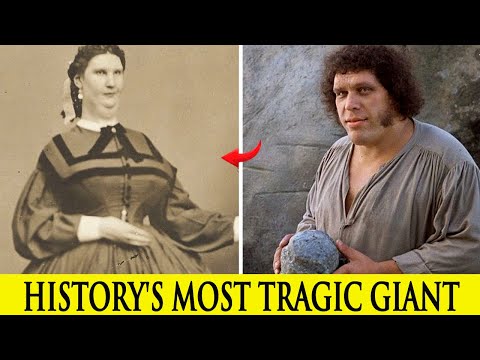
Andre René Roussimoff was born on May 19, 1946, in the small countryside town of Coulommiers, France. He weighed nearly 13 pounds at birth—already bigger than most newborns. By age 12, he stood at a staggering 6’3″, towering over teachers and classmates alike. This wasn’t just a growth spurt; it was the beginning of a lifelong transformation.
At 14, Andre left school to work on the family farm, later taking a job at a local factory. But his body wasn’t done growing. By adulthood, he measured an unbelievable 7’4″ and weighed over 500 pounds. His hands were like catcher’s mitts, his voice rumbled like thunder. Even everyday things like finding clothes or walking through doorways became challenges.
When he turned 17 and was summoned for military service, the army quickly realized they weren’t equipped to handle someone like Andre. No uniform fit, no boots came close, and even the bunk beds couldn’t support his size. So, in a rare move, the government excused him from service. It was one of the first times Andre’s sheer size bent the rules of the world around him. But it wouldn’t be the last.
At 18, Andre left the quiet life of the farm behind and moved to Paris, hoping to find work and maybe a new path. What he found instead was destiny. While working construction jobs, his immense size drew constant attention—none more important than from a local wrestling promoter who took one look at Andre and saw a gold mine.
He convinced the young man to step into the ring, not just as a novelty, but as a spectacle. That’s when Andre adopted the name Géant Ferré, based on a mythical French giant from folklore. It wasn’t long before he was traveling across Europe, wrestling in packed halls and sports arenas in Germany, the United Kingdom, and eventually Japan and Canada.
In every country, the reaction was the same. Audiences couldn’t believe their eyes. Wrestling promoters began billing him as the “Roussimoff Monster,” and he delivered on that title, tossing opponents like ragdolls and drawing standing ovations everywhere he went. But Andre wasn’t just big—he was quick on his feet, shockingly agile for a man of his size. In the ring, he moved with purpose and surprising grace, giving performances that blurred the line between strength and showmanship.
Everything changed for Andre in 1971 when he met Vince McMahon Sr., the powerful promoter behind the World Wide Wrestling Federation (WWF), what we now know as WWE. McMahon instantly recognized Andre’s potential, but he also saw a need for reinvention. Up to that point, Andre had been marketed as a novelty, a giant sideshow attraction. But McMahon had a bigger vision. He advised Andre to slow down his wrestling style, to move deliberately—to become not just a big man, but a living myth.
And with that shift came a new name: Andre the Giant. It was simple. It was powerful. And it stuck. From that point on, the name wasn’t just a wrestling persona—it was a brand, a legend in the making.
As his star rose, so did the demands on his body. Around this time, Andre was diagnosed with a rare condition called acromegaly, caused by an overactive pituitary gland that floods the body with growth hormone. It explained everything—his enormous hands, his deep voice, his towering frame. But it also came with a dark side: chronic pain, joint issues, and a shortened life expectancy. For Andre, the very thing that made him famous was also slowly wearing him down.
Still, none of that slowed him yet. Andre embraced the spotlight. He didn’t need a championship belt to prove his worth. His presence alone filled arenas. While other wrestlers built their reputation by winning titles, Andre didn’t need them. He was the main event just by walking into the room. Everywhere he went, fans stood in awe. Andre the Giant wasn’t just a wrestler anymore—he was a phenomenon, a walking wonder, and the face of a new era in professional wrestling.
As Andre’s fame exploded, so did his travel schedule. Back in the 1970s and ’80s, professional wrestling wasn’t the global empire it is today—it was regional, divided into territories, each with its own fan base and television broadcast. That worked in Andre’s favor. Because there was no internet and limited national coverage, most people only saw him once. When Andre arrived in a new city, it felt like a once-in-a-lifetime event.
But behind the curtain, life on the road was grueling. Airplanes were a nightmare—Andre couldn’t fit into a standard seat, so he was forced to book two first-class tickets just to have enough space. Even then, his knees pressed into the seat in front of him, and using the airplane bathroom was nearly impossible. Hotel beds were too short, showers too cramped, and toilets too fragile for his size. The world simply wasn’t built for someone like Andre.
And then there were the taxis, especially in Japan. Andre was so enormous that drivers were genuinely afraid of him. One time he had to hide around the corner while another wrestler flagged down a cab. When Andre stepped out to get in, the driver saw him, screamed “No, no, no!” and hit the gas. Without flinching, Andre calmly reached out and grabbed the rear bumper, holding the car in place like it was nothing. The driver wasn’t going anywhere until Andre let go. That story became legend among wrestlers.
For most people, travel meant freedom. For Andre, it was a constant reminder of just how different—and how difficult—his life really was.
In the world of wrestling, matches may be scripted, but Andre’s strength was anything but pretend. Inside the ring, he didn’t just perform—he commanded respect. And while most wrestlers played by the rules, everyone knew that if Andre didn’t like you, he could make your night very real, very quickly.
There’s a famous story involving real-life boxer Chuck Wepner, the same man who inspired Rocky. In a special match, Wepner threw legitimate punches, but they barely fazed Andre. Finally, when Andre had enough, he scooped the heavyweight boxer up like a sack of laundry and tossed him over the ropes as if he were made of paper. The crowd roared, but that was no show. That was pure strength.
And then there’s the barroom story. Andre was having a quiet drink when a local tough guy decided to pick a fight. Andre tried to brush him off, even offering to buy the man a drink, but the guy wouldn’t back down. Finally, without losing his cool, Andre stood up, lifted the man clear off the ground, and flung him across the room. The guy landed hard—broken ribs and all.
If Andre’s strength made him a legend, his drinking made him a myth. Nearly every wrestler who traveled with him has a story, and they all sound too wild to be true. But the truth is, Andre the Giant could drink like no one else on Earth. It wasn’t just a party trick—it was part of his routine, his way of coping, and maybe a bit of both.
He reportedly consumed around 7,000 calories of alcohol a day. To stay warm in colder climates, he’d casually sip two bottles of vodka like someone else might have a cup of tea. One night at the Tampa Airport’s Delta Lounge, Andre sat down and drank 108 beers in a single sitting. Let that sink in. 108. That’s more than four cases. For most people, that’s fatal. For Andre, it was just Thursday.
It didn’t stop there. During a hotel stay in England, he racked up a $40,000 bar tab over the course of a month. On a trip to Japan, he polished off 12 bottles of French wine in three hours. And on a flight from Chicago to Tokyo, sitting next to Ric Flair, Andre drank every last bottle of vodka on the plane. On another trip, this one from Miami to Dayton, he and Hillbilly Jim went through 56 mini vodka bottles—Andre drank 50 of them before stepping into the ring.
His pre-match ritual was equally astonishing: six bottles of Portuguese wine just to loosen up. One night for his final round, Andre calmly ordered 40 shots of vodka, and the bartender stayed late to pour every last one. It was entertaining, sure, but underneath the laughs and disbelief, you could see the truth. Andre was drinking not just for fun, but to dull the pain that came with being a living giant in a world too small to hold him.
For all his strength, Andre lived in near-constant pain. His condition didn’t just make him grow—it wore his body down from the inside out. By the time he was in his thirties, every movement was a struggle. His back ached, his knees throbbed. Even getting out of bed in the morning took effort. But Andre wasn’t one to complain. He kept it to himself, smiled for the fans, and did the job.
While filming The Princess Bride, a movie that introduced him to an entirely new generation, Andre’s back was in such bad shape that he couldn’t even hold his co-star Robin Wright, who weighed barely 110 pounds. For a key scene, a hidden rig had to be used just to make it look like she was in his arms. That’s how much pain he was in. And in the ring, the giant who once moved with surprising speed now appeared slower, more deliberate. The spark was still there, but his body was fading.
His legendary match with Hulk Hogan at WrestleMania III wasn’t just a scripted passing of the torch. It was a real turning point—the beginning of the end for a man whose body had carried the weight of greatness for far too long.
In January 1993, Andre returned to France for his father’s funeral. While staying in a Paris hotel, he passed away in his sleep. He was just 46. The cause was congestive heart failure—his massive heart could no longer keep up. The wrestling world was stunned, but not surprised.
Soon after, the WWE created its Hall of Fame, and Andre the Giant was the very first person inducted. A fitting tribute to the man who filled arenas just by walking into the room.
Anna Haning Bates lived a different kind of giant’s life. Born in Nova Scotia in 1846, she stood over 7’6″ and weighed nearly 400 pounds. By age four, she was already over four feet tall. She dreamed of becoming a teacher, but the world wasn’t built for her—desks too small, stairs too steep, stares too constant.
At 16, she joined P.T. Barnum’s American Museum, billed as the Nova Scotian Giantess. But Anna refused to be just a spectacle. She earned $23 a week in gold, took private tutoring, learned piano, and held Q&A sessions with audiences—turning gawkers into listeners.
In 1865, a massive fire engulfed the museum. Too large for the windows, Anna was trapped until 18 people carried her to safety. She lost everything she owned but didn’t leave until others had escaped first.
She later met Martin Van Buren Bates, a fellow giant, and they married in London. Queen Victoria sent a wedding gown of 100 meters of satin and 50 meters of lace, and gifted Anna a diamond ring. But tragedy struck: two children, both lost shortly after birth. The second, a boy, weighed 23 pounds and lived only 11 hours.
Anna retreated from public life, finding peace on her Ohio farm, caring for rescued animals. She died in 1888, just before her 42nd birthday. Martin erected a monument and was later buried beside her and their son.
Two giants. Two lives marked by pain and loss. Yet both left behind something far greater than their size—a legacy of quiet dignity. What do you think we can learn from the way they carried their burdens?
Report this article
Select a reason for reporting:






