The sepia-toned photograph seemed to radiate a chill that had nothing to do with the autumn air. Rebecca Martinez hesitated, her fingers hovering over the image of a young woman in an elaborate Victorian dress, her dark hair styled in the fashion of the early 1880s. But it was the eyes that held her—haunted, piercing through the decades. The woman clutched an enormous bouquet of wildflowers so densely arranged it formed an almost defensive barrier. Her knuckles were white from gripping the stems, and her forced smile couldn’t mask the terror in her eyes.
Rebecca turned the photograph over. An inscription made her stomach drop: “Eleanor Hartwell, Wichita, Kansas, October 1882.” Below that, in different handwriting with dried brown stains, someone had scrawled: “Justice for what he did to Mary.”
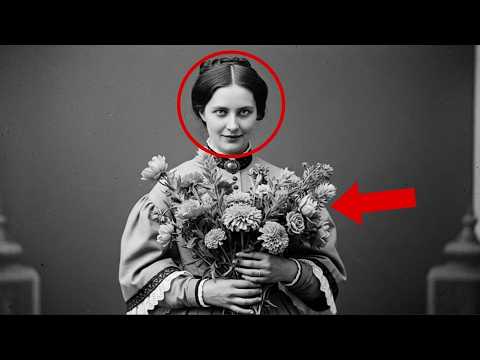
That evening, Rebecca positioned the photograph under her professional magnifying equipment. As she focused on Eleanor’s hands, she noticed they were positioned unnaturally—not just gripping flower stems, but supporting something heavy and solid hidden within the bouquet. Using her highest power lens, she could make out the edge of a metallic object between the prairie roses. At first, she thought it might be a picture frame or jewelry box, but as she adjusted the lighting and angle, the horrible truth became clear. It was the barrel of a gun—specifically, what appeared to be a Colt revolver carefully positioned among the flowers with only a small portion visible to the camera.
The weapon was stained with what looked like dark spots, and Rebecca’s hands shook as she realized what those stains likely represented. Eleanor Hartwell wasn’t just holding flowers in this photograph—she was displaying the murder weapon while posing as an innocent young woman. The image was a confession, a taunt, or perhaps evidence preserved for reasons Rebecca couldn’t yet understand.
She immediately called Dr. Michael Torres at the Kansas State Historical Society, her voice barely steady. “Michael, I need you to look at something, but I have to warn you. This isn’t just a historical photograph. I think I’m looking at evidence of a murder from 1882.”
Dr. Torres arrived the next morning bringing equipment from the university’s forensic laboratory. When he saw the enhanced images Rebecca had created, his face went pale. “My God, Rebecca. This woman is posing with what appears to be a murder weapon. We need to contact the authorities immediately.”
But it’s from 1882, Rebecca protested. Surely any investigation would be closed by now. “Not necessarily,” Dr. Torres replied grimly. “There’s no statute of limitations on murder, even historical ones. And if this photograph is authentic, it could solve a cold case that’s been open for over 140 years.”
Rebecca and Dr. Torres drove to Wichita to research the city’s records from October 1882. What they discovered in the police archives sent chills down their spines. October 1882 had been marked by a series of brutal murders that had terrorized the growing frontier community. The first victim was Mary Garrett, a 19-year-old school teacher found shot to death in her boarding house room on October 8, 1882. The second victim, discovered three days later, was Thomas Sullivan, a local merchant killed in his store after hours. Both had been shot with the same weapon—a Colt revolver—but the gun had never been found.
The police records, written in faded ink, described a community gripped by fear. “The killer strikes without warning and leaves no witnesses,” wrote Police Chief William Murphy. “We believe the same individual is responsible for both murders, but we have no suspects and no motive.”
Rebecca found the connection she was looking for in a witness statement dated October 12th, 1882. A neighbor of Mary Garrett’s had reported seeing a well-dressed woman leaving the boarding house around the time of the murder. The witness described her as young with dark hair and an expensive dress—carrying a large bouquet of flowers.
Dr. Torres discovered another crucial detail in the coroner’s reports. Both victims had been shot at close range, suggesting they knew their killer and had allowed the person to approach them. “This points to someone the victims trusted,” the coroner had noted. “Perhaps a woman—as they would be less likely to perceive her as a threat.”
The investigation had stalled after several weeks with no arrests made. The final police report dated November 15th, 1882 stated: “Case remains open pending new evidence. The killer has seemingly vanished, leaving only death and fear in their wake.”
Rebecca realized that Eleanor Hartwell’s photograph might be that new evidence—140 years too late to bring her to justice, but perhaps finally able to solve the mystery of who had murdered Mary Garrett and Thomas Sullivan in the autumn of 1882. The wreath inscription on the photograph now made horrifying sense. “Justice for what he did to Mary.” Eleanor hadn’t been the random killer the police had assumed. She had been seeking revenge for something that had happened to Mary Garrett.
But as Rebecca and Dr. Torres delved deeper into the records, a far more disturbing truth began to emerge—one that would shatter everything they thought they knew about the woman in the photograph.
They located the site of Mary Garrett’s former boarding house, now occupied by a modern office building. The Wichita Historical Museum, however, had preserved extensive records about the building and its residents from the 1880s. The museum’s archivist, Patricia Coleman, showed them the boarding house register from 1882. “Mary Garrett lived here for eight months before her death,” Patricia explained. “She was well-liked by the other residents and had no known enemies. Her murder shocked everyone who knew her.”
But as they examined the register more closely, Rebecca found a disturbing entry. Eleanor Hartwell had also lived in the same boarding house, occupying a room just down the hall from Mary Garrett. According to the records, Eleanor had moved out abruptly on October 10th, 1882—just two days after Mary’s murder.
Patricia pulled out a collection of letters donated by former boarding house residents. Among them was a letter from another resident dated October 5th, 1882, just three days before Mary’s death. “My dear sister, I must tell you about the strange situation developing here at Mrs. Henderson’s boarding house. Our newest resident, Miss Eleanor Hartwell, has become quite agitated about something involving poor Mary Garrett. Eleanor claims that Mary has been interfering with her beau, though Mary insists she has done nothing wrong. The tension between them is becoming quite uncomfortable for all of us.”
Another letter, dated October 7th, provided more disturbing details. “Eleanor’s behavior has become frightening. She accused Mary of trying to steal her intended husband, though none of us have ever seen this mysterious suitor. Eleanor has been making veiled threats, saying that Mary will pay for her betrayal. Mrs. Henderson is considering asking Eleanor to leave, but we all fear what she might do if confronted.”
Rebecca felt sick as she read these accounts. Eleanor Hartwell hadn’t been seeking justice for Mary Garrett. She had been the one who murdered her, driven by jealousy and delusion over an imaginary romantic rival. The photograph now took on an even more sinister meaning. Eleanor had posed with the murder weapon—not as evidence for justice, but as a trophy, a chilling memento of her crime hidden beneath innocent flowers while she maintained the facade of a respectable young woman.
Dr. Torres discovered the connection between Eleanor Hartwell and the second victim, Thomas Sullivan, in the merchant’s personal papers preserved at the Kansas State Archives. Sullivan had kept detailed records of his business dealings, including a disturbing series of interactions with Eleanor in the weeks before his death. His diary entries from September 1882 revealed growing concern about a customer who had become obsessed with him.
“The young woman who calls herself Miss Hartwell continues to visit my store daily, purchasing unnecessary items and lingering for hours,” he wrote on September 25th. “She speaks of marriage as if we have an understanding, though I have never encouraged such notions. Her attention has become quite unsettling.”
By early October, Sullivan’s entries showed real fear. “Miss Hartwell’s behavior has become frightening. She insists that we are engaged, despite my repeated explanations that I am already promised to Miss Catherine Wells of Lawrence. When I mentioned Catherine today, Miss Hartwell flew into a rage, declaring that any woman who interfered with her happiness would meet the same fate as that school teacher.”
Rebecca’s blood ran cold as she read Sullivan’s final diary entry, dated October 10th—the day before his murder. “I have learned that Miss Hartwell was acquainted with the murdered school teacher, Mary Garrett. She has been making increasingly violent threats against anyone who betrays her. I fear she may be responsible for Miss Garrett’s death, and I worry that I may be her next target. I have written to the police expressing my concerns, but they seem to believe that a well-dressed young woman could not be capable of such violence.”
The police had apparently dismissed Sullivan’s concerns—a tragic example of the era’s assumptions about women and violence. His letter, found in the investigation files, had been marked unfounded concerns and filed away without action.
Dr. Torres found evidence that Eleanor had indeed visited Sullivan’s store on the evening of October 11th. A witness statement from a neighboring shopkeeper described seeing a young woman with dark hair carrying flowers entering Sullivan’s store just before closing time. The witness had thought nothing of it at the time, assuming she was a late customer. Eleanor’s pattern was becoming clear. She used flowers as both a disguise and a weapon concealment method, approaching her victims under the pretense of innocent social calls while carrying the murder weapon hidden beneath elaborate bouquets.
Rebecca tracked down the location of the photography studio where Eleanor’s portrait had been taken, using city directories from 1882 Wichita. The studio had belonged to a photographer named Marcus Webb, whose business records had been preserved by his descendants. Webb’s appointment book from October 1882 contained a chilling entry: “October 15th, Miss E. Hartwell portrait session. Client insisted on specific positioning and lighting. Unusual request to photograph flowers. Paid in advance, cash only.”
Webb’s personal notes, written in the margins, provided more disturbing details. “Client seemed nervous and agitated. Insisted on holding flowers throughout session. When I suggested removing them for a clearer portrait, she became quite upset, saying the flowers were essential to the meaning of the photograph. She specified that the image must show everything she was carrying, though I’m not sure what she meant.”
Rebecca found Webb’s business correspondence, including a letter to his brother dated October 20th, 1882. “I had the strangest client last week—a young woman who wanted her portrait taken while holding an enormous bouquet of flowers. She was very specific about the arrangement and positioning, almost as if she wanted to hide something within the bouquet while still having it visible to the camera. The whole session felt wrong somehow, but she paid well and in advance.”
Most disturbing was Webb’s final note about Eleanor. “After completing her portrait, Miss Hartwell asked me to make multiple copies and to preserve the glass plate negative indefinitely. She said the photographs might be important evidence someday, and that I should give copies to the proper authorities if anything happened to her.” Rebecca realized Eleanor had deliberately created evidence of her crimes—as insurance, or as a way to maintain control even after her potential capture.
City records showed Eleanor sold all her possessions and closed her bank account on October 16th, 1882—one day after posing for her portrait. She purchased a train ticket to Denver under the name Elizabeth Harrison, then vanished. But newspaper archives from cities along the western railroad routes revealed a chilling pattern: Denver, Colorado Springs, Pueblo, Santa Fe, Albuquerque, Flagstaff—in each city, mysterious deaths of young men and women, all shot with similar weapons, all victims found after encounters with well-dressed women carrying flowers.
Rebecca’s research led her to Los Angeles newspaper archives from March 1883. “Mysterious woman arrested in multiple murders.” The description matched Eleanor Hartwell perfectly. Her personal journal, found in her room, detailed her crimes with cold calculation: “The flowers make it so easy. People see beauty and never suspect death walks among the petals.” Eleanor was convicted of at least fifteen murders and hanged on September 8th, 1883. Her final words: “The flowers remember everything. They know who truly loved and who betrayed that love.”
Today the photograph resides in the Los Angeles Police Museum, displayed alongside Eleanor’s journal and the murder weapon. Rebecca established a fund to help law enforcement digitize historical crime records, hoping to prevent other cases from remaining hidden for decades. Standing before Eleanor’s serene portrait, she reflected on its dark lesson: the most dangerous predators often hide behind society’s most trusted symbols. Eleanor Hartwell’s flowers had indeed remembered everything—waiting nearly 150 years for someone to look closely enough to see the gun among the prairie roses.
What other secrets might be hiding in plain sight, waiting for a careful eye to finally notice?
Report this article
Select a reason for reporting:






