Daniel Reeves stood motionless in the middle of his bakery, staring at the dark oven panel like it had personally betrayed him. Flour dusted his hands, and a tray of half-made dough sat abandoned behind him. He hadn’t moved in ten minutes. The repair estimate was folded in his pocket—he didn’t need to read it again. He already knew the number. The kind that doesn’t just fix a machine, it ends a business. The kind that quietly closes doors that have been open for decades.
A thin beam of late afternoon light slipped through the front window and stretched across the empty glass display case. Empty. That hadn’t happened before, not even on bad days. Daniel’s eyes shifted to the photograph behind the register—slightly crooked, untouched. Martha stood mid-laugh, flour on her cheek, holding up a burnt loaf like a trophy. “Proof,” she used to say, “that even failures can feed someone.” Daniel swallowed hard. The silence pressed in.
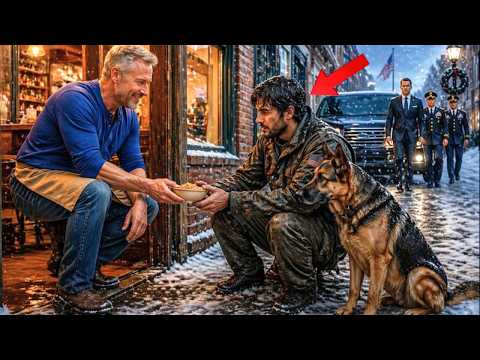
Then, a soft chime. The door opened. Daniel didn’t turn right away—customers had slowed to a trickle months ago. But something about the air shifted, heavy and subtle. He turned.
A man stood just inside the doorway, tall and still, wearing a worn military jacket that had seen more weather than years. His beard was uneven, his face lined in a way that didn’t come from age alone. Beside him, a large dog—quiet, alert, more partner than pet. The man didn’t step forward, didn’t speak. He just let his eyes adjust, or maybe let the room adjust to him. The dog scanned the space, not nervous, measured, trained.
Daniel wiped his hands on a towel. “What can I get you?” His voice sounded smaller than he intended. The man hesitated, then shook his head slightly. “Just looking.” But his eyes betrayed him—they drifted to the empty display case, to the single tray of bread behind the counter. Daniel followed his gaze. Three loaves left. That was it. No backup, no second batch, no tomorrow if those didn’t sell.
The dog took a small step forward, not pulling, not begging—just present. Daniel exhaled slowly. “Sit anywhere,” he said. The man nodded once, moved to the corner table near the window. The dog lay down beside him without being told, perfectly still.
Minutes passed. Daniel pretended to rearrange things that didn’t need rearranging, glancing over. The man didn’t ask for anything, didn’t call out, didn’t complain—just sat with hands folded, eyes distant, like someone who had learned to wait because waiting was all that was left. The sun dipped lower. The bakery grew dimmer. And Daniel knew something he didn’t want to admit: no one else was coming. Not today, not before closing, not before those loaves turned into waste instead of income.
He walked to the counter, picked up one of the loaves—still warm, still soft. He held it for a moment, the way you hold something that matters more than it should. Then he walked over and set it gently on the table. The man looked up, confused. “I didn’t order.” “I know.” Silence. The dog lifted its head, watching. Daniel nodded toward the bread. “It’s fresh.”
The man didn’t move right away, didn’t reach for it. “Can’t pay,” he said quietly. Daniel shrugged, didn’t ask. Another pause—longer this time, the kind of silence where pride and need argue with each other. Finally, the man reached out, tore a small piece, and gave it to the dog first. The dog took it carefully, no rush, no desperation. Then the man ate, slowly, like someone who had learned not to trust full meals.
Daniel stepped back, returned to the counter, but something inside him had shifted—not relief, not satisfaction, something quieter, something steadier. The man finished every crumb, stood, and walked back to the counter. “Thank you,” he said, simple and direct, but it carried weight. Daniel nodded. The man hesitated, then reached into his pocket, pulled out a small coin—worn smooth, old—and placed it on the counter. “It’s not much.” Daniel pushed it back gently. “Keep it.”
The man studied him for a second, like he was trying to understand something deeper than the gesture. Then he nodded once, turned, and left. The dog followed without a sound. The bell chimed again, and the bakery was quiet.
Daniel looked at the remaining two loaves, then at the dark oven, then at Martha’s photograph. “Failures can feed someone,” he murmured. He turned off the lights early that night, locked the door, and walked home with empty hands.
The next morning came too quickly. Daniel unlocked the bakery out of habit, not hope. The air inside was cold, still. He stepped in and paused. Something was different. At first, he couldn’t place it. Then he saw it—a truck parked across the street, clean, out of place. Then another, and another. Black, polished, engines off, waiting.
Daniel frowned, stepped further inside, set his keys down slowly. The door opened behind him. He turned. The same man stood there—the same jacket, the same stillness, the dog at his side. But this time, he wasn’t alone. Two other men entered behind him, straight-backed, eyes scanning everything—not like customers, like evaluators. Daniel’s chest tightened. “What’s going on?” he asked.
The man stepped forward, calmer now, clearer. “My name is Marcus Hale.” Daniel said nothing. Marcus gestured lightly around the bakery. “You gave away your last bread yesterday.” It wasn’t a question. Daniel shrugged, didn’t seem like it mattered. Marcus studied him. It mattered.
A pause. “Then I’ve spent the last six months traveling across this state,” Marcus continued, “looking for something.” Daniel crossed his arms slightly. “What?” Marcus glanced at the dog, then back. “Someone who still understands what this place was built for.”
Daniel frowned. “I don’t follow.” One of the suited men stepped forward, placed a folder on the counter, and opened it. Inside: documents, numbers, plans. Daniel didn’t touch them. Marcus spoke again. “I own a logistics company. We supply food networks across three states.” Daniel blinked, didn’t respond. Marcus continued. “I also fund community food programs—small towns, places that got left behind.” His voice softened slightly. “Places like this.”
Daniel’s eyes flicked to the empty shelves, then back. “And?” he said. Marcus stepped closer. “You didn’t know who I was. You didn’t expect anything in return. You gave anyway.” Daniel hesitated. “Then yes.” Marcus nodded. “That’s exactly who I’ve been looking for.”
Silence filled the room, heavy, uncertain. Then Marcus pushed the folder slightly forward. “We’re opening this place,” he said, “not as it was, but as something bigger.” Daniel didn’t move, didn’t breathe. “You’ll run it,” Marcus added. Daniel let out a small, disbelieving laugh. “I can’t even fix my oven.” Marcus smiled faintly. “You won’t have to.”
The suited man spoke for the first time. “Full renovation, new equipment, staffing support, supply chain integration.” The words sounded distant, like they were meant for someone else. Daniel shook his head slowly. “Why me?” Marcus didn’t hesitate. “Because yesterday, when it actually cost you something,” he glanced toward the door, “you still chose to give.”
The dog stepped forward slightly, sat beside Daniel—calm, certain. Marcus reached down, resting a hand briefly on the dog’s head. “He doesn’t trust easily,” Marcus said. “Neither do I.”
Daniel looked at the dog, then at the bread crumbs still faintly visible on the table from yesterday, then at Martha’s photo. His voice came out quieter this time. “What happens if I say no?” Marcus met his eyes. “Then I find someone else.” A beat. “But I don’t think you will.”
The bakery was silent again, but it wasn’t empty anymore—not in the same way. Daniel exhaled slowly, looked at his hands, still rough, still tired. Then he looked up. “Okay.”
Marcus didn’t smile, didn’t offer a handshake. He simply nodded, once, and the two suited men moved instantly—one folding the folder closed, the other already stepping toward the door with a phone pressed to his ear. “Renovation crew arrives Monday,” Marcus said. “You’ll be closed for six weeks. Maybe eight.” Daniel opened his mouth to protest—six weeks without income, without anything—but Marcus held up a hand. “Your rent, your bills, your salary. Covered. Consider it an investment, not charity.”
The dog nudged Daniel’s leg, then trotted after Marcus, who was already halfway out the door. Daniel stood alone in the cold bakery, the folder still untouched on the counter. He didn’t open it. Not that day.
That night, he sat at his kitchen table with Martha’s photograph propped against the salt shaker. “You’d have liked him,” he told her. “Didn’t say much. Brought a dog.” The silence that followed wasn’t heavy—it was the kind of quiet that waits for you to catch up.
Monday came. Then Tuesday. By the end of the first week, the old oven was gone, hauled out in pieces, and Daniel watched from the sidewalk as strangers in hard hats tore down shelves he’d wiped clean a thousand times. He felt nothing at first. Then, unexpectedly, something like relief.
On the tenth day, a woman named Priya showed up with a clipboard and a list of names—local farmers, a dairy two towns over, a grain mill that had been struggling since the highway bypassed it. “Marcus wants everything sourced within fifty miles,” she said. “No exceptions.” Daniel stared at the list. He knew half these people. Had bought from them when he could afford it, before the numbers stopped working.
By the third week, the new oven arrived—gleaming, enormous, almost obscene in its capability. Daniel ran a hand along its edge. “Martha would’ve called this overkill,” he muttered. But he was smiling.
Marcus visited every Friday, always with the dog, always at the corner table. He never asked about progress reports or timelines. Instead, he asked questions. “What did you bake first, when you started?” “Who taught you the recipe?” “Why this town?” Daniel answered slowly at first, then more easily, the way you do when someone is genuinely listening.
One Friday, Marcus brought a young man with him—early twenties, nervous hands, a resume that showed three jobs in two years. “This is Eli,” Marcus said. “He wants to learn.” Daniel looked at Eli, then at Marcus. “I’m not a teacher.” Marcus shrugged. “You are now.”
Eli started the next morning. He burned the first batch of rolls, dropped a tray of muffins, and forgot to set the timer twice. Daniel corrected him quietly, without heat, the way Martha had once corrected him. “You’re not supposed to be good yet,” he said. “You’re supposed to keep showing up.” Eli showed up.
By the sixth week, the bakery smelled like it used to—warm, alive, impossible to ignore. The sign outside still read Reeves Bakery, but beneath it, in smaller letters, Priya had added: Community Kitchen Initiative. Daniel stood behind the counter the morning they reopened, watching people file in—not just customers, but neighbors, farmers from Priya’s list, Eli’s mother, a retired teacher who’d once bought bread here every Friday for thirty years.
Marcus sat at the corner table, the dog beside him, older now, healthier, at peace. Daniel walked over and set down a fresh loaf. Marcus smiled. “You kept the recipe.” Daniel nodded. “Some things don’t change.” Marcus broke a piece, gave it to the dog first, then took one himself.
Daniel glanced around the room—full, loud, steady—then back. “You know,” he said quietly, “that day I thought I was losing everything.” Marcus leaned back slightly. “Sometimes,” he said, “that’s the only moment you find out what you’re actually holding on to.”
Daniel looked once more at the bakery, then at Martha’s photograph—still slightly crooked, still untouched. He didn’t fix it. He never would. “Failures can feed someone,” he murmured, and this time, the words didn’t sting. They tasted like bread.
What would you have done if a stranger walked into your darkest moment and simply sat down—would you have given away your last loaf too?
Report this article
Select a reason for reporting:






